10 Best Job Apps in 2026, Tested: Which Lands Interviews?
The best job apps in 2026 are not the ones with the most listings. They are the ones that move you from “applied” to “interviewing” with the least effort on your part. Most career coaches skip the part that actually matters: the job search in 2026 is brutal. The average job seeker now submits roughly 32 applications to land 4 interviews, and it takes about six months on average to find a job (roughly a month longer than what was typical in early 2023). AI-powered ATS filters have only tightened the funnel.
The people landing jobs in weeks instead of months are not working harder. They understand something simple: every job app sits on one of three automation levels, and the level you spend most of your time on decides how many applications you can realistically send. Pick the wrong level and you burn out at 15 applications a week. Pick the right mix and you clear 100 without touching a form.
This guide sorts the 10 best job apps for 2026 into those three levels, then ranks them by how fast each one gets you in front of a recruiter. Tested, honest about tradeoffs, no outdated advice.
The 3 Levels of Job-Search Automation
Before the ranking, this is the ladder that everything below hangs on. Almost every tool you have heard of fits one of these rungs.
Level 1: Manual boards (you search and apply by hand). These are the search engines of the job world. You type keywords, scroll listings, and fill out every form yourself. LinkedIn, Indeed, ZipRecruiter, and Glassdoor live here. They have the most jobs and the most competition, and they demand the most of your time per application.
Level 2: Assisted and one-click (semi-automatic). These tools cut the friction of each application without fully removing you from the loop. Think LinkedIn Easy Apply, autofill assistants like Simplify, and trackers with autofill and AI tailoring like Huntr and Teal. You still click Submit on every job, but the form fills itself and your applications stay organized. Faster than Level 1, still capped by how many buttons you can personally press.
Level 3: Full auto-apply engines (they submit for you at scale). These run in the background, match you to jobs across many boards and ATS platforms, tailor a resume, and submit the application without you sitting there. FastApply is a Level 3 tool, and it is not the only one in the category. This is the rung that lets one person hit the 100-plus applications a week that the 2026 math now demands.
Most successful searches use all three: Level 1 for discovery and being found by recruiters, Level 2 for the handful of high-stakes roles you want to touch personally, and Level 3 for volume. The ranking below tags each app with its level so you can build that mix on purpose.
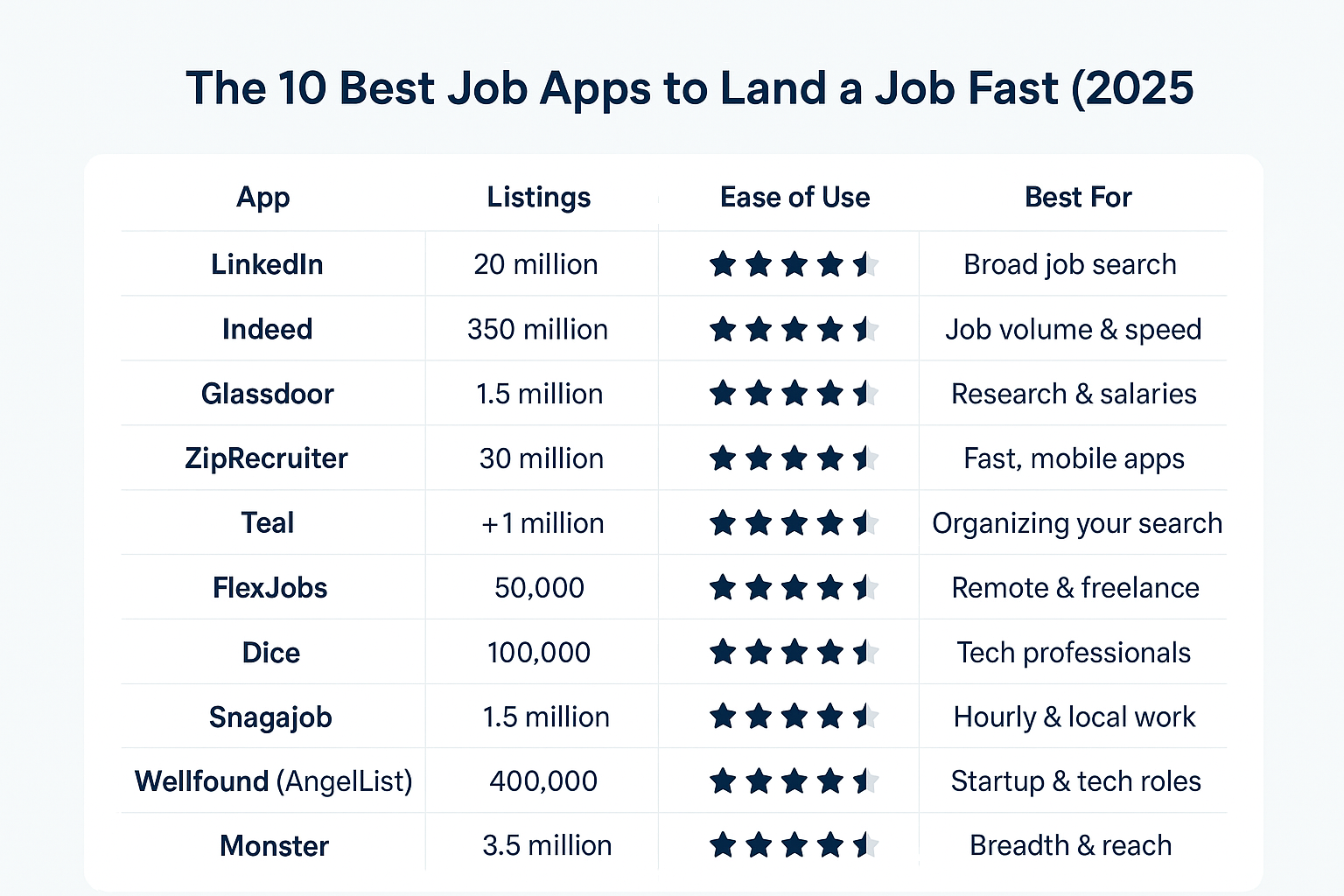
Quick answer: the best job apps for 2026 (ranked, with level):
- LinkedIn (Level 1 / Level 2): best overall for networking and recruiter outreach
- Indeed (Level 1): best for volume and variety
- FastApply (Level 3): best full auto-apply engine; submits for you across 12+ boards with a tailored resume
- ZipRecruiter (Level 1): best for AI matching at scale
- Glassdoor (Level 1): best for salary and company research alongside jobs
- Simplify (Level 2): best free one-click autofill assistant
- Huntr (Level 2): best tracker with autofill and AI tailoring
- Teal (Level 2): best for organization and resume tracking
- FlexJobs (Level 1): best for vetted remote and flexible work
- Dice (Level 1): best for tech professionals
Full breakdown of each app, its level, what it is good at, and what to watch out for, below.
Why Your Current Job Search Strategy Isn’t Working
Before the apps, understand what changed. According to the U.S. Bureau of Labor Statistics Job Openings and Labor Turnover Survey, there were 7.2 million job openings in August 2025. An estimated 75% of resumes are rejected by applicant tracking systems before they reach human hands. When your resume does get through, it is screened for an average of about 7.4 seconds.
Seven seconds. That is less time than it took to read this paragraph.
The old “spray and pray” habit of sending the same resume to hundreds of jobs does not work anymore. Companies use sophisticated AI to filter candidates, which means you need equally sophisticated tools to compete. That is the whole case for climbing to Level 2 and Level 3 instead of grinding away at Level 1 alone.
The 10 Best Job Apps to Land a Job Fast in 2026
1. LinkedIn (Level 1 / Level 2, Best Overall for Networking + Job Search)
LinkedIn continues to dominate as the go-to platform for professionals, featuring millions of active job listings. It straddles two levels: the main board is Level 1, while Easy Apply nudges it into Level 2. What most people miss is that LinkedIn is not really a job board. It is your digital reputation.
Why it works in 2026:
- Recruiters source heavily from LinkedIn, so a strong profile gets you found
- The Easy Apply feature (Level 2) lets you apply to many postings in a few clicks
- The platform’s AI recommends roles based on your profile and activity
Pro tip: Do not apply blindly. Comment on industry posts, share insights, and build your network. A sourced candidate (one recruiters reach out to) is far more likely to be hired than someone who only applies online.
Best for: Professionals at all levels, especially corporate and tech roles.
2. Indeed (Level 1, Best for Volume and Variety)
Indeed draws hundreds of millions of monthly visitors and lists jobs across nearly every industry. It is a classic Level 1 board: enormous reach, and you fill out every application yourself.
Why it works in 2026:
- New jobs are added constantly across all industries
- The mobile app supports quick applications and salary insights
- Advanced filters help you narrow to flexible or remote work
The reality check: Indeed is massive, which means high competition. Apply within the first 24-48 hours of a posting to stand out. Set up alerts and move fast. If you want that speed without doing it by hand, see how a Level 3 engine compares in FastApply vs Indeed.
Best for: Job seekers who want maximum exposure across all industries and experience levels.
3. FastApply (Level 3, Best Full Auto-Apply Engine)
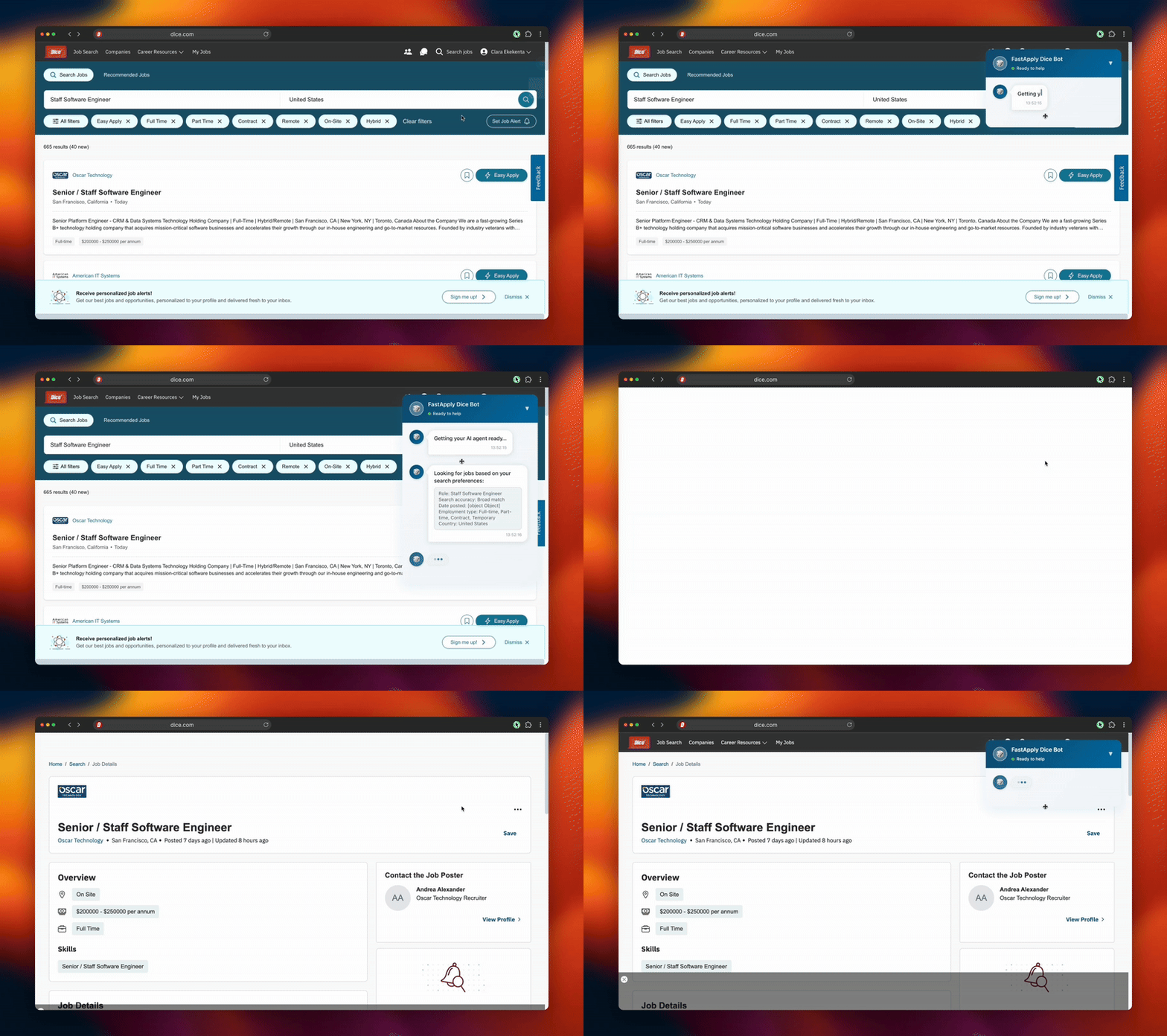
This is the Level 3 layer. While Level 1 and Level 2 tools help you find and start applications, FastApply submits them for you.
Why it works in 2026:
- A 24/7 AI Job Matcher scans openings across 12+ boards (LinkedIn, Indeed, ZipRecruiter, Glassdoor, Dice, Workday, Greenhouse, Lever, Ashby, and more) plus many ATS platforms, drawing from 1M+ jobs across every industry, including remote-global and visa-sponsored roles
- On Pro and up, per-job AI resume tailoring and AI cover letters run automatically for each application
- A real-time dashboard tracks every submission in one place
Why volume matters here: applying inside the early-applicant window is worth 5-10x higher response rates, and FastApply is built to hit that window at scale while you do other things. The founder built it after applying to eight jobs overnight with a rough script and waking up to two interview invitations, the first in months.
Pricing (honest and current): a free tier gives you 5 application credits with no card. Starter is $14/mo (200 apps), Pro is $29/mo (500 apps plus per-job AI resume tailoring and AI cover letters), and Elite is $49/mo (1,000 apps plus priority support). Teams and Enterprise plans add API access and SSO.
Where it fits: FastApply is not the only Level 3 tool, and it is not a replacement for networking. Use it for volume, and keep a Level 1 profile alive for discovery. To see how full auto-apply engines actually submit (and which do not), read AI job application bots that actually submit, and for the broader category, see the best AI job application automation tools of 2026.
Best for: Job seekers who want to maximize application volume without spending 40 hours a week on forms.
4. ZipRecruiter (Level 1, Best for AI Matching)
ZipRecruiter is known for an AI matching system that connects job seekers with roles that fit. You still apply yourself, so it stays a Level 1 board with smarter suggestions.
Why it works in 2026:
- Many employers report finding qualified candidates within a day of posting
- One-click apply speeds things up, and match scores give real-time feedback
- The AI learns from your activity, so engagement improves your matches
Pro tip: Keep your ZipRecruiter profile complete and current. The more you engage, the sharper the matches become.
Best for: Mid-level professionals and technical roles where skills matching is critical.
5. Glassdoor (Level 1, Best for Company Intelligence)
Before you apply anywhere, know what you are getting into. Glassdoor offers millions of company reviews with insight into culture and pay, alongside its job listings.
Why it works in 2026:
- The Know Your Worth tool supports salary negotiation
- A database of real interview questions helps you prepare
- Filters cover remote, hybrid, and on-site roles
The insider secret: Read reviews from people who left within their first year. They tell you what a company hides during interviews.
Best for: Research-driven job seekers who want to avoid toxic workplaces and negotiate better offers.
6. Simplify (Level 2, Best Free One-Click Autofill)
Simplify is a browser extension that autofills online applications and tracks where you have applied. It is a clear Level 2 tool: the form fills itself in one click, but you still review and submit each application yourself. It is not true auto-apply, and that is worth being honest about.
Why it works in 2026:
- The core autofill, tracker, and job matching are free, with no card required
- Autofill is strong on startup and tech ATS platforms like Greenhouse, Lever, and Ashby
- A paid tier adds AI resume tailoring and cover letters for those who want them
The reality check: autofill accuracy drops on heavy enterprise systems like Workday and iCIMS, so budget time to fix fields there.
Best for: Job seekers who want to speed up manual applications for free without handing off the Submit button.
7. Huntr (Level 2, Best Tracker With Autofill and AI Tailoring)
Huntr combines a job tracker with one-click autofill and resume tailoring. Another Level 2 tool: it removes friction from each application while keeping you in control of what gets sent.
Why it works in 2026:
- The free plan tracks up to 100 jobs with unlimited autofills and a couple of tailored resumes
- Paid Pro adds more tailoring and export options
- A visual board keeps your pipeline organized instead of living in a spreadsheet
Best for: Organized job seekers who want autofill plus tailoring in one place.
8. Teal (Level 2, Best for Organization and Resume Tracking)
Job searching is chaos. You apply to 50 jobs, hear back from 5, and cannot remember which companies you contacted. Teal tracks applications, bookmarks roles, and builds resumes in one place. It is Level 2: helpful automation around your applications, but you still submit each one.
Why it works in 2026:
- Unlimited job tracking on the free plan, with a limited pool of AI credits
- A resume builder and Chrome extension keep everything connected
- Paid tiers unlock the full AI tailoring experience
Best for: Job seekers who need to stay on top of follow-ups and keep resumes organized.
9. FlexJobs (Level 1, Best for Vetted Remote and Flexible Work)
FlexJobs specializes in flexible work and hand-screens every listing for legitimacy. It is a Level 1 board with a curation advantage: fewer scams, still manual applications.
Why it works in 2026:
- Every job is vetted, cutting out the scams that plague open boards
- Focus on remote, part-time, and flexible schedules
- Company profiles include work-life balance detail
Best for: Parents, digital nomads, and anyone who values flexibility and wants to skip the scam listings. For how its curation stacks up against a Level 3 auto-apply engine, see FastApply vs FlexJobs.
10. Dice (Level 1, Best for Tech Professionals)
For IT and engineering, Dice lists tech-specific roles and connects you with tech recruiters. A focused Level 1 board that does one thing well.
Why it works in 2026:
- Highly targeted tech roles instead of everything-for-everyone listings
- Salary tools tuned to tech markets
- Direct lines to tech recruiters
Best for: Software engineers, data scientists, cybersecurity professionals, and IT specialists.
The Winning Strategy: Stack the Three Levels
Successful job seekers do not pick one app. They stack all three levels so each one does what it is best at.
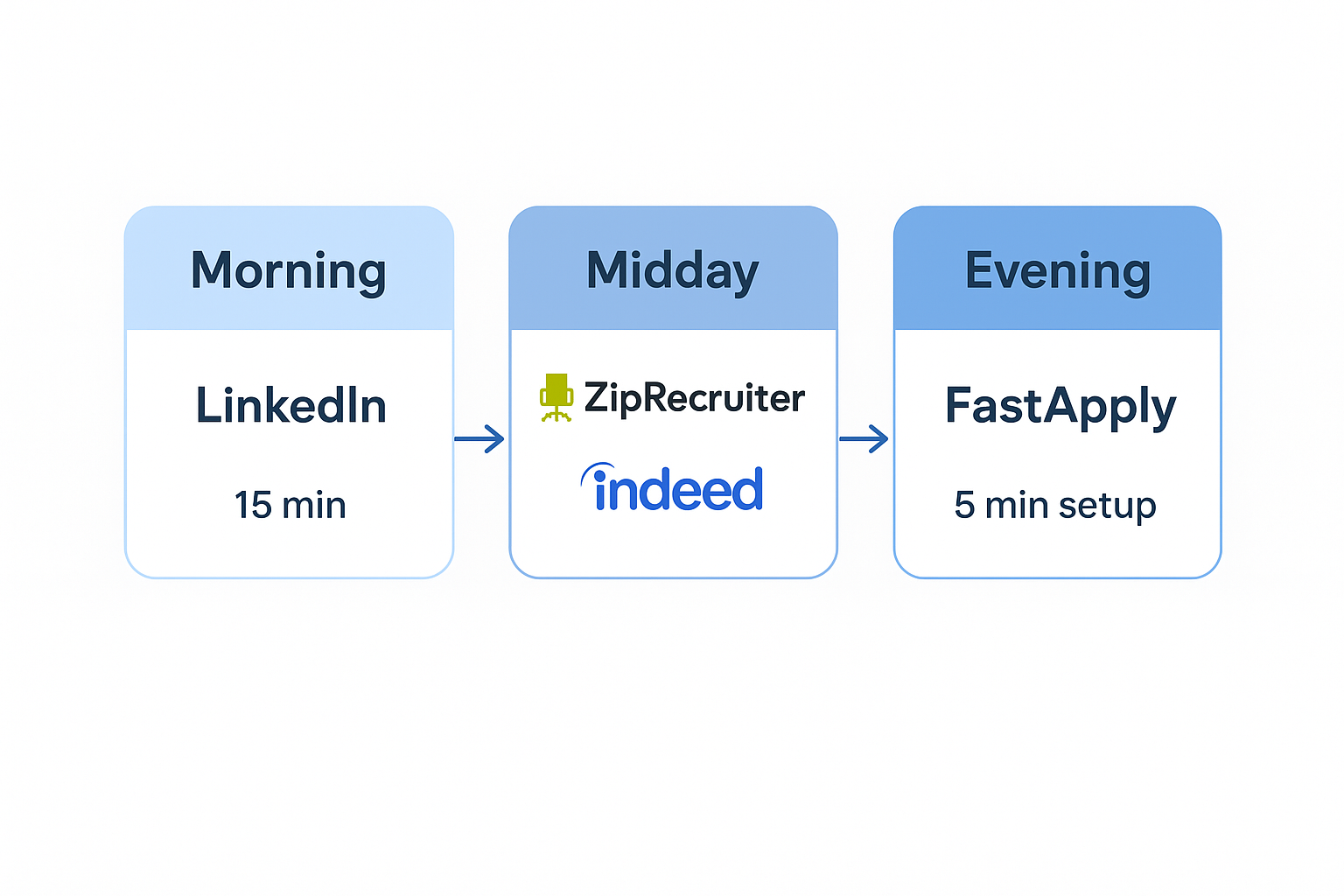
The power stack:
- Level 1 for discovery: LinkedIn to be found by recruiters, Indeed or ZipRecruiter to see what is out there
- Level 2 for high-stakes roles: Simplify or Huntr to fill and submit the handful of jobs you truly want to touch by hand
- Level 3 for volume: FastApply to submit across boards while you sleep, so you clear the application count the 2026 math requires
- Glassdoor for research before every interview
A daily routine that works:
- Morning: check LinkedIn notifications and engage with a few posts (15 minutes)
- Midday: review new matches on ZipRecruiter and Indeed, and hand-apply to one or two dream roles with Simplify (20 minutes)
- Evening: let a Level 3 engine run volume applications in the background (5 minutes to set up)
- Weekly: update your tracker and follow up with companies (30 minutes)
If you want the full playbook for wiring these together, read how to automate your job search in 2026.
The Uncomfortable Truth About Job Apps in 2026
Most job apps do not help people because most people use only one level. They download a Level 1 board, upload a resume, and wonder why nothing happens.
Here is what actually moves the needle:
- Be specific, not desperate. Target roles where you are a strong match instead of applying to everything.
- Speed matters. The application clock starts the moment a job posts, and early applicants see 5-10x higher response rates. Apply early, which is exactly what a Level 3 engine buys you.
- Automation is not cheating. Companies use AI to filter you out. Using AI to get through simply levels the field.
- Follow up. A polite follow-up after 7-10 days moves you from forgotten to front-of-mind.
Your Next Steps
You have the tools and the ladder. Here is the plan for this week.
Today:
- Create or update your LinkedIn profile (Level 1 discovery)
- Set up job alerts on Indeed and ZipRecruiter
- Try a Level 3 engine with a free tier to see if volume automation fits your search
This week:
- Install a Level 2 autofill tool like Simplify for your dream roles
- Research 10 target companies on Glassdoor
- Set up a tracker (Teal or Huntr) so nothing slips
- Apply to at least 10 positions by hand, or let a Level 3 engine handle 50-plus
This month:
- Network on LinkedIn for 15 minutes daily
- Follow up with every application after 7-10 days
- Adjust your mix based on which level is producing interviews
The Bottom Line
The 2026 job market is tougher than it has been in years, but you are not powerless. The right apps shorten your search when you use them by level: Level 1 to be discovered, Level 2 to apply carefully to what you want most, and Level 3 to hit the volume that gets replies.
Stop relying on one platform. Stop sending the same resume to every job. Stop waiting to be found. The people landing jobs fast run all three levels at once.
You can spend the next six months manually filling out forms and wondering why no one calls back, or you can climb the ladder, work smarter, and start getting interviews in weeks.
Ready to add the Level 3 layer to your search? Try FastApply with 5 free application credits, no card required, and start submitting to relevant jobs while you sleep. Compare plans on the pricing page.
Frequently Asked Questions
#best job apps

FastApply Team
Career Experts