10 Highest-Paying Tech Certifications in 2026 (Ranked by Salary)
This guide breaks down 10 high paying tech certifications in 2026 across three tiers: foundational (Tier C), specialization (Tier B), and elite (Tier A). Each tier builds on the previous one, creating a career ladder from entry-level roles to leadership positions earning $200,000 or more per year.
How to Use This Certification Tier System
Think of these tiers as a career progression map, not a random checklist. Each tier serves a distinct purpose in your career trajectory.
-
Tier C (Foundational) certifications get you hired. They prove baseline competence and open the door to your first IT or cybersecurity role. These cost the least and take the shortest time to earn. If you hold zero certifications today, start here.
-
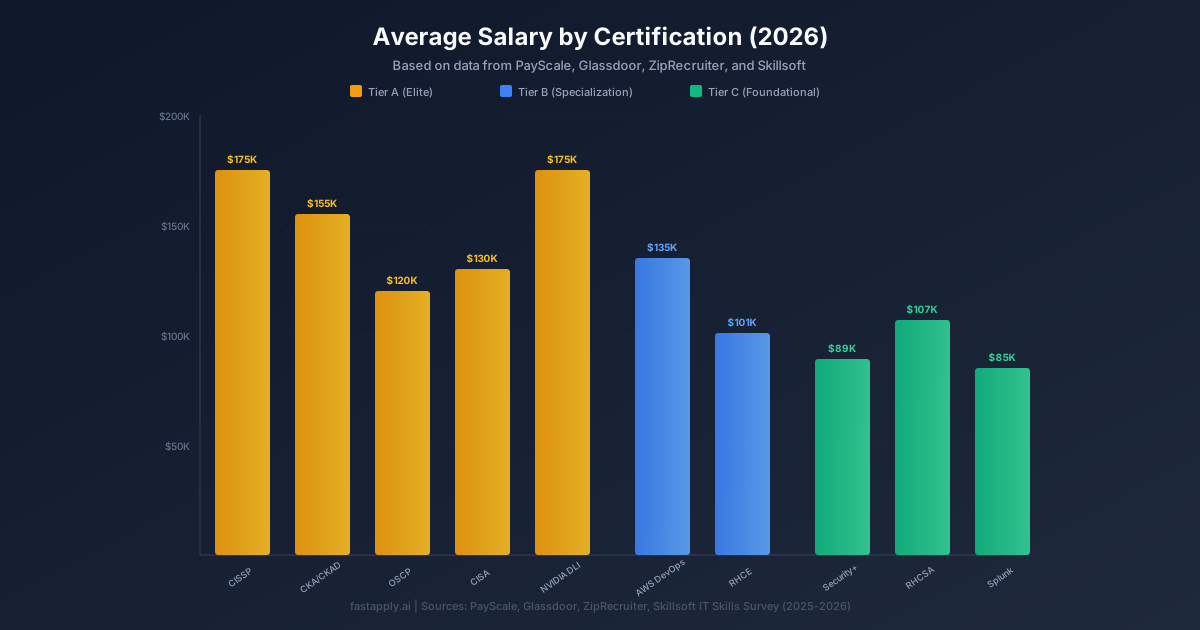
Tier B (Specialization) certifications increase your salary. They signal depth in a specific domain like cloud automation or Linux infrastructure. Professionals at this level typically earn $101,000 to $135,000 per year and work in mid-level engineering roles.
-
Tier A (Elite) certifications command top-dollar compensation. These require years of experience and prove mastery at a senior or leadership level. Earning potential at this tier reaches $200,000 to $350,000+ depending on clearance level, location, and employer.
The most effective path starts with one or two Tier C certifications, then moves into Tier B within your chosen specialization, and finishes with a Tier A credential that positions you for leadership or expert-level roles.
Tier C: Foundational Starting Point
These certifications represent the fastest path from “interested in tech” to “employed in tech.” They cost less, demand less experience, and open doors to entry-level positions that pay well above the national median salary.
1. CompTIA Security+
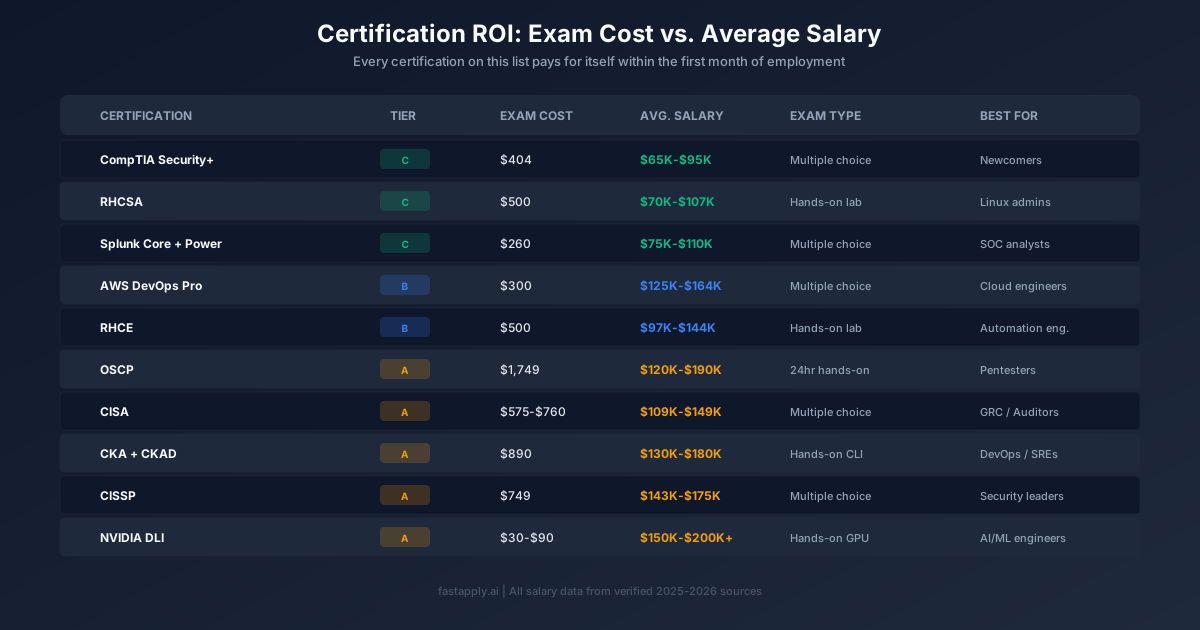
Exam cost: $404 Average salary range: $50,500 to $89,000 per year Best for: Newcomers to IT and cybersecurity
CompTIA Security+ is the single best starting point for anyone entering tech. It covers network security, threat management, risk identification, and cryptography at a vendor-neutral level. This means the knowledge applies regardless of which platforms your employer uses.
The certification carries particular weight in the government sector. The U.S. Department of Defense requires Security+ (or an equivalent) for anyone accessing government information systems under the DoD 8140 framework. This requirement makes Security+ a direct entry point into GovTech, where defense contractors like Raytheon, Booz Allen Hamilton, and SAIC hire thousands of cleared professionals annually. PayScale reports that Security+ holders at these companies earn between $85,000 and $127,000 per year.
For someone with no prior IT experience, Security+ combined with a help desk or IT support role provides the foundation for everything that follows on this list.
2. Red Hat Certified System Administrator (RHCSA)
Exam cost: $500 Average base salary: $107,000 per year Best for: IT professionals moving into Linux system administration
RHCSA is a hands-on, performance-based exam that proves you know how to administer Red Hat Enterprise Linux systems. There are no multiple-choice questions. You either complete the tasks on a live system or you do not pass.
Linux runs the backbone of cloud infrastructure, web servers, and enterprise data centers. Companies that depend on Red Hat (and there are thousands) need administrators who hold this certification. Pairing RHCSA with CompTIA Security+ creates a powerful combination for junior Linux system administrator roles. ZipRecruiter job listings show RHCSA-qualified positions ranging from $80,934 to $117,200 per year.
This certification also serves as the direct prerequisite for the Red Hat Certified Engineer (RHCE) credential, which sits in Tier B of this guide.
3. Splunk Core Certified User and Splunk Core Certified Power User
Exam cost: $130 (Core User), $130 (Power User) Average salary range: $75,000 to $110,000 per year for SOC analyst roles Best for: Aspiring SOC analysts and cybersecurity analysts
Splunk is one of the most widely deployed Security Information and Event Management (SIEM) tools in the industry. SOC (Security Operations Center) teams use it daily to monitor networks, detect threats, and respond to incidents.
Earning both the Core User and Power User certifications demonstrates that you know how to search, report, and analyze data within Splunk. This skill set maps directly to SOC Analyst Tier 1 and Tier 2 roles, which are among the most common entry points into cybersecurity. Glassdoor reports the average SOC Analyst salary at approximately $75,000 to $137,000 depending on experience level and location.
These certifications are particularly effective when combined with CompTIA Security+. The combination tells employers: “I understand security fundamentals AND I know how to use the tools your team relies on every day.”
Tier B: Specialization Tier
Tier B certifications move you from generalist to specialist. They demand more experience (typically two or more years) and focus on specific technologies that drive high demand and high salaries.
4. AWS Certified DevOps Engineer (Professional)
Exam cost: $300 Average salary range: $125,000 to $164,000 per year Best for: Cloud engineers and DevOps professionals with 2+ years of AWS experience
This professional-level certification validates your ability to automate testing, deployment, and monitoring of applications on the AWS platform. DevOps engineers sit at the intersection of software development and IT operations, and demand for this role continues to climb.
AWS dominates the cloud market, and organizations of every size need engineers who know how to build and maintain deployment pipelines on this platform. This certification pairs well with Kubernetes credentials (Tier A) for engineers who want to reach the $200,000+ salary range.
5. Red Hat Certified Engineer (RHCE)
Exam cost: $500 Average base salary: $119,000 per year Best for: RHCSA holders ready to specialize in automation
RHCE builds directly on the RHCSA foundation and focuses heavily on Red Hat Ansible for automation. The exam tests your ability to automate system configuration, deployment, and management across multiple servers.
This certification opens the door to infrastructure engineer, platform engineer, and senior Linux administrator roles. According to InfoSec Institute, the RHCE is one of the top-paying Linux certifications, with a median annual salary of $101,527 that increases with experience. PayScale data from major employers like Bank of America shows average salaries of $122,449 for RHCE holders.
The Ansible automation focus makes RHCE especially relevant in 2026. Infrastructure as Code (IaC) practices now define how organizations manage servers at scale. Engineers who prove they handle this workflow are in a strong negotiating position during salary discussions.
Tier A: Elite Tier
These certifications sit at the top of the tech certification hierarchy. They require years of experience, carry the highest difficulty level, and lead to the largest salaries. Professionals at this tier typically hold leadership positions, work on the most complex security challenges, or operate in high-clearance environments.
6. Offensive Security Certified Professional (OSCP)
Exam cost: $1,749 (includes PEN-200 course, 90 days lab access, and one exam attempt) Average salary range: $90,000 to $168,000+ per year Best for: Aspiring penetration testers and red team operators
OSCP is the most respected ethical hacking certification in the industry. The exam is a 24-hour hands-on test where you must break into live networks, exploit vulnerabilities, escalate privileges, and document your findings. There are no multiple-choice questions. You hack or you fail.
ZipRecruiter reports the average OSCP salary at $119,895 per year, with top earners reaching $158,500+. Programs notes that the average OSCP-holder salary sits at $120,000, making the $1,749 investment pay for itself in roughly one to two weeks of higher earnings.
The difficulty is real but that difficulty is exactly what makes OSCP such a powerful differentiator. If CISSP is the manager’s certification, OSCP is the hacker’s certification.
7. Certified Information Systems Auditor (CISA)
Exam cost: $575 (ISACA members), $760 (non-members) Average salary range: $109,000 to $140,000+ per year Best for: Cybersecurity professionals pursuing GRC (Governance, Risk, and Compliance) careers
CISA is the gold standard for IT auditors. It validates your expertise in assessing vulnerabilities, reporting on compliance, and implementing controls within enterprise information systems. Over 151,000 professionals hold the CISA globally.
ZipRecruiter places the average at $109,713 per year, with top earners reaching $140,500. Employers like J.P. Morgan Chase, Citigroup, and SAIC pay CISA holders between $142,000 and $195,000 per year.
GRC is one of the fastest-growing niches in cybersecurity. Every regulated industry (finance, healthcare, energy, government) needs professionals who understand compliance frameworks like SOC 2, ISO 27001, NIST, and HIPAA. CISA proves you are that professional.
Note: CISA requires five years of experience in information systems auditing, control, security, or assurance to obtain full certification.
8. Certified Kubernetes Administrator (CKA) and Certified Kubernetes Application Developer (CKAD)
Exam cost: $445 each Average salary range: $130,000 to $180,000 per year Best for: DevOps engineers, platform engineers, and site reliability engineers (SREs)
Kubernetes is the standard for container orchestration. Major tech companies, government agencies, and enterprises of all sizes use it to deploy and manage applications at scale. CKA and CKAD are hands-on, performance-based exams administered by the Cloud Native Computing Foundation (CNCF).
Data from Talent and the Kube Careers report shows that engineers with CKA-level skills earn between $130,000 and $180,000 per year in the U.S., with the highest reported salary bracket reaching $275,000 to $319,000. PayScale reports an average of $117,000 per year for professionals with Kubernetes skills, while LinkedIn shows over 124,000 Kubernetes jobs in the U.S., with more than 28,000 listing salaries above $100,000.
CKA focuses on cluster administration (installing, configuring, managing clusters). CKAD focuses on deploying and managing applications on Kubernetes. Both exams are two-hour, live, command-line tests. Holding both places you at the intersection of infrastructure and application deployment, making you valuable to almost any engineering team.
9. Certified Information Systems Security Professional (CISSP)
Exam cost: $749 Average salary range: $121,000 to $226,000+ per year Best for: Experienced cybersecurity professionals moving into leadership
CISSP is the “MBA of cybersecurity.” It is not a technical hacking exam. It tests your ability to design, implement, and manage an organization’s entire security program across eight domains: security and risk management, asset security, security architecture, network security, identity management, security assessment, security operations, and software development security.
CISSP requires five years of full-time professional experience in at least two of these eight domains. That experience requirement is intentional. ISC2 designed the CISSP for senior professionals, not beginners. According to InfoSec Institute, the average total compensation for CISSP holders working as information security managers reaches $175,583.
Where CISSP becomes especially powerful is in government and defense contracting. CISSP holders with a Top Secret or TS/SCI security clearance regularly earn $200,000 to $250,000+ in the Washington D.C. metro area. This combination of the certification plus clearance creates one of the most stable and lucrative career paths in all of tech.
10. NVIDIA Deep Learning Institute (DLI) Certifications
Exam cost: Varies by course ($30 to $90 per workshop/certification) Average salary range: $150,000 to $200,000+ per year for AI/ML engineer roles Best for: Engineers adding AI and deep learning skills to their existing expertise
NVIDIA’s Deep Learning Institute offers a collection of hands-on certifications in AI, deep learning, and accelerated computing. These are not theory exams. You complete instructor-led workshops using NVIDIA GPUs and real-world datasets, then earn certificates upon successful completion of the assessment.
The AI/ML engineering market is one of the hottest in tech right now. The BLS projects 29% growth for information security analysts through 2034, and AI roles are growing at a similar or faster rate. Engineers who combine AI skills with existing cybersecurity, DevOps, or cloud expertise position themselves for some of the highest salaries in the industry.
NVIDIA DLI certifications stand out because they prove practical, GPU-accelerated computing skills that map directly to production AI workloads. Companies building AI infrastructure (from startups to FAANG) need engineers who demonstrate this ability. The certifications are also relatively affordable compared to traditional IT certifications, making them an accessible addition to your credential portfolio.
The strategic play is not earning DLI certifications in isolation. Instead, combine them with a strong foundation (like AWS DevOps or CKA) to become the engineer who deploys and manages AI workloads in production. That crossover profile is where the largest salary premiums exist.
How to Plan Your Certification Path Strategically
Earning certifications without a plan is like applying to jobs without a resume. Follow these principles to get maximum return on your investment.
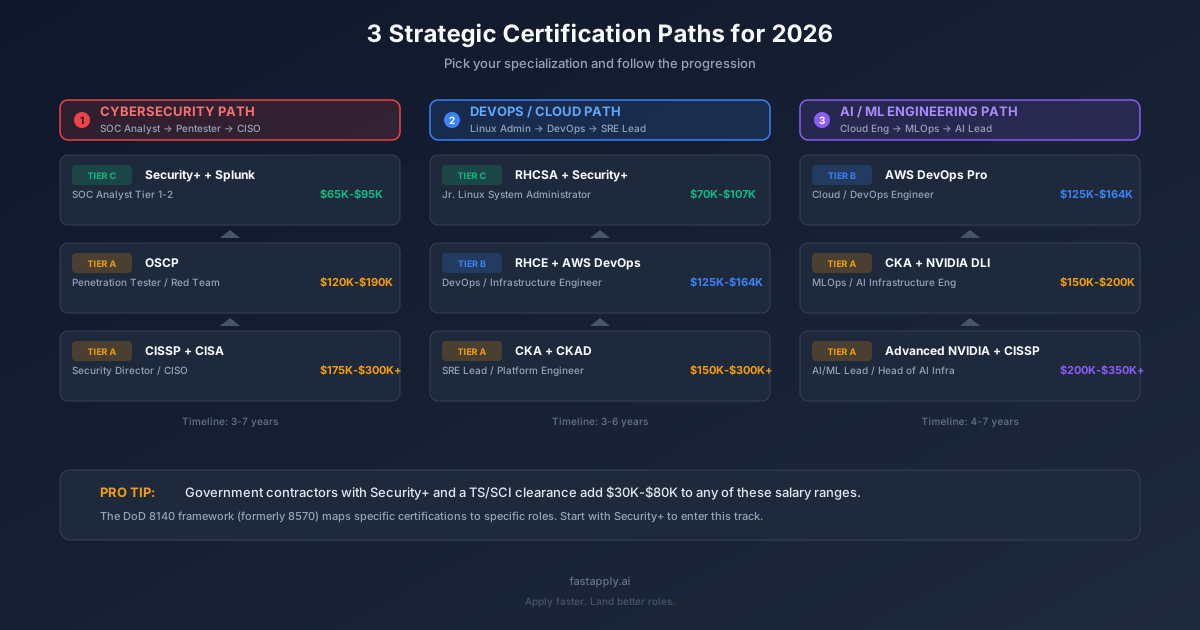
1. Start with Tier C, move to Tier B, then aim for Tier A. The foundational certifications get you hired. The specialization certifications raise your salary. The elite certifications put you in the top earning bracket.
2. Pair certifications for multiplied impact. CompTIA Security+ alone is good. Security+ plus RHCSA opens the door to junior Linux admin roles in government. Security+ plus Splunk certifications gets you into SOC analyst positions. These combinations multiply your marketability.
3. Target government contracting for maximum financial return. Government contractors and defense agencies pay premium salaries for certified professionals. A CISSP holder with a TS/SCI clearance in the D.C. area earns significantly more than the same professional in the private sector. Getting your foot in the door through a Tier C certification (especially Security+, which meets DoD 8140 requirements) is the fastest path to this career track.
4. Do not collect certifications for the sake of collecting. Hiring managers look for depth, not breadth. Three certifications in a focused area (like the RHCSA-to-RHCE-to-CKA path for infrastructure engineers) signals more value than ten unrelated credentials.
How FastApply Helps Certified Professionals Land the Right Roles
Here is the reality most certified professionals face: you earn the certification, update your resume, and then spend weeks manually applying to roles. Tailoring each application takes 20 to 30 minutes. Over the course of a serious job search (100 to 200 applications), that adds up to 50 to 100 hours of repetitive work.
FastApply eliminates the gap between earning your certification and landing the role it qualifies you for. The Chrome extension works across major job platforms including Indeed, LinkedIn, Glassdoor, Lever, Greenhouse, and Workday. It reads each job description and automatically tailors your resume to match the requirements. If a role asks for “CISSP certification with experience in SOC 2 compliance,” FastApply moves that experience to the top and emphasizes the right keywords.
But unlike fully automated tools that blast generic applications everywhere, FastApply pauses before submission. You review the tailored resume, make adjustments if needed, and approve. This human-in-the-loop approach prevents mismatches while keeping your search moving at speed. The 30-minute application process becomes a 3-minute review.
For certified professionals, this matters more than most people realize. ATS (Applicant Tracking System) software filters resumes before a human ever sees them. If your resume does not match the job description’s keywords, it gets rejected automatically. FastApply ensures your certifications, skills, and experience align with what each ATS expects to find.
Frequently Asked Questions
What is the highest paying tech certification in 2026?
CISSP consistently ranks among the highest-paying certifications, with average total compensation reaching $175,583 per year according to InfoSec Institute. OSCP and CKA/CKAD also command strong salaries, especially when combined with cloud platform experience.
Which tech certification should I get first?
CompTIA Security+ is the recommended starting point for most professionals. It is vendor-neutral, recognized by the DoD, and opens doors across both private and public sector roles. If you are specifically interested in Linux, RHCSA is another strong first certification.
Do I need a college degree to earn these certifications?
No. Most certifications on this list have no formal education prerequisites. Some (like CISSP and CISA) require professional experience, but that experience does not need to come with a degree. Many successful cybersecurity professionals are entirely self-taught and certification-driven.
How long does it take to earn a Tier C certification?
Most professionals prepare for CompTIA Security+ in 2 to 4 months of focused study. RHCSA typically takes 3 to 6 months depending on your prior Linux experience. Splunk Core User takes 1 to 2 months.
Is it worth paying for certification training or should I self-study?
Both approaches work. Self-study costs less but requires strong discipline. Bootcamps and structured courses cost more but compress the timeline and often include practice exams. For certifications with hands-on exams (RHCSA, OSCP, CKA), practicing in lab environments is not optional. Budget for lab access regardless of your study approach.
What certifications do government contractors look for?
The DoD 8140 framework (which replaced 8570) outlines certification requirements by role. CompTIA Security+ is the most commonly required baseline certification. CISSP, CISA, and RHCE all carry significant weight in government contracting. Holding one of these plus a security clearance places you in a high-demand, high-pay bracket.
How much more will I earn after getting certified?
Salary increases vary by certification and experience level. CompTIA reports that Security+ certified professionals see an average salary increase of 5-7% annually. Larger jumps come from changing roles after certification. Moving from help desk to SOC analyst, for example, brings a $15,000 to $30,000 increase in many markets.
#high paying tech certifications in 2026
#best IT certifications 2026
#highest paying cybersecurity certifications
#cybersecurity certification path

Fastapply Team
Career Experts