10 Best Remote Job Boards in 2026 (Free List, Tested)
Short answer: The best remote job boards in 2026 are We Work Remotely for volume, FlexJobs for vetted listings, and Remote.co and Remote OK for free coverage. Remote roles attract 2.6x more applicants than in-person ones, so application speed matters. FastApply, an AI job application tool, auto-applies across all ten boards below free.
Remote job listings make up only about 10% of all U.S. job postings, yet they attract 2.6 times more applications than in-person roles, according to Vena’s 2026 Remote Work Statistics report. That gap between supply and demand is the central challenge of every remote job search today. You are not just competing with candidates in your city. You are competing with everyone who has a laptop and an internet connection.
The good news: the right platforms, combined with a disciplined application strategy, give you a measurable edge. This guide covers the best remote job boards in 2026, what makes each one worth your time, and how to auto-apply across all of them without sending generic, low-quality applications.
Why Remote Job Boards Matter More Than General Job Sites
Searching for remote roles on a general job board like Indeed or LinkedIn is like searching for flights on a general search engine. You’ll find results, but the noise-to-signal ratio is brutal.
Specialized remote job boards solve a specific problem: they filter out listings that are only technically remote (one day per quarter from home counts as “flexible”) and surface roles where remote work is the actual design of the job.
Only about 10% of job postings are fully remote, but those listings attract on average 2.6 times as many applications as in-person jobs. This creates a paradox for job seekers. Everyone wants remote work, but relatively few roles offer it. The candidates who find roles first are the ones using the right tools in the right order.
According to Jobgether’s Remote Work Barometer, the number of applicants per posting has tripled on some platforms, and a growing number of highly qualified professionals now apply exclusively to fully remote positions. Small supply and massive demand means unprecedented competition.
The strategic response is not to apply to fewer jobs. It is to apply smarter, faster, and across more platforms simultaneously.
The 10 Best Remote Job Boards in 2026
1. We Work Remotely (WWR)
Best for: Tech, design, marketing, and customer support roles
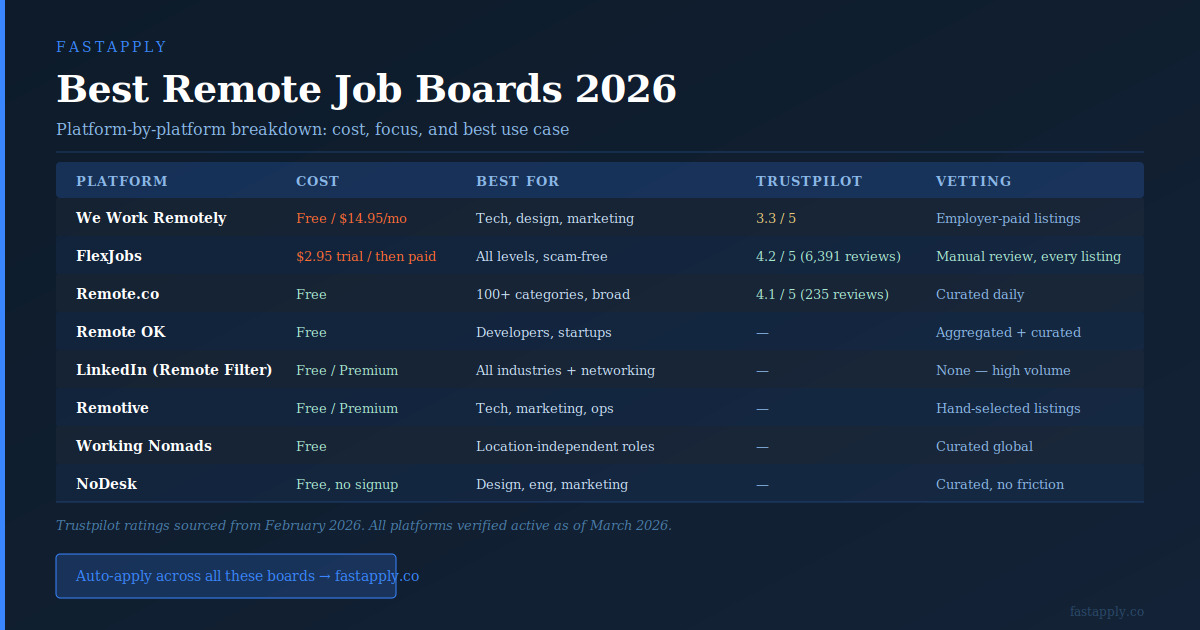
Cost: Free to browse. Pro subscription at $14.95/month (after $2.95 first month)
We Work Remotely has been one of the most established sites for remote jobs for over a decade, with 6 million monthly visitors and one of the largest remote work communities online.
Employers pay $299 per listing to post on WWR, which means listings tend to be serious and from real companies. The free tier lets you browse and apply without an account. The Pro tier adds unlimited applications, custom job alerts, and a resume builder.
The mixed Trustpilot rating (3.3/5) largely reflects frustration with the subscription billing structure rather than the quality of listings themselves. If you use only the free tier, the platform consistently delivers.
Best use: Set up email alerts for your target roles. The daily digest keeps you ahead of new listings without requiring you to check the site manually.
2. FlexJobs
Best for: Professionals who want hand-screened, scam-free listings
Cost: $2.95 for a 14-day trial. Continues as a subscription after that
FlexJobs has a customer review rating of 4.2 out of 5 on Trustpilot from 6,391 reviews as of February 2026. That volume of reviews, and that rating, is unusual in this space. Most job boards have a fraction of that feedback.
What makes FlexJobs different is the vetting model. Every listing is manually reviewed before it goes live. No freelancer scams, no pyramid schemes disguised as “flexible income opportunities.” FlexJobs has been used by over 135 million people since 2007, and the platform covers roles from entry-level to executive, from startups to public companies.
According to FlexJobs’ data, 67% of remote job postings were for experienced-level roles, followed by manager-level roles at 19% and senior-level positions at 9%. Only 6% were entry-level. If you are mid-career or senior, this platform is worth the trial cost.
Best use: Start with the $2.95 trial. If you land interviews within 14 days, continue. The 14-day satisfaction guarantee means you can cancel and get a refund if it does not deliver.
3. Remote.co
Best for: Broad industry coverage with no cost barrier
Cost: Completely free
Remote.co aggregates over 2,000 new remote and hybrid job listings daily, spanning more than 100 categories from accounting and healthcare to marketing and technology, without requiring any subscription fee.
The platform also includes a Q&A section where remote workers share experiences, a library of career articles, and a “Why Remote” section where 140+ companies explain their remote work practices. This context helps you write stronger cover letters and applications.
Remote.co maintains a Trustpilot rating of 4.1 out of 5 based on 235 reviews as of February 2026, reflecting strong user satisfaction.
Best use: Use Remote.co as a high-volume daily check. The breadth of categories means it catches roles that narrower platforms miss.
4. Remote OK
Best for: Tech, startups, and developer roles
Cost: Free
Remote OK is one of the fastest-moving boards in the space. Listings go up, get filled, and come down quickly. The platform shows salary ranges and company details upfront on most listings, which saves time during the research phase of each application.
Remote OK offers over 129,000 remote tech and startup jobs, the filtering system covers role type, experience level, company size, and region. If you write software, build products, or work in a technical discipline, this board belongs in your daily rotation.
Best use: Bookmark the filtered URL for your specific role type. The real-time feed means checking it twice a day outperforms weekly searches.
5. LinkedIn (Remote Filter)
Best for: Professional networking combined with job search
Cost: Free. LinkedIn Premium adds recruiter access and application insights
LinkedIn does not specialize in remote work, but its scale makes it impossible to ignore. The remote filter surfaces roles across every industry and seniority level.
A report shows that 10% of LinkedIn postings marked as remote received 46% of all applications, a pattern that underscores the sustained appeal of specialized boards and LinkedIn’s remote filter alike.
The real advantage of LinkedIn is not the job listings themselves. It is the ability to connect with hiring managers, see who works at a company, and send a direct message alongside your application. That combination raises your response rate above what any job board delivers on its own.
Best use: Apply through the job board and then find the hiring manager on LinkedIn. Send a brief, direct message referencing the role. This two-track approach outperforms a solo job board application in most industries.
6. Remotive
Best for: Tech, marketing, and operations with a community focus
Cost: Free. Premium option adds early listing access
Remotive curates its listings by hand, which keeps the quality high. The platform also runs a newsletter and community forum that doubles as a source of career advice and job market intelligence.
For job seekers who want more than a feed of listings, Remotive provides the context that helps you decide which roles to pursue and how to frame your applications.
Best use: Subscribe to the weekly newsletter. The editorial commentary on specific roles and companies often surfaces information that the job description itself leaves out.
7. Working Nomads
Best for: Global roles and digital nomad-compatible positions
Cost: Free
Working Nomads curates remote job listings across development, marketing, design, and more. Daily updates and email digests are customizable by skill set and interest area.
The platform is particularly strong for roles that explicitly support location independence, not just “work from home in your home country.” If you travel or plan to relocate, Working Nomads filters for that.
Best use: Set up a customized daily digest and treat it as your morning briefing. The curated format is faster to review than an unfiltered feed.
8. NoDesk
Best for: Design, engineering, and marketing without account friction
Cost: Free. No account required to browse
NoDesk requires no account creation to browse and apply for positions. The platform features thousands of high-quality remote positions updated daily across engineering, design, sales, and customer support.
The zero-friction model matters. Job seekers who have to create accounts, verify emails, and complete profiles before seeing a single listing often abandon the process. NoDesk removes that barrier entirely.
The content hub, which includes guides, articles, and curated book recommendations, makes it more than a listing aggregator.
Best use: Use NoDesk for a quick daily check when you want listings without login friction. It works well as a complement to platforms where you maintain a full profile.
9. Jobgether
Best for: Location-flexible roles with a global scope
Cost: Free. Premium tiers available
Jobgether aggregates remote and hybrid roles globally, with strong filtering for degree of location flexibility. The platform distinguishes between “remote in specific country,” “remote in specific region,” and “fully location-independent” in a way most boards do not.
Jobgether data shows that fully remote roles attract 25 times more applicants than hybrid ones, meaning hundreds of candidates, sometimes thousands, compete for the same few listings. Understanding this helps you prioritize. Roles that accept hybrid applicants in your region may have 25 times less competition than the fully remote listings everyone targets.
Best use: Search hybrid-compatible roles in addition to fully remote ones. The competition differential is significant.
10. DailyRemote
Best for: Volume and variety across all experience levels
Cost: Free
DailyRemote, LinkedIn, and We Work Remotely are among the top platforms for finding remote jobs in 2026. Company career pages at remote-first organizations like GitLab, Zapier, and Automattic list positions directly.
DailyRemote covers an unusually wide range of roles, from senior engineering to data entry and virtual assistant positions. If you are early in your career or transitioning into remote work for the first time, this breadth is valuable.
Best use: Use the platform alongside more specialized boards. The volume of listings makes it a good source for market research on what roles are currently active.
The Real Problem: Managing Applications Across 10 Platforms
Here is what nobody tells you about multi-platform remote job searching: the overhead compounds fast.
Each platform has its own interface, its own saved searches, and its own application process. A typical remote job seeker checking five platforms daily, applying to five roles per day across those platforms, faces 25 separate application workflows. Most roles require different resume versions, different cover letters, and different emphasis depending on the job description.
Job seekers now submit 32 to 200+ applications on average before receiving an offer, while most online applications result in a 0.1% to 2% success rate. At that volume, doing each application manually is not a strategy. It is a recipe for exhaustion and declining quality.
The math is clear. If it takes 30 minutes to tailor a resume and write a cover letter for one role, applying to 100 roles takes 50 hours. Most job seekers do not have 50 hours of focused application time to spare while also working, interviewing, or managing other responsibilities.
How to Auto-Apply Across Remote Job Boards Without Losing Quality
The solution is not mass-applying with a generic resume. That approach has a lower success rate than targeted applications, and ATS systems increasingly penalize resume-to-job-description mismatches.
The solution is automating the preparation and submission steps while keeping a human in the loop for the final review.
FastApply takes this approach directly. The Chrome extension works across the platforms where remote jobs are actually posted: Indeed, Glassdoor, Lever, Greenhouse, Workday, and 20+ other major platforms.
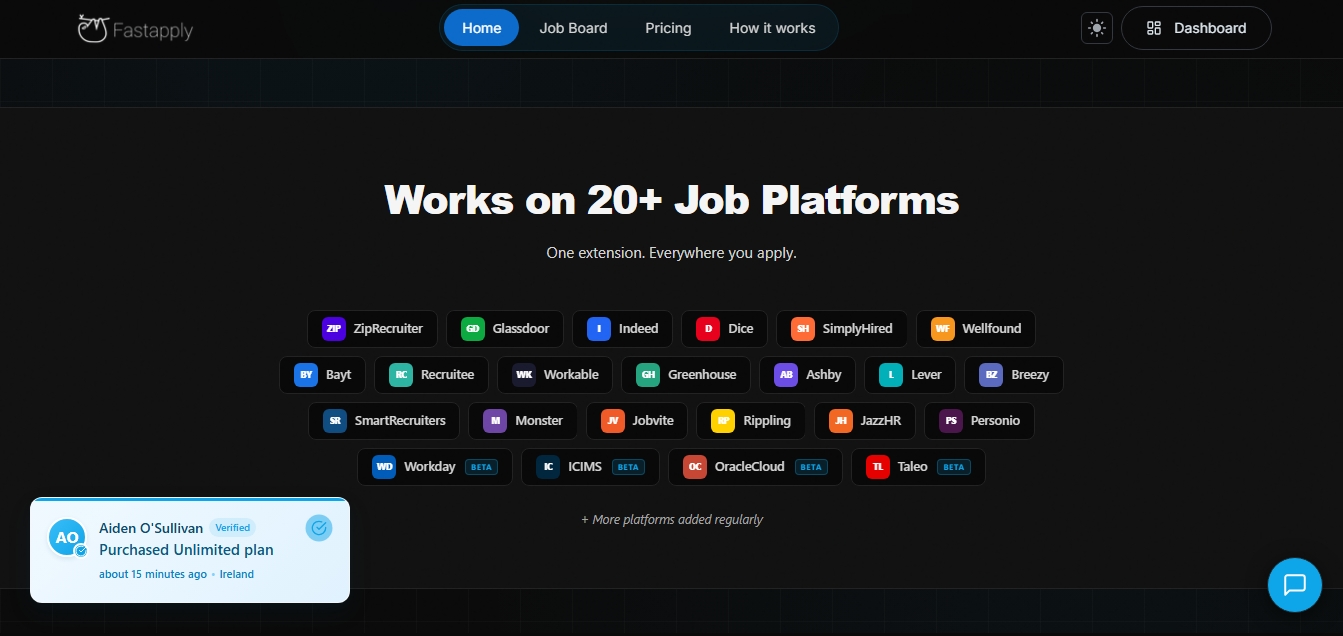
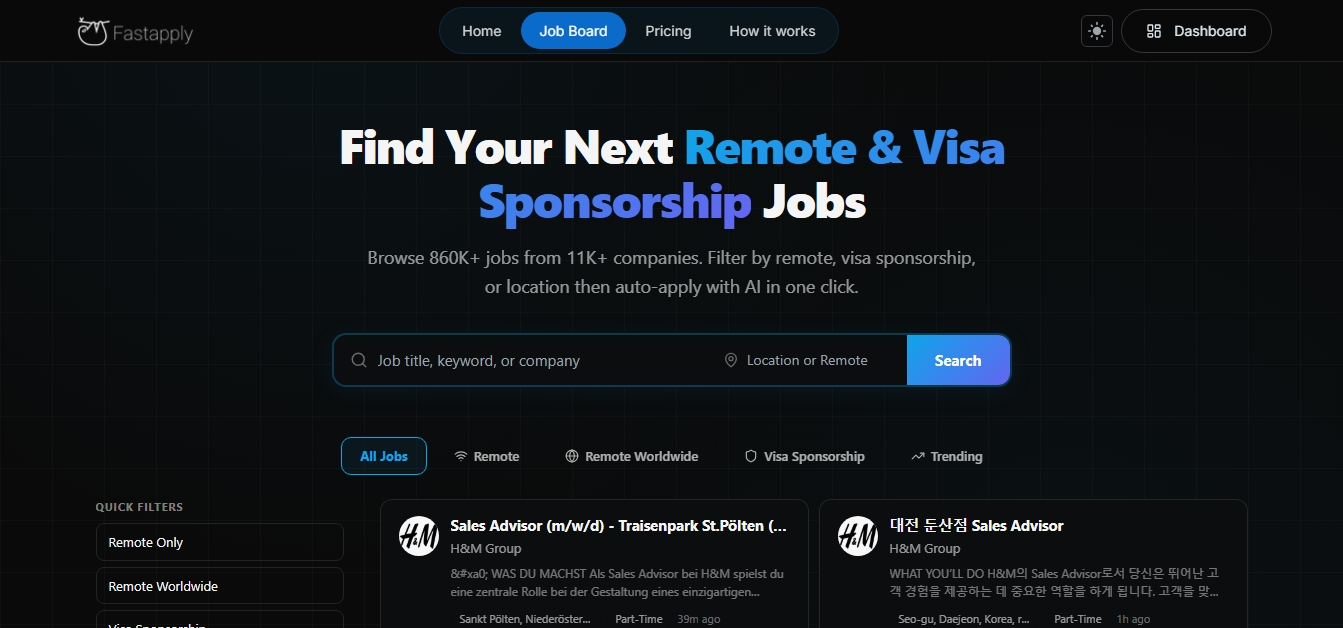
But searching across all those platforms is a job on its own.
FastApply’s job board solves that by bringing 800,000+ listings from multiple sites into one place. Instead of repeating searches across tabs, you can discover relevant remote roles, filter what matters, and move straight into tailoring and applying, all within the same flow.
When you reach a job listing you want to apply for, FastApply reads the job description and automatically tailors your resume to match. Keywords that appear in the job description get emphasized. Relevant experiences move forward. Skills that align with the role become more prominent.
With FastApply, everything from ‘discovery to application’ happens in one place.
The critical difference from fully automated tools is what happens next. FastApply pauses before submission. You review the tailored application, make any adjustments, and approve it. That review step is what prevents the quality problems that make mass auto-apply tools ineffective.
What was a 30-minute tailoring and submission process becomes a 3-minute review. The quality stays high because you are still the one making the final call. The speed increases because the preparation work is done for you.
Across a search involving 100 applications, that difference saves roughly 45 hours.
Strategies That Work Alongside Auto-Apply
Target Boards Strategically by Role Type
Not every board is equally strong for every discipline. A rough guide:
- Software engineers and developers: Remote OK, We Work Remotely, FlexJobs
- Marketing, content, and design: We Work Remotely, Remotive, Remote.co
- Operations, HR, and administration: FlexJobs, Remote.co, DailyRemote
- Customer support and entry-level: DailyRemote, Remote.co, Working Nomads
- High-salary roles ($100K+): FlexJobs, Remote100K, LinkedIn with salary filters
Spreading your search across boards that specialize in your field gives you better listings and less noise.
Managing all of them, however, can quickly become overwhelming. FastApply’s job board pulls listings into one place, so you can apply this strategy without the overhead.
-
Apply Early
In Q4 2025, remote job postings increased by 3%, marking a shift away from the cooling remote job market earlier in the year. But even in a recovering market, applications submitted in the first 24-48 hours after a listing goes live get significantly more attention than those submitted after a week.
Set up daily email alerts on every platform where you search. Check them in the morning. Apply the same day.
-
Research the Company Before Applying
86.6% of job seekers said they are upskilling for remote work, with 44.9% having optimized their resume and LinkedIn profiles specifically for remote roles. The candidates who stand out are not always the most qualified. They are the most prepared. A brief check of a company’s LinkedIn page, recent news, and Glassdoor reviews before applying gives you material to personalize a cover letter in a way that generic applications cannot replicate.
-
Verify Before Applying
Curated remote listings reduce the chances of misleading recruitment offers and improve job authenticity. Even on vetted boards, it is worth cross-checking listings against the company’s official website. Remote roles are disproportionately targeted by job scammers precisely because applicants expect less in-person verification.
What Industries Have the Most Remote Roles in 2026
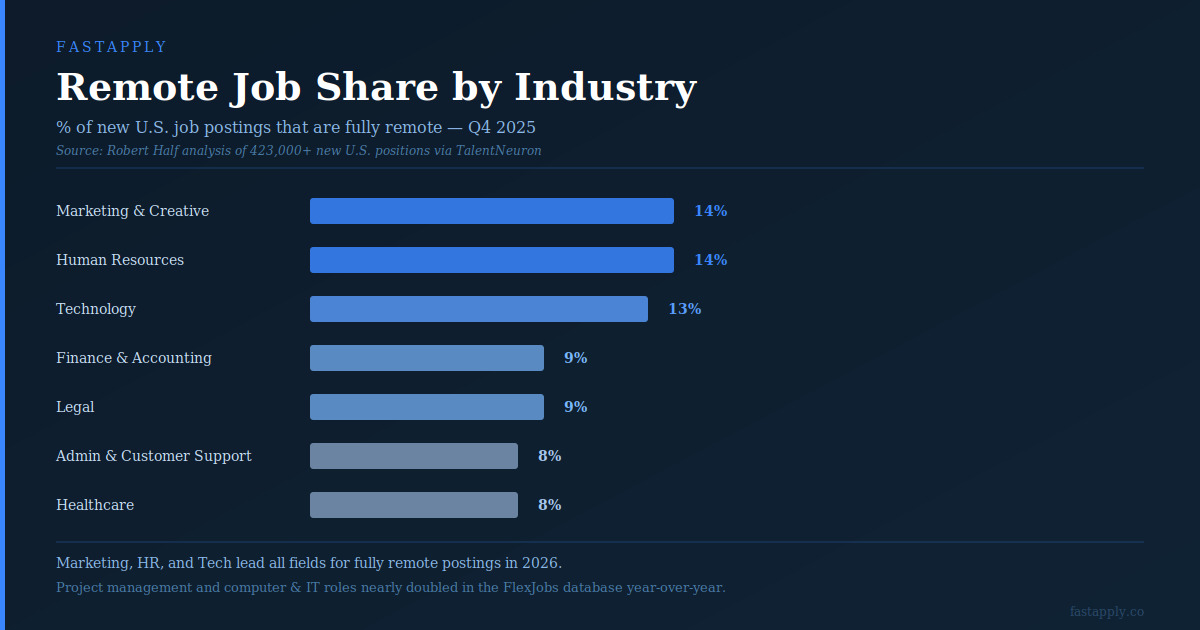
According to Robert Half’s analysis of over 423,000 new U.S. job positions, marketing and creative fields lead with 14% of new postings being fully remote, followed by human resources at 14%, technology at 13%, finance and accounting at 9%, legal at 9%, administrative and customer support at 8%, and healthcare at 8%.
If you work in technology, marketing, or human resources, remote roles represent a larger share of what is being posted than in most other fields. Your job board strategy should reflect that.
According to FlexJobs, project management and computer & IT experienced the largest increases in remote job postings, with each category nearly doubling within the FlexJobs database. Operations, sales, and business development roles grew by more than 20%.
FAQ: Best Remote Job Boards in 2026
Q: Which remote job board has the most listings in 2026?
We Work Remotely has one of the largest volumes of active remote listings globally. For U.S.-focused searches, LinkedIn’s remote filter reaches the widest total audience. For quality over quantity, FlexJobs offers the most carefully vetted listings.
Q: Are remote job boards worth using instead of general job sites like Indeed?
Yes, for remote-specific searches. General boards include many listings mislabeled as remote or flexible. Specialized boards filter for genuine remote work from the start, saving significant time in your search.
Q: Is it worth paying for a subscription to FlexJobs or We Work Remotely?
FlexJobs offers a $2.95 14-day trial that provides access to hand-screened remote listings, with a satisfaction guarantee and refunds available. If the platform delivers interviews within the trial period, continuing the subscription makes financial sense. For job seekers on a tight budget, combining free boards like Remote.co, Remote OK, and Working Nomads covers most of the same market without cost.
Q: How many remote job boards should I use at once?
Three to five platforms gives you meaningful coverage without overwhelming your daily workflow. A practical stack: one premium vetted board (FlexJobs), one high-volume free board (Remote.co or Remote OK), one industry-specific board, and LinkedIn.
Q: How competitive are remote jobs in 2026?
Only about 10% of job postings are fully remote, but they attract on average 2.6 times as many applications as in-person jobs. Jobgether data shows that fully remote roles attract 25 times more applicants than hybrid ones. The competition is real. Speed of application, quality of tailoring, and direct outreach to hiring managers are the three factors that most consistently separate successful from unsuccessful remote job searches.
Q: What is the fastest-growing category of remote jobs in 2026?
Project management and computer & IT saw the largest increases, with remote job postings in each category nearly doubling within the FlexJobs database. Operations, sales, and business development roles also grew by more than 20%.
Q: Does applying through multiple platforms for the same job hurt my chances?
In most cases, no. If a company posts the same role on FlexJobs, Remote.co, and their own careers page, submitting through the channel where you write the strongest application is the right move. Avoid submitting duplicate applications to the same company through different channels, as this appears disorganized to hiring teams.
#best remote job boards 2026
#remote job sites
#work from home job boards
#apply remote jobs automatically

Fastapply Team
Career Experts