The College Senior's Job Application Checklist: Everything to Do Before Graduation (2026)
Senior year moves fast. One minute you are focused on classes, projects, and graduation plans. The next, you are competing in a crowded job market with thousands of other graduates trying to land their first full-time role.
That transition catches many students off guard. A large share of graduates reach commencement without a job offer in hand, not because they lack ability, but because they started too late or approached the search without a clear system. Job offers are often won months before graduation by students who prepare early, apply consistently, and stay organized.
The gap is rarely talent. It is timing, volume, and preparation.
This checklist breaks down everything college seniors should do before graduation, from building your resume and LinkedIn profile to networking, applying strategically, and staying ahead of deadlines, so you finish school with stronger options and less uncertainty.
Why Seniors Start Their Job Search Too Late
The default assumption is that spring semester is job search time, but that is wrong.
Hiring cycles for full-time entry-level roles at large companies often close months before your graduation date. Employers in industries like finance, consulting, and technology typically extend offers to new graduates as early as August or September of their senior year for the following May/June start date.
If you wait until March to start, you are already behind at firms like these.
Smaller companies and startups hire on a rolling basis, so there is more flexibility there. But the earlier you build your materials and develop your strategy, the more options you will have across all company types.
The good news is you have time right now to act.
The Month-by-Month Job Application Checklist for College Seniors
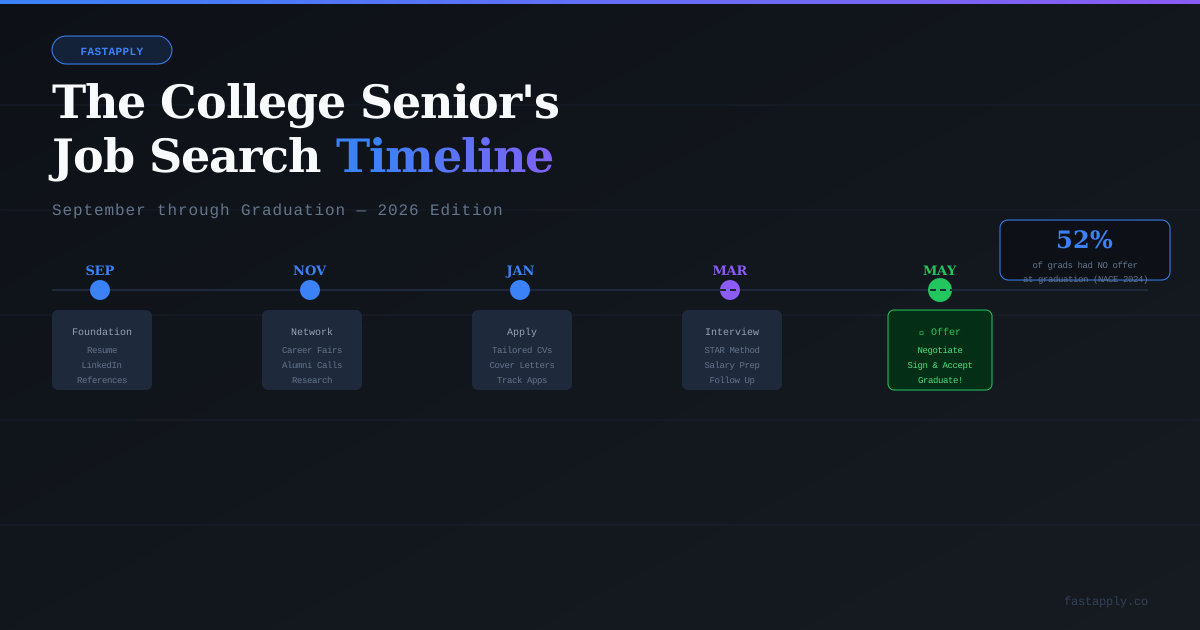
1. September - October: Build the Foundation
Your goal in early fall is not to apply for jobs yet. Your goal is to get ready to apply.
- Resume
- Write a one-page resume tailored to the role type you are targeting. New grads with less than two years of experience rarely need more than one page.
- Lead with your education section if you have limited work experience. Put your GPA if it is above 3.2.
- Quantify everything you can. “Managed social media” is weak. “Grew Instagram following from 800 to 4,200 over one semester” is strong.
- Run your resume through a free ATS checker to identify formatting issues before applications start.
- LinkedIn Profile
- Fill every section: summary, experience, education, skills, projects, certifications.
- Use a professional headshot. Study shows that profiles with photos receive 21 times more profile views and 36 times more messages than those without.
- Write a headline that describes what you do or want to do, not just “Student at X University.”
- Turn on the “Open to Work” feature. This signals recruiters directly.
- Reference List
Identify three people willing to speak on your behalf: a professor, a supervisor from an internship or job, and ideally someone in your target field. Ask them now. Do not wait until an employer requests references in week one of your job search. Give your references a copy of your resume and a brief note about the roles you are targeting.
- Portfolio or Work Samples
If you are in design, writing, engineering, marketing, research, or any field where work products exist, build a basic portfolio now. This does not need to be fancy. A Google Drive folder of your best work samples or a free Notion page is enough to start. Having something to share beats having nothing.
2. November - December: Research and Network
Fall semester is prime networking season. Alumni are active. Career fairs happen. Professors make introductions.
- Attend Career Fairs
Most universities host a fall career fair in October or November. Go. Dress professionally. Bring printed resumes. Research the companies attending in advance and prioritize three to five employers you genuinely want to speak with. Recruiters remember candidates who ask specific questions about the company’s work, not just “what positions are available.”
- Reach Out to Alumni
Your university alumni network is one of the most underused resources available to you. Most alumni genuinely want to help students from their school. Use LinkedIn to search for alumni working at companies or in roles that interest you.
Send a short, specific message. Ask for a 15-minute conversation, not a job. Ask about their path, their day-to-day, and what advice they would give someone entering the field. This is called an informational interview, and it builds relationships that matter.
- Research Target Employers
Build a list of 20 to 30 companies you want to work for. Note their hiring timelines, benefits, culture, and reputation. Some industries (finance, consulting, federal government) recruit on fixed schedules. Knowing this prevents you from missing application windows.
The [Bureau of Labor Statistics Occupational Outlook Handbook]is a reliable source for understanding job growth projections by field.
- Start Tracking Applications
Even before you submit anything, create a tracking system. A simple spreadsheet works: company name, role, date applied, contact name, follow-up date, status. You will apply to many positions, and losing track of where you stand is a real problem.
3. January - February: Applications in Full Swing
This is when most of your applications should go out.
- Tailor Your Resume for Each Role
Generic resumes perform worse against ATS systems. Each job posting contains keywords. Your resume needs to reflect those keywords in context, not just stuffed in randomly.
This is where volume becomes painful. Tailoring 50 or 100 applications manually is genuinely time-consuming. The average tailoring session per application takes 20 to 30 minutes if done well. At 100 applications, that is over 40 hours of work.
This is where FastApply changes the math.
FastApply’s Chrome extension reads the job description and automatically adapts your resume to highlight relevant experience and match the role’s language. Instead of rewriting bullet points for each application, you review the tailored version FastApply generates, make any adjustments, and approve it before submission. The 30-minute tailoring process becomes a 3-minute review.
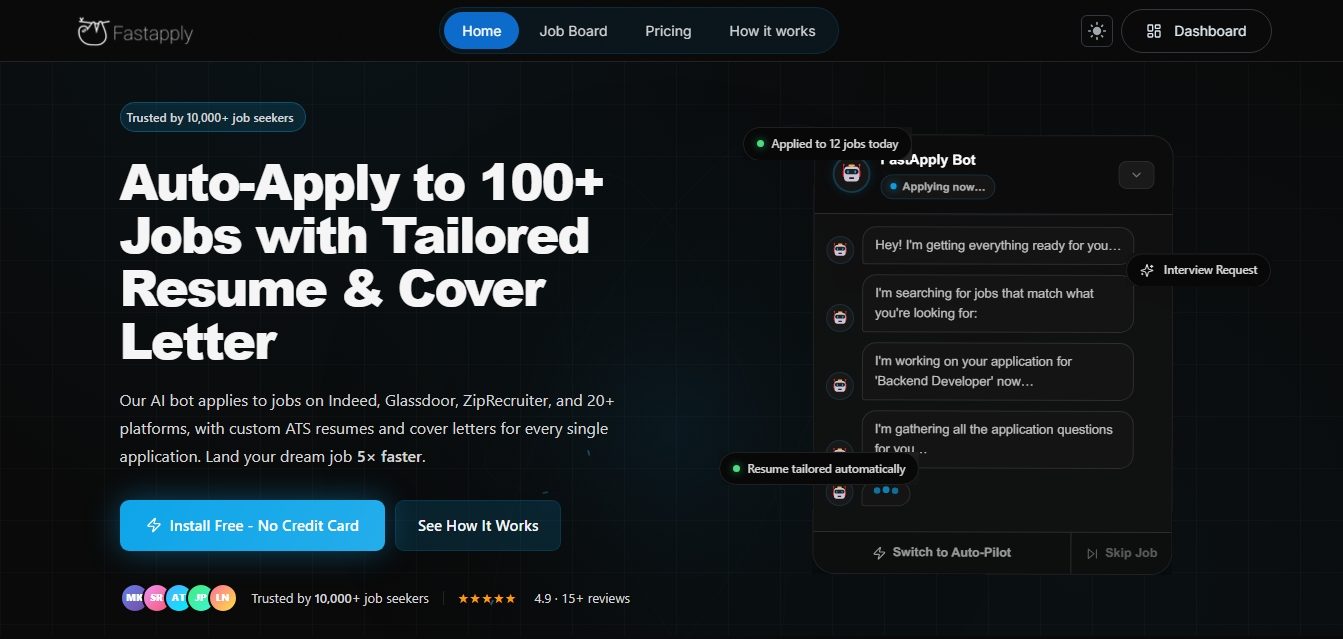
What makes FastApply particularly useful for seniors doing a high-volume search is the job board integration. Rather than opening 10 tabs across Indeed, Glassdoor, Lever, and Greenhouse, you discover relevant listings from multiple platforms in one place. You search once. You see aggregated results. You do not repeat the same keyword search across five different sites and try to remember which postings you already saw.
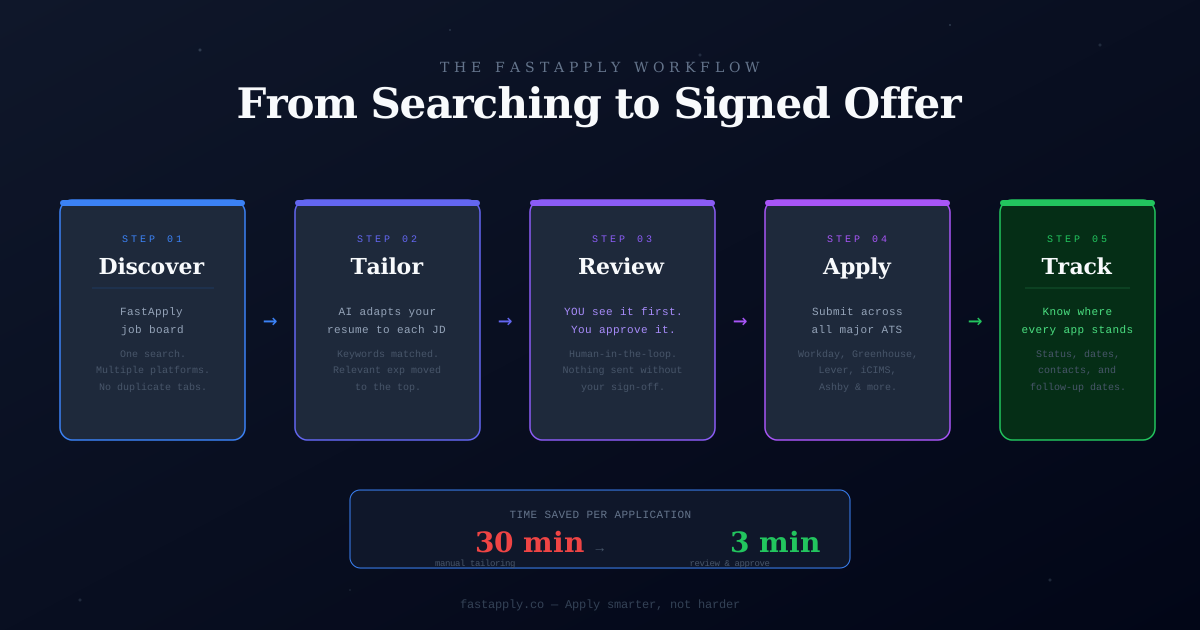
The workflow becomes: Discover on the FastApply job board → tailor with AI → review and approve → submit → track automatically. That is a materially faster loop than the default tab-juggling approach most seniors end up using.
- Write Cover Letters Strategically
Not every role requires a cover letter. When one is optional, submit one anyway. It is a chance to show personality and explain something your resume does not cover.
A cover letter should be three short paragraphs:
- Why this specific company and role
- What you bring that is relevant (one or two concrete examples)
- A brief close with a call to action
Do not summarize your resume. Do not start with “I am applying for…”
- Apply to a Range of Employers
Apply to stretch roles (companies you aspire to), target roles (strong matches), and safety roles (smaller companies where your profile clearly fits). Applying only to stretch roles is how job seekers end up with nothing by May.
The Bureau of Labor Statistics shows that the average job search for a new graduate takes approximately five months. Starting in January gives you that runway before summer.
4. March - April: Follow Up, Interviews, and Decisions
By March, applications are out and interviews should be starting. Shift your energy toward preparation.
- Prepare for Interviews
Use the STAR method (Situation, Task, Action, Result) to prepare behavioral interview answers. Write out five to seven examples from your experience that you can adapt to different questions.
Practice out loud. Record yourself. The candidates who do this are meaningfully better in real interviews than those who just think through answers mentally.
- Research Compensation Before Negotiating
Many new grads do not negotiate their first offer. They should. According to research compiled by Glassdoor, entry-level candidates who negotiate their first offer typically see salary increases of 5 to 10 percent.
Use the Glassdoor salary database, LinkedIn Salary Insights, and the BLS Occupational Employment Statistics to research fair market compensation for the role and location before an offer arrives.
- Send Thank-You Notes
After every interview, send a short thank-you email within 24 hours. This is not about being polite for its own sake. It is a follow-up touchpoint that keeps you visible. Reference something specific from the conversation.
- Keep Applying
Do not stop applying because you have interviews in progress. Interviews fall through. Offers get rescinded. Maintain your pipeline until you have a signed offer letter in hand.
5. May - Graduation: Wrap Up and Prepare to Start
- Negotiate Before Accepting
Evaluate the full offer, not just the salary. Health benefits, 401(k) matching, PTO, remote flexibility, professional development budgets, and start date flexibility all have real value.
If you have competing offers, use them thoughtfully. You do not need to lie or exaggerate. “I have another offer I am considering with a higher base salary. Is there flexibility here?” is a professional and honest way to negotiate.
- Give Yourself Time to Decompress
The senior year job search is exhausting. Give yourself a realistic buffer between graduation and your start date if you have the financial ability to do so. Starting a new job depleted is not a strong foundation.
- Update Your Documents One Final Time
Before you start your role, update your resume with your graduation date and any final projects or honors. You will need a current resume again sooner than you expect.
Using Technology Without Losing the Human Touch
Automation tools are useful, but they work best as assistants, not replacements.
When FastApply tailors your resume or helps draft a cover letter, the output goes through your review before submission. You see what the AI generated. You make changes and approve it. This is the human-in-the-loop model that separates quality applications from spray-and-pray submissions.
The goal is not to apply to 500 jobs in a week. The goal is to apply to 150 to 200 well-matched roles over several months, with materials that are actually tailored to each one, without spending 100 hours doing it manually.
Technology handles the repetitive parts. You handle the judgment calls.
Common Mistakes College Seniors Make During Job Searches
-
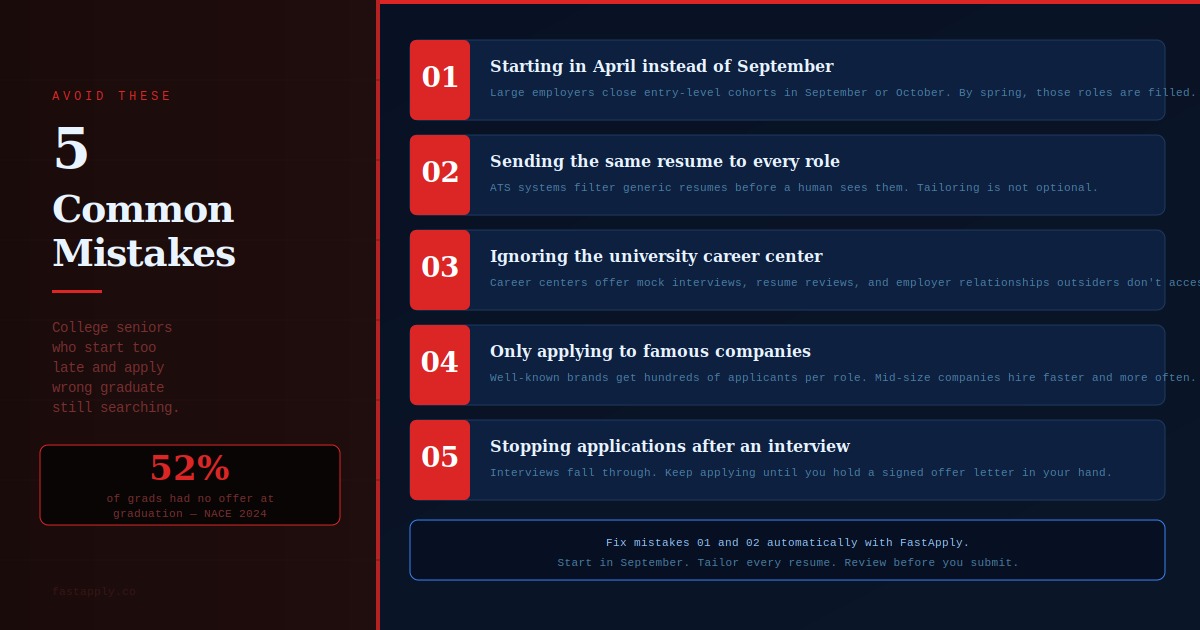
Starting in April: This is the most common mistake. Large employers close their entry-level cohorts months earlier. Smaller employers hire faster but also fill quickly. Start in September.
-
Sending the same resume everywhere: ATS systems filter out generic resumes before a human ever sees them. Tailoring is not optional if you want to get past the first screening layer.
-
Ignoring your university career center: Career centers have employer relationships, resume review services, mock interview programs, and on-campus recruiting infrastructure that outside candidates do not get access to. Use them heavily in the first half of senior year.
-
Applying only to well-known companies: Famous companies receive hundreds of applications for each opening. Your odds improve when you diversify your target list to include mid-size and smaller companies in your field.
-
Stopping after an interview: Keep your pipeline active until you have a signed offer.
FAQ: Job Search Timeline for College Seniors
- When should a college senior start applying for jobs?
For roles at large companies with structured entry-level hiring, the application window often opens in August or September of your senior year. For smaller companies, rolling hiring means January through April is still productive. Starting your prep work (resume, LinkedIn, references) in September gives you the best overall position.
- How many jobs should a college senior apply to?
There is no single right number, but most career advisors recommend applying to at least 50 to 100 positions over the course of the search. Applying to only 10 to 15 companies and waiting for responses is a slow, high-risk approach.
- What should a college senior’s resume look like?
One page. Education section near the top if you have limited work experience. Quantified accomplishments wherever possible. Clean formatting with no graphics or tables that confuse ATS systems. Tailored to each role using keywords from the job description.
- Is a cover letter necessary?
It depends on the employer. When a cover letter is required, it is necessary. When optional, submitting one still gives you an advantage. A good cover letter is three short paragraphs: why the company, what you bring, and a brief close.
- How long does the job search take for a new graduate?
The Bureau of Labor Statistics data suggests an average of approximately five months for new graduates. Starting earlier shortens that timeline because you have more weeks to generate applications and work through the interview process.
- Does GPA matter to employers?
It depends on the industry. Finance, consulting, and some technology employers screen for GPA thresholds (often 3.0 to 3.5 and above). Many employers in marketing, media, nonprofit, and general business focus more on experience and projects. Research your target industries specifically.
- What is the most common reason new grads do not get hired?
Starting too late is the most frequent cause of slow searches. After that, the most common issues are generic resumes that fail ATS screening, insufficient application volume, and inadequate interview preparation.
#job application checklist college senior
#graduation job search timeline
#senior year job prep
#when to start applying for jobs
#how to get a job after graduation

Fastapply Team
Career Experts