10 Most Common Interview Questions (and How to Nail Every One)
Your words, pauses, and examples shape how employers see you. With the right preparation, you enter any interview with confidence and clarity. For the wider prep picture (virtual interviews, first impressions, follow-ups), see our interview tips for the 2026 job market.
Companies receive hundreds of applications for one role. Many are filtered by Applicant Tracking Systems before reaching a human. When you reach the interview stage, expect a mix of behavioral, situational, and technical questions. Your goal is to stand out through structure, clear communication, and relevance.
What This Guide Covers
We’ll walk through the 10 questions that appear in most interviews, the STAR method for structuring answers, sample answers for different experience levels, expert insights from Indeed, Robert Half, and The Muse, and a pre-interview checklist to help you prepare.
Expert Insight
Indeed’s hiring specialists say: “Top candidates practice out loud, prepare examples from real experiences, and tailor their answers to the company they’re interviewing with.”
Good preparation helps you tell your story in a way that feels authentic, relevant, and memorable. It also makes your responses stronger for both humans and AI-driven screening systems.
Types of Interviews You’ll Face
Modern interviews often combine several formats to evaluate how you think, adapt, and communicate.
1. Behavioral Interviews
These focus on how you’ve handled real situations in the past. They help employers predict future behavior.
Examples:
- “Tell me about a time you handled a workplace challenge.”
- “Describe a situation where teamwork played a major role.”
Tip: Use the STAR method (Situation, Task, Action, Result) to stay clear and organized.
2. Situational Interviews
These explore how you would respond to future scenarios.
Examples:
- “What would you do if two projects had overlapping deadlines?”
- “How would you handle a difficult client or teammate?”
Tip: Explain your thought process step by step.
3. Technical Interviews
These test your practical skills. Interviewers care about how you approach a problem, not only the final answer.
Tip: Talk through your reasoning before presenting the solution.
4. Screening Interviews
These are short virtual or phone calls led by recruiters. Expect questions about your background, motivation, and salary expectations.
Tip: Prepare a 30-second summary covering who you are, what you do, and what you want next.
Pre-Interview Checklist
Before you walk into any interview, make sure you:
- Identify the interview type
- Prepare two STAR-based stories
- Expect a technical or case-style question
- Rehearse your elevator pitch
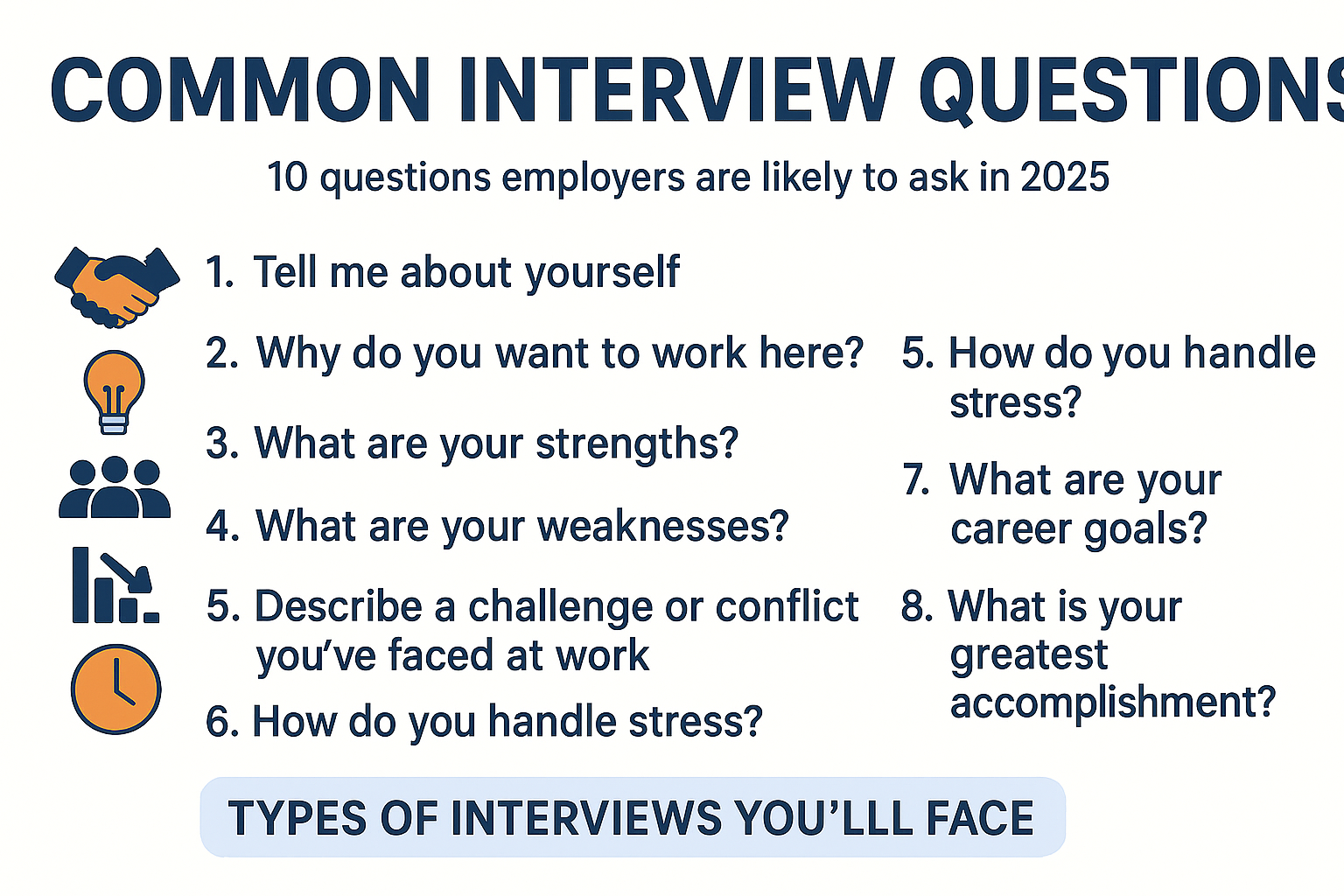
The 10 Most Common Interview Questions
These questions appear in most interviews. Use the tips below to stay sharp and clear.
1. Tell me about yourself
Why they ask: To see how you summarize your experience.
How to answer: Share your professional story in a few sentences and end with why you’re excited about this role. Don’t recite your resume. Focus on relevant experience and connect it to the job you want.
Example (Entry-Level): “I graduated with a degree in Marketing last year and completed two internships where I managed social media campaigns and analyzed engagement data. I’m drawn to this role because your company values data-driven creativity, which matches how I approach marketing.”
2. Why do you want to work here?
Why they ask: To gauge genuine interest.
How to answer: Mention specific company values, projects, or culture that align with your goals. Do your research. Generic answers kill your chances.
Example (Mid-Level): “I’ve followed your product launches for the past year, and I’m impressed by how you prioritize user feedback in development. I want to contribute to a team that values iterative improvement and customer-first thinking.”
3. What are your strengths?
Why they ask: To identify your main value.
How to answer: Choose strengths relevant to the role and support them with examples. Don’t list random qualities. Pick 2-3 strengths and prove them with stories.
Example (Tech): “I’m strong at breaking down complex problems. In my last role, I debugged a system issue that had stumped the team for weeks by isolating variables and testing systematically. I solved it in three days.”
4. What’s your biggest weakness?
Why they ask: To test self-awareness.
How to answer: Pick a real but manageable weakness and show what you’ve done to improve. Never say “I’m a perfectionist” or “I work too hard.” Interviewers see through that.
Example (Finance): “I used to struggle with delegation because I wanted to ensure everything was perfect. I’ve been working on trusting my team more by clearly defining expectations upfront and checking in at milestones instead of micromanaging.”
5. Tell me about a time you faced a challenge
Why they ask: To assess problem-solving and resilience.
How to answer: Use the STAR method to describe the situation and your impact. Focus on what YOU did, not what your team did.
- STAR Example (Entry-Level | Tech):
- Situation: My project team lost two members a week before the deadline.
- Task: I had to ensure the project was completed on time.
- Action: I split tasks efficiently and worked extra hours to close gaps.
- Result: We submitted early and received top marks.
6. Describe a time you worked on a team
Why they ask: To understand collaboration skills.
How to answer: Focus on teamwork, communication, and results. Show how you contributed, not how great the team was.
Example (Mid-Level): “I worked with a cross-functional team to launch a product feature. My role was to coordinate between design and engineering. I set up weekly syncs, documented decisions, and kept everyone aligned. We launched two weeks early.”
7. How do you manage tight deadlines?
Why they ask: To test organization and composure.
How to answer: Explain how you prioritize and share a quick example of success.
Example: “I break projects into smaller tasks, rank them by urgency and impact, then tackle high-priority items first. Last quarter, I had three client deliverables in one week. I created a timeline, communicated realistic expectations, and delivered all three on time.”
8. Tell me about a failure or mistake
Why they ask: To gauge accountability.
How to answer: Be honest, explain what you learned, and how you improved. Don’t blame others or minimize the mistake.
Example: “I once missed a project deadline because I underestimated the time needed for revisions. I learned to build buffer time into my estimates and now use project management tools to track progress. I haven’t missed a deadline since.”
9. How do you handle feedback?
Why they ask: To see if you’re coachable.
How to answer: Share an example where feedback helped you grow.
Example: “My manager once told me my presentations were too detailed for executive audiences. I learned to lead with the takeaway and save details for questions. My next presentation got approved in one meeting instead of three.”
10. Do you have any questions for us?
Why they ask: To measure curiosity and interest.
How to answer: Ask about culture, team goals, or career growth. Never say “No questions.”
Strong Questions:
- “What does success look like in the first six months of this role?”
- “How does the team collaborate on projects?”
- “What challenges or goals is the company focused on right now?”
- “What professional development programs do you offer?”
- “What do you enjoy most about working here?”
Avoid:
- Salary or time-off questions early in the process
- Questions easily answered on the website
- Saying “No questions”
Tip: End with, “Is there anything you’d like me to clarify about my background?”
The STAR Method Explained
The STAR method helps you structure interview stories with focus and clarity.
S - Situation: Describe the context in 1-2 sentences. T - Task: Define the challenge or goal you faced. A - Action: Explain what YOU did (not your team). R - Result: Share the measurable outcome.
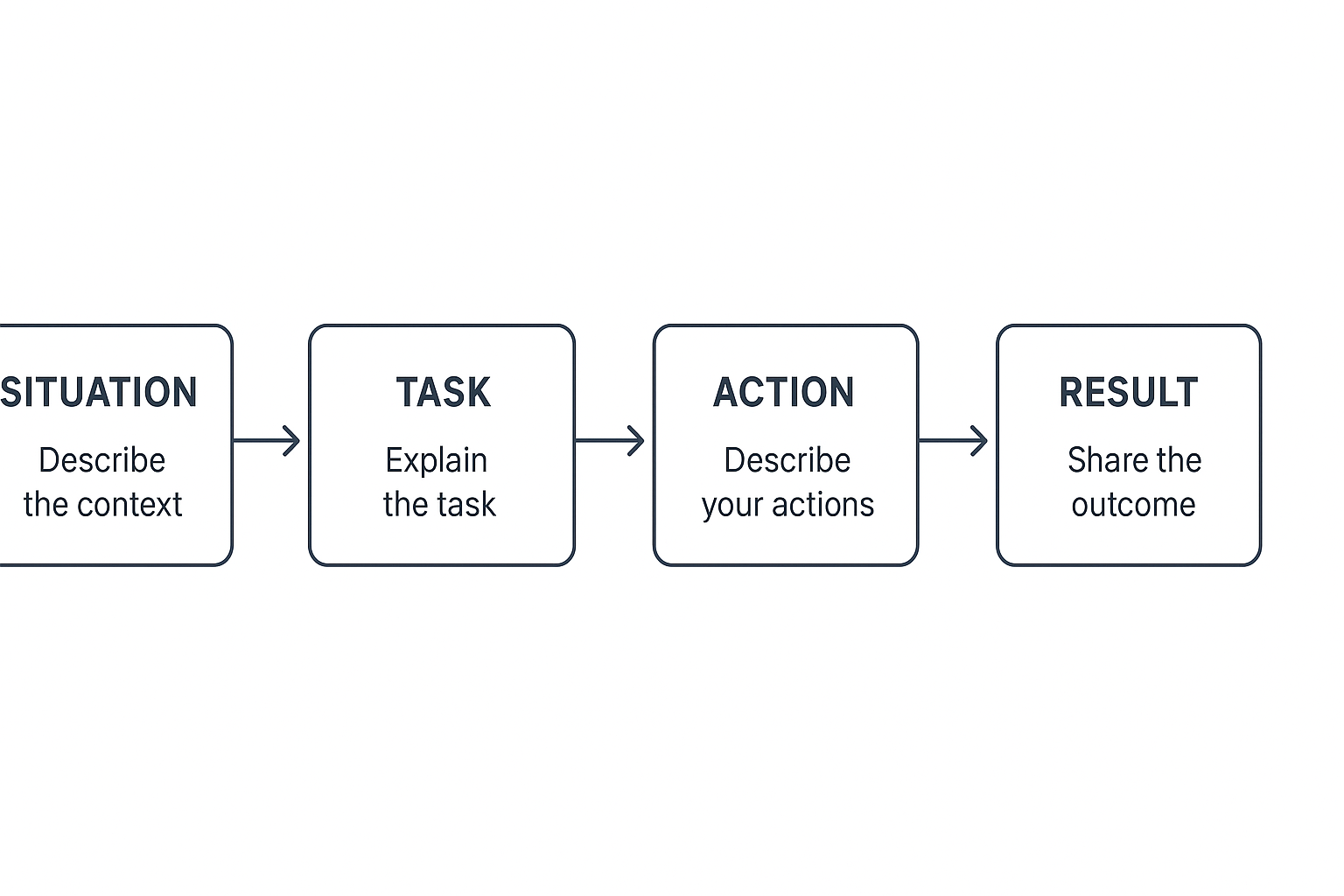
Why it works: It keeps your answer concise and highlights results. Recruiters love this structure because it shows clear thinking and impact.
STAR Example (Mid-Level | Finance)
Question: “Describe a situation where you managed multiple priorities.”
Situation: Two client reports were due before quarter-end. Task: Deliver both accurately and on time. Action: I created a task list, updated clients daily, and delegated work to junior analysts. Result: Both reports were delivered early and received positive feedback. One client increased their contract by 20%.
Common STAR Mistakes
- Skipping the results (the most important part)
- Speaking vaguely without specific details
- Forgetting to connect your story to the role
- Talking about what “we” did instead of what “I” did
Tip: Prepare three STAR stories before any interview. One about success, one about teamwork, and one about a setback.
How to Prepare Like a Pro
Most candidates wing their interviews. Don’t be most candidates.
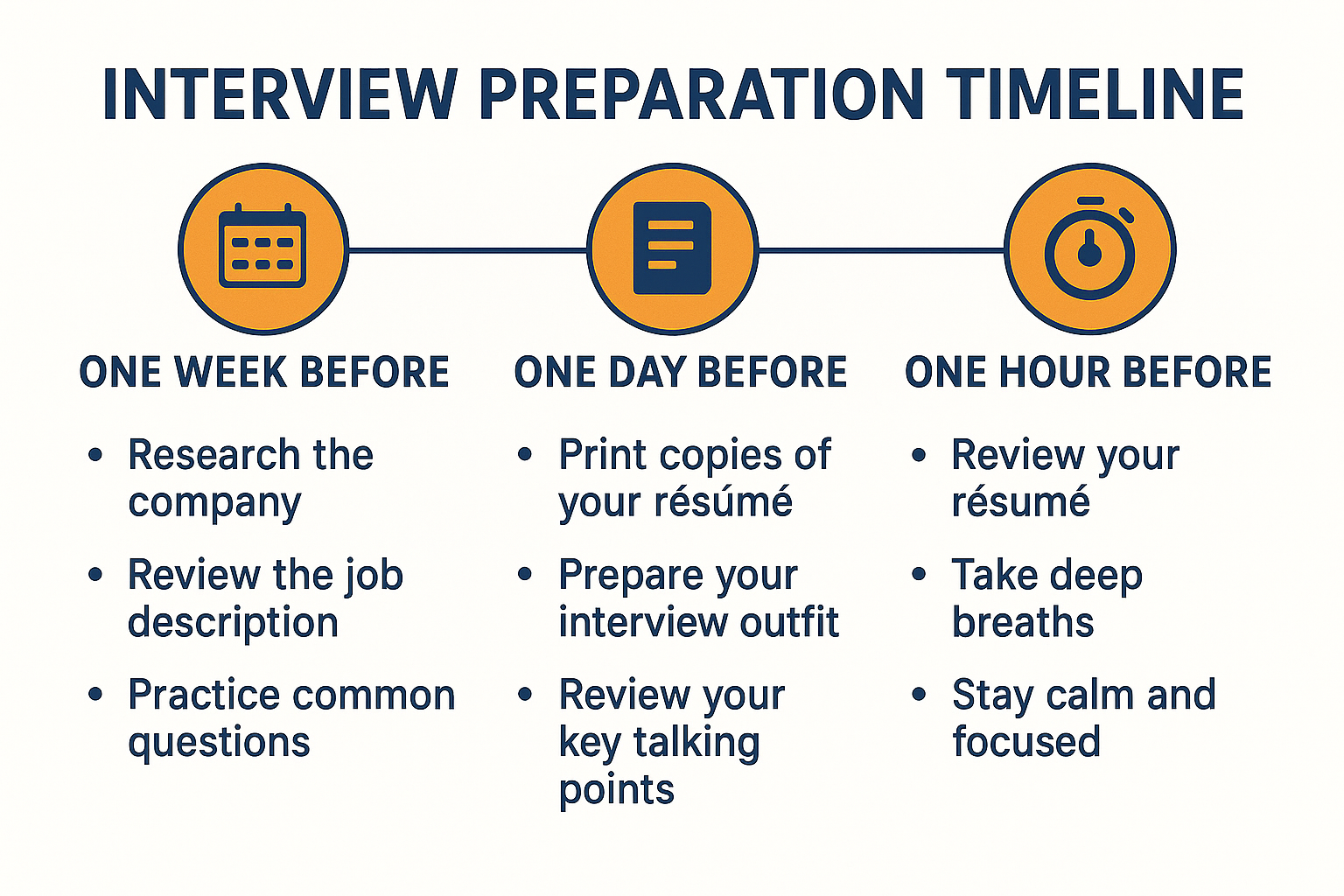
One week before:
- Research the company’s recent news, values, and culture
- Read the job description carefully and note key requirements
- Prepare 3-5 STAR stories that highlight relevant skills
- Practice answers out loud (not in your head)
One day before:
- Review your resume and be ready to explain any gaps
- Prepare questions to ask the interviewer
- Plan your outfit and test your tech if it’s virtual
- Get good sleep (tired candidates make weak impressions)
One hour before:
- Review your notes and STAR stories
- Do a quick breathing exercise to calm nerves
- Arrive 10-15 minutes early (or log in 5 minutes early for virtual)
How FastApply Gets You More Interviews
Here’s the truth: you need volume to land interviews. The average job seeker applies to 32 jobs to get 4 interviews. Doing that manually while also preparing for interviews is exhausting.
FastApply’s AI Job Agent improves how you find and apply for jobs so you spend less time applying and more time preparing.
Why job seekers use it:
- Intelligent Matching: Finds jobs that match your skills and goals across LinkedIn, Indeed, Glassdoor, and 6+ other platforms
- AI Autofill: Completes applications and tailors cover letters automatically for each role
- Autopilot and Copilot Modes: Choose between automatic applications or manual review
- Smart Tracker: Tracks every application and recruiter response in one dashboard
- ATS Resume Builder: Turns your profile into a clean, recruiter-ready resume that passes screening systems
One data analyst put it this way: “Before FastApply, I sent out dozens of resumes with no reply. Within weeks, I started getting callbacks and landed two interviews.”
The tool handles the volume. You handle the preparation.
Start for free today. No subscription required.
Key Takeaways
Preparation sets you apart. Research the company and rehearse your answers out loud. STAR stories show results and reflection. Thoughtful questions show interest. Honesty builds trust, so show growth through your experiences.
Human connection still wins interviews. Use structured preparation and tools like FastApply to take control of your career journey. The companies worth working for want to see the real you. Show up prepared, authentic, and confident.
You’ve got the questions. You’ve got the method. Now go nail that interview.
Ready to land more interviews? FastApply automates your job search so you apply to hundreds of relevant jobs while focusing on interview prep. Your next opportunity is one application away.
#10 Common
#Interview Questions
#Answers (2025 STAR Guide)

FastApply Team
Career Experts