Entry-Level Jobs Are Disappearing: What New Grads Need to Do Differently in 2026
The share of unemployed Americans who are new workforce entrants hit a 37-year high in 2025, peaking at 13.3% in July before settling at 10.6% by early 2026. That figure sits higher than at any point during the Great Recession.
The entry level jobs disappearing trend is not a myth, not a narrative, and not your fault. But waiting for the market to recover is not a strategy.
This guide covers what is happening to the new grad job market, why 2026 looks different from any previous downturn, and the specific actions you need to take right now to get ahead of peers who are still applying the same way job seekers did five years ago.
How Bad Is the Entry-Level Job Crisis, Really?
The headline unemployment rate sits around 4.2%, which sounds manageable. The problem is that this number hides what is happening to people at the start of their careers.
-
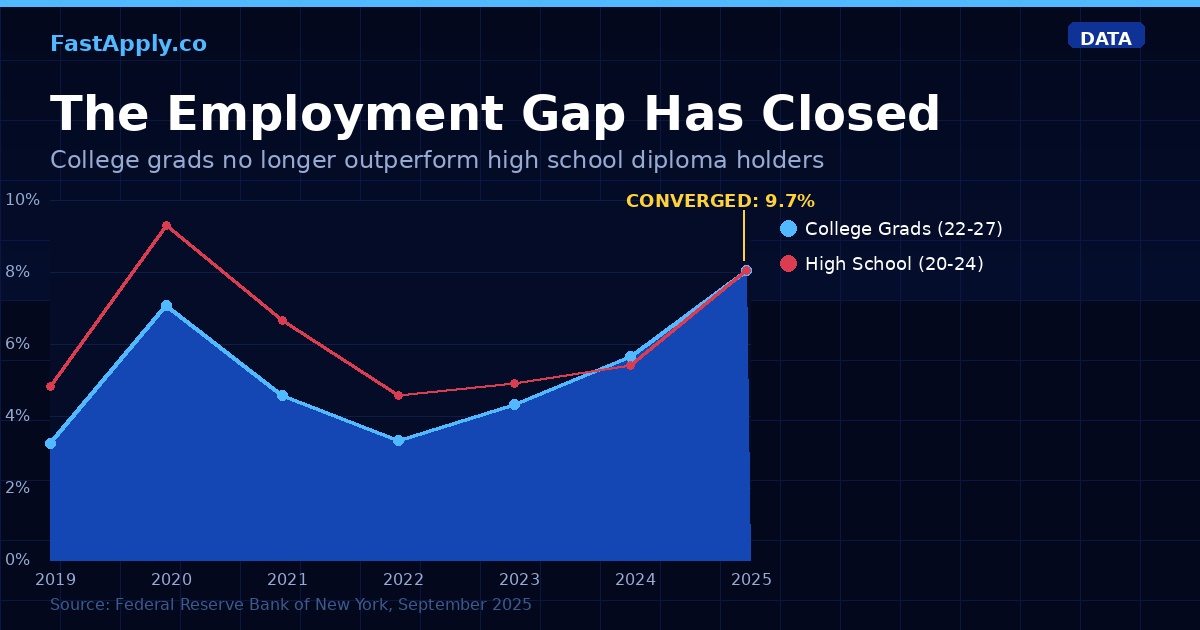
The gap between college grads and everyone else has collapsed: The unemployment rate for recent college graduates reached 9.7% as of September 2025, the same rate as 20-to-24-year-olds with only a high school diploma. For six months in 2025, workers with occupational associate’s degrees in skilled trades posted slightly better employment outcomes than four-year degree holders, marking the first time college graduates have lost their employment advantage since the federal government began tracking this data in the 1990s.
-
Hiring for college graduates has collapsed relative to recent history: Hiring for college graduates dropped down to 16% in 2025 compared to 2024 and 44% below 2022 levels. Software development job postings fell 40% compared to four years ago. LinkedIn workforce data from late 2025 shows national hiring slowing by nearly 9% year-to-date, remaining over 20% below pre-pandemic levels.
-
Underemployment is becoming the norm, not the exception: Nearly 43% of U.S. college graduates aged 22 to 27 are underemployed, meaning they are working jobs that do not require the degree they earned, according to Federal Reserve Bank of New York data as of December 2025. Among the class of 2023, 52% were underemployed one year after graduation.
-
The competition for what is left has intensified: Job postings for new grads fell 15% year-over-year, while applications per role jumped 30%. Among 2025 graduates, 16% submitted more than 20 applications before landing a single offer, up from 12% of 2024 grads.
This is the no entry level jobs 2026 reality. It is structural, not cyclical.
Why This Downturn Is Different From Past Recessions
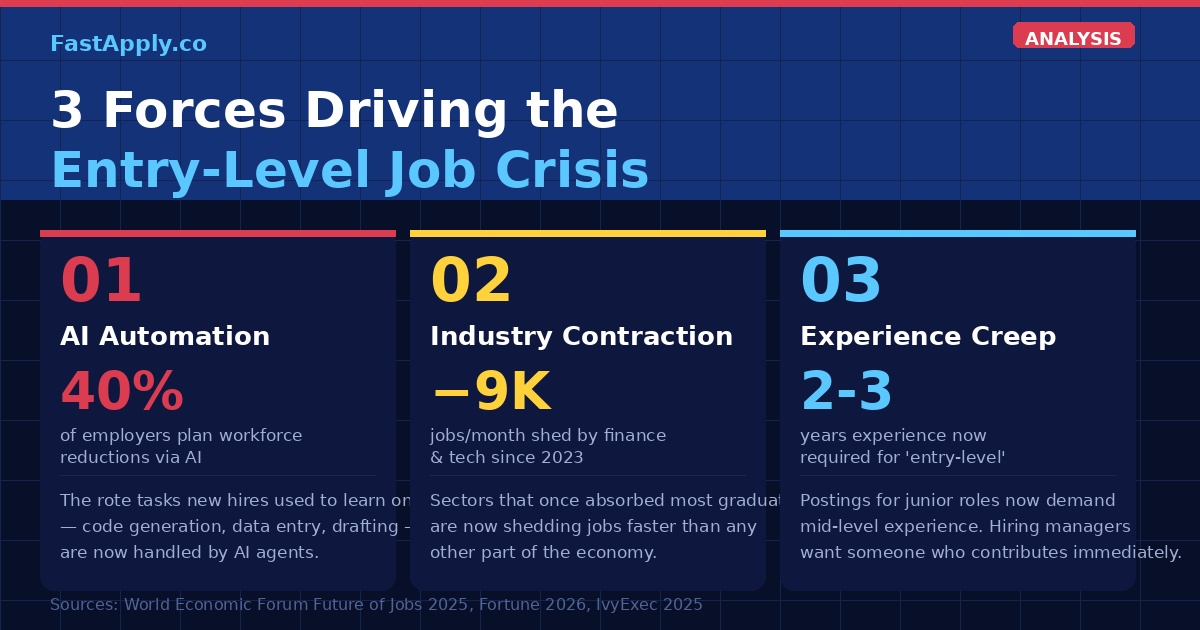
Previous downturns hit everyone. This one is surgical. Three forces are working together in ways that make this entry-level job crisis unlike anything previous graduating classes faced:
- AI Is Automating the Work New Grads Used to Do
The traditional unwritten deal of entry-level employment was simple: you trade rote, repetitive work for mentorship and exposure. You learn by doing the grunt work. You build up to bigger responsibilities.
AI is automating that grunt work. Code generation, financial modeling, data entry, document drafting, basic analysis; these are exactly the tasks that once gave junior employees their footing. The World Economic Forum’s Future of Jobs Report 2025 reveals that 40% of employers expect to reduce their workforce where AI automate tasks.
A survey found that 49% of U.S. Gen Z job hunters believe AI has reduced available opportunities. Among 2026 grads, a similar share say they believe AI will reduce the number of entry-level roles available to them.
- Industries That Once Absorbed Graduates Are Contracting
Finance and information services used to be the primary on-ramp for college graduates. Before the pandemic, those industries were adding 44,000 jobs per month. Since 2023, they have been shedding an average of 9,000 jobs per month.
Tech employers including Meta, Intel, and Cisco announced more than 130,000 job cuts in 2025. At the end of 2025, job openings overall dropped to 6.5 million, the lowest level since September 2020.
- Experience Requirements Have Shifted Upward
Job postings now routinely demand two to three years of experience for roles listed as entry-level, creating a paradox where you need the job to get the job. This is not new, but it has intensified sharply. Employers are asking new graduates to walk in performing at a mid-level capacity.
What Sectors Are Still Hiring New Grads
Not every door is closed. Healthcare, cybersecurity, skilled trades, and business operations are adding new graduates right now. Healthcare entry-level postings specifically bucked the broader trend, rising 13 percentage points against the overall market decline.
Secondary markets including Nashville, Detroit, and Atlanta are showing hiring resilience where traditional tech hubs have pulled back. Government, healthcare, and leisure/hospitality accounted for almost 75% of all jobs added in late 2024 and 2025.
Internship postings on ZipRecruiter are up 32% year-over-year, primarily in white-collar fields, even as full-time entry-level listings shrink. Employers say they expect to hire nearly 4% more interns and 5.6% more new college grads in 2026 compared with last year, according to the National Association of Colleges and Employers (NACE).
The opportunity exists. It is just narrower, more competitive, and in different places than graduates from three years ago found it.
What New Grads Need to Do Differently in 2026
This is where the actionable part starts. The grads landing roles right now are not necessarily more qualified than peers who are not. They are doing a small number of things differently and more deliberately.
1. Stop Relying on GPA and Degree Name Alone
This shift is already underway at the employer level. Only 42% of employers plan to screen candidates by GPA in 2026, down from 73% in 2019. Nearly 70% of employers now use skills-based hiring processes.
Employers prioritize adaptability, clear communication, and demonstrated hands-on experience over GPA or school prestige. Skills you have built, created, or contributed to matter more than where you studied.
This does not mean GPA is worthless. It means GPA alone will not move your application forward. Build proof.
2. Build a Portfolio Before You Graduate
A portfolio or work sample is now expected in many fields: marketing, design, writing, data analytics, UX, coding, and consulting roles all expect candidates to show their work.
If you do not have work samples from internships, create them. Case studies, personal projects, GitHub repositories, and writing samples all count. This is not about padding, it is about giving hiring managers something to evaluate besides your transcript.
A specific example: if you are targeting a marketing role, run a real campaign for a student organization or local business, document results, and write up the case study. If you are targeting data roles, find a public dataset and build an analysis. Make it findable.
3. Treat AI Fluency as Baseline, Not a Differentiator
Familiarity with AI tools is quickly becoming a baseline expectation, not a bonus. Candidates who demonstrate they use tools like ChatGPT, Claude, or Copilot to work smarter signal readiness for modern workplaces. This is especially true in technology, marketing, finance, and consulting.
Just 29% of rising grads and 23% of recent grads said their school provided extensive AI training for their careers. That gap is your opportunity. Learn these tools actively. Get certified where certifications exist. Apply them in your portfolio projects.
4. Get Specific and Certified
Earning a relevant certification closes the experience gap faster than most approaches. CompTIA Security+ for cybersecurity roles. Salesforce certifications for sales and business operations. Microsoft Azure for cloud and IT roles. Google Analytics or HubSpot for marketing.
These are not substitutes for internship experience, but they demonstrate commitment and specific technical readiness. They also help you clear automated resume screening that filters for skill keywords.
5. Network Differently
Networking advice rarely changes, but the application of it needs to change. Talk to people who already hold your dream job. Ask how they are using AI daily, where the gaps are, and how new grads add value. Those insights differentiate you in the actual interview.
Direct applications through company career pages, combined with outreach to a recruiter on LinkedIn, consistently outperform cold applications through aggregators. The hiring process now runs through relationships more than ever, because hiring managers want to reduce the risk of a bad hire in an uncertain market.
Alumni networks exist for exactly this moment. Use them before you need them.
6. Apply in Volume Without Sacrificing Quality
Here is the math problem most new grads are not solving correctly. Applications per role jumped 30% year-over-year. You are competing against more people for fewer spots. The answer is not to apply to fewer jobs with more time spent on each one. The answer is to apply to more jobs without destroying the quality of each application.
This is the tradeoff that beats most job seekers. Tailoring takes time. High volume without tailoring produces low response rates. Most people choose one side of this equation and lose.
The grads seeing results right now are solving this through a combination of systems and tools. A master resume with two or three tailored versions for different role types is a realistic approach. The job description should echo through your bullet points in language, not copy-paste.
How FastApply Fits Into This Workflow
The application volume problem has a practical solution. FastApply’s job board aggregates listings across Indeed, Ashby, Glassdoor, Greenhouse, Lever, Workday, and company career pages into a single dashboard, so you are not jumping between eight tabs and missing roles posted on platforms you do not check regularly. When you are applying to the volume of roles this market requires, fragmented job search costs you hours per week.
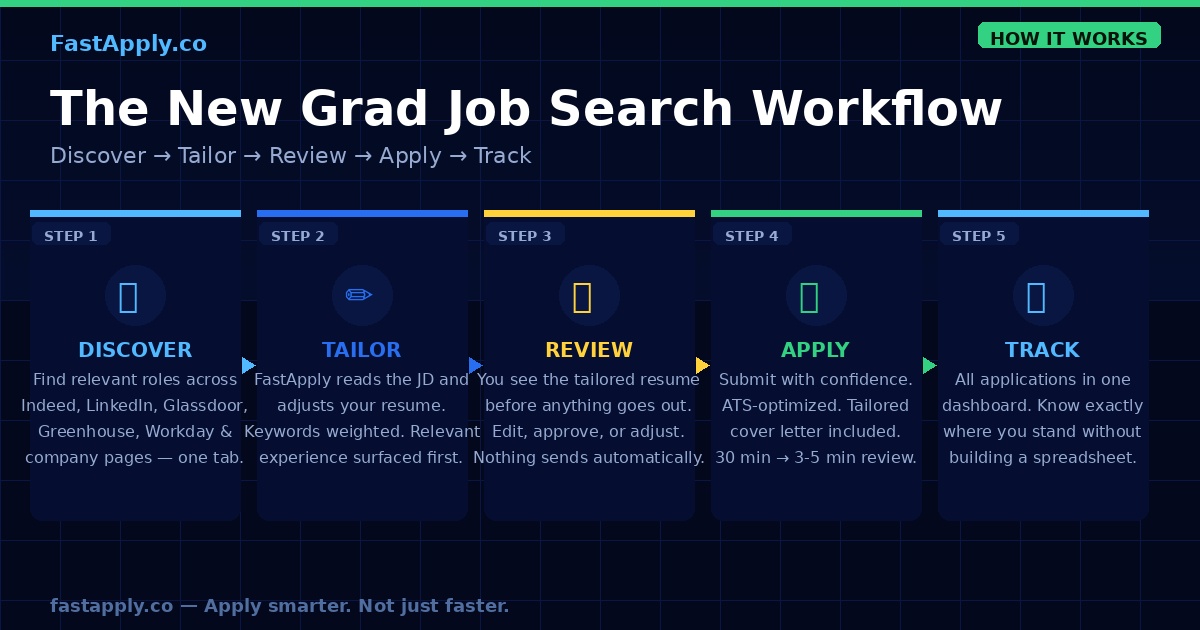
Once you find relevant roles, the FastApply Chrome extension reads each job description and tailors your resume to match. Keywords get weighted. Relevant experience rises. But the submission does not go out automatically, you review the tailored resume first, make adjustments, and approve. This gives you the volume you need without sending generic applications that ATS systems filter out in seconds.
For a new grad applying to 50 to 100 roles during a serious search, that workflow matters. What used to take 30 minutes per application becomes a three-to-five-minute review. You keep your quality standards without burning out before week two of your search.
FastApply also generates tailored cover letters and tracks your application status across platforms in one place, so you know exactly where you stand without building a spreadsheet from scratch.
Consider Adjacent Entry Points
-
Contract and temp work: These are legitimate career starts in a low-hire, low-fire economy. Contract work builds experience, proves competence, and sometimes converts. Start your career in adjacent industries or temporary roles that build experience rather than titles.
-
Grad school is not the answer by default: This requires an honest assessment. Graduate school makes sense if it closes a specific skills gap or opens doors in a field where an advanced degree is genuinely required. It does not make sense as a strategy for waiting out the market, especially with student debt costs.
-
Startups and smaller companies: Traditional job board searches over-represent large employers. Mid-sized and smaller companies often have less formal hiring processes, move faster, and give early-career employees broader responsibility. They are also underrepresented in standard job board results.
-
Geographic flexibility: Secondary markets are growing while major tech hubs are shedding. Nashville, Detroit, and Atlanta are showing hiring resilience right now. If remote is not possible in your target field, geographic flexibility dramatically expands your options.
What the Grads Who Are Landing Roles Have in Common
Handshake’s chief education strategy officer Christine Cruzvergara put it directly: students still graduating with relevant skills are still getting hired, but those seeing the most success are the ones who proactively equip and market themselves as a critical part of a new era of the workplace.
More than 60% of the class of 2026 is pessimistic about their career prospects. That pessimism is understandable. It is also an opening. The grads who treat this market as a solvable problem and work it systematically separate themselves from the majority who are hoping for a callback.
The structural factors creating this entry-level job crisis are real and not going away fast. But the grads who combine specific credentials, demonstrated skills, high-quality volume applications, and targeted networking are still getting hired. The playbook just changed.
Frequently Asked Questions
Q: Are entry-level jobs really disappearing or is competition just higher?
Both. The number of postings dropped 15% year-over-year while applications per role rose 30%, so you are facing fewer opportunities and more competition simultaneously. The structural shift from AI automation is also removing tasks that historically belonged to entry-level roles. This is not a temporary correction.
Q: Which industries are still hiring new graduates in 2026?
Healthcare, cybersecurity, skilled trades, and business operations are actively adding new grads. Healthcare entry-level postings rose 13 percentage points against the broader market decline. Finance and tech are the hardest hit sectors right now.
Q: Does GPA still matter?
Fewer employers are screening by GPA, 42% plan to in 2026, down from 73% in 2019. Skills, certifications, internship experience, and portfolio work now carry more weight than GPA for most employers using skills-based hiring processes.
Q: How many applications should new grads be sending?
There is no universal answer, but the data shows 16% of 2025 grads submitted 20-plus applications before landing a single offer. In a market where applications per role are up 30%, volume matters. The goal is maintaining quality while increasing volume, which requires systems and tools rather than doing everything manually.
Q: Is graduate school a good option right now?
Graduate school makes sense if it closes a specific gap or is required in your target field. It is not a good default for avoiding the market. Grad school costs have not fallen while the job market has.
Q: How do I get experience when every entry-level job requires experience?
Build your own proof: personal projects, freelance work, volunteering, student organization leadership, and open-source contributions all count. Specific certifications also demonstrate readiness for systems employers use. These do not substitute for internship experience but they move your application past the first filter.
Q: What do employers actually prioritize in 2026?
Employers hiring new grads in 2026 prioritize adaptability, clear communication, demonstrated hands-on experience, and AI tool familiarity. Skills-based hiring is now the norm, meaning you need to show what you have built or contributed, not just where you studied.
#entry level jobs disappearing
#no entry level jobs 2026
#new grad job market
#entry level job crisis

Fastapply Team
Career Experts