
H-1B Layoff Survival Guide: What to Do in Your 60-Day Grace Period (2026)
If you’re navigating an H-1B layoff in 2026, you need more than general advice. You need a clear plan: how to secure a transfer quickly, how to stay compliant with immigration rules, and how to compete in a hiring market that moves fast. Sixty days is enough, if you approach it strategically.
This guide breaks down exactly what to do during your H-1B 60-day grace period, week by week, so you can protect your status and accelerate your job search with precision. You will learn your legal options, how to find a new sponsor fast, what paperwork to file, and how to protect your family’s status. Every day counts.
Understanding the H-1B 60-Day Grace Period
The 60-day grace period comes from the I-140 Final Rule, which went into effect in 2017. Under 8 CFR 214.1(l)(2), workers in H-1B, E-1, E-2, E-3, H-1B1, L-1, O-1, and TN status get up to 60 consecutive days after their employment ends to take action.
Here is what you need to know about how it works:
-
When the clock starts: Your grace period begins the day after your last day of employment. According to USCIS, this is “typically determined based on the last day for which a salary or wage is paid.” If your employer pays you through a notice period or garden leave where you remain on payroll, your 60 days start after that pay ends. Some immigration attorneys have successfully argued that severance pay periods push back the start date, but this remains at the discretion of the USCIS officer reviewing your case.
-
Your I-94 matters: The grace period lasts 60 days or until your I-94 expires, whichever comes first. If your I-94 expires in 30 days, you only get 30 days. Check your I-94 expiration date immediately at i94.cbp.dhs.gov.
-
You are still in status: During the grace period, USCIS considers you to be maintaining your nonimmigrant status. You are not accumulating unlawful presence during these 60 days.
-
You are not authorized to work: This is a common misunderstanding. The grace period keeps you in status, but it does not give you work authorization. You are not permitted to work for any employer during this window unless a new H-1B petition is filed on your behalf.
-
DHS has discretion: The same regulation that grants the grace period also states that DHS has the power to shorten or eliminate it. In 2025, USCIS moved its guidance page for terminated workers to its digital archives, labeling it “out of date.” While the underlying regulation has not changed, this signals a less predictable enforcement environment.
The NTA Risk in 2025-2026
An NTA is the government’s formal charging document that begins removal (deportation) proceedings. According to Manifest Law, receiving one creates indicates USCIS considers a nonimmigrant to be out of status, which can trigger unlawful presence.
This development makes speed more important than ever. The faster you act within your grace period, the better your position.
Day 1-3: Immediate Steps After a Layoff
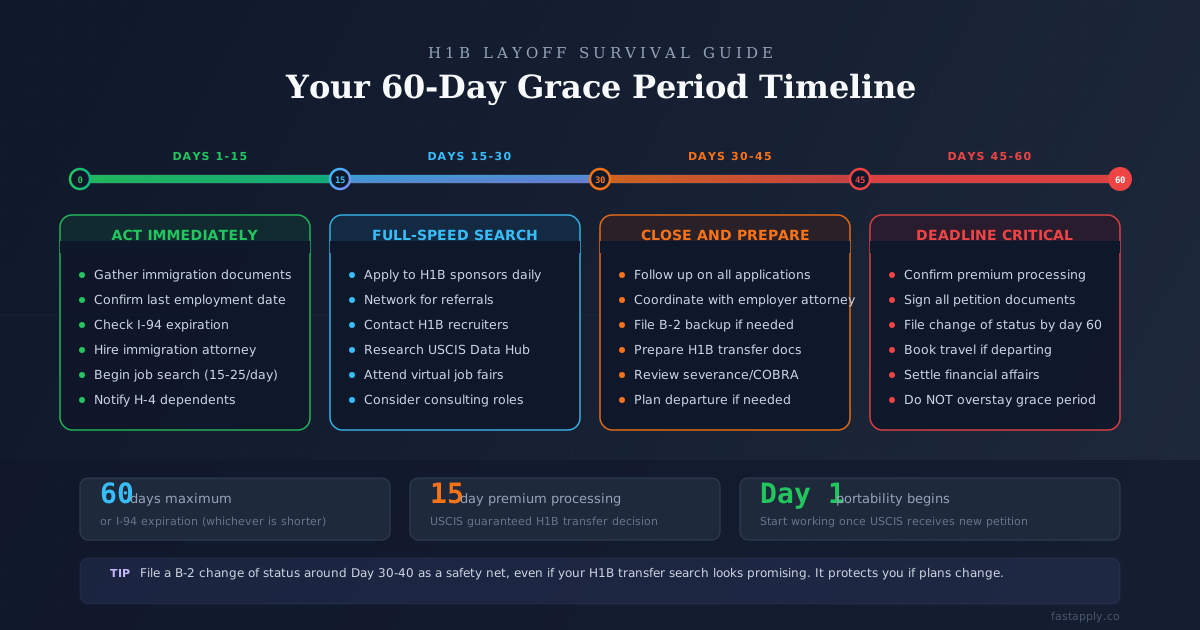
Do not wait to process the shock. The first 72 hours after a layoff set the foundation for everything that follows.
Gather Your Documents
Collect these from your employer before you lose access to company systems:
- Your most recent pay stubs (at least 3 months)
- Your H-1B approval notice (Form I-797)
- A copy of your approved H1B petition (Form I-129)
- Your Labor Condition Application (LCA)
- Your employment termination letter or layoff notice
- Any severance agreement documents
- Your I-94 record (download from i94.cbp.dhs.gov)
- Copies of your passport and visa stamp
Consult an Immigration Attorney
This is not optional. Book a consultation within the first three days. An experienced immigration attorney will evaluate your specific situation, including your I-94 dates, pending green card processes, family status, and available options. The American Immigration Lawyers Association (AILA) maintains a directory of qualified immigration attorneys.
Given the shifting enforcement environment around the grace period, professional legal advice is more important now than it has been in previous years.
Notify Your Dependents
If your spouse and children hold H-4 visas, their status depends on yours. When your H-1B status is in question, so is their H-4 status. If your spouse has an H-4 Employment Authorization Document (EAD), that authorization also ties to your H1B status. Start discussing backup plans immediately.
Your Legal Options During the Grace Period
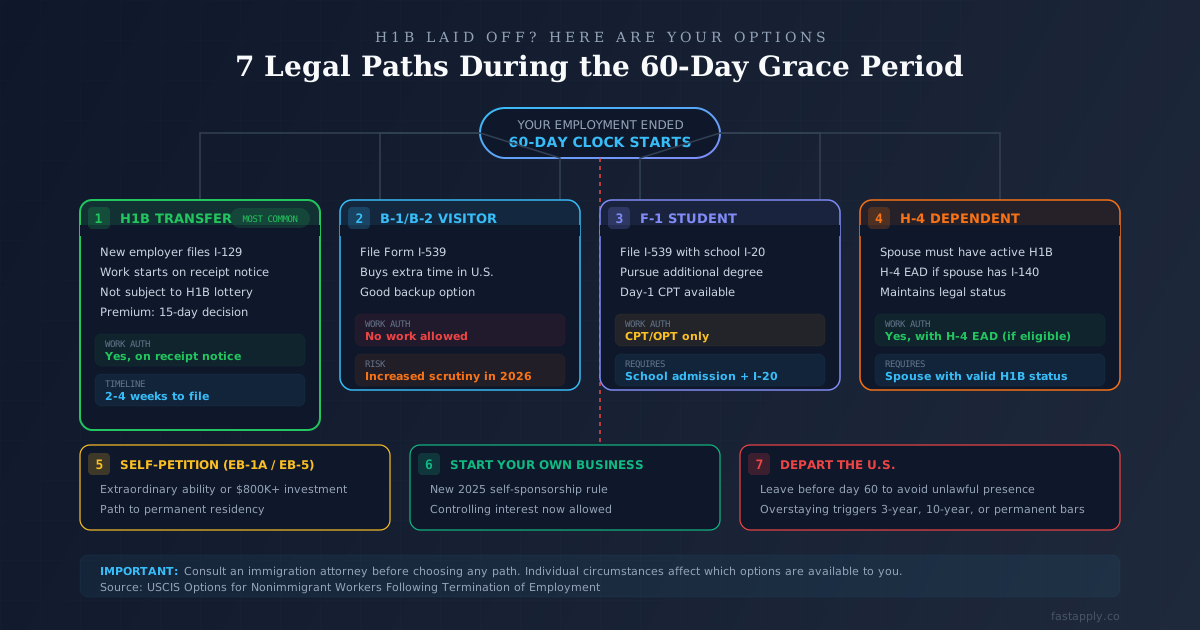
You have several paths available during the 60-day window. The right choice depends on your personal situation, your career timeline, and any pending immigration processes.
Option 1: Transfer Your H-1B to a New Employer
This is the most common path. If you find a new job with an employer willing to sponsor your H-1B, that employer files a new H-1B petition (Form I-129) on your behalf. Here is the good news: under H1B portability rules, you do not need to wait for USCIS to approve the petition. According to USCIS, you are authorized to begin working as soon as USCIS receives the petition and issues a receipt notice (Form I-797C).
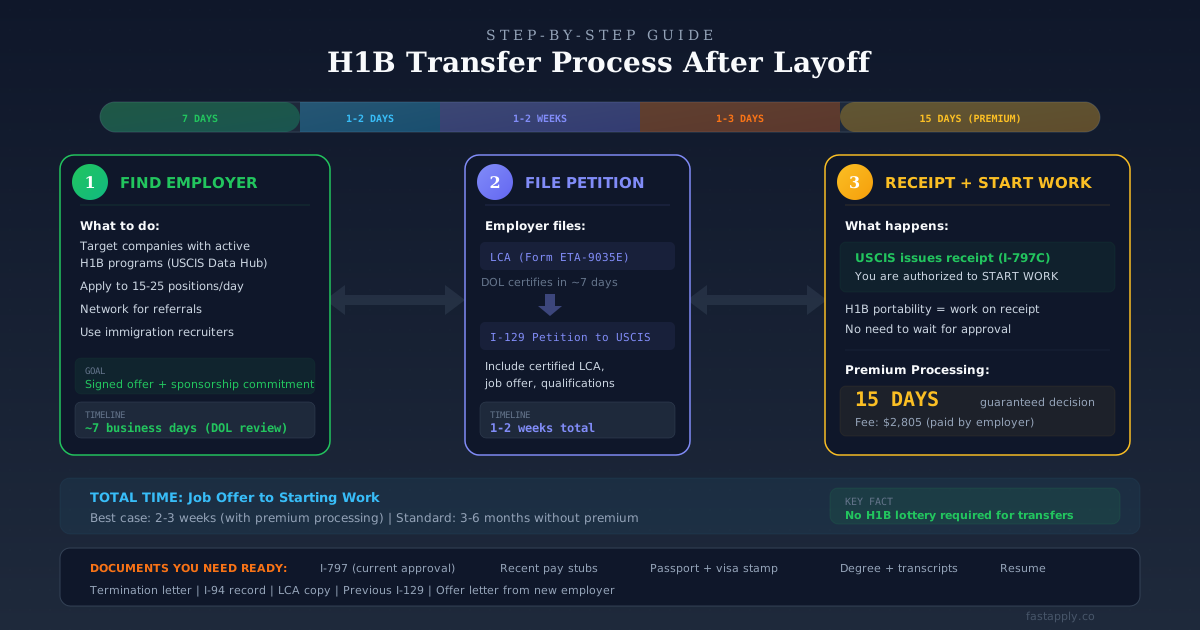
The H-1B transfer process involves several steps. Your new employer must first file a Labor Condition Application (LCA) with the Department of Labor, which takes about 7 business days for certification. After LCA certification, the employer files the I-129 petition with USCIS. With premium processing ($2,965), USCIS guarantees a response within 15 calendar days.
One more benefit: since you have already been counted against the H1B cap, this transfer is not subject to the annual lottery. Your new employer does not need to wait until April to file.
Option 2: Change to B-1/B-2 Visitor Status
If you need more time to search for a new sponsor, you have the option to file for a change of status to B-1/B-2 (visitor) using Form I-539. This buys additional time in the U.S. while you continue your job search. Filing this application before your grace period ends keeps you in a “period of authorized stay” while the application is pending.
There are drawbacks. B-2 status does not authorize employment. According to immigration law firm Reddy Neumann Brown, this strategy now carries “increased uncertainty and risk” because USCIS is likely to scrutinize whether you are using B-2 status simply to wait out unemployment, which is not a permitted use of the visitor classification.
Option 3: Change to F-1 Student Status
If you want to pursue additional education, you have the option to apply for a change of status to F-1 using Form I-539 along with an I-20 from a SEVP-certified school. This works best if you have already been admitted to a program or if you have the ability to get a quick admission. Some Day-1 CPT programs accept applications on short timelines.
Option 4: Change to H-4 Dependent Status
If your spouse holds an H-1B visa and is still employed, you have the option to apply for H-4 dependent status. If your spouse has an approved I-140, you would also be eligible for H-4 EAD work authorization.
Option 5: Self-Petition for an Immigrant Visa
Workers with extraordinary ability in their field have the ability to self-petition for an EB-1A immigrant visa. If you have an approved I-140 from a previous or current employer with a current priority date, you might also be eligible to file for adjustment of status (Form I-485). Workers in the EB-5 investor category have used this route as well, though it requires a minimum investment of $800,000 in a targeted employment area.
Option 6: Start Your Own Business
A January 2025 USCIS policy change now allows H-1B beneficiaries who own a business to self-sponsor their H-1B visa, even with a controlling interest. You need a legitimate business plan and must work in a specialty occupation. Consult an attorney before pursuing this route.
Option 7: Depart the United States
If none of the above options are available within the 60-day window, you must leave the U.S. before the grace period expires. Overstaying leads to unlawful presence, which triggers 3-year, 10-year, or permanent bars on reentry depending on the duration.
How to Find a New H-1B Sponsor Fast
With a 60-day deadline, your job search operates on a compressed timeline. Every tactic needs to prioritize speed.
Target Companies With Active H-1B Programs
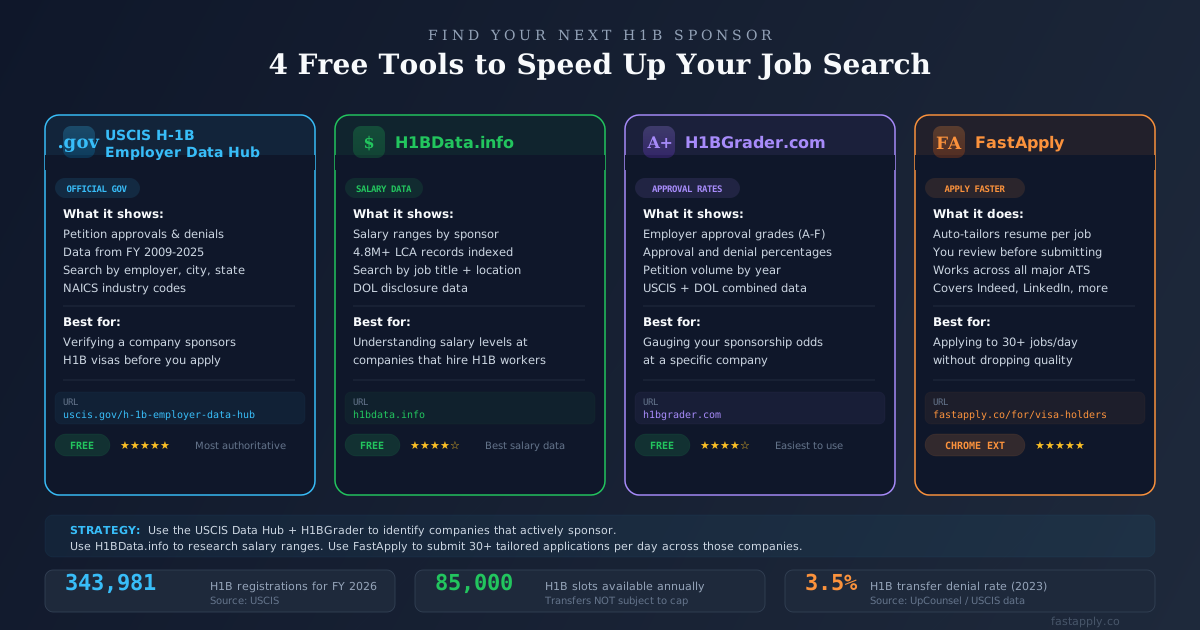
Do not waste time applying to companies that have never sponsored H1B visas. Use these free tools to identify active sponsors:
- USCIS H-1B Employer Data Hub: Search by employer name, city, state, and industry to see petition approval data going back to 2009.
- H1BData.info: Search by sponsor name, job title, and location to see salary data and petition volumes.
- H1BGrader.com: Grades employers on their H-1B approval rates to help you gauge sponsorship likelihood.
Focus on companies that file dozens or hundreds of H-1B petitions per year. These companies have established immigration legal teams and processes that move faster.
Apply in Volume Without Sacrificing Quality
Here is the reality H-1B holders face during a grace period: you need to apply to a large number of positions while tailoring each application to the specific role. Sending generic resumes will not get callbacks. Sending perfectly tailored resumes to five companies will not generate enough opportunities in 60 days.
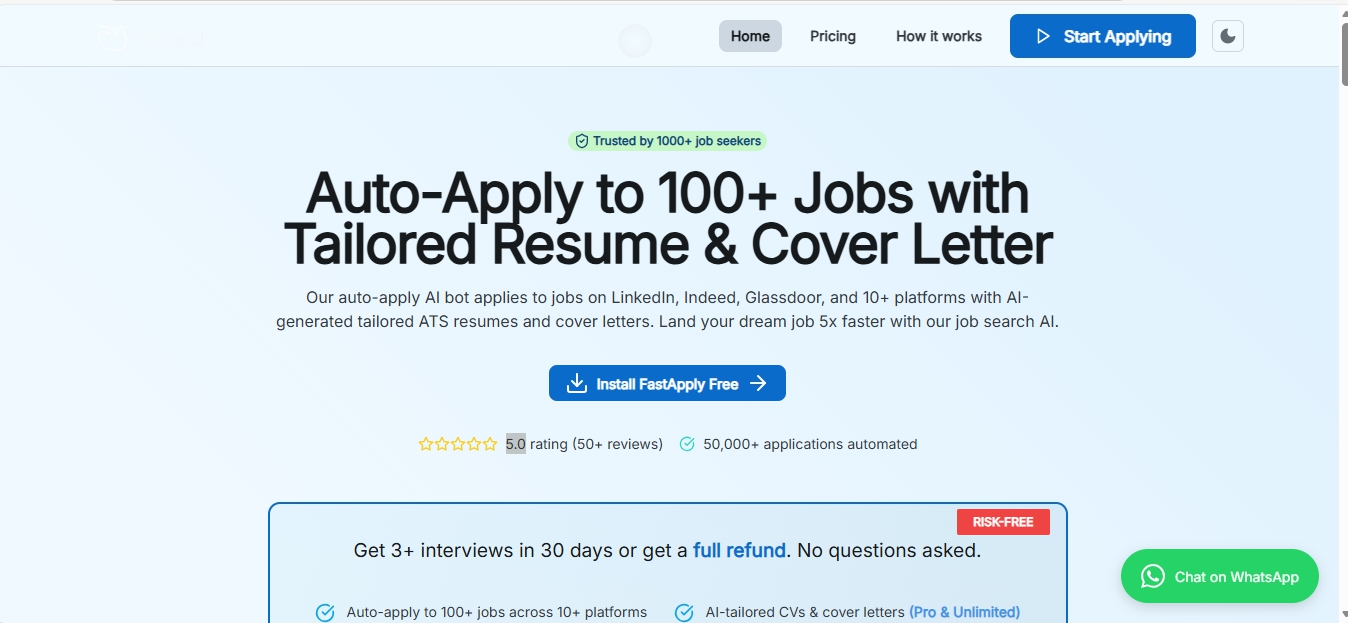
FastApply helps solve this tension. The Chrome extension reads each job description and automatically tailors your resume to match the position. It pulls out the right keywords and reorders your experience to align with what the employer is looking for. But unlike tools that blast identical applications everywhere, FastApply pauses before each submission so you review the tailored materials and approve. This gives you speed without losing the personal touch that gets interviews.
For someone on a 60-day grace period, the math is straightforward. Manually customizing a resume takes 20-30 minutes per application. Reviewing a pre-tailored resume in FastApply takes 2-3 minutes. That difference turns 5 daily applications into 30 or more, without dropping quality.
Time is your greatest asset and FastApply makes every minute of your application count.
Work Your Network Aggressively
Referrals move faster than cold applications. Reach out to every professional contact who works at a company with an active H-1B program. Be specific in your ask: “I am on a 60-day grace period after a layoff and need an H-1B sponsor. Does your company have open roles in [your specialty]? Would you be willing to refer me?”
Post on LinkedIn about your situation. Many H-1B holders hesitate to do this, but the H-1B community is large and supportive. Posts about layoffs and visa timelines regularly generate leads and introductions.
Talk to Immigration-Focused Recruiters
Several staffing firms and recruiters specialize in placing H-1B workers. They already have relationships with companies that sponsor visas and understand the urgency of the grace period timeline. Search LinkedIn for “H-1B recruiter” or “immigration recruiter” in your field.
Consider Contract and Consulting Roles
A contract role with an H-1B sponsoring consulting firm also works for maintaining status. IT consulting companies have high volumes of H-1B petitions and often bring on new consultants quickly.
Protecting Your Family’s Immigration Status
If your family members are in the U.S. on H-4 dependent visas tied to your H-1B, their legal status is directly affected by your layoff.
H-4 Spouse and Children
Your spouse and children in H-4 status get the same grace period you do. If your spouse holds an H-4 EAD and is working, that employment authorization remains valid during the grace period, according to multiple immigration attorneys. If you secure a new H-1B and file a transfer petition, your dependents file a concurrent I-539 to extend their H-4 status.
Backup Status Options for Family Members
If your spouse holds their own H-1B visa with a different employer, you have the option to change your status to H-4. If your spouse is on an F-1 student visa, your children could apply for F-2 dependent status. Discuss all options with your immigration attorney during that first consultation.
Financial Planning During the Grace Period
A layoff without work authorization creates a financial squeeze. Plan carefully.
Negotiate Your Severance
Federal law does not require severance pay, but many companies offer it during layoffs. Negotiate for the longest possible severance period with continued payroll. This extends your financial runway and, in some cases, delays the start of your grace period.
Ask your employer about COBRA health insurance continuation. You typically get 60 days to elect COBRA coverage, which extends your health insurance for up to 18 months (though at full cost plus a 2% administrative fee).
Unemployment Benefits
Whether H-1B holders qualify for unemployment insurance varies by state. Consult your state’s employment development department for specific rules.
Manage Your Expenses
With no work authorization during the grace period, reduce discretionary spending immediately. Know your exact financial runway in terms of rent, insurance, and living expenses for the next 60-90 days.
Timeline: What to Do Each Week
Week 1 (Days 1-7)
- Collect all employment and immigration documents
- Confirm your last employment date in writing
- Check your I-94 expiration date
- Schedule and attend an immigration attorney consultation
- Update your resume and LinkedIn profile
- Start applying to H1B-sponsoring employers
- Notify your family about their dependent status implications
Week 2-3 (Days 8-21)
- Apply to 15-25 positions per day using FastApply
- Reach out to your professional network for referrals
- Contact immigration-focused recruiters
- Research companies on the USCIS H-1B Employer Data Hub
- Attend virtual networking events and job fairs in your field
Week 4-5 (Days 22-35)
- Follow up on all pending applications and interviews
- If you have job offers, coordinate with the employer’s immigration attorney
- If no offers yet, consult your attorney about filing a B-2 change of status as a backup
- Prepare all documents needed for an H-1B transfer petition
Week 6-8 (Days 36-60)
- If your new employer is filing an H-1B petition, confirm premium processing
- Review and sign all petition documents
- If no H-1B transfer is possible, file a change of status application before day 60
- If departing the U.S., book travel and settle affairs before the grace period ends
Common Mistakes to Avoid
-
Working without authorization. Do not perform any work during the grace period unless a new H-1B petition has been filed and you have a receipt notice. Unauthorized employment voids your grace period and starts accumulating unlawful presence.
-
Missing your I-94 deadline. Your grace period is 60 days or your I-94 expiration, whichever comes first. If you only have 25 days left on your I-94, you have 25 days, not 60.
-
Waiting too long to file. An H-1B transfer petition takes a minimum of 2-3 weeks to prepare and file. If you find a new employer in week 7, you have already run out of time. Start your job search on day 1.
-
Traveling internationally. Leaving the U.S. during the grace period is risky. You would need a valid visa stamp to re-enter, and there is no guarantee of readmission. Consult your attorney before any international travel.
-
Ignoring the B-2 backup. Even if you are optimistic about finding a new sponsor, consider filing a B-2 change of status around day 30-40 as a safety net. You do not have to use it if an H-1B transfer comes through, but it protects you from falling out of status if your search takes longer than expected.
Frequently Asked Questions
- How many times is it possible to use the 60-day grace period?
You are eligible for one grace period during each authorized employer petition validity period. If you transfer to Employer B and later get laid off from Employer B, you get another 60-day grace period under that new petition’s validity.
- Does it matter if I was laid off versus fired?
No. The regulation refers to “cessation of employment” and does not distinguish between layoff, termination, or voluntary resignation. The grace period applies to all scenarios.
- Is it possible to start working for a new employer before the H1B transfer is approved?
Yes. Under H-1B portability rules, you are authorized to begin work as soon as USCIS receives the new petition and issues a receipt notice. You do not need to wait for approval.
- What happens if my new H-1B petition gets denied?
Your work authorization with the new employer ends immediately upon denial. You would need to stop working and either find another sponsor, change status, or depart the U.S.
- Does my employer have to notify USCIS about the termination?
Yes. H-1B employers are required to notify USCIS when an H-1B employee’s employment is terminated. This notification does not affect your eligibility for the grace period.
- Is it possible to apply for the H-1B grace period on a specific form?
No. There is no separate application form for the grace period. USCIS determines whether the grace period applies when adjudicating your subsequent petition, change of status application, or adjustment of status application.
- What if my spouse is also on an H-1B and gets laid off at the same time?
Each of you has your own independent grace period tied to your own H-1B petition. You would each need to find a new sponsor or change status independently. If one spouse secures a new H-1B first, the other has the option to change to H-4 dependent status.
Disclaimer: This article provides general information about the H-1B grace period and is not legal advice. Immigration law is complex and individual situations vary. The regulatory environment around H1B visas has been changing in 2025-2026. Always consult a qualified immigration attorney for guidance specific to your situation.
#h-1b laid off what to do
#h-1b grace period
#h-1b layoff options 2026
#h-1b terminated find job fast

Fastapply Team
Career Experts