
H1B Transfer Process 2026: How to Switch Employers Without Losing Your Visa Status
Switching jobs on an H-1B visa feels risky. You have a status tied to one employer, a new offer on the table, and a process that, if mishandled, could cost you your legal right to work in the United States. According to U.S. Citizenship and Immigration Services (USCIS), H-1B portability provisions under the American Competitiveness in the 21st Century Act (AC21) allow workers to change employers while maintaining valid status, but only if you follow the steps correctly.
This guide breaks down the H-1B transfer process from start to finish. You will learn when you are eligible, what your new employer needs to file, how long the process takes, and what mistakes to avoid. If you are actively job searching while on H-1B status, there is also a section on finding roles at companies already familiar with sponsorship workflows.
What Is an H-1B Transfer (and Why “Transfer” Is a Misnomer)
The term “H-1B transfer” is widely used, but it is technically inaccurate. You are not transferring an existing visa from one employer to another. What actually happens is that your new employer files a new H-1B petition on your behalf. Your current visa stamp does not change. Your current I-94 record does not move. A brand new petition gets filed with USCIS, and once it is approved (or in some cases, once it is filed), you get to work for the new employer.
The reason this matters: your old employer’s H-1B approval stays with them. If the transfer process gets delayed or denied, your status reverts to whatever the old employer’s petition covered. Understanding this distinction helps you make smarter decisions about timing.
The AC21 Portability Rule
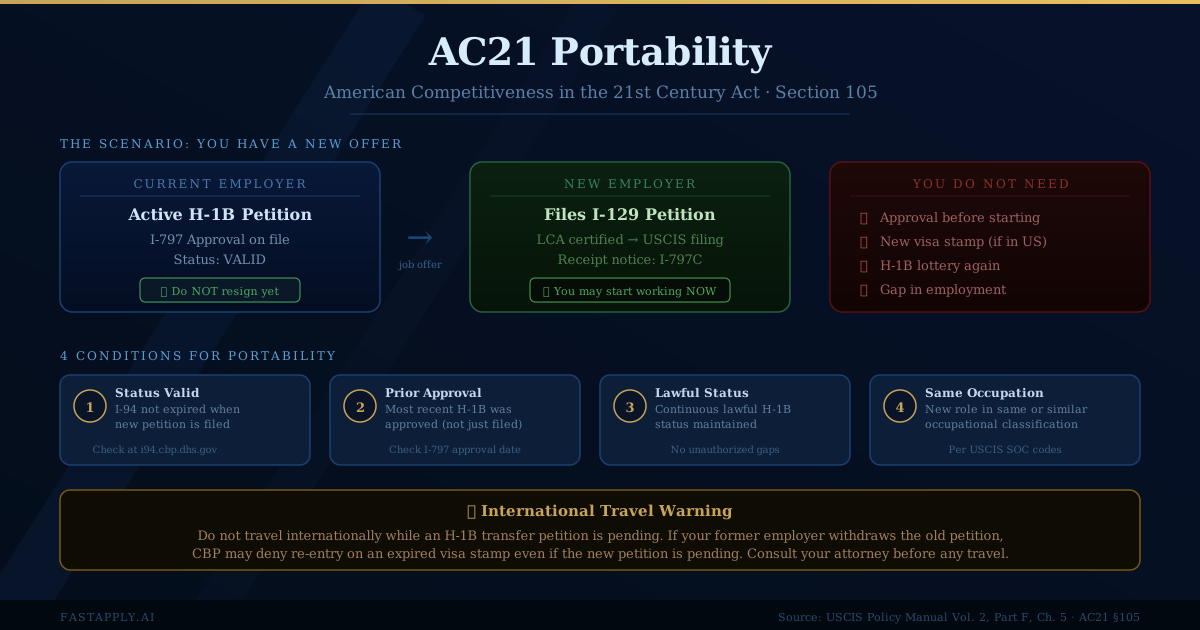
The AC21 Act, passed in 2000, created H-1B portability. Under this rule, you do not have to wait for USCIS to approve the new petition before starting work, as long as specific conditions are met.
To qualify for portability:
- Your new employer must file an H-1B transfer petition before your current authorized period of stay expires
- Your most recent H-1B petition must have been approved (not just filed)
- You must have maintained lawful H-1B status since that approval
- The new job must be in the same or a similar occupational classification as the approved petition
Once the new petition is filed and your current status is valid, you can start working for the new employer immediately. You do not have to wait for the approval notice.
Step-by-Step: The H-1B Transfer Process
- Step 1: Get a Written Job Offer
Before any immigration paperwork begins, you need a formal written offer from the new employer. This offer should include the job title, salary, start date, and location. The salary must meet the prevailing wage for that occupation and geographic area, as determined by the Department of Labor.
Do not resign from your current job until this offer is in writing. Some candidates accept verbal offers and resign, only to discover that the employer’s immigration attorney raises objections or the company’s internal approval process stalls.
- Step 2: New Employer Retains an Immigration Attorney
The new employer is responsible for filing the H-1B transfer petition. They will hire an immigration attorney (or use in-house counsel) to handle the paperwork. You, as the employee, are not responsible for filing fees or legal costs under USCIS regulations, the employer bears those costs.
The attorney will typically request the following documents from you:
-
Copy of your current H-1B approval notice (Form I-797)
-
Copy of your passport (biographical page and all visa stamps)
-
Copy of your I-94 arrival/departure record
-
Educational credentials and degree certificates
-
Current resume
-
Any previous I-140 approvals (if you have a pending green card case)
-
Step 3: Labor Condition Application (LCA) Filing
Before USCIS receives anything, the employer’s attorney files a Labor Condition Application (LCA) with the Department of Labor. The LCA certifies that:
- The employer will pay you the prevailing wage
- Working conditions will not adversely affect other workers
- There is no strike or lockout at the worksite
DOL typically processes LCAs within 7 business days. In practice, most are approved faster for common occupational categories.
- Step 4: Filing the H-1B Petition with USCIS
Once the LCA is certified, the employer files Form I-129 (Petition for a Nonimmigrant Worker) with USCIS along with supporting documentation. The filing includes:
- Certified LCA
- Job offer letter and employer support letter
- Evidence of your qualifications (degrees, transcripts, work history)
- Copy of your current H-1B approval
- Filing fee (base fee is $460 as of 2025, with additional fees for certain employers)([6])
For employers with 25 or fewer full-time equivalent employees, the base filing fee is $230.([6])
- Step 5: Start Working (If Using AC21 Portability)
If your current status is valid and the new employer files before your authorized stay expires, you may begin working at the new employer on the petition filing date. Keep a copy of the receipt notice (Form I-797C) from USCIS. This receipt notice is your documentation that a petition is pending.
- Step 6: Wait for Approval
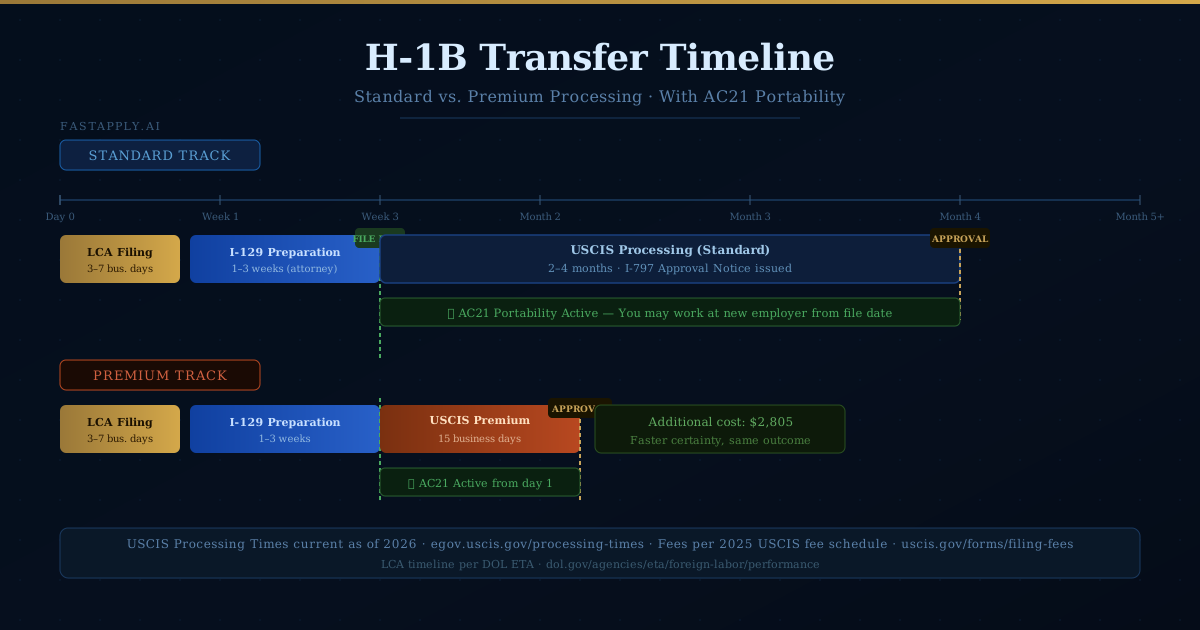
Standard processing times for H-1B transfers vary. As of early 2026, USCIS reports standard service center processing times of 2 to 4 months for Form I-129. Premium processing is available for an additional fee ($2,805 as of 2025) and guarantees a decision within 15 business days.
Most employers in time-sensitive hiring situations opt for premium processing to reduce uncertainty.
H-1B Transfer vs. New H-1B Cap: What Is the Difference?
This is one of the most common points of confusion. If you are already in H-1B status, your transfer does not go through the annual H-1B lottery (the cap). Cap-exempt transfers are available to workers who:
- Are currently in H-1B status (or were previously counted against the cap)
- Are changing to another cap-subject employer
If your current employer is cap-exempt (a university, nonprofit research organization, or government research institution), and you are moving to a cap-subject employer, you may need to go through the regular cap process depending on your specific situation. Consult an immigration attorney to confirm which category applies.
Maintaining Status During the Transfer
One of the biggest fears in an H-1B transfer is accidentally falling out of status. Here is what you need to watch:
- Do Not Resign Before the Filing Receipt
Under AC21 portability, you need the new employer to have filed the petition before you can legally work for them. Do not leave your current employer before you have the receipt notice in hand. Resigning before that filing leaves a gap in your authorized employment.
- Watch Your I-94 Expiration
Your I-94 records your authorized period of stay. If your I-94 shows an expiration date that passes before the new petition is filed, you are out of status. Check your current I-94 on the CBP website.
Most H-1B workers have an I-94 that says “D/S” (Duration of Status) tied to the validity of their current employer’s petition approval. Know exactly when that approval expires.
Keep Copies of Everything
Maintain physical and digital copies of:
- All I-797 approval notices
- All I-94 records
- Your most recent visa stamp
- Each employer’s petition documents
- Any I-140 filings
This documentation trail becomes critical if USCIS issues a Request for Evidence (RFE) or if you travel internationally during the transfer process.
Traveling Internationally During an H-1B Transfer
Travel is risky during a pending transfer petition. This is because your current visa stamp is tied to your old employer. When you re-enter the U.S., the Customs and Border Protection officer will look at your visa stamp and the underlying petition. If the old petition has been withdrawn by your former employer (some do this quickly after resignation), your entry could be denied even though the new petition is pending.
It’s best you do not travel internationally between the time you leave your old employer and the time your new H-1B petition is approved. If travel is unavoidable, consult with your immigration attorney about the specific risks and whether you need a new visa stamp at a U.S. consulate before returning.
What Happens to Your Green Card Process
If you have an approved I-140 (Immigrant Petition for Alien Workers) from your old employer, the news is relatively good. Under AC21 Section 106, you may be able to port your priority date and I-140 approval to a new employer, if your I-485 (Adjustment of Status) has been pending for at least 180 days and the new job is in the same or similar occupational classification.
This is a separate analysis from the H-1B transfer. The H-1B transfer can happen independently and quickly. The I-140 portability question is a longer, more complex analysis that requires its own legal assessment.
How Long Does an H-1B Transfer Take?
Timeline summary:
| Stage | Typical Duration |
|---|---|
| LCA filing and approval | 3–7 business days |
| Employer prepares I-129 petition | 1–3 weeks |
| Standard USCIS processing (I-129) | 2–4 months |
| Premium processing (I-129) | 15 business days |
If you use AC21 portability, none of this timeline affects your ability to start work. The clock starts the day the employer files the petition. The approval notice just formalizes what you are already doing.
Common Mistakes That Jeopardize H-1B Transfers
- Resigning Before the Filing Receipt
Covered above, but worth repeating. Do not resign from your current employer until you hold the USCIS receipt notice. Some candidates feel pressured by the new employer to start quickly. The answer is always: file first, start after receipt.
- Accepting a Job Outside Your Specialty Occupation
The new role must qualify as a specialty occupation under USCIS definitions. Roles requiring a bachelor’s degree or higher in a specific professional field typically qualify. If the new role is significantly different from your approved H-1B classification, USCIS may issue an RFE or denial. Confirm with the attorney that the new role qualifies before accepting the offer.
- Salary Below Prevailing Wage
The LCA requires the employer to pay the prevailing wage. If the offered salary is below the DOL wage level for that occupation and location, the LCA will be denied and the transfer cannot proceed. Candidates sometimes negotiate salaries without realizing there is a regulatory floor. Use the DOL Foreign Labor Certification Data Center to check prevailing wages for any occupation and location.
- Not Telling the New Employer About Existing H-1B Issues
If you have an RFE pending, a prior denial, or any history of immigration complications, the new employer’s attorney needs to know. Omitting this information delays the process when it surfaces in USCIS records and damages your credibility with your new employer.
Finding H-1B-Friendly Employers During Your Search
The H-1B transfer process depends on the new employer being willing and able to sponsor. Not all companies have experience with H-1B filings. Smaller companies may find the process unfamiliar, the fees burdensome, or the legal complexity discouraging.
When you are actively searching, your job is to filter for employers who have sponsored H-1B workers in the past. The DOL’s Office of Foreign Labor Certification publishes LCA disclosure data quarterly, which lists every employer that filed an LCA by company name, occupation, and location.
Searching this data manually works, but it is slow. You end up cross-referencing DOL records against job boards, running searches across Indeed, Glassdoor, and company career pages in separate tabs, and then trying to remember which roles you already reviewed.
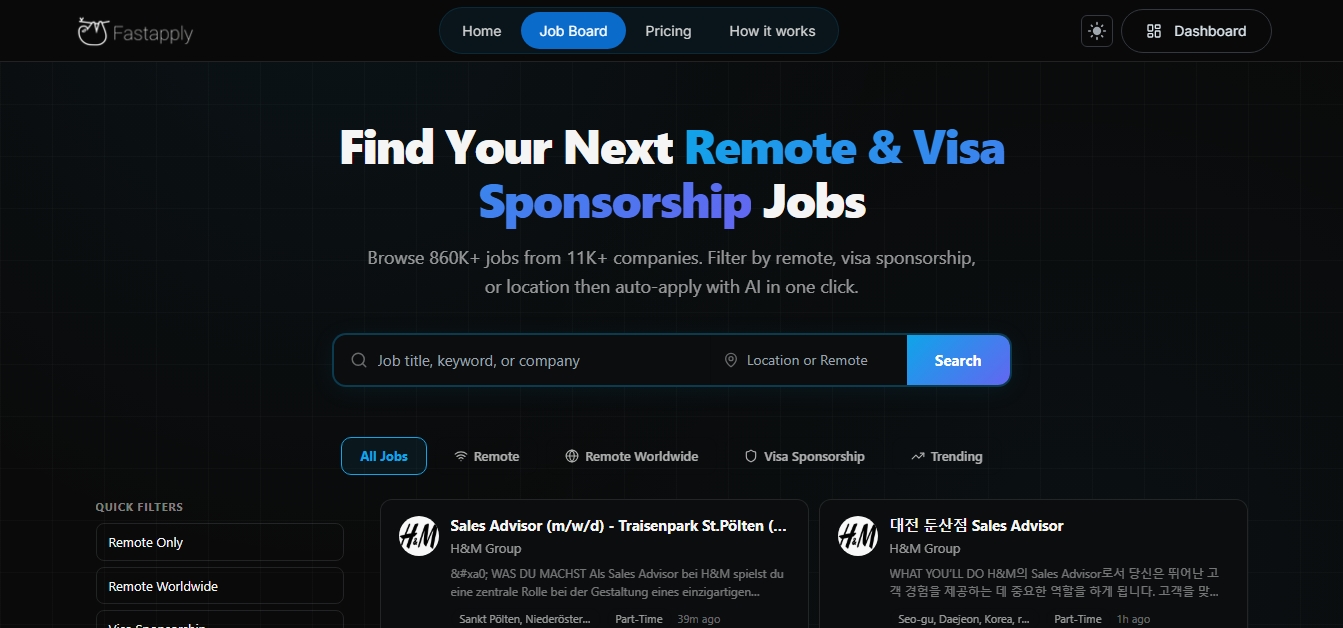
FastApply’s job board consolidates listings from major platforms into a single feed, which removes the multi-tab problem from the start of your search. When you are filtering for H-1B-sponsoring employers specifically, cutting down the raw discovery time matters. Less time switching between platforms means more time researching which companies on your list have a documented LCA history.
Once you identify a role worth pursuing, FastApply reads the job description and tailors your resume to match the language in that posting. For H-1B workers, this alignment matters beyond just ATS optimization. The job description that you apply to effectively becomes the basis for the specialty occupation justification in the I-129 petition. The closer your stated experience matches the role description, the cleaner the petition narrative.
You review the tailored resume before it submits. You stay in control of what goes out. The process moves faster without cutting corners on quality.
FAQ: H-1B Transfer Process
- Can I work for two H-1B employers at the same time?
Yes. H-1B allows concurrent employment. Each employer must file a separate H-1B petition for your position with them. Both petitions must be approved (or you must be using AC21 portability for each). This is common for workers who consult part-time while holding a primary H-1B position.
- What happens if my old employer withdraws the petition after I leave?
If you are using AC21 portability and the new petition has been properly filed, the withdrawal of the old petition does not affect your status. You were working under portability, and the new petition is the relevant one. If the new petition is still pending, keep the receipt notice on you at all times.
- Does the H-1B transfer reset my H-1B clock?
No. H-1B status is typically granted in 3-year increments, up to a maximum of 6 years. The transfer does not reset the clock. You continue counting from your original H-1B start date. Extensions beyond 6 years require a qualifying I-140 or labor certification under specific rules.
- Do I need a new visa stamp after an H-1B transfer?
Not if you remain in the U.S. Your current visa stamp remains valid for re-entry until it expires. The approval of the new petition does not require a new stamp. You would need a new stamp only if you travel internationally after the transfer and your current stamp has expired.
- What is the cost of an H-1B transfer?
The employer is required to pay most fees. Base USCIS filing fees start at $460 for most employers. An additional $500 fraud prevention and detection fee applies. Premium processing (optional) adds $2,805. The total employer cost ranges from roughly $3,000 to $6,000+ depending on legal fees.
- What if USCIS issues an RFE on the transfer petition?
A Request for Evidence is not a denial. The employer’s attorney submits a response with additional documentation within the deadline given (typically 84 days). RFEs on transfer petitions most commonly ask for more evidence of specialty occupation qualification or the employer-employee relationship. Work with the attorney to respond thoroughly.
- Do H-1B transfers go through the lottery?
No, if you are already in H-1B status or were previously counted against the cap. The transfer uses your existing cap count. Only workers who have never been subject to the H-1B cap (or whose cap count has lapsed under specific circumstances) would need to go through the lottery again.
#h1b transfer process
#h1b employer transfer
#change h1b sponsor
#h1b portability

Fastapply Team
Career Experts