How to Apply for a Canadian Work Permit in 2026
Canada admitted over 766,000 temporary foreign workers in 2024. The demand for skilled workers remains strong in 2026. This guide covers every pathway to legal work authorization in Canada.
You will learn about LMIA-based work permits, LMIA-exempt options, the Post-Graduation Work Permit, Express Entry, and International Experience Canada. Each section includes current processing times, costs, and step-by-step instructions.
Canadian Work Permit Requirements (2026 Eligibility)
The core requirements to apply for a Canadian work permit in 2026 are consistent across pathways, with stream-specific additions on top. You qualify for a Canadian work permit if you meet all of the following baseline requirements:
- A valid job offer from a Canadian employer (required for most employer-specific work permits; not required for open permits like PGWP or IEC)
- Proof your employer has a Labour Market Impact Assessment (LMIA) if applying through the Temporary Foreign Worker Program, or evidence of LMIA exemption if applying through the International Mobility Program
- Proof you will leave Canada when your permit expires (intent to return home or apply for permanent residence)
- Sufficient funds to support yourself and any accompanying family members during your stay
- A clean criminal record, with police certificates provided when requested
- Medical admissibility, including a medical exam if your job involves public health or safety or you plan to stay more than 6 months
- A valid passport covering the full length of your intended stay
- Biometrics (fingerprints and photo) submitted within 30 days of request
Stream-specific requirements you need on top of the baseline:
- LMIA-based work permit: Employer-provided LMIA confirmation letter, job offer letter, and proof the role matches the LMIA
- Post-Graduation Work Permit (PGWP): Completion of an eligible Canadian study program, application within 180 days of completion, and (since November 2024) CLB 7 or NCLC 7 language scores for degree graduates or CLB 5 / NCLC 5 for college graduates. Programs starting on or after Nov 1, 2024 must fall under an eligible Classification of Instructional Programs (CIP) code
- Express Entry (permanent residence): Minimum 67 points on the Federal Skilled Worker grid, language test results (IELTS, CELPIP, or TEF), Educational Credential Assessment (ECA) for foreign credentials, and sufficient settlement funds unless you have a valid job offer
- International Experience Canada (IEC): Citizenship of a partner country, age between 18 and 35 (30 in some agreements), and valid travel insurance for the full duration of your stay
- LMIA-exempt permits (Intra-Company Transfer, CUSMA, Francophone Mobility): Pathway-specific documentation, such as proof of one year of prior employment with the parent company for ICT, professional credentials for CUSMA, or NCLC 5 French for Francophone Mobility
Processing times and fees vary by stream, with details in each section below.
Understanding the Canadian Work Permit System
Canada operates two main programs for temporary foreign workers: the Temporary Foreign Worker Program (TFWP) and the International Mobility Program (IMP).
The TFWP requires employers to obtain a Labour Market Impact Assessment (LMIA) before hiring you. This document proves no Canadian worker is available for the job. The IMP allows LMIA-exempt work permits based on reciprocal agreements, significant benefit to Canada, or other specific conditions.
Your pathway depends on your situation. International graduates follow one route. Skilled workers with job offers follow another. Youth from partner countries have their own program. Understanding which pathway fits you saves months of wasted effort.
The Labour Market Impact Assessment (LMIA)
The LMIA is a document your Canadian employer must obtain before you apply for most work permits. Employment and Social Development Canada (ESDC) issues LMIAs after reviewing the employer’s application.
Your employer must prove they tried to hire Canadians first. The requirements include advertising the position for at least four consecutive weeks on the Government of Canada Job Bank and two other platforms. Employers must document every application received and explain why each Canadian applicant was unsuitable.
LMIA applications fall into two main categories: high-wage and low-wage. High-wage positions pay at or above the provincial or territorial median hourly wage. Low-wage positions pay below this threshold.
In January 2026, IRCC resumed processing low-wage LMIAs in eight additional regions including Vancouver, Winnipeg, and Kingston. Regions with unemployment rates of 6% or higher remain restricted for low-wage LMIA processing.
The 2026 LMIA rules include several changes from previous years. LMIA validity dropped from 18 months to 6 months. Low-wage stream jobs are limited to one year maximum. Employers hiring through the TFWP face a 10% cap on foreign workers. Priority processing applies to critical occupations in technology, healthcare, and engineering.
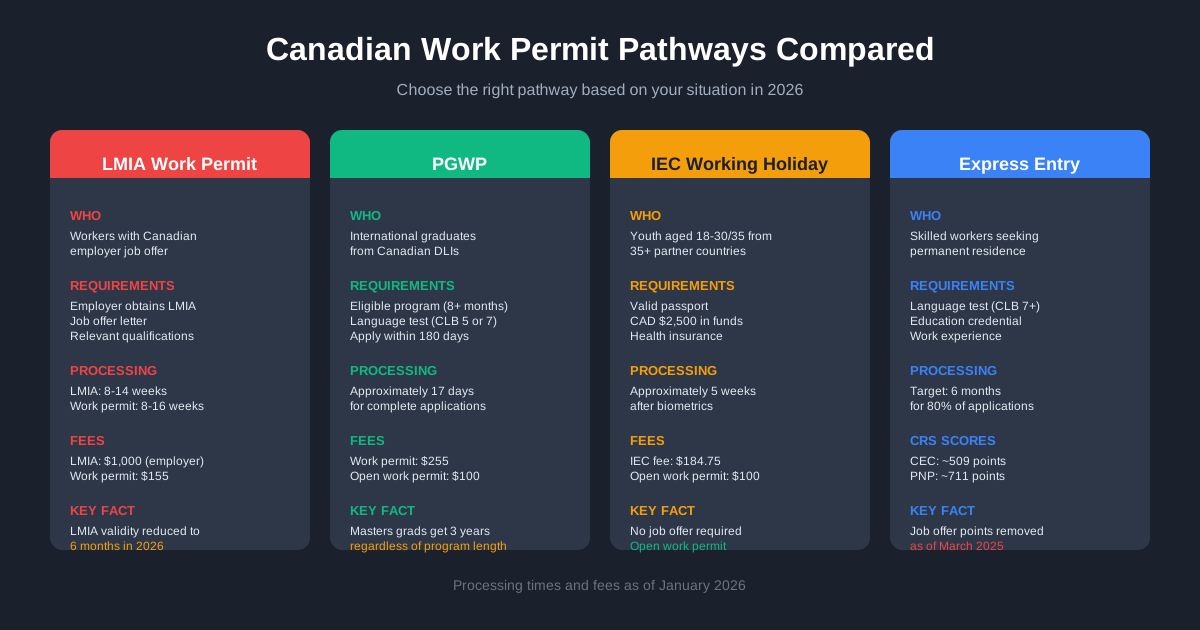
LMIA processing times vary by stream. The Global Talent Stream processes applications in approximately 10 business days. Standard high-wage applications take 8 to 12 weeks. Low-wage applications take 10 to 14 weeks.
The LMIA application fee is $1,000 per position. Your employer pays this fee. You do not pay it. Once approved, your employer receives a confirmation letter. You use this letter to apply for your work permit.
For detailed LMIA requirements, visit the official IRCC page.
LMIA-Exempt Work Permits
Not every work permit requires an LMIA. The International Mobility Program covers LMIA-exempt categories.
Intra-Company Transfers allow multinational companies to move employees to Canadian branches. You must have worked for the company for at least one year in the past three years. You must transfer into an executive, senior managerial, or specialized knowledge position.
The Canada-United States-Mexico Agreement (CUSMA) provides work permit access for certain professionals from the US and Mexico. Professionals in categories like accountants, engineers, and scientists receive expedited processing.
Francophone Mobility offers LMIA exemption for French-speaking workers destined to work outside Quebec. You need intermediate French proficiency in speaking and listening (NCLC 5). The employer submits an offer through the Employer Portal using exemption code C16.
Significant Benefit exemptions apply when hiring you provides substantial economic, social, or cultural benefit to Canada. Entrepreneurs, self-employed persons, and certain artists use this pathway.
Reciprocal Employment programs cover situations where Canadians receive similar benefits in your home country. International Experience Canada falls under this category.
Post-Graduation Work Permit (PGWP)
The PGWP allows international students who graduated from eligible Canadian institutions to work in Canada. This open work permit lets you work for any employer in any location.
Eligibility requirements changed in November 2024. Most applicants now need language test results. Bachelor’s, master’s, and doctoral graduates need CLB 7 or NCLC 7 in all four skills. College and polytechnic graduates need CLB 5 or NCLC 5.
Students who applied for study permits on or after November 1, 2024 face field-of-study requirements for non-degree programs. Your program must fall under an eligible Classification of Instructional Programs (CIP) code linked to occupations in long-term shortage. IRCC froze the CIP list for 2026. No programs will be added or removed this year.
PGWP duration depends on your program length. Programs of 8 months to 2 years receive a permit matching the study duration. Programs of 2 years or longer receive a 3-year permit. Master’s degree graduates receive 3-year permits regardless of program length, even if the program was shorter than 2 years.
You must apply within 180 days of receiving confirmation you completed your program. Your study permit must have been valid at some point during those 180 days. Apply online from inside or outside Canada. Border applications are no longer permitted.
The application fee is $255 for the work permit plus $100 for the open work permit holder fee. Processing time averages 17 days for complete applications.
Detailed PGWP eligibility information.
Special Considerations for PGWP Applicants
The 180-day application window is strict. IRCC calculates this from the date on your completion letter or transcript, whichever confirms graduation. Mark this date immediately upon receiving confirmation.
Students whose study permits expire before graduation face additional steps. If your permit expires while waiting for final grades, you have options. Apply for a visitor record to maintain status. Alternatively, leave Canada and apply for your PGWP from outside the country within the 180-day window.
Maintained status applies to PGWP applicants who apply before their study permit expires. You may continue working under the conditions of your study permit while your PGWP application is processed. This requires submitting your application while your permit is still valid.
The 50% in-Canada study requirement affects students with a lock-in date on or after September 1, 2024. You must complete at least half your program physically in Canada. Time spent studying online from outside Canada is deducted from your PGWP duration. Earlier COVID-era flexibilities no longer apply.
Public-private partnership programs present complications. If you studied at a private college delivering a public institution’s curriculum, your PGWP eligibility depends on when you started. Students who began before May 15, 2024 (same province) or January 31, 2023 (different province) may qualify under grandfathered provisions. Others are not eligible.
Automating Your Job Search with AI
Navigating immigration pathways is only half the battle. You also need to secure a job offer to qualify for many of these permits (like the Young Professionals stream or LMIA-based routes). This is where the numbers game works against you. Manually tailoring resumes for Canadian format and applying to hundreds of listings is exhausting and inefficient.
FastApply changes this equation. It uses AI to auto-fill applications, tailor your resume to match specific job descriptions (crucial for passing Canadian ATS filters), and track every submission. By automating the repetitive parts of the job search, you can focus your energy on networking and interview preparation, the high-value activities that actually get you hired.
Express Entry for Permanent Residence
Express Entry is not a work permit program. It is the primary pathway to Canadian permanent residence for skilled workers. Understanding it helps you plan your long-term strategy while on a temporary work permit.
Express Entry manages three federal programs: Federal Skilled Worker Program (FSW), Canadian Experience Class (CEC), and Federal Skilled Trades Program (FST). The Comprehensive Ranking System (CRS) scores and ranks candidates.
CRS scores changed in March 2025. Job offer points were removed from the scoring system. Previously, job offers added 50 to 200 points. This change affects all current and future candidates.
In January 2026, IRCC issued 6,000 invitations to Canadian Experience Class candidates with a minimum CRS score of 509. CEC draws target candidates already working in Canada. Provincial Nominee Program (PNP) candidates need scores around 711 due to the automatic 600-point boost from provincial nomination.
Category-based draws continue in 2026. Healthcare workers, French speakers, STEM professionals, and tradespeople receive targeted invitations at lower CRS thresholds. French-language draws have seen cut-offs as low as 379 points.
If you want permanent residence, start building your profile while on a work permit. Improve language scores. Gain Canadian work experience. Explore Provincial Nominee Programs. A provincial nomination adds 600 CRS points and guarantees an invitation.
Improving Your Express Entry Profile
Language scores offer the fastest CRS improvement for most candidates. The difference between CLB 8 and CLB 9 in all four skills adds approximately 20 to 30 CRS points. Retaking language tests is common. Many successful applicants test two or three times before achieving optimal scores.
French language proficiency provides a significant advantage. Bilingual candidates receive bonus points. More importantly, French-language Express Entry draws have cut-offs as low as 379 points. Learning French opens a parallel pathway with dramatically lower competition.
Canadian work experience accumulates over time. Each additional year of skilled work experience in Canada improves your CRS score. One year of Canadian experience is more valuable than three years of foreign experience in the CRS calculation.
Education credential assessments take 4 to 8 weeks depending on the organization. Submit your foreign credentials for evaluation early. World Education Services (WES) and other designated organizations convert your credentials to Canadian equivalents.
Provincial Nominee Programs deserve serious attention. A provincial nomination adds 600 CRS points, guaranteeing an invitation in the next PNP-targeted draw. Research programs in your province of residence. Many provinces have streams for workers in specific occupations, graduates of local institutions, or candidates with job offers from provincial employers.
The 2026 PNP allocation increased to 91,500 nominations, a 66% increase from 2025. Provincial pathways are expanding, not contracting.
International Experience Canada (IEC)
IEC provides work permits to youth aged 18 to 30 or 35 (depending on country) from over 35 partner nations. The 2026 pools opened on December 19, 2025.
Three categories exist within IEC:
Working Holiday provides an open work permit. No job offer required. Work for any employer anywhere in Canada. Duration ranges from 12 to 24 months depending on your country’s agreement.
Young Professionals requires a job offer in a position contributing to professional development. The job must be classified under TEER 0, 1, 2, or 3 of the National Occupational Classification. You receive an employer-specific work permit.
International Co-op requires enrollment in a post-secondary program and a job offer related to your field of study. You receive an employer-specific work permit for your internship.
The application process works through a pool system. Create a profile on the IRCC website. If you meet eligibility requirements, your profile enters the pool. IRCC conducts random draws throughout the year. If selected, you receive an Invitation to Apply (ITA).
After receiving an ITA, you have 10 days to accept and begin your application. You then have 20 days to submit your complete application with all required documents.
Required documents include a valid passport, proof of CAD $2,500 in funds, health insurance coverage for your entire stay, and police certificates if requested. Biometrics fees of $85 apply for most applicants. The IEC participation fee is $184.75. Working Holiday applicants pay an additional $100 open work permit holder fee.
Processing time averages 5 weeks after submitting all documents and completing biometrics. Popular country quotas fill quickly. Apply early in the season to maximize your chances.
The pool system creates uncertainty. Unlike direct application programs, IEC requires waiting for a random selection. Some applicants receive invitations within days of submitting their profile. Others wait months. Still others never receive an invitation before pools close.
Strategies for improving IEC success:
Submit your profile as early as possible. Profiles in the pool longer have more exposure to draws.
Ensure all information is accurate. Incorrect data can result in profile rejection or processing delays.
Monitor your email and IRCC account regularly. You have only 10 days to accept an invitation once received.
Prepare documents in advance. After accepting an invitation, you have 20 days to submit your complete application. Having documents ready allows you to submit quickly.
UK passport holders received expanded eligibility in 2024. The age limit increased from 30 to 35. Repeat participation is now permitted for an additional 12 months if you previously held an IEC visa since 2015.
IEC work experience counts toward Express Entry. Time spent working in Canada on an IEC permit builds the Canadian work experience required for the Canadian Experience Class. Many IEC participants use this pathway to transition to permanent residence.
Application Process Step by Step
The work permit application follows the same general structure regardless of category. Details vary by permit type.
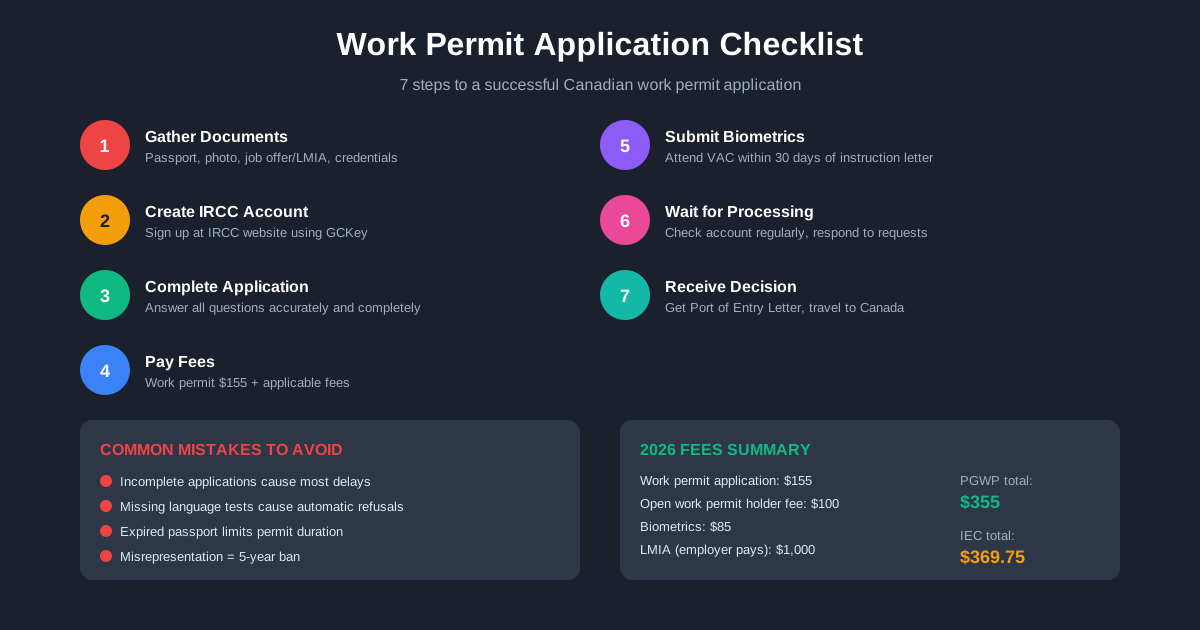
Step 1: Gather your documents. Required documents typically include a valid passport, digital photo meeting IRCC specifications, proof of funds, job offer letter or LMIA (if applicable), educational credentials, and language test results (if applicable).
Step 2: Create an IRCC online account. Visit the IRCC website and select “Sign in or create an account.” Use the GCKey option to create new credentials or sign in with existing ones.
Step 3: Complete the online application form. Answer all questions accurately. Inconsistencies between your application and supporting documents cause delays or refusals.
Step 4: Pay the fees. Work permit fee: $155. Open work permit holder fee (if applicable): $100. Biometrics fee: $85. Employer compliance fee: $230 (paid by employer for LMIA-based permits).
Step 5: Submit biometrics. After submitting your application, you receive a biometrics instruction letter. Attend a designated visa application centre within 30 days to provide fingerprints and a photo.
Step 6: Wait for processing. Check your online account regularly. IRCC may request additional documents. Respond promptly to any requests.
Step 7: Receive your decision. Approved applicants receive a Port of Entry Letter of Introduction. This is not your work permit. You receive the actual work permit when you arrive in Canada and clear immigration.
Processing Times in 2026
Processing times vary by permit type and application location.
PGWP applications: approximately 17 days for complete applications submitted from within Canada.
IEC Working Holiday: approximately 5 weeks after submitting all documents and biometrics.
LMIA-based work permits from outside Canada: 8 to 16 weeks depending on country of residence.
LMIA-exempt work permits: 2 to 8 weeks depending on category.
Work permit extensions from within Canada: 60 to 90 days on average.
Check current processing times on the IRCC website before planning your timeline. Processing times fluctuate based on application volumes and seasonal patterns.
Common Mistakes to Avoid
Incomplete applications are the leading cause of delays and refusals. Double-check every document before submission.
Missing language test results now cause automatic refusals for many PGWP applications. Book your language test well in advance of your application deadline.
Expired passports limit your work permit duration. IRCC issues work permits only up to your passport expiry date. Renew your passport before applying if it expires within the next three years.
Working without authorization violates immigration law. Do not start work before receiving your work permit or before your start date if already approved.
Misrepresentation has severe consequences. Providing false information results in a five-year ban from Canadian immigration applications. Answer all questions truthfully even if you think the truth hurts your chances.
Waiting too long to apply creates unnecessary stress. PGWP applicants have 180 days from graduation. Work permit holders should apply for extensions at least 30 days before expiry. Earlier is better.
Extending Your Work Permit
Most work permits are extendable. Apply before your current permit expires to maintain legal status.
If you apply for an extension before your permit expires, you benefit from maintained status. This allows you to continue working under your previous permit conditions while your extension is processed. The requirement: you must remain in Canada during processing.
Extension applications follow the same general process as initial applications. Submit through your IRCC online account. Pay applicable fees. Provide updated documents showing continued eligibility.
PGWP holders whose permits expired between January 30, 2024 and December 31, 2025 have access to an 18-month extension program. This extension requires meeting minimum language proficiency standards (CLB 5 for most categories, CLB 7 for healthcare).
Transitioning to Permanent Residence
A work permit is temporary. Planning your pathway to permanent residence starts on day one.
Canadian Experience Class requires 12 months of skilled work experience in Canada within the past three years. Your work must be in NOC TEER 0, 1, 2, or 3 occupations. Time on a work permit counts toward this requirement.
Provincial Nominee Programs offer pathways for workers in specific occupations or regions. Each province operates its own streams with different requirements. Research programs in your province of residence.
French language proficiency opens additional pathways. Francophone immigration programs have lower requirements and dedicated Express Entry draws. Consider learning French while working in Canada.
Document everything. Keep copies of pay stubs, T4 tax slips, employment letters, and contracts. You need this evidence when applying for permanent residence.
Resources
International Experience Canada
Related Guides for Your Canadian Job Search
Once you understand your work permit pathway, the next step is landing the job offer that anchors it. These guides help you find and apply to Canadian roles faster:
- Job Bank Canada: How to Find Jobs Posted in the Last 3 Days — target fresh postings before applications pile up
- Best Remote Job Boards in 2026 — remote-friendly Canadian employers often sponsor LMIA-exempt permits
Applying to dozens of Canadian roles by hand is where most newcomers stall. FastApply auto-fills and submits applications across job boards, so you can spend your time on the permit paperwork instead of retyping the same details on every portal.
Next Steps
Determine which pathway fits your situation. If you graduated from a Canadian institution, the PGWP is your immediate priority. If you have a job offer, work with your employer on LMIA requirements or explore LMIA-exempt options. If you are a young person from a partner country, check IEC eligibility.
Gather your documents before starting the application. Missing documents cause the most delays. Book language tests early. Create your IRCC online account. Research processing times for your specific situation.
The Canadian immigration system rewards preparation. Applicants who understand the requirements and submit complete applications move through the system faster than those who apply and hope for the best.
Your work permit is the first step. Canadian work experience opens doors to permanent residence. Start planning your long-term pathway today.
#Canada work permit
#LMIA 2026
#PGWP rules
#Express Entry Canada
#IEC visa
#Canada immigration guide
#foreign worker Canada
#Canadian visa sponsorship

FastApply Team
Career Experts