
How to Get a Visa Sponsorship Job in the UK (For Offshore & Postgraduates)
Let’s cut through the noise.
If you’re an international professional trying to land a UK job with visa sponsorship in 2026, you’ve probably already discovered the hard truth: the old playbook doesn’t work anymore. Sending out 200 generic applications and hoping for the best? That’s not a strategy-it’s a slow path to burnout.
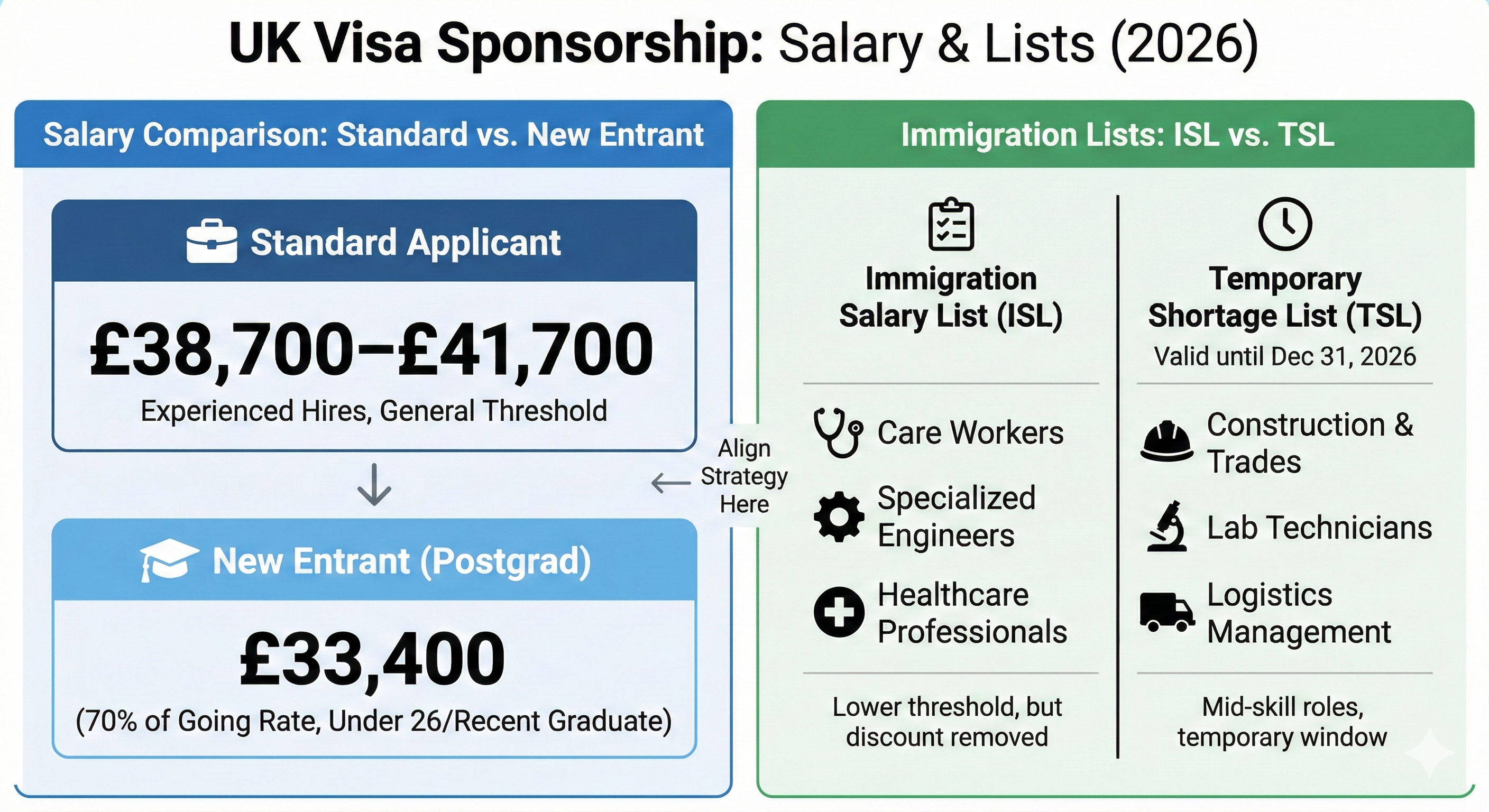
The landscape has shifted. Salary thresholds have climbed to £38,700 for most roles (and £41,700 for many others). English language requirements now sit at CEFR Level B2. The old Shortage Occupation List has been replaced by two new systems. And yet, despite all this, companies across the UK are still struggling to find talent-if you know where to look.
This guide is your roadmap. Whether you’re applying from overseas or you’re a postgraduate already in the UK on a Student or Graduate visa, the principles are the same: stop chasing jobs, start targeting sponsors, and position yourself as an investment rather than a cost.

Understand the 2026 Rules Before You Apply to Anything
You wouldn’t play poker without knowing the rules. The same logic applies here.
The Skilled Worker Visa: Your Main Route
Most sponsorship jobs fall under the Skilled Worker visa. To qualify, you need three things:
- A job offer from a licensed sponsor - not just any company, but one the Home Office has approved
- A role at RQF Level 3 or above - that’s A-level equivalent, meaning skilled work
- A salary of at least £38,700 - or the “going rate” for your specific occupation, whichever is higher
That salary figure scares a lot of people. But here’s what most applicants miss: there are legitimate ways around it.
The “New Entrant” Discount (Postgraduates, This Is Your Golden Ticket)
If you’re under 26, a recent graduate, or switching from a Student or Graduate visa, you qualify as a “New Entrant.” This means you only need to meet 70% of the going rate for your occupation.
In real numbers? While an experienced overseas hire might need £41,700, your minimum floor could be around £33,400 for the same role.
This isn’t a loophole. It’s a legitimate pathway designed to help employers access emerging talent without the full salary burden. When you’re job hunting, don’t let recruiters reject you based on the headline £41,700 figure. Know your number, and mention it explicitly.
The New Lists: ISL and TSL
Forget everything you knew about the “Shortage Occupation List.” It’s gone. In its place, you now have two distinct systems:
-
The Immigration Salary List (ISL): This replaced the old shortage list. Certain roles-like care workers and specialized engineers-can still be sponsored at slightly reduced thresholds, though the 20% “going rate” discount has largely disappeared.
-
The Temporary Shortage List (TSL): Introduced in July 2025 and valid until December 31, 2026. This is crucial for mid-skill roles (RQF Level 3–5) in sectors like construction, laboratory work, and logistics. If your occupation is on this list, you have a limited window to secure sponsorship before these permissions expire.
Check both lists before you start applying. Your occupation code determines your salary requirements and your eligibility.
The “Reverse Search” Strategy (Stop Applying Blind)
Here’s where 90% of job seekers go wrong: they apply to jobs on LinkedIn, Indeed, or Glassdoor and hope the company sponsors visas.
Most UK companies don’t have a sponsorship license. They literally cannot hire you, no matter how qualified you are. Every application you send to an unlicensed company is wasted effort.
Flip the script. Instead of searching for jobs, search for sponsors.
Step 1: Download the Register of Licensed Sponsors
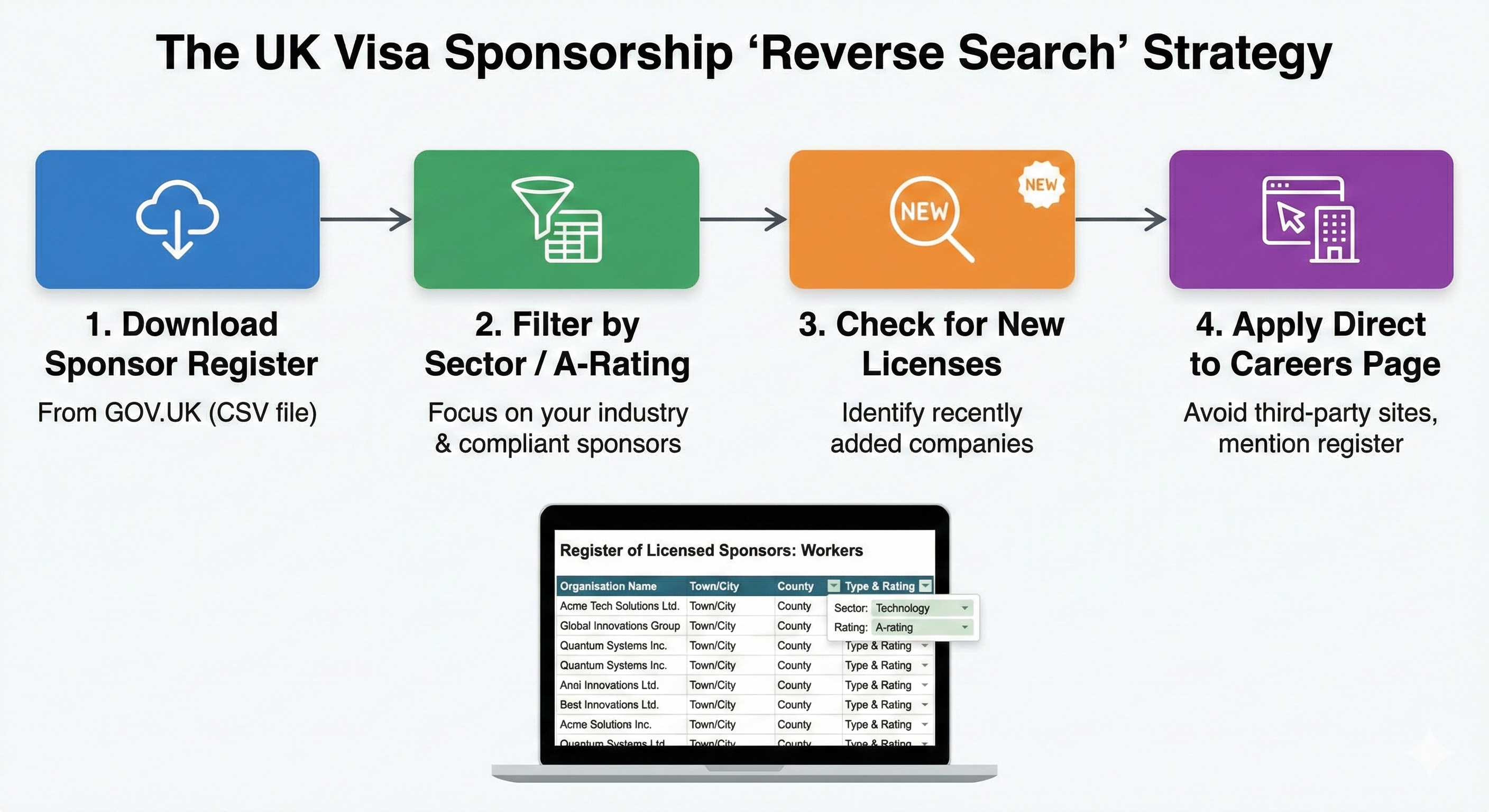
The Home Office publishes a complete list of every company in the UK that’s legally permitted to hire international workers. It’s called the Register of Licensed Sponsors: Workers, and it’s free to download from GOV.UK as a CSV file.
This is your goldmine.
Filter by your sector-engineering, healthcare, tech, finance-and by location. Look specifically for companies with an “A-rating” on the Skilled Worker route. These are fully compliant sponsors who can issue a Certificate of Sponsorship immediately.
Step 2: The “New License” Hack
Companies don’t go through the expensive, months-long process of getting a sponsor license for fun. They do it because they’ve already identified a hiring need they can’t fill locally.
The insight? Companies that just received their license are actively looking for international talent right now.
Monitor the register for new additions. A company added last week is your warmest lead. They didn’t go through all that paperwork to let it sit unused.
Step 3: Go Direct
Once you’ve identified licensed sponsors in your field, go to their careers page. Do not use LinkedIn’s “Easy Apply.” Apply directly on their website.
In your cover letter, demonstrate that you’ve done your homework:
“I noticed you’re a licensed sponsor on the Home Office Register, and I’m excited about the opportunity to bring my [specific skill] to your team…”
This immediately separates you from the thousands of generic applicants who spam every opening they see.
Step 4: The “Niche Down” Approach
Generic job titles get ignored. In 2026, recruiters and ATS systems are filtering for hyper-specific skills.
Don’t brand yourself as a “Business Analyst.” Brand yourself as a “FinTech Data Analyst with Python and SQL expertise.” Don’t be a “Marketing Manager.” Be a “B2B SaaS Growth Marketing Specialist.”
Specificity does two things: it gets you past keyword filters, and it makes the “skilled” requirement (RQF Level 6) crystal clear to the Home Office when your employer submits the sponsorship application.
Optimize Your Application for the UK Market
UK recruiters spend less than 10 seconds on a CV. If your application looks foreign or generic, it’s getting deleted.
The UK CV Format
-
No photos. This isn’t continental Europe. Including a headshot can trigger immediate rejection due to strict anti-discrimination practices.
-
No personal data. Remove your age, marital status, religion, nationality, and full address. Include only your name, email, phone, LinkedIn URL, and current city.
-
Two pages maximum. British recruiters expect concise, achievement-focused CVs, not exhaustive career histories.
The “Commercial Value” Cover Letter
Sponsoring you costs an employer between £1,000 and £5,000 upfront, plus ongoing Immigration Skills Charges. You need to justify that investment in your very first interaction.
-
Weak approach: “I am seeking a role that offers visa sponsorship…”
-
Strong approach: “I understand the investment involved in sponsorship. In my previous role, I delivered £25,000 in cost savings through process automation-more than covering the cost of my employment within the first quarter.”
Frame yourself as a revenue generator or cost saver, not an expense.
The RQF Level 6 Keywords
Your job must qualify as “skilled work” at RQF Level 6 (degree level) for most graduate roles. The Home Office checks this.
Use the ONS Occupation Coding Tool to find the official description for your target role. Then mirror that exact language in your CV. If the official “Marketing Associate” description uses specific verbs and responsibilities, use those same terms. You’re not lying-you’re speaking the language the system is designed to recognize.
Handle English Proficiency Upfront
As of January 2026, first-time Skilled Worker applicants must prove English at CEFR Level B2 (upper-intermediate).
If your degree was taught in English at a UK institution, you’re covered. If not, you’ll need a valid SELT result at B2 level.
Don’t wait for a job offer to sort this out. Having “IELTS UKVI B2 Achieved” on your CV removes a major friction point for HR. It signals you’re ready to hire, not a compliance headache waiting to happen.
The 2026 Efficiency Hack (Automating the Grind)
Here’s the brutal paradox of the current job market: to get noticed, you need to tailor your CV for every single role (quality). But to find that one sponsor willing to take a chance on you, you need to send out a high volume of applications (quantity).
Doing this manually for 50+ companies is a recipe for burnout-and by the time you’ve spent two hours perfecting one application, the best candidates have already submitted theirs.
Top candidates in 2026 are solving this with intelligent automation.
Why Manual Applications Are Losing
-
The keyword gap: When you manually edit your CV, you often miss the specific phrases buried in the job description that ATS algorithms score you on. You might say “managed projects” when the system is looking for “led cross-functional initiatives.”
-
Speed to market: Roles at newly licensed sponsors-your warmest leads-receive hundreds of applications in the first 24 hours. If you’re spending an entire evening on one application, you’re already too late.
The Strategic Advantage of FastApply
This is where tools like FastApply have become the not-so-secret weapon for international applicants.
Instead of copy-pasting standard cover letters or manually hunting for keywords, FastApply analyzes the specific job description alongside your profile. It auto-generates a tailored, keyword-optimized resume and cover letter in seconds-not hours.
The result? You maintain the “high quality” approach of Phase 3 while hitting the “high volume” necessary to find a sponsor in a competitive market.
Use automation to get the interview. Then use your personal research from Phase 2-knowing they’re a licensed sponsor, understanding their business, preparing your “commercial value” pitch-to win the job.
High-Probability Sectors in 2026
Not all industries are equal when it comes to sponsorship. Focus your energy where the shortages are real and the infrastructure for hiring internationals already exists.
Health & Social Care
Roles like nurses, pharmacists, care workers, and senior care workers remain in constant demand. However, recent rule changes have restricted care workers from bringing dependents-check the specific occupation code (e.g., 6145) before committing.
STEM & Engineering
Lab technicians, civil engineers, electrical technicians, IT business analysts, and software developers are featured prominently on both the ISL and the Temporary Shortage List. If you’re in these fields, 2026 is your window.
Construction & Skilled Trades
The UK housing crisis has forced the government to open sponsorship pathways for bricklayers, roofers, plasterers, and other trades-provided the employer holds a valid license.
Finance & Professional Services
The Big 4 (PwC, Deloitte, EY, KPMG) and major banks (JP Morgan, HSBC, Goldman Sachs) are high-volume sponsors with dedicated visa teams. They’re used to the process and less likely to be scared off by sponsorship requirements.
Tech & AI
Roles in artificial intelligence, machine learning, renewable energy, and software development often bypass strict salary scrutiny due to critical demand. If you have specialized technical skills, you’re in a strong position.
Phase 6: The Graduate Visa Bridge (For Postgraduates Already in the UK)
If you’re a recent graduate and can’t secure immediate sponsorship, the Graduate visa isn’t just a way to “buy time.” Used strategically, it’s an audition.
The “Prove Your Value” Strategy
Apply to licensed sponsors who seem hesitant about upfront visa costs. Offer to work for 6–12 months on your Graduate visa first.
During that time, you’re not just an employee-you’re demonstrating that you’re indispensable. Once you’re embedded in the team, the £3,000–£5,000 sponsorship cost becomes a retention expense rather than a recruitment gamble. Companies will pay to keep someone they already trust.
The Warning
Don’t stay in non-professional roles too long. Working retail or hospitality on your Graduate visa might pay the bills, but it won’t help you transition to Skilled Worker status. You need to be in an eligible graduate-level position to eventually switch routes.
Handling the “Right to Work” Question
Every application form asks it: “Do you have the right to work in the UK?”
If you’re offshore with no visa, answering “No” can trigger an automatic ATS rejection. Here’s how to handle it strategically.
On application forms (if text is allowed):
“I require a Skilled Worker Visa. I am a qualified candidate for a licensed sponsor, and I have all documentation ready for a smooth CoS process.”
If you’re on a Student or Graduate visa:
“Yes-I hold a Graduate Visa valid until [date] and am eligible for the Skilled Worker ‘New Entrant’ salary threshold.”
In interviews, be honest but confident:
“I don’t currently hold a Skilled Worker visa, but I’ve verified your status on the Sponsor Register. My English test results and university transcripts are ready, so the Certificate of Sponsorship process will be fast and straightforward.”
Confidence matters. You’re not asking for a favor-you’re presenting a business case.
Protect Yourself from Scams
The desperation for UK jobs has created a thriving scam industry. Protect yourself.
-
Never pay for a job. It is illegal for a UK employer to ask you to cover the Certificate of Sponsorship fee or “application processing charges.” The employer pays the Immigration Skills Charge-not you.
-
Verify the email domain. Real offers come from official company domains (@company.com), not variations like @company-hr-recruitment.com or Gmail addresses.
-
Ignore “guaranteed visa” promises. No agency can guarantee a visa. Only the Home Office grants them. Anyone claiming otherwise is lying.
Your 2026 Action Plan
Getting sponsored isn’t about luck. It’s about alignment-matching your skills to shortage lists, targeting licensed employers, and presenting yourself as a low-risk, high-value hire.
This week:
- Download the Register of Licensed Sponsors from GOV.UK
- Find your SOC 2020 occupation code and check if it’s on the ISL or TSL
- Audit your CV: remove the photo, quantify your achievements, add your English proficiency status
- Identify 5 recently licensed sponsors in your sector
- Set up FastApply to scale your tailored applications without burning out
This month:
- Apply directly to at least 20 licensed sponsors
- Connect with alumni and professionals who successfully made the switch on LinkedIn
- Attend industry events (virtual or in-person) hosted by A-rated sponsors
- Calculate your “New Entrant” salary threshold and use it in negotiations
The UK market is open to top international talent-but only for those who treat the job search as a strategic campaign rather than a lottery ticket.
You’ve got this. Now go execute.
Struggling to keep up with tailored applications? FastApply helps you generate keyword-optimized resumes and cover letters in seconds, so you can maintain quality at scale. Stop choosing between personalization and volume-do both.
#UK visa sponsorship
#skilled worker visa UK
#UK work visa 2026
#visa sponsorship jobs UK
#how to get sponsored in UK
#UK visa for international workers
#postgraduate visa UK
#graduate visa to skilled worker
#new entrant visa discount
#UK sponsor license register
#how to find UK visa sponsors
#UK visa salary threshold 2026
#immigration salary list UK
#temporary shortage list UK
#certificate of sponsorship UK
#offshore job seekers UK
#international graduates UK

FastApply Team
Career Experts