How to Secure a U.S. Job with a Post-Graduate Visa in 2026
The dream of working in the United States has driven millions of international students to uproot their lives, invest years of study, and pour significant financial resources into American education. If you’re reading this, you’ve likely done exactly that-and now you stand at graduation’s edge facing what feels like an impossible challenge.
Here’s what nobody tells you: The narrative that “American companies don’t hire international students” is a myth. Every single year, tens of thousands of F-1 and J-1 visa holders successfully transition into full-time roles at Fortune 500 companies, cutting-edge startups, and research institutions. The difference between those who land offers and those who return home often isn’t talent or credentials. It’s strategy. It’s knowing how the game works before you step onto the field.
This guide isn’t a collection of generic tips you’ve already heard. It’s an operational roadmap covering the legal frameworks most students misunderstand, the hidden job market most never access, the visa conversation that terrifies everyone, and the psychological shifts required to actually win.
Understanding Your Legal Arsenal
Before you write a single cover letter, you need to master the legal instruments at your disposal. Employers are risk-averse by nature; if you can’t confidently explain your immigration status in thirty seconds, they will move on to the next candidate who can.
Optional Practical Training (OPT)
OPT serves as the critical bridge for F-1 students. Many students misunderstand what OPT actually is-it’s not a visa. It’s a benefit tied to your F-1 status that permits off-campus employment. The standard duration is 12 months, and here’s where most students make their first mistake: they wait too long to apply.
You can submit your application up to 90 days before graduation, and given that USCIS processing times in 2026 can swing wildly from weeks to months, early application isn’t just advisable-it’s essential. The last thing you want is an employer ready to hire you while you’re still waiting for your Employment Authorization Document.
The “related field” requirement trips up many students as well. Your job must connect to your major, but the interpretation is more flexible than you might think. If you studied Computer Science, you obviously can’t work as a cashier. But you absolutely can work as a web developer for a retail company. What matters is the function of your role, not the industry of your employer.
The STEM OPT Extension
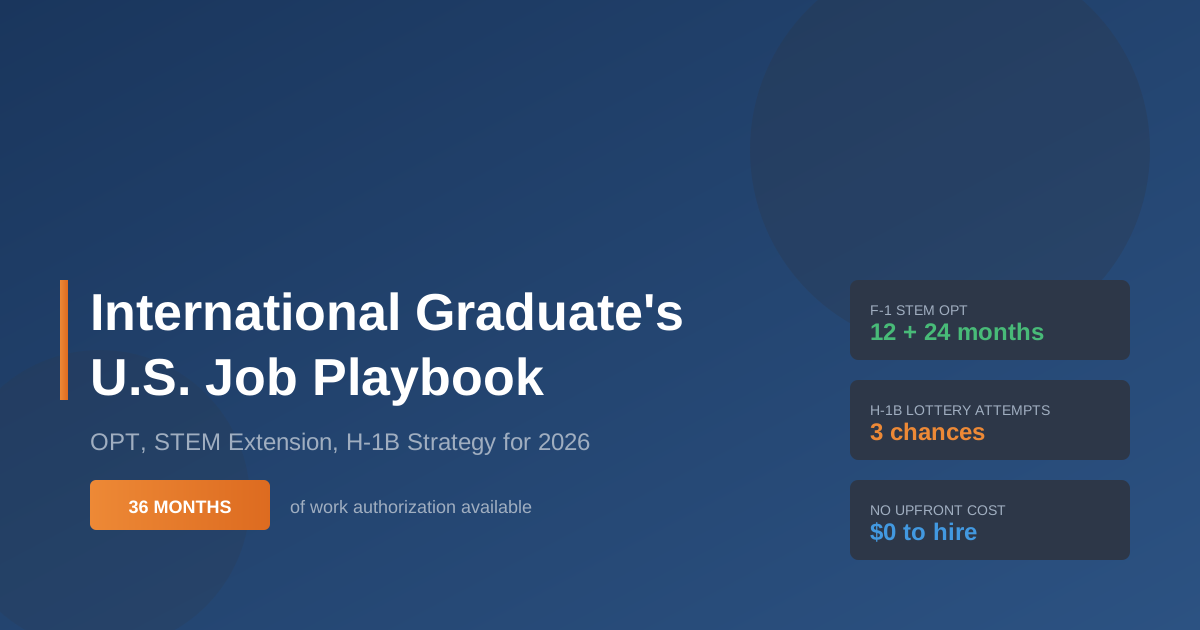
The STEM extension transforms everything for students with qualifying degrees. If your field falls under the Department of Homeland Security’s STEM designation, you become eligible for an additional 24 months of work authorization. Combined with your initial 12 months, this gives you three full years of authorized employment.
Why does this matter so much? Because three years is an eternity in corporate decision-making. It provides an employer three separate opportunities to sponsor you for an H-1B visa through the annual lottery. This completely changes how you should position yourself in interviews. Never say “I have a visa for one year”-that sounds temporary and risky. Instead, frame it accurately: “I have up to three years of work authorization requiring no immediate sponsorship from you.”
The Cap-Gap Extension
One piece of the puzzle many students don’t learn about until it’s almost too late is the cap-gap extension. Here’s the scenario: your OPT expires in June, but even if you win the H-1B lottery, that visa doesn’t activate until October 1st. What happens during those months? The cap-gap provision automatically extends your student status and work authorization to bridge this period-but only if your employer files a timely H-1B petition. You don’t need to leave the country. You don’t need to do anything special. The system accounts for this.
J-1 Academic Training
For those on J-1 visas, Academic Training functions similarly to OPT but operates under different rules. The duration can extend to 18 months for most students or up to 36 months for postdoctoral researchers. The crucial difference? Unlike OPT, where you can apply first and then job hunt, J-1 Academic Training typically requires a job offer before your authorization is finalized. This means J-1 students need to front-load their job search even more aggressively.
The 12-Month Countdown That Determines Everything
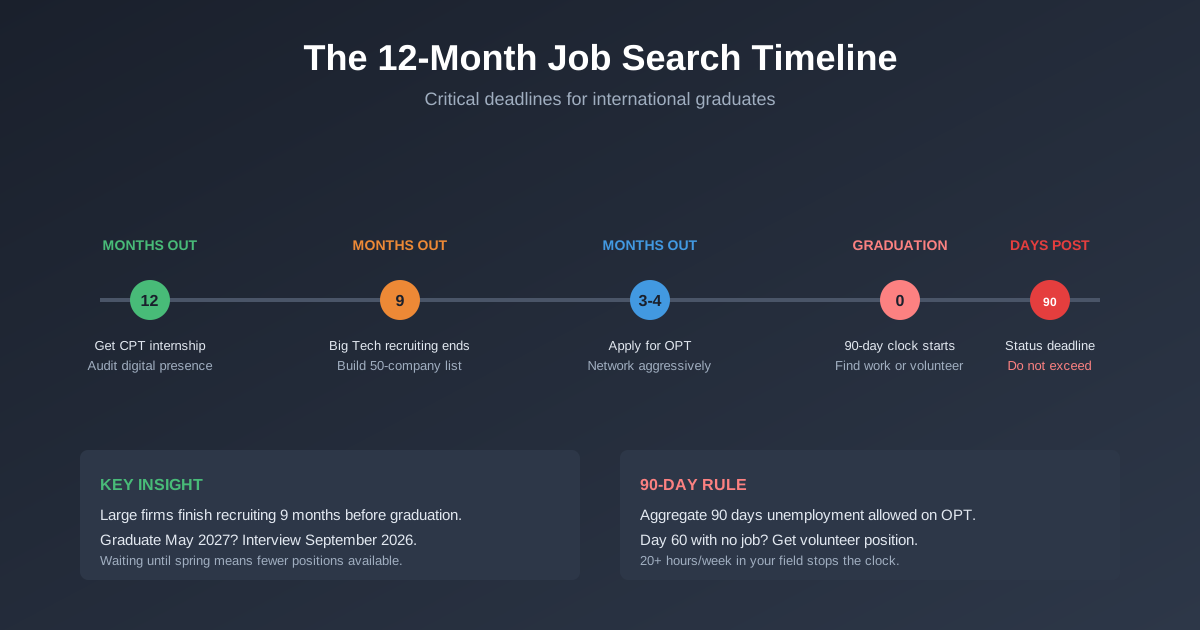
American recruitment follows rigid cycles that operate independently of your personal timeline. Miss a cycle, and you might delay your career by an entire year. Understanding this rhythm is non-negotiable.
Twelve Months Before Graduation
Your primary focus should be securing a CPT (Curricular Practical Training) internship if your program allows it. Think of CPT as your test drive-and more importantly, as your employer’s test drive of you. Companies convert CPT interns to full-time OPT employees at dramatically higher rates than they hire external candidates. Why? Because you’re already trained, already integrated into the team, already a known quantity. The sponsorship conversation becomes far easier when a manager can say “we literally cannot afford to lose this person” rather than “this candidate seems promising.”
This is also the time to audit your digital presence with ruthless honesty. Google yourself. Clean up anything that reads as unprofessional on social media. Build a LinkedIn profile that positions you as a working professional, not a student seeking opportunities. The difference is subtle but meaningful-one suggests someone who needs help, the other suggests someone who adds value.
Nine Months Before Graduation
You need to understand that large firms recruit early. Not a little early-dramatically early. Investment banks, consulting firms, and Big Tech companies often close their recruiting cycles for the following year by September or October. If you’re graduating in May 2027, you should be deep in interview processes by September 2026. Waiting until spring to “start looking” means competing for a drastically smaller pool of remaining positions.
Create a target list of at least 50 companies, but don’t just pick famous names. Pick companies that actually hire. This distinction matters enormously. A prestigious company that sponsors one international graduate every three years is a worse target than a mid-sized firm that regularly hires a dozen per year.
Three to Four Months Before Graduation
This window marks your OPT application deadline and the peak season for what I call “just-in-time” hiring-the startups and mid-sized companies that don’t plan a year ahead. This is when aggressive networking pays the highest dividends, because these companies are actively solving urgent problems and will move quickly for the right candidate.
The 90-Day Danger Zone
The period following graduation represents your most vulnerable window. Federal regulations allow you an aggregate of 90 days of unemployment while on OPT. Exceed this, and you fall out of status. The clock is real and unforgiving.
If you reach day 60 without a paid position, you need to find a volunteer position or unpaid internship in your field immediately. As long as it’s at least 20 hours per week and related to your degree, it stops the unemployment clock. This isn’t ideal-nobody wants to work for free-but it buys you critical time to continue searching for paid employment while remaining in legal status.
Strategic Targeting: Where the Jobs Actually Are
The “spray and pray” method-blasting applications to hundreds of random job postings-has a near-zero success rate for international students. You must target companies that possess both the infrastructure and the intent to hire you.
The E-Verify Requirement
E-Verify eliminates more potential employers than most students realize. For the 24-month STEM OPT extension, your employer must be enrolled in E-Verify, a Department of Homeland Security database system that confirms work eligibility. The official USCIS E-Verify search tool lets you verify any company’s enrollment status. If a company isn’t on this list, they cannot employ you for the STEM extension period-full stop. Don’t waste months pursuing a role you ultimately can’t accept.
The silver lining? E-Verify enrollment is free and straightforward for employers. If you find a company you’re excited about that isn’t enrolled, part of your pitch can include explaining how simple enrollment is. But recognize that you’re adding friction to your candidacy when you do this.
Cap-Exempt Employers
Cap-exempt employers represent a backdoor that most international students never discover. Everyone obsesses over the H-1B lottery, which caps regular sponsorships at 85,000 visas per year. But certain employers can file H-1B petitions at any time of year with no lottery and no cap. These include universities, non-profit research organizations, and government research entities.
The strategic implication is significant: if corporate roles aren’t materializing, a position as a Data Analyst at a university research center or a hospital affiliated with an academic institution provides a pathway to long-term U.S. employment without gambling on lottery odds. The work might not be exactly what you envisioned, but it keeps you in the country building experience while you develop alternative options.
Mining Employer Data
Data mining employer behavior gives you intelligence most candidates lack. Websites like MyVisaJobs.com and H1BGrader.com track every company’s Labor Condition Application (LCA) history-the filings required before H-1B petitions. A company that has filed ten or more LCAs in the past year almost certainly has an immigration lawyer on retainer and established processes for sponsorship. These are your green-flag targets. A company with zero LCA history isn’t necessarily a bad option, but recognize that you’ll be educating them from scratch-a heavier lift that requires more patience and persuasion. Companies that explicitly state “US Citizens Only” are typically defense contractors or roles requiring security clearance. Don’t waste your time.
Your Resume as a Strategic Document
Your resume isn’t a biography chronicling your academic journey. It’s a marketing document with one purpose: getting you past the Applicant Tracking System (ATS) and into a human being’s hands.
Americanizing Your Format
Americanizing your format means stripping out elements that are standard in other countries but red flags in the U.S. Remove your photo entirely-American anti-discrimination law makes photos a liability rather than an asset, and including one signals unfamiliarity with local norms. Remove your age, marital status, religion, and gender. Unless you have a PhD or more than a decade of experience, keep everything on a single page. If you’re in Boston applying for jobs in San Francisco, remove your address entirely or add “Willing to Relocate” to eliminate geographic friction.
The Work Authorization Header
The work authorization header remains controversial, but in 2026’s hiring environment, it’s necessary. Many recruiters see a foreign-sounding name and immediately assume expensive, complicated sponsorship requirements. You need to address this assumption before it costs you the interview.
Under your contact information, add a single line: “Eligible for 36 months of U.S. work authorization (STEM OPT). No immediate sponsorship cost required.” This statement is accurate-hiring you on OPT costs nothing extra-and it directly addresses the elephant in the room before it becomes a reason to reject you.
Impact Over Duty
Impact statements transform forgettable resumes into interview-generating ones. Don’t write “Responsible for coding features” or “Managed team communications.” These describe what you were supposed to do, not what you actually accomplished. Instead: “Developed Python automation that reduced manual data entry by 10 hours weekly” or “Led cross-functional standups that cut project delays by 30%.” Americans are trained from childhood to respond to quantified achievement. Give them numbers: dollars saved, percentages improved, users acquired, time reduced. If you can’t quantify something, question whether it belongs on your resume at all.
The Efficiency Multiplier: Scaling Your Strategy
Here is the tension every international student faces: you need high volume to find the needle-in-a-haystack sponsor, but you need high quality (tailored resumes) to pass the ATS. Doing both manually is mathematically impossible.
If you spend 45 minutes tailoring one resume, you can apply to maybe 3 jobs a day. In a numbers game where response rates can be 2-3%, that’s not enough velocity to secure a role before your 90-day clock runs out.
This is where tools like FastApply become your strategic advantage. Instead of manually re-typing your resume for every role, FastApply analyzes the job description and your profile to auto-generate a keyword-optimized, tailored resume in seconds.
It allows you to maintain the “Impact Over Duty” quality we discussed while hitting the volume necessary to find a cap-exempt or E-Verify employer. Stop choosing between personalization and volume-do both.
The Referral Advantage You’re Not Using
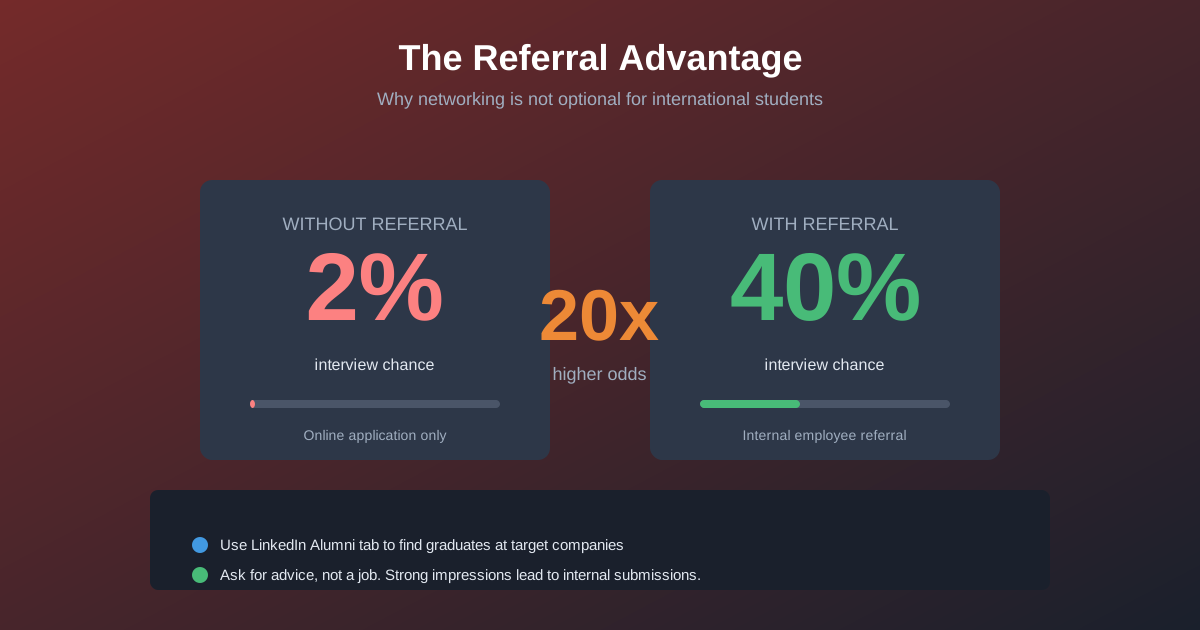
Here’s a brutal truth most job seekers don’t want to hear: if you apply online to a popular position without an internal referral, your statistical chance of getting an interview is roughly 2%. With a referral, that number jumps to approximately 40%. The math is unforgiving. Networking isn’t optional.
The Alumni Network
Your alumni network is your most underused asset. People genuinely enjoy helping others who share their background-it’s human nature. LinkedIn makes this searchable. Navigate to your university’s page, click the Alumni tab, then filter by location and job function. Looking for engineering roles in New York? Filter accordingly, and you’ll see exactly which graduates from your school work in relevant positions.
Your outreach message matters enormously. “Hi, can you give me a job?” is the fastest way to get ignored. Instead, try something like:
“Hi [Name], I’m a fellow [University] grad finishing my Master’s in CS. I noticed you successfully navigated the F-1 to [Company] transition-something I’m working on now. Would you have 10 minutes sometime to share how you approached that process? I’d genuinely appreciate any insights.”
This message acknowledges shared background, references a specific challenge, asks for a small time commitment, and requests advice rather than employment.
The Informational Interview
The informational interview is where networking converts into opportunity, but most people execute it wrong. When someone agrees to talk with you, do not ask them for a job. Ask them for wisdom. “How did you approach the sponsorship conversation when you were interviewing?” “What skills is your team currently struggling to find?” “Based on my background, who else should I be talking to?”
This approach works because it respects their time while demonstrating your thoughtfulness. More importantly, it often generates the result you actually wanted. If you make a strong impression-if you seem competent, curious, and easy to work with-they will frequently offer unprompted: “Actually, send me your resume. I’ll put it in our internal system.”
Conferences and Hackathons
Conferences and hackathons level the playing field in ways that traditional applications cannot. In technical fields, demonstrated skill trumps visa complications. If you win a hackathon, present research at a conference, or build something impressive that gets attention, you’ve created proof of value that overrides administrative concerns. The recruiters at these events are often technical leads rather than HR gatekeepers-people who care about what you can build, not paperwork.
The Visa Conversation Nobody Prepares You For
You’ve made it to the interview stage. Now comes the conversation that terrifies every international student. How you handle it often determines whether you receive an offer.
The Application Form
On application forms, you’ll encounter two standard questions. “Are you legally authorized to work in the United States?” The answer is YES. Your OPT provides full authorization-you are not lying. “Will you now or in the future require sponsorship for employment visa status?” The answer is also YES. Lying here can result in termination for cause later. Honesty is non-negotiable.
The HR Screening Call
During the HR screening call, the recruiter will likely notice that you checked “Yes” for future sponsorship and call to clarify. This is your moment. Have your response prepared and rehearsed until it sounds natural: “I’m currently on F-1 OPT status, which grants me full work authorization for the next [12/36] months. I don’t require any sponsorship to start, and there’s no cost to the company to hire me today. My goal is to do excellent work during this period, and if the fit is right on both sides, we can discuss long-term options like the H-1B down the road.”
Notice what this script accomplishes. It shifts the conversation from “cost and hassle” to “performance and value.” You’re not asking for a favor. You’re offering a risk-free trial period where you prove your worth.
Educating Smaller Employers
For smaller employers, education often becomes necessary. Many hiring managers at startups or mid-sized companies have never hired an international worker. They imagine that bringing you on requires $5,000 in legal fees and mountains of paperwork starting on day one. This is wrong, but they don’t know it’s wrong.
Be prepared to explain: “Hiring me on OPT works exactly like hiring a US citizen. You verify my I-9 form just like any other employee. There are no lawyer fees, no special filings, nothing extra required for the first few years.” Some candidates even prepare a clean one-page PDF summarizing OPT benefits for employers, which they send as a follow-up after interviews. This positions you as someone who solves problems rather than creates them.
Building Your Contingency Architecture
The H-1B visa is fundamentally a lottery. It is based on luck. You cannot build a life strategy solely on luck. You need contingencies.
The O-1 Visa (Extraordinary Ability)
The O-1 visa exists for individuals who have demonstrated extraordinary ability in their field. Unlike the H-1B, it has no cap and no lottery. The criteria require meeting three out of eight benchmarks-things like published research, judging the work of others, commanding a high salary relative to peers, or playing a critical role in distinguished organizations.
The strategic insight most students miss: you can build your O-1 profile while still a student. Publish papers. Serve as a hackathon judge. Write technical articles that get cited. These activities position you for an O-1 application regardless of what happens in the H-1B lottery.
The L-1 Visa (Intracompany Transfer)
The L-1 visa pathway offers another route through international transfer. If H-1B sponsorship doesn’t work out, multinational companies can transfer you to a branch outside the U.S.-London, Toronto, Dublin, Singapore. After working there for one year, they can transfer you back to the U.S. on an L-1 visa, which has no lottery requirement. This path requires patience and employer cooperation, but it keeps the door open.
Day 1 CPT Programs
Day 1 CPT programs represent a grayer area. Some students enroll in a second Master’s or PhD program at institutions that allow CPT work authorization from the first day, maintaining employment eligibility while studying. If you pursue this route, exercise extreme caution. Ensure the university is properly accredited. Attend your classes genuinely. USCIS scrutinizes these programs heavily, and cutting corners can result in consequences far worse than returning home.
The Mindset That Separates Winners From Everyone Else
Finding employment in the U.S. with a post-graduate visa isn’t primarily about competence. The library is full of brilliant international students who went home. What separates those who stay is persistence and adaptability-the willingness to play a longer game than feels comfortable.
In 2026, you are not a student asking for a chance. You are a global professional offering specialized skills in a market that desperately needs talent. Start early, because the clock is your enemy from day one. Network relentlessly, because the “Apply” button is a black hole that swallows applications without human review. Educate employers on immigration realities, because you cannot expect them to understand complexities they’ve never encountered. And above all, be undeniably excellent at what you do. Companies sponsor talent they cannot afford to lose. Make yourself that talent.
The road is steep. The bureaucracy is maddening. The uncertainty is exhausting. But tens of thousands of people walk this path successfully every single year, and there is no reason you cannot be one of them.
#US visa sponsorship
#F1 visa jobs
#OPT jobs 2026
#STEM OPT extension
#H1B visa sponsorship
#international student jobs USA
#US work visa guide
#cap-exempt H1B
#international graduate jobs

FastApply Team
Career Experts