Interview Tips You Need for the New 2026 Job Market
The average job posting now attracts 250 applicants and only about 2% of those applicants receive an interview invitation. Once you land that interview, hiring managers form their first impression within 7 minutes.
The 2026 job market rewards prepared candidates who understand what interviewers look for and how to stand out fast. This guide covers the strategies that move the needle: how to answer common questions with confidence, how to nail virtual interviews, how to manage pre-interview nerves, and why a simple thank-you note still tips the scale.
Whether you are interviewing for your first role or switching careers mid-stream, these 2026 interview tips give you a clear advantage.
How to Answer “Tell Me About Yourself” Without Rambling
This is the single most common interview question. According to Apollo Technical, 93% of hiring managers ask some version of it. Most candidates fumble here because they treat it as a biography. It is not.
Use the Present-Past-Future format to keep your answer tight and relevant.
-
Present: Start With Where You Are Now
Open with your current role and one or two specific accomplishments. Keep it to two sentences.
Example: “Right now I work as a product marketing manager at a B2B SaaS company, where I led a campaign last quarter that increased demo requests by 35%.”
-
Past: Connect Your Background to the Role
Pick one or two past experiences that directly relate to what this job requires. Do not walk through your entire resume.
Example: “Before this, I spent three years in content strategy at a media startup, where I built the editorial calendar from scratch and grew organic traffic from 10,000 to 120,000 monthly visitors.”
-
Future: Show Where You Are Headed
End by tying your trajectory to this specific company and position. Make the interviewer see why you want this role, not just a role.
Example: “I am excited about this position because your team is scaling into enterprise markets, and that is exactly the challenge I want to take on next.”
The entire answer should take 60 to 90 seconds. Practice it out loud with a timer.
How to Talk About Weaknesses Without Sabotaging Yourself
“What is your greatest weakness?” is a trap only if you treat it like one. Interviewers do not expect you to be flawless. They want to see self-awareness and proof that you are working on the problem.
The Framework: Name It, Own It, Fix It
Step 1: Name a real weakness that is not a dealbreaker for the role.
If you are applying for a data analyst position, do not say “I struggle with numbers.” Pick something adjacent but not disqualifying. Public speaking, delegation, or perfectionism that slows output are all honest and safe.
Step 2: Own it with a specific example.
“In my last role, I noticed that I spent too long polishing decks before presenting them to stakeholders. I missed two soft deadlines because I was revising slides that were already 90% done.”
Step 3: Explain what you are doing to fix it.
“Now I set a hard cutoff for revision time. I give myself two editing passes per deliverable and then share it. My manager noticed the improvement in our last quarterly review.”
What to Avoid
Do not use the “I work too hard” cliche. Interviewers hear it constantly and it signals that you are not willing to be honest. Do not name a weakness that goes against the core requirements listed in the job description. And do not say you have no weaknesses. Nobody believes that.
Acing Virtual Interviews in 2026
Virtual interviews are not going away. According to an Indeed report, 82% of employers now use virtual interviews as part of their hiring process and 93% of those employers plan to continue using them.
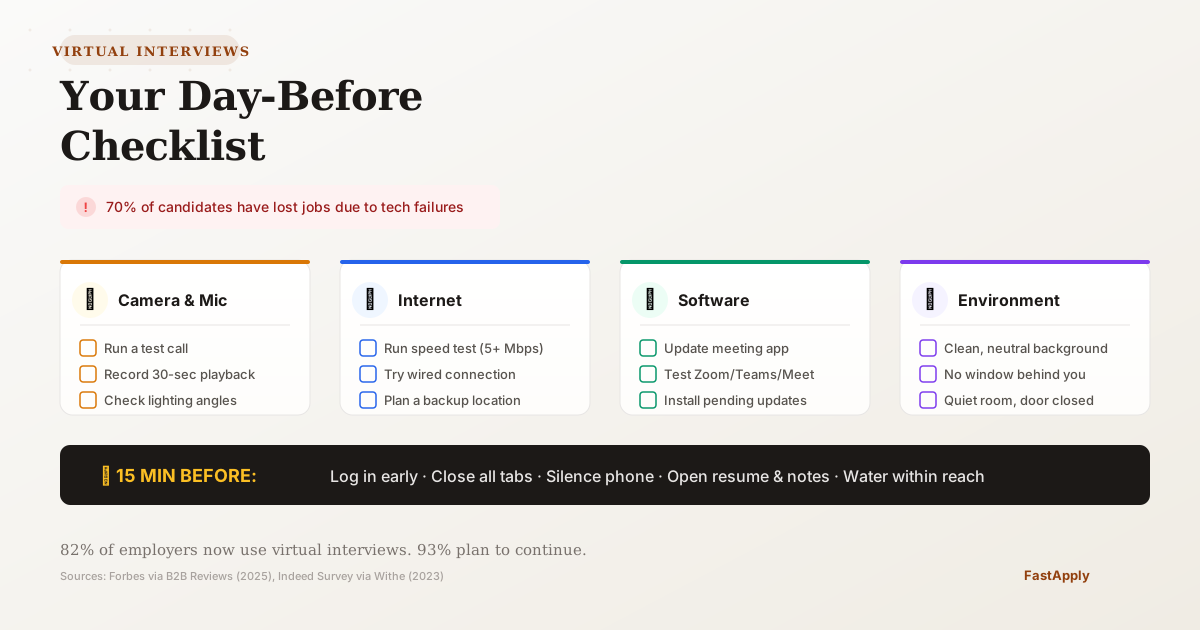
But here is the problem: 62% of candidates experience technical issues during online interviews, and 70% have lost a job opportunity because of tech failures during a video call.
The fix is preparation. Not day-of preparation. Day-before preparation.
The Day-Before Checklist
-
Test your camera and microphone. Open the meeting platform (Zoom, Teams, Google Meet) and run a test call. Record yourself for 30 seconds and play it back. Check for audio lag, lighting issues, and background noise.
-
Confirm your internet connection. Run a speed test. You need at least 5 Mbps upload speed for smooth video. If your home Wi-Fi is unreliable, consider a wired ethernet connection or find a backup location.
-
Update your software. Nothing kills momentum like a forced update that delays your entrance by five minutes. Open the meeting platform and install any pending updates the day before.
-
Choose your location. Pick a quiet room with a clean, neutral background. A blank wall or a tidy bookshelf both work. Avoid sitting in front of a window, which turns you into a silhouette.
The 15-Minute Pre-Interview Routine
Log in 15 minutes early and use that time to:
- Close every tab and application that is not related to the interview
- Silence your phone and put it face-down in another room
- Open your resume, the job description, and your notes in separate windows
- Pour a glass of water and place it within reach
- Do a final audio and video check
How to Build Rapport Through a Screen
Virtual interviews make it harder to read body language and build connection. Research from B2B Reviews found that 48% of recruiters report difficulty assessing soft skills through video.
Combat this by:
-
Looking at the camera, not the screen: This creates the illusion of eye contact. It feels unnatural at first, but it makes a noticeable difference in how engaged you appear.
-
Nodding and reacting visibly: Subtle cues like a slight head nod or a smile get lost on video. Amplify them slightly so the interviewer knows you are listening.
-
Finding common ground early: If you notice something in the interviewer’s background (a book, a team logo, a photo), mention it briefly before diving in. This breaks the formality barrier.
Dress for the Full Frame
Wear a complete professional outfit, not just the top half. You never know when you might need to stand up unexpectedly. A button-down shirt paired with sweatpants is a meme, not a strategy.
Red Flags to Watch for During Interviews
Interviews are a two-way evaluation. You are assessing the company just as much as they are assessing you. According to a Paychex survey, 40% of job seekers said an unfairly low salary offer was the most off-putting interviewer behavior they experienced, and 51% withdrew their candidacy as a result.
Warning Signs That the Role Does Not Match the Posting
Pay attention when answers contradict the job description. If the listing says “standard 40-hour work week” but the interviewer casually mentions “we all pitch in on weekends during busy season,” that is a signal.
Watch for these specific red flags:
-
Vague answers about day-to-day responsibilities. If the interviewer has a hard time explaining what you would do in the first 90 days, the role might not be well-defined.
-
High turnover language. Phrases like “we need someone who hits the ground running” or “the last person did not work out” without further context suggest instability.
-
Reluctance to discuss salary or benefits. Companies confident in their compensation packages discuss them openly. If you get redirected every time you ask, that is a pattern.
-
Schedule bait-and-switch. A “fixed schedule” position that suddenly requires on-call duties, 50+ hour weeks, or mandatory weekend coverage is not what was advertised.
Questions to Ask That Expose Red Flags
- “What does a typical day look like for someone in this role?”
- “How long has the team been in its current form?”
- “What happened with the person who previously held this position?”
- “How does the company handle overtime or after-hours work?”
These questions sound professional but surface the information you need to make a smart decision.
Managing Interview Stress: Practical Techniques That Work
Pre-interview anxiety is normal. Among job seekers surveyed by iHire, 55.3% said waiting to hear back after an interview was the most stressful part of the entire job search process.
The good news: stress management for interviews is about preparation, not personality. You do not need to be a naturally calm person. You need a system.
Prepare Until the Questions Feel Familiar
Review the job description line by line. For each requirement listed, write down a specific example from your experience that demonstrates that skill. This gives you a mental bank of stories to draw from regardless of how questions are framed.
Practice your answers out loud. Not in your head. Out loud. Record yourself on your phone and listen back. You will catch filler words (“um,” “like,” “so”) and places where your answer trails off.
Reframe the Conversation
The interviewer is not an adversary. They are a person with a problem (an open role) looking for someone to solve it. You are there to show you are that person.
Remind yourself: the company already reviewed your resume and decided you were worth their time. They want you to succeed in this conversation just as much as you do.
Acknowledge Nervousness Instead of Fighting It
If you feel nervous, name it. Say something like: “I have to be honest, I am a little nervous because I am genuinely excited about this opportunity.” This is disarming. It shows both vulnerability and confidence. Most interviewers respond with warmth because they have been in the same position.
Trying to hide nerves usually makes them worse. Acknowledging them takes the pressure off.
The 4-4-4 Breathing Technique
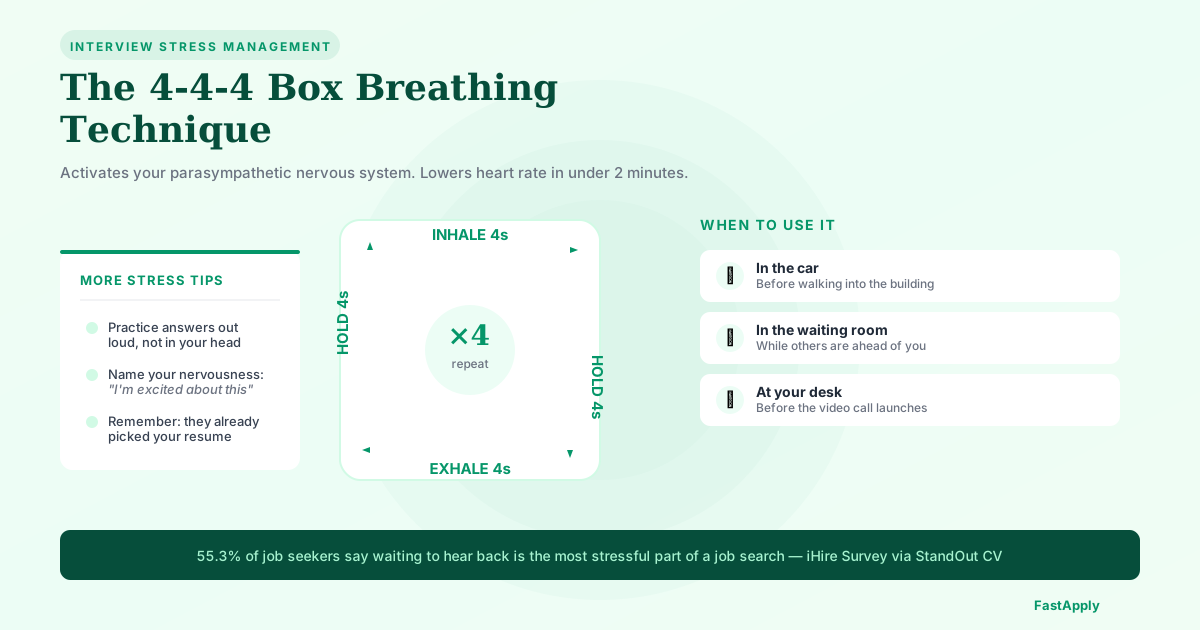
Before the interview starts, use box breathing: inhale for 4 seconds, hold for 4 seconds, exhale for 4 seconds. Repeat four times. This activates your parasympathetic nervous system and lowers your heart rate. Do it in the car, in the waiting room, or while sitting at your desk before the video call launches.
Why Thank-You Notes Still Matter in 2026
Some candidates skip the post-interview thank-you email because it feels outdated. The data says otherwise.
According to a TopResume survey, 68% of hiring managers and recruiters said that a thank-you note impacts their hiring decisions. And 16% of interviewers admitted they dismissed a candidate entirely for not sending a follow-up.
Despite these numbers, only 24% of job seekers send a thank-you note after their interview. That gap is your opportunity.
What a Good Thank-You Email Looks Like
Send it within 24 hours of the interview. Not three days later. Not “when you get around to it.” Within 24 hours.
Include these elements:
A specific reference to something discussed during the interview. This proves you were paying attention and did not copy-paste a template.
A brief restatement of why you are a strong fit for this specific role. One to two sentences maximum.
A genuine expression of interest in the position and the team.
A Sample Thank-You Email
Subject: Thank you for today’s conversation
Hi [Interviewer Name],
Thank you for taking the time to speak with me today about the [Job Title] role. I enjoyed learning about [specific project or initiative discussed]. The approach your team is taking to [specific detail] aligns with how I have tackled similar challenges in my current role.
I am confident my experience in [relevant skill] would help the team [achieve specific goal mentioned in the interview]. I look forward to the next steps.
Best, [Your Name]
What Not to Do
Do not send a generic message. If a hiring manager receives three identical “Thank you for your time, I look forward to hearing from you” emails, none of them stand out.
Do not write an essay. Keep it under 150 words. The shorter your message, the more likely it gets read completely.
Do not use AI to write it without editing. Hiring managers recognize templated language. Write it yourself and let your personality show.
Speed Up Your Application Process So You Have More Time to Prepare
Here is the reality most job seekers face: the application grind eats into interview prep time. Job seekers now submit anywhere from 32 to over 200 applications before receiving an offer. Spending 20 to 30 minutes tailoring each resume means dozens of hours lost to formatting and keyword matching instead of practicing answers and researching companies.
FastApply eliminates the trade-off between application quality and preparation time. The Chrome extension reads each job description and automatically tailors your resume to match. It pulls the right keywords, reorders your experience, and formats for ATS compatibility across platforms like Indeed, LinkedIn, Glassdoor, Lever, Greenhouse, and Workday.
But unlike fully automated tools that blast generic applications, FastApply pauses before submission. You review every tailored resume, adjust anything that needs a human touch, and approve. This human-in-the-loop approach prevents mismatches while giving you something more valuable than speed: time to prepare for the interviews those applications generate.
A 30-minute manual tailoring process becomes a 3-minute review. Multiply that across 50 applications and you free up over 20 hours. That is 20 hours you could spend rehearsing your “Tell me about yourself” answer, researching company backgrounds, or practicing virtual interview setups.
FastApply also generates tailored cover letters and tracks every application, so you walk into each interview knowing exactly what version of your resume the interviewer has in front of them.
Your 2026 Interview Preparation Checklist
Use this checklist before every interview this year:
One Week Before:
- Research the company: recent news, mission, products, competitors
- Review the job description and map your experience to each requirement
- Prepare 3 to 5 questions to ask the interviewer
- Write out your “Tell me about yourself” answer using the Present-Past-Future format
- Prepare your weakness answer with a specific example and improvement plan
The Day Before:
- Test all technology (camera, microphone, meeting platform, internet speed)
- Choose your outfit and lay it out
- Print or save your resume, the job description, and your prepared notes
- Confirm the interview time, format, and interviewer name
15 Minutes Before:
- Log in to the meeting platform or arrive at the location
- Silence your phone
- Do the 4-4-4 breathing exercise
- Review your notes one final time
- Have water within reach
Within 24 Hours After:
- Send a personalized thank-you email to each interviewer
- Record your impressions and any follow-up items while the conversation is fresh
- Log the interview in your application tracker
FAQ: 2026 Interview Tips
-
How long should my answer to “Tell me about yourself” be?
Aim for 60 to 90 seconds. Use the Present-Past-Future format: describe your current role, connect your past experience to the position, and explain why this opportunity fits your career direction.
-
Is it okay to acknowledge being nervous in an interview?
Yes. Saying something like “I am a little nervous because I am genuinely excited about this opportunity” shows self-awareness and confidence. Most interviewers respond positively because it is honest and relatable.
-
What should I wear for a virtual interview?
Wear professional attire from head to toe. You never know when you might need to stand. Solid colors work best on camera. Avoid busy patterns that create visual distortion on video calls.
-
How quickly should I send a thank-you email after an interview?
Within 24 hours. Reference a specific conversation topic, restate your fit for the role, and keep it under 150 words.
-
What are the biggest red flags during an interview?
Watch for contradictions between the job posting and what the interviewer describes, reluctance to discuss compensation, vague descriptions of daily responsibilities, and signs of high turnover in the team.
-
How many job applications does it take to get an interview in 2026?
Current data suggests it takes roughly 42 applications to land a single interview, which represents about a 2.4% conversion rate. Tailoring your resume to each role improves these odds.
-
Do thank-you notes after interviews make a difference?
Yes. According to TopResume, 68% of hiring managers say thank-you notes affect their decisions, and 16% have dismissed candidates who did not send one. Yet only 24% of job seekers follow through.
#2026 interview tips
#how to prepare for interview
#virtual interview tips
#job interview questions 2026

FastApply Team
Career Experts