Job Application Services Compared: AI Tools vs Human Services vs DIY (What's Worth Your Money in 2026)
Job seekers today spend an average of 11 hours per week on applications during an active search, that is nearly a part-time job. Most of those hours go into administrative work: reformatting resumes, copying and pasting information into forms, writing cover letters from scratch. None of it is strategic thinking about the right roles or preparing for interviews.
That time pressure is what has driven a booming market for job application services. Type “hire someone to apply for jobs” into Google today and you will find hundreds of options: AI tools that automate submissions, human-staffed services that handle applications on your behalf, freelance job application assistants, and hybrid platforms promising the best of both worlds. Prices range from free to several hundred dollars per month.
This guide cuts through the noise. We compare every major category of job application service: AI automation, human-run services, and DIY approaches, on cost, quality, risk, and results. By the end, you will know exactly which option fits your situation and budget.
What Is a Job Application Service?
A job application service is any tool, platform, or professional that helps you apply for jobs faster, better, or in greater volume. The category splits into three broad types:
- AI-powered tools: Software that reads job descriptions, tailors your resume, fills out application forms, and sometimes submits applications automatically.
- Human-run services: Freelancers or agencies that manage applications on your behalf. You hand over your credentials. They do the legwork.
- DIY with support tools: No outsourcing, but you use software to speed up your own process (ATS checkers, resume builders, job trackers).
Each type makes a different trade-off between cost, control, and quality.
The Real Cost of Doing It Yourself
Before comparing paid options, it is worth understanding what “free” truly costs. The average timeframe for a standard application is 50 minutes, summing up to 125 hours over 5 months. That does not count job searching itself, interview prep, or networking.
Here’s a break down of what that looks like:
| Task | Time per application | 150 applications |
|---|---|---|
| Reading job description | 5 min | 12.5 hrs |
| Tailoring resume | 20 min | 50 hrs |
| Writing cover letter | 15 min | 37.5 hrs |
| Filling out ATS form | 10 min | 25 hrs |
| Total | 50 min | 125 hrs |
The quality problem
Speed and quality fight each other in a manual search. When you are tired and behind on applications, shortcuts happen: you submit a resume without adjusting the summary, you skip the cover letter, you copy-paste without reading the job spec carefully. A rushed application often does not make it through.
AI Job Application Tools: What They Do
AI job application tools have matured significantly since 2023. The best ones today do far more than fill in name and email fields. Here is a breakdown of what the category offers.
1. Resume tailoring and keyword matching
Most AI job application services include some form of resume tailoring. The tool reads the job description, identifies the skills and keywords the employer emphasizes, and rewrites or reorganizes your resume to match. This matters because ATS platforms score resumes based on keyword density against the job description.
Keyword matching is not gaming the system. It is speaking the system’s language.
2. Form auto-fill and application submission
Some AI tools go further and fill out the actual application form, copying your work history, education, and answers into Workday, Greenhouse, Lever, iCIMS, and other ATS platforms. The more aggressive services submit applications automatically without your review.
3. Cover letter generation
AI cover letter generation has improved dramatically. The best tools today produce letters that reference specific details from the job posting rather than filling in a template. They vary tone for different company types: a fintech startup cover letter reads differently from one written for a government agency role.
4. The risk of full automation
Here is where AI tools diverge sharply in quality and safety. Fully automated “spray and pray” services submit applications without human review. This creates real problems:
- Wrong answers on screening questions: Many ATS forms ask specific questions about salary expectations, start dates, work authorization, or professional licenses. An automated system making assumptions about your answers is a liability.
- ATS bans: Some platforms flag and block users who submit unusually high application volumes in short windows.
- Reputational damage: Sending a generic or mismatched application to a company you care about wastes that opportunity entirely.
The better AI job application tools build in a human review step. You see what will be submitted before it goes out. This is the approach that protects quality at scale.
Human Job Application Services: What You Are Paying For
A parallel market exists for human-assisted job application services. On platforms like Fiverr, Upwork, and managed providers, job seekers pay someone to help with the application process. Depending on the provider, that support can range from simple bulk submissions to more hands-on search assistance.
What these services typically include
- Searching for jobs matching a brief you provide
- Filling out applications using your resume and profile
- Tracking submissions in a shared spreadsheet or dashboard
- Writing customized cover letters
Prices vary widely. Freelancers may charge weekly rates for application support, while specialized agencies often offer monthly managed search packages.
Human services can be helpful for busy job seekers. Instead of spending hours searching listings, organizing applications, and filling forms, you can outsource part of the workload and stay focused on interviews, networking, and improving your materials.
This can be especially useful when the provider uses a structured workflow and good tools to stay organized. Like any service model, quality varies significantly by provider. The outcome usually depends less on the concept itself and more on how the work is handled.
Common issues include:
-
Limited visibility: Some services provide detailed tracking and proof of submissions, while others offer little transparency. Clear reporting matters.
-
Generic applications: If applications are rushed or handled at scale without enough review, personalization can drop. This is especially important for competitive roles.
-
Credential sharing and privacy: Some services require access to job boards, email accounts, or professional profiles. Users should understand how credentials are stored and managed before proceeding.
-
Role complexity: Senior, niche, or highly specialized positions often require more context, strategy, and customization than a basic submission service can provide.
AI Tools Head-to-Head: Major Players in 2026
The AI job application tool space has several established players. Here is how the main options compare.
- LazyApply
LazyApply uses a Chrome extension to auto-fill applications on Indeed, and Glassdoor. It offers a one-time payment option rather than a monthly subscription. The tool applies automatically in the background.
- Simplify
Simplify is primarily a form auto-fill tool with a job tracker built in. It remembers your profile data and fills forms when you visit a job listing. It does not submit automatically. You still click the submit button.
- Sonara
Sonara is a subscription service that applies to jobs on your behalf after you build a profile. The service runs in the background and submits applications automatically.
- Jobscan
Jobscan is not an application tool but an optimization tool. You upload your resume and a job description, and it scores the match and shows you which keywords to add.
FastApply
FastApply takes a different architectural approach from the tools above. The Chrome extension works across a wider range of ATS platforms, including Workday, Greenhouse, Lever, iCIMS, Ashby and more. It also adds an AI layer that tailors the resume and cover letter specifically for each job description.
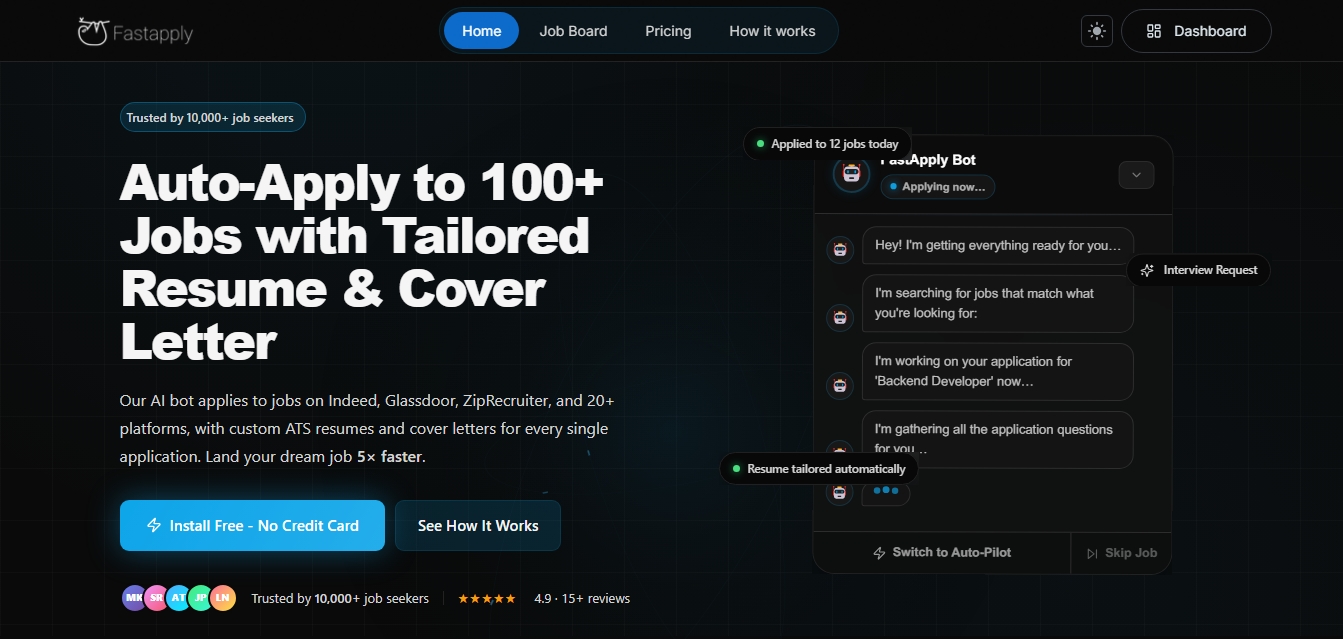
The feature that separates it from fully automated competitors is the human-in-the-loop review step. Before any application goes out, you see the tailored resume, the completed form answers, and the cover letter. You approve, edit, or reject. This converts a 30-minute manual application process into a 3-minute review process without removing you from the loop.
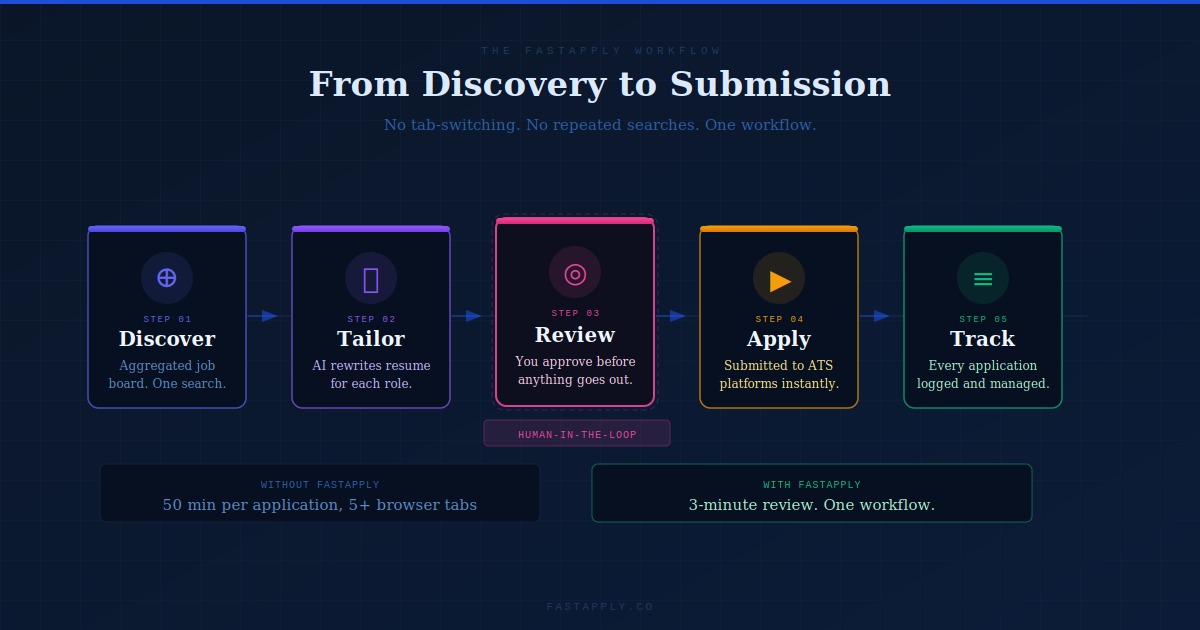
The job discovery side matters too. Most job seekers waste significant time switching between tabs. Indeed open in one window, Ashby in another, Glassdoor in a third, each requiring separate searches. FastApply’s built-in job board aggregates listings from across major platforms and company career pages into a single search interface. You search once, filter by role type, location, and recency, and get a consolidated feed. From that feed, you move directly into the tailoring and application workflow. The full loop runs: Discover → Tailor → Review → Apply → Track, without leaving the extension or managing 10 browser tabs.
For job seekers doing active searches across multiple platforms, that consolidation alone saves a meaningful amount of time each day.
Comparing Costs Across Service Types
| Service type | Monthly cost | Applications per month | Review before submit | Resume tailoring |
|---|---|---|---|---|
| DIY (no tools) | $0 | 20-40 | Yes | Manual |
| Jobscan (optimization only) | $30-$50 | N/A | N/A | Guidance only |
| Simplify | Free | Unlimited | Yes | No |
| LazyApply | $99 one-time | Unlimited | No | No |
| Sonara | $50-$200/mo | Unlimited | No | Limited |
| Human freelancer (Fiverr) | $50-$200/mo | 30-100 | No | Inconsistent |
| Managed agency | $200-$500/mo | 50-150 | No | Variable |
| FastApply | Subscription | Unlimited | Yes | Yes, per role |
The cost column alone does not tell the story. A $50/month service that submits 100 generic applications with no review is worse value than a $30/month tool that helps you send 50 well-targeted applications with full control.
What to Look for in a Job Application Service
Whether you choose AI automation or a human-run service, evaluate any job application assistant against these criteria.
1. Do you maintain control before submission?
This is the single most important question. Any service that submits applications without letting you review them first is a risk. One bad application with a wrong salary expectation, incorrect answer about work authorization, or mismatched job title does more damage than skipping the application entirely.
Look for a tool that shows you what will be submitted before it goes out.
2. Does it tailor or just fill?
Form auto-fill tools save time. AI resume tailoring saves applications. There is a meaningful difference. A tool that reads the job description and adjusts your resume to match that specific role produces better outcomes than one that submits the same resume 100 times.
4. Is your data secure?
For AI tools: check whether your resume data is stored, shared, or used for model training. For human services: assess whether you are sharing login credentials with a third party, and what their data handling policy looks like.
5. Does it include tracking?
Knowing where you have applied, what stage each application is at, and which roles are still active matters for managing follow-up. A job application service with no tracking component forces you to maintain a manual spreadsheet on top of everything else.
Which Type of Job Application Service Is Right for You?
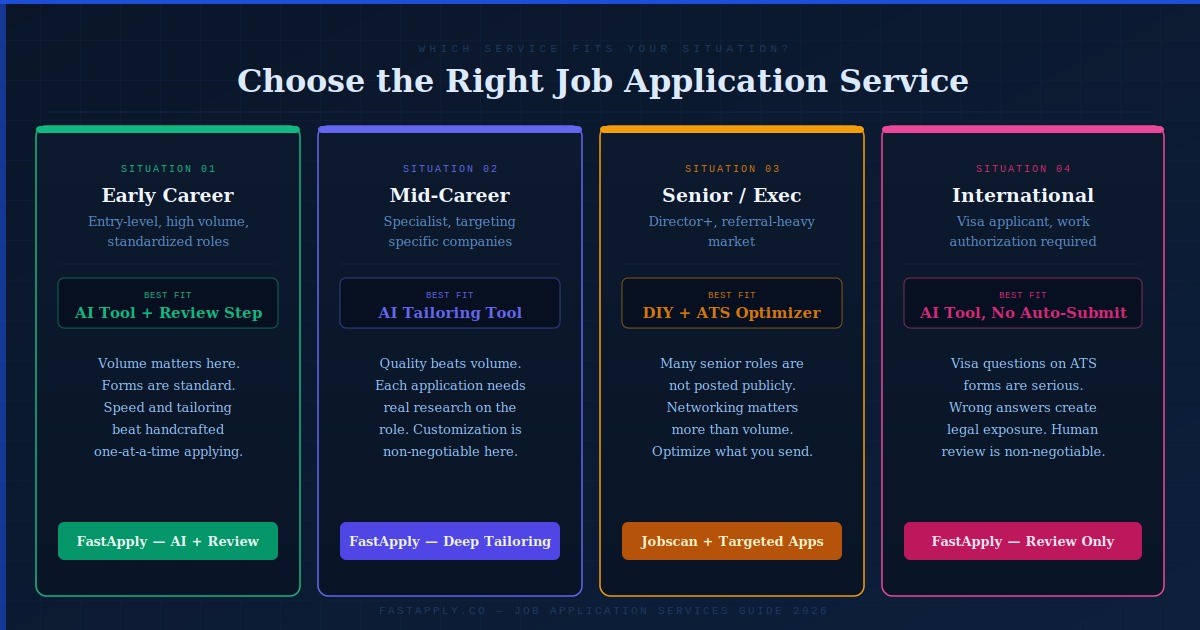
Your situation determines which approach makes sense.
- You are early-career, applying to many standardized roles
Entry-level roles on Indeed and Glassdoor tend to have standardized forms and less nuanced requirements. Speed and volume matter here. A tool like FastApply lets you move through more applications per session without the review step becoming a bottleneck.
- You are a mid-career professional targeting specific companies
At this level, quality beats volume. You probably apply to fewer roles but need each application to land. An AI tool that reads the job description and genuinely adjusts your resume and cover letter outperforms generic volume tools significantly.
- You are a senior professional or executive
At director level and above, companies often do not post roles publicly or use referral networks heavily. Bulk application tools have limited utility. The focus shifts to networking, LinkedIn presence, and targeted outreach. An ATS optimization tool like Jobscan still has value for the applications you do submit, but the strategy is fundamentally different.
- You are burned out and want to outsource everything
If you want to hand off the process entirely, human services are your only real option. But vet the service carefully. Ask for sample applications they have sent on behalf of clients. Confirm they provide logs of submitted applications. Avoid services that cannot show accountability.
- You are an international applicant or have complex work authorization
Work authorization questions on ATS forms are serious. Incorrect answers about visa status, authorization type, or sponsorship needs create legal exposure. Any service that answers these questions automatically without your review is not suitable for this situation.
FAQ
- Is it legal to hire someone to apply for jobs?
Yes, hiring a job application assistant or service is legal. There is no law against having someone help you complete job applications. The practical risk is professional, not legal: if a company discovers you did not write your own cover letter or fill out your own application, it could affect their impression. Most services operate within professional norms as long as the submitted materials accurately represent you.
- Do AI job application tools work?
Results vary significantly by tool and job type. Tools that include AI resume tailoring and keyword optimization produce better callback rates than generic auto-fill tools. A 2023 Jobscan analysis found optimized resumes received callbacks at more than double the rate of unoptimized ones. Tools that submit without review introduce quality risks that offset volume gains.
- What is the “apply for me” service and is it safe?
“Apply for me” services are human-staffed job application services where an operator submits applications on your behalf. Safety concerns include credential sharing, lack of submission accountability, and the risk of generic applications going to companies you care about. For senior roles or specialized industries, these services typically deliver low-quality results. For entry-level bulk applying, the risk-reward balance is more acceptable.
- How do ATS systems detect automated applications?
ATS platforms use several signals to detect non-human submissions: submission speed (filling a 40-field form in under 10 seconds), unusual IP addresses, browser fingerprinting, and behavioral patterns that do not match normal user interaction. Some platforms, including LinkedIn, have active bot detection. Tools that simulate realistic human interaction patterns are less likely to trigger flags, but no tool eliminates this risk entirely.
- How much does a good job application service cost?
AI tools range from free (basic form fill) to $50-200 per month for full-featured AI tailoring and submission support. Human-run services range from $50 per month for freelance operators to $500 per month for managed agency services. The price does not reliably predict quality. Look for services that include resume tailoring, multi-platform coverage, and a review step before pricing becomes the deciding factor.
- Should I use a job application assistant for technical roles?
Technical role applications require care. Coding assessments, technical screening questions, and specific skill declarations on ATS forms need accurate answers. Any service that auto-fills technical screening questions without your review is a risk. AI tools that tailor resumes for technical roles, emphasizing relevant languages, frameworks, and projects, add genuine value. But the review step before submission matters more here than in any other category.
- What happens if a job application service uses my credentials and something goes wrong?
If a human service misuses your credentials, sending applications you did not approve, accessing accounts beyond the scope agreed, or sharing your data, your recourse depends on whether you have a written agreement. Always get terms in writing. For AI tools, read the data handling policy before uploading your resume. Your resume contains personal data (name, address, employment history) that is subject to privacy law in the EU, UK, and increasingly in US states.
The Bottom Line
The job application service market in 2026 offers more options than ever, but the quality gap between the best and worst tools is enormous. Full automation without review is a false economy. It saves time while eroding the quality of every application it touches. Human-run services transfer control but introduce accountability and privacy risks that are hard to manage.
The middle path works best for most job seekers: AI tools that do the heavy lifting on resume tailoring, form filling, and job discovery, while keeping you in the loop before anything gets submitted. That combination lets you run a high-volume search without the recklessness of blind automation.
For most active job seekers, an AI tool with human-in-the-loop review, multi-platform coverage, built-in job discovery, and application tracking delivers the best return on both time and money. That is not about any one product. It is about the architecture of the solution.
The 125 hours of manual application work over a 5-month search is not inevitable. The question is which service structure reduces it without creating new problems in the process.
#job application service
#hire someone to apply for jobs
#job application assistant
#apply for me service

Fastapply Team
Career Experts