LinkedIn Easy Apply vs Direct Company Applications: Which Gets More Interviews in 2026?
LinkedIn Easy Apply changed how people apply for jobs. Instead of spending 20 minutes filling out applications, you can now submit to multiple roles in less than a minute.
That convenience is powerful, especially in a job market where volume matters. But it also means recruiters are flooded with applications faster than ever before. A posting that once received dozens of applicants can now attract hundreds within hours.
Direct company applications are slower and more repetitive, but they often place your application deeper inside the company’s hiring process from the start.
So which approach actually gets more interviews?
This guide breaks down the real differences between LinkedIn Easy Apply and applying directly through company career pages, where each method performs better, how recruiters handle them, and how to decide when speed is helping your search versus hurting it.
What Is LinkedIn Easy Apply and Why Do So Many People Use It?
LinkedIn Easy Apply lets you submit a job application without leaving the platform. You click the blue button, confirm your profile details, attach a resume if required, and submit. The whole process takes under two minutes.
The appeal is obvious. LinkedIn’s Workforce Confidence Index confirmed that application volume has surged to over 14,200 submissions per minute in 2026, a 58% increase from the 9,000-per-minute figure recorded in 2024. Job seekers are applying more than ever, and Easy Apply is the fastest tool available for getting volume up quickly.
But speed has a price.
Q3 2024 saw a 45.5% increase in applications despite a 10.6% decrease in jobs posted. More candidates are chasing fewer roles. When hundreds of people apply to the same job in minutes, standing out becomes significantly harder.
How Recruiters See Easy Apply Submissions
When a recruiter opens their LinkedIn inbox after posting a job with Easy Apply enabled, they often face a flood of applications. As of 2025, LinkedIn saw over 45% growth in applications year-over-year, with many submitted via quick apply tools. Recruiters see your LinkedIn profile, whatever resume you attached, and any screening question answers. They do not see a tailored cover letter or company-specific context unless you added it.
Recruiters typically expect high application counts with a low initial fit rate, often 5 to 20% passing the first automated or human screening step, depending on the role. For highly specialized or senior positions, Easy Apply tends to be supplementary rather than the primary hiring channel.
The Response Rate Problem: What the Data Shows
Here is where the numbers get uncomfortable.
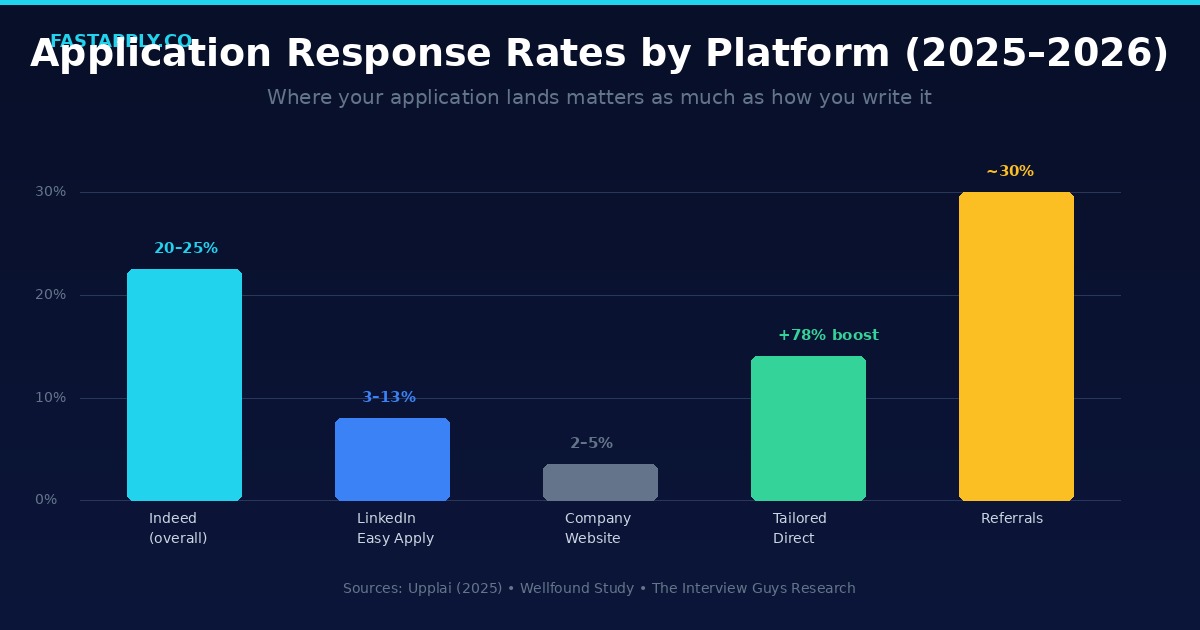
Research reveals that Indeed offers the highest response rates at 20 to 25%, compared to LinkedIn at 3 to 13%, and company websites at 2 to 5%. On its face, that suggests LinkedIn beats company websites. But the comparison is not that simple.
The 2 to 5% figure for company websites reflects all applications, including generic, low-effort submissions. When you apply directly to a company with a tailored resume and relevant cover letter, the numbers shift considerably. According to a study by Wellfound, candidates who tailor their application to each job get 78% higher response rates than candidates who send the same resume to every job.
Research shows direct company applications receive 40% higher response rates than third-party submissions.
The pattern holds across the hiring funnel as well. CareerPlug’s data shows that while job boards produce 60% of all applications, they have the lowest hire rates of any source. Company career pages show significantly higher conversion rates.
Why does this gap exist? An applicant who takes the time to research a role and apply directly through a company careers page is more likely to have spent time considering their own fit for the role and the company, compared to applicants from job boards who are more likely to be sending out dozens of applications in short order.
The ATS Factor
Many applicants assume that company career pages are harder to navigate because they use Applicant Tracking Systems. That assumption misses something important.
75% of resumes are automatically rejected by Applicant Tracking Systems before human eyes ever see them. 97.4% of Fortune 500 companies use ATS technology to screen candidates.
LinkedIn Easy Apply does not bypass ATS systems. Most Easy Apply submissions feed directly into the same ATS the employer uses on their own careers page. The difference is that applicants who go to the company website directly tend to read the job description more carefully, tailor their resume more deliberately, and sometimes find additional context in the careers page that strengthens their application.
When LinkedIn Easy Apply Works in Your Favor
Easy Apply is not always the wrong choice. There are situations where it works well.
-
Early timing matters: LinkedIn data suggests applications submitted within the first 24 hours of a job posting have a 64% higher chance of securing an interview. When you apply to a fresh posting through Easy Apply before the competition floods in, your application gets more attention by default.
-
Role type matters: Technology startups, sales roles, and customer service positions typically see 8 to 15% response rates through LinkedIn, above the platform average. These roles often have higher-volume hiring needs and less intensive screening for each candidate.
-
Your LinkedIn profile does the heavy lifting: For jobs where the recruiter reviews your full LinkedIn profile rather than just a submitted resume, a complete and well-optimized profile substitutes for a tailored application. According to LinkedIn’s 2025 Talent Solutions data, companies with complete, regularly updated Company Pages receive 2x more applicants per posting than companies with inactive profiles. The same logic applies in reverse to candidate profiles.
-
Volume at the right level: The sweet spot is 21 to 80 applications with high customization rather than 100+ generic applications. Quality beats quantity every time. Easy Apply fits into a high-quality search when it is paired with profile optimization and targeted selection, not used as a spray-and-pray tool.
When Easy Apply Hurts Your Chances
For senior roles, specialized positions, and competitive employers, Easy Apply often signals low intent. A hiring manager who receives 400 Easy Apply submissions for a Director of Product role knows that most applicants clicked the button without thinking deeply about fit. Submitting a company-specific application in that context differentiates you immediately.
Multiple open-source projects exist that automatically apply to hundreds of jobs per day. These bot applications rarely include customized cover letters or tailored resumes, making them easy for recruiters to spot and discard. But they still contribute to the intimidating applicant count. When your Easy Apply submission lands in the same pile as hundreds of bot-generated applications, the bar for standing out is higher than most people expect.
Direct Company Applications: The Case For Going to the Source
Applying directly through a company’s careers page takes more time. You create an account, fill out a profile, upload documents, and answer company-specific questions. For a single application, this process takes 20 to 40 minutes instead of 2 minutes.
So why bother?
- Higher Signal of Genuine Interest
Company careers pages are a hugely successful source of hires, but an underutilized source of applicants overall. Recruiters know that candidates who find and navigate a company’s own careers page are self-selected. They wanted this specific job enough to do the work of applying through a less convenient channel.
This signal matters. Hiring decisions are not purely algorithmic. Hiring managers want to know that candidates genuinely want to work at their company, not just any job that matches their title and salary range.
- Better Customization Opportunity
Direct applications almost always give you more space to customize. Cover letter fields. Company-specific questions. Role-specific skills sections. These fields are your opportunity to show that you understand what the company needs and why you fit.
A tailored direct application is not just about keyword matching. It demonstrates that you read the job description carefully, understand the company’s context, and connected your experience to what they are looking for. That effort shows up in interview rates.
- Access to Unlisted Roles
Some companies post roles on their own careers pages that never make it to LinkedIn or other job boards. These openings see far fewer applicants by definition. Applying directly through company career pages gives you access to opportunities that come with built-in competitive advantages because fewer candidates discover these openings through traditional channels.
The Real Issue: Discovery Eats All the Time
Here is the problem nobody talks about when comparing Easy Apply to direct applications.
Before you apply anywhere, you have to find the right jobs. And that search process is exhausting. You open LinkedIn. Then Indeed. Then the company’s own careers page to check for roles not listed elsewhere. Then Greenhouse to see if a startup you follow is hiring. Then back to LinkedIn. You run the same search across four tabs and still feel like you are missing something.
This tab-switching is where most job seekers lose their time and focus. The application method itself, Easy Apply versus direct, matters less than having a reliable process for finding good opportunities in the first place.
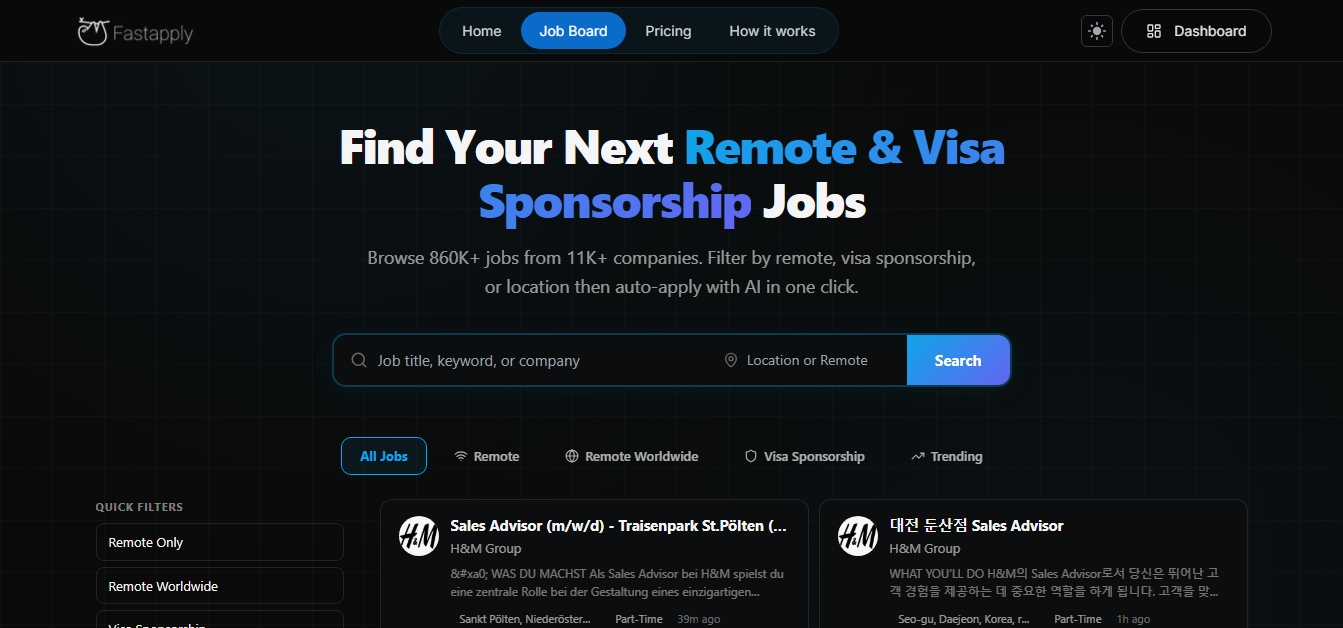
FastApply’s job board addresses this directly. Instead of running duplicate searches across multiple platforms, you search once and get consolidated results that pull from Indeed, Ashby, Greenhouse, Lever, Workday, and other sources in one place. You spend less time tab-hopping and more time reading actual job descriptions and deciding which roles genuinely match your goals.
Once you identify the right roles, the workflow becomes cleaner. FastApply reads each job description, tailors your resume to match the requirements, and brings you into the loop before anything gets submitted. You review the tailored version, make changes, approve it, and submit.
The 30-minute process of switching between platforms, re-running searches, customizing a resume, and submitting becomes a 3-minute review. You are still in control of every application. FastApply just handles the groundwork.
A Practical Framework: When to Use Each Method
Most job seekers do not have to pick one strategy and ignore the other. The smarter approach is knowing which situation calls for which method.
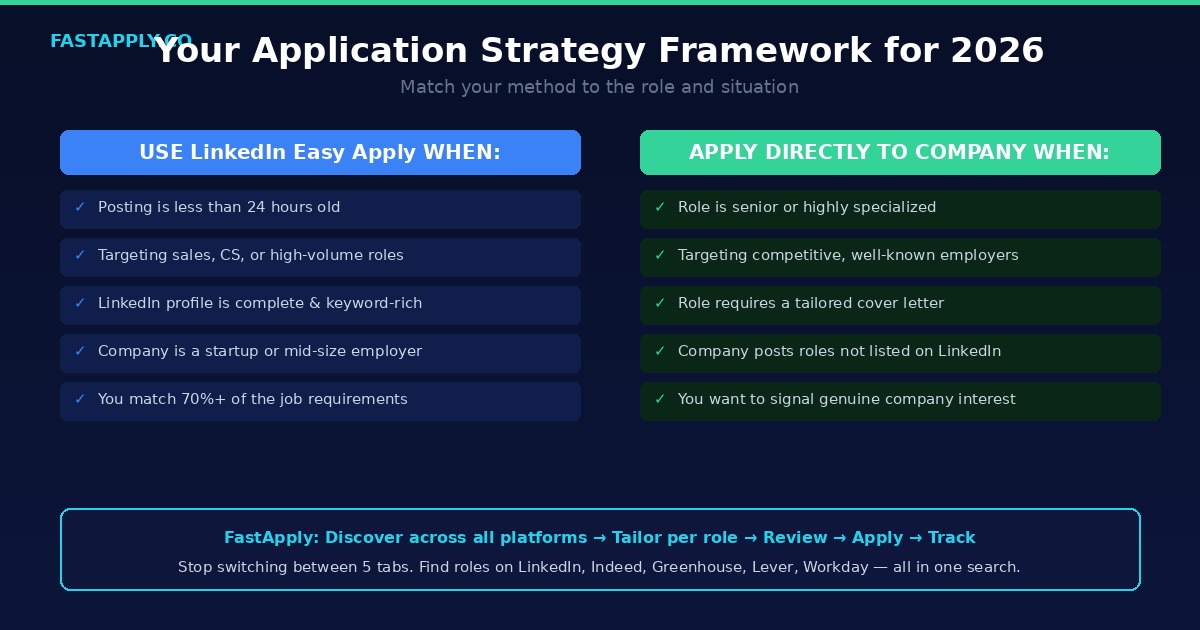
Use LinkedIn Easy Apply when:
- The posting is less than 24 hours old
- You are targeting sales, customer success, or high-volume hiring roles
- Your LinkedIn profile is complete, keyword-optimized, and current
- The company is a startup or mid-size employer with a lean recruiting team
- You have already researched the company and the role fits your background closely
Apply directly through the company’s careers page when:
- The role is senior or specialized
- You are targeting a competitive employer where hundreds of Easy Apply submissions are expected
- The company posts roles on their own site that are not on LinkedIn
- The role requires a cover letter or company-specific answers
- You want to signal genuine interest in that specific company
Combine both when:
- You find the role through LinkedIn but see a more complete job description on the company’s site
- The company uses LinkedIn Easy Apply but also links to their ATS for additional materials
- Your LinkedIn profile is strong AND you have a tailored resume ready for that specific role
FAQ
- Is LinkedIn Easy Apply worth it in 2026?
It depends on how you use it. Easy Apply works well for active candidates who apply early to fresh postings, keep their LinkedIn profile current, and target roles where high-volume hiring is normal. It works poorly for senior roles, competitive employers, and applicants sending generic submissions to hundreds of jobs. Used strategically alongside direct applications, it remains a useful part of a job search.
- Do recruiters treat Easy Apply applications differently?
Some do. Recruiters who manage extremely high application volumes often use filters and keyword screening before reading individual submissions. An Easy Apply application that lacks tailored keywords from the job description is more likely to get screened out early. Recruiters at smaller companies tend to review applications more individually regardless of source.
- Does applying directly on a company website genuinely improve your odds?
The data suggests yes, particularly for tailored applications. Candidates who tailor their application to each job get 78% higher response rates than those who send the same resume to every employer. Direct applications tend to be better tailored because the process requires more effort and engagement with the job description.
- What is the average response rate for LinkedIn jobs?
LinkedIn response rates sit at 3 to 13%, depending on industry. Healthcare and education see higher rates, while tech and finance tend to be lower.
- How many applicants does a typical LinkedIn job get?
It varies significantly. When LinkedIn displays “Over 100 applicants,” the platform is deliberately vague. In late 2023, LinkedIn changed their system to show this generic label instead of specific numbers for any posting with 100 or more clicks. The real competition pool is often smaller, since a meaningful portion of people who start an Easy Apply submission do not complete it.
- Is it better to apply to fewer jobs with more effort or more jobs with less effort?
The research points toward fewer, higher-quality applications. The sweet spot is 21 to 80 applications with high customization rather than 100-plus generic applications. This does not mean avoiding volume entirely. It means making sure each application has enough tailoring to get past initial screening.
- Does LinkedIn Premium improve Easy Apply success rates?
LinkedIn Premium gives you additional tools like InMail and profile visibility features, but it does not directly change how recruiters review Easy Apply submissions. It helps with networking and profile visibility rather than improving the application itself.
#linkedin easy apply worth it
#linkedin vs company website apply
#easy apply success rate
#best way to apply for jobs

Fastapply Team
Career Experts