
OPT Job Search Guide 2026: How International Students Get Hired Before Their Clock Runs Out
The standard OPT timeline begins the moment your EAD arrives. You have a fixed 12-month window to secure employment, with strict limits on unemployment.
This makes OPT a time-bound system where speed, positioning, and consistency matter more than effort alone. It should not be treated like a normal job search.
Most international students make the same mistake. They apply slowly, treat each application as a one-off task, and run out of time before they build real momentum.
This guide breaks down how to approach the OPT job search differently, how to move fast without losing quality, how to target employers that actually sponsor, and how to structure your applications so you get responses before your clock runs out.
Understanding Your OPT Timeline (And What Happens If You Miss It)
Before you send a single application, know your numbers cold.
How Much Time Do You Have?
Standard post-completion OPT gives you 12 months of work authorization. The clock counts from the start date on your Employment Authorization Document (EAD), not from graduation.
STEM OPT extension adds 24 months on top of standard OPT for students who earned a qualifying degree in science, technology, engineering, or mathematics. Total authorization reaches 36 months.
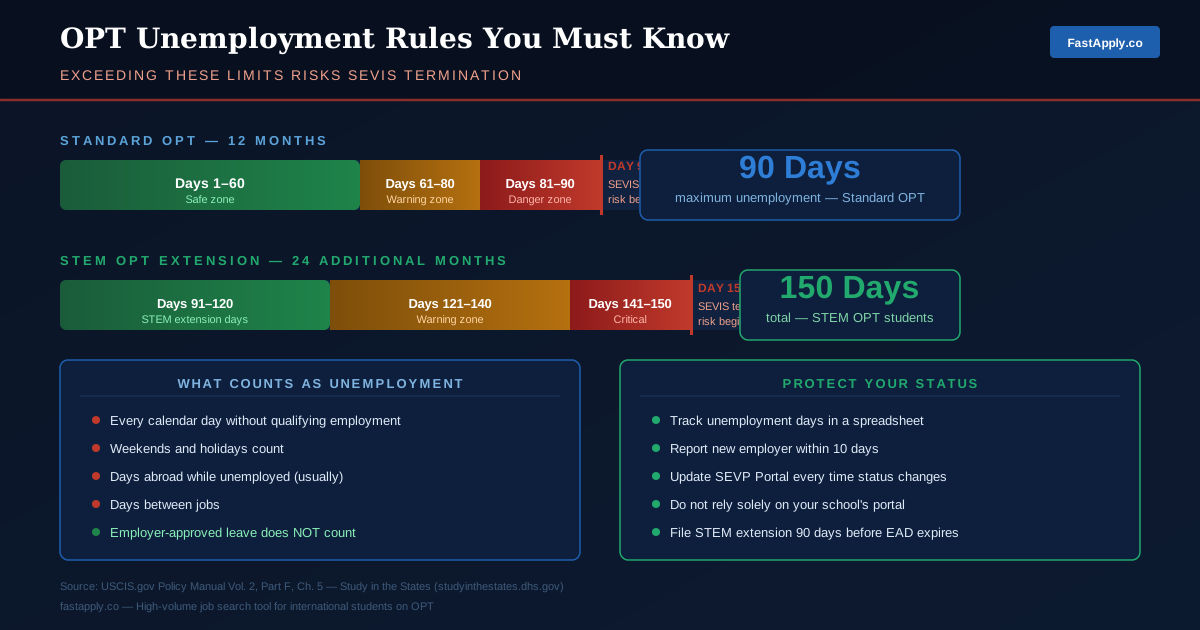
Here is the part most students underestimate: you do not get 12 months to find a job. You get 12 months of authorized work time. Every day you are not employed burns against your unemployment limit.
According to USCIS, F-1 students on post-completion OPT may not accumulate more than 90 days of unemployment. For STEM OPT students, that limit rises to 150 days total across both authorization periods. Exceed either limit and your SEVIS record faces termination.
The 60-Day Grace Period
Once your OPT authorization ends, USCIS provides a 60-day grace period during which you remain in legal F-1 status. You must use this window to either leave the United States, transfer to another SEVP-certified school, or change your nonimmigrant status. You cannot work during this grace period.
This matters for your job search strategy. If you receive a job offer that starts after your OPT end date but within the 60-day window, your employer needs to file an H-1B or other sponsorship petition before the grace period expires.
Why This Makes the OPT Job Search Uniquely Pressured
The stakes are real. In calendar year 2024, 418,781 individuals held active OPT authorization out of 1.58 million F-1 and M-1 students in the United States. All of them faced the same countdown. Most applications go to the same pool of employers. Employers willing to sponsor become the narrow filter through which every OPT job search must pass.
Who Is Hiring OPT Students in 2026?
The data from 2024 shows clear patterns. Computer science majors account for 31% of OPT participants, with engineering at 18% and business at 15%. The top employers of OPT workers are large technology firms: Amazon, Google, Microsoft, and Meta. Large university systems also appear near the top of employer rankings.
This matters because it tells you where the willing employers concentrate. A startup that has never hired an international student before faces a steeper learning curve than a Fortune 500 tech company with a dedicated immigration team.
How to Identify OPT-Friendly Employers
Look for these signals:
-
E-Verify enrollment: STEM OPT employers must be enrolled in E-Verify as a regulatory requirement. If a company is not enrolled, you cannot do STEM OPT there. Check E-Verify participation before investing time in applications.
-
H-1B filing history: The USCIS H-1B Employer Data Hub shows which companies have sponsored H-1B petitions in recent years. Employers who regularly file H-1B petitions are accustomed to the immigration process and more likely to extend that support to OPT students.
-
Job description language: Look for phrases like “sponsorship available” or “we sponsor OPT/H-1B.” Listings that say “must be authorized to work without sponsorship” filter you out before the first interview.
-
Company size and international presence: Larger companies with international offices and existing immigration counsel handle OPT logistics more easily than small businesses navigating it for the first time.
Building Your OPT Job Search Strategy
Speed and precision matter more on OPT than during any other job search. Here is how to structure your approach.
Start Before You Graduate
The single biggest mistake OPT job seekers make is waiting until graduation to begin. You need time in the system to work in your favor, not against you.
Apply for OPT authorization up to 90 days before your program completion date. USCIS takes approximately 90 days to process a standard I-765 application, and the OPT I-20 request window requires you to apply within 30 days of your DSO issuing the recommendation. Miss these windows and you lose authorization days before you start working.
Start your job search during your final semester. Send applications, attend career fairs, and schedule informational interviews while you still have the buffer of your student status. Offers that materialize after graduation give you a start date to plan around with your EAD timeline.
Target High-Volume Applications Without Losing Quality
The reality of the OPT job search is that you need volume. Sponsorship-willing employers represent a smaller fraction of the total market. You need to reach more of them to land the same number of interviews a domestic candidate would get from a shorter list.
Most job seekers underestimate how many applications this requires. The OPT population is no different. Manually customizing each application, tailoring your resume, writing a cover letter, and completing ATS forms takes 20–30 minutes per submission.
Multiply that across hundreds of applications and you face a real time problem. Finding and managing relevant roles across multiple platforms adds another layer of overhead.
This is where FastApply changes the math. The Chrome extension reads each job description and tailors your resume automatically. Keywords from the posting get matched to your experience. Relevant roles and accomplishments surface to the top.
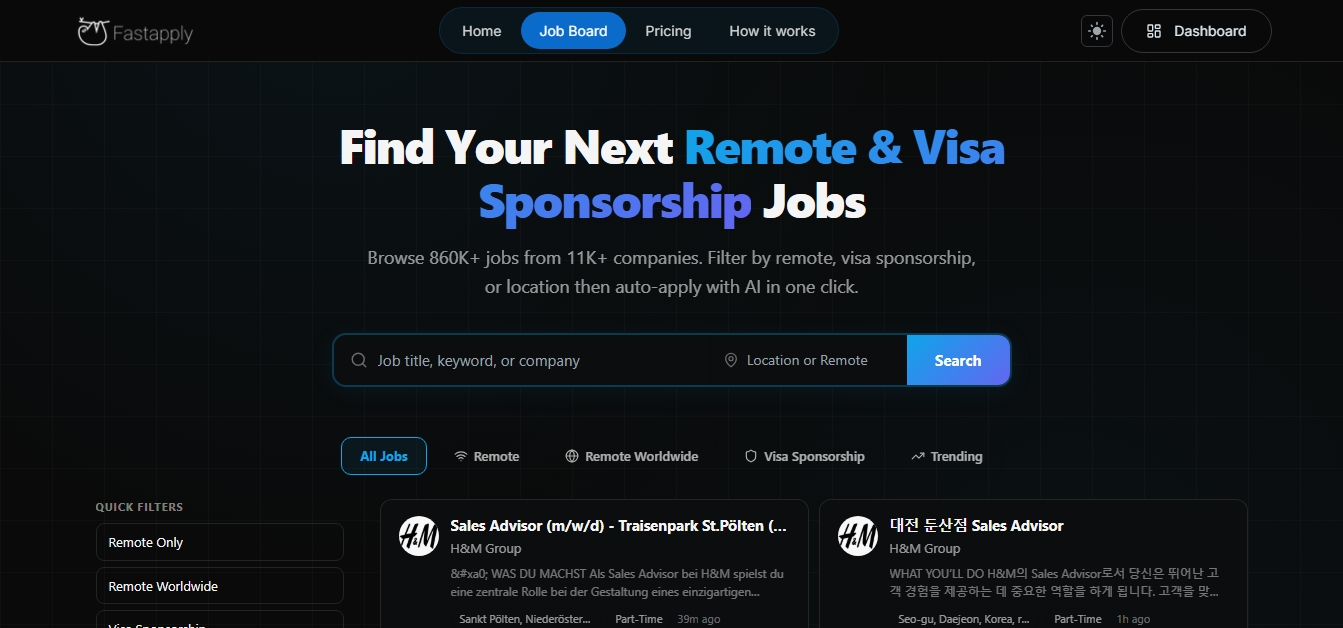
FastApply also simplifies the discovery step by bringing listings from multiple platforms into one place, so you can filter and move directly into applying without repeating searches across tabs.
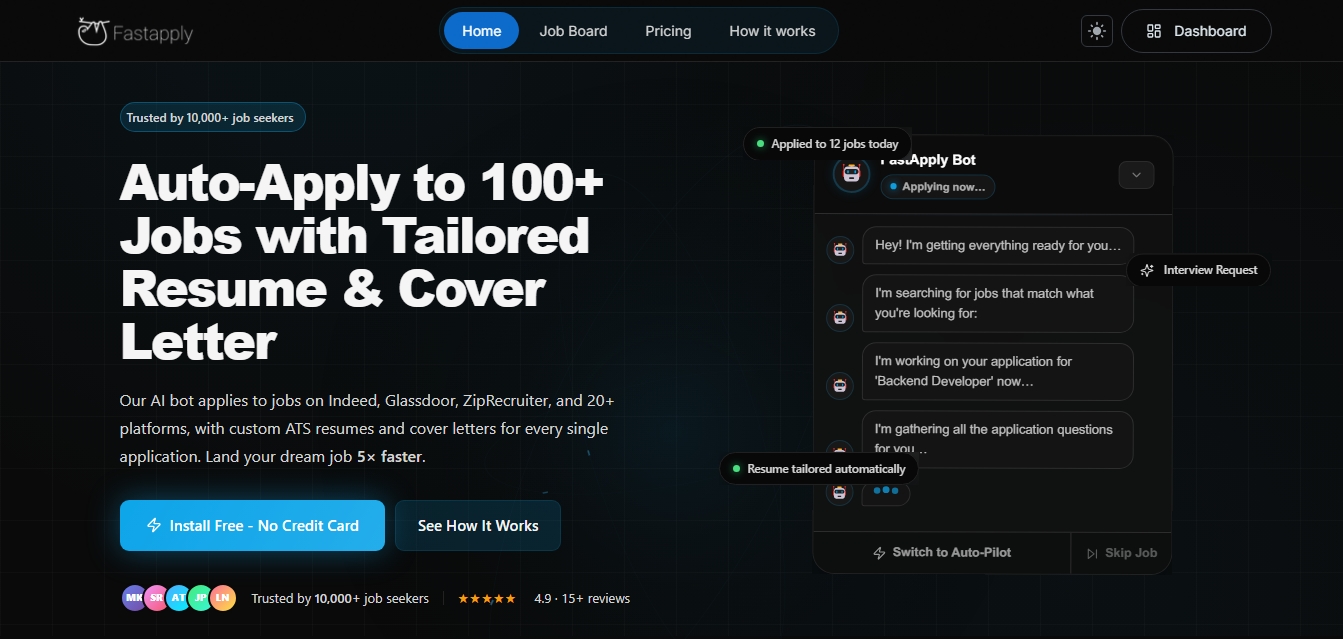
Before submission, you review and approve each application. No application goes out without your sign-off.
What takes 25–30 minutes manually becomes a 3–5 minute review. That difference is what allows you to move from 10 applications a week to 50, without sacrificing quality.
For OPT students working against a fixed timeline and a smaller pool of sponsorship-friendly employers, this is not just a productivity gain. It is a competitive advantage.
Write Your Resume for ATS Systems First
Most large employers, including the tech companies most likely to sponsor OPT students, route applications through Applicant Tracking Systems before a human reads them. Your resume must pass the ATS before it reaches a hiring manager.
Format for machine readability:
- Use a standard single-column layout
- Avoid tables, text boxes, headers, and footers
- Use common section titles: Work Experience, Education, Skills
- Save as a PDF or Word document, not an image file
Tailor for each job description:
- Pull exact keywords from the posting and match them in your resume
- Use the same job title the company uses, not a synonym
- Quantify achievements in numbers wherever possible (reduced processing time by 40%, managed $200K budget, led a team of 5)
Address your authorization status clearly:
- Many ATS systems ask directly whether you require sponsorship. Answer honestly.
- In your resume or cover letter, state your status clearly: “Authorized to work in the US on OPT through [date], eligible for STEM OPT extension”
- This prevents wasted interviews where sponsorship becomes a surprise dealbreaker at the offer stage
Prepare Your Visa Status Pitch
Every hiring manager at a sponsorship-willing company needs reassurance that the paperwork will not derail the hire. Prepare a brief, confident explanation of your status and the path forward.
A practical script: “I am currently authorized to work in the US on OPT through [date]. I am eligible for a 24-month STEM OPT extension, which gives us [X] total months of work authorization. Companies typically file H-1B petitions during that window. The H-1B lottery this year had a selection rate of approximately 35%, so there is meaningful likelihood of approval. My preference is to stay long-term, and I have researched the process to make it as straightforward as possible for your team.”
This approach does several things: it shows you understand the timeline, it demonstrates you have done your research, and it signals that you are not asking the employer to figure out immigration from scratch.
STEM OPT Extension: How to Make Those Extra 24 Months Count
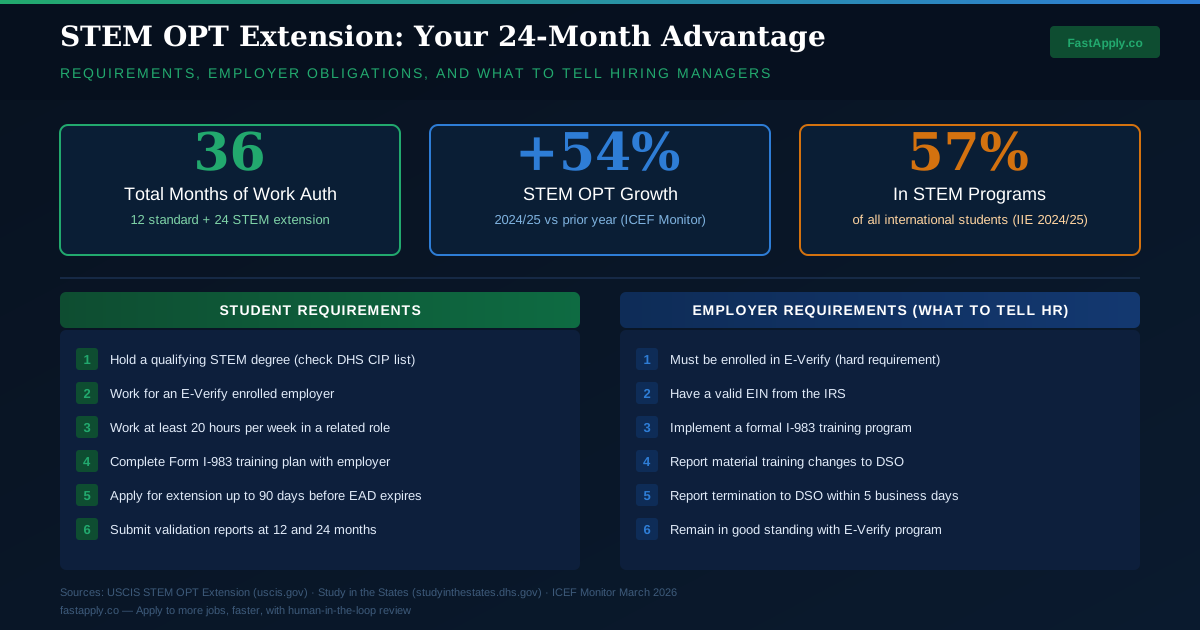
If you earned a STEM degree, your OPT window extends from 12 months to 36. This is a material advantage in your job search and in negotiating with employers.
Do You Qualify?
Your degree must appear on the DHS STEM Designated Degree Program List. Common qualifying fields include computer science, engineering, mathematics, physics, chemistry, biology, and many subfields of each. Check your specific CIP code against the list your DSO maintains.
STEM OPT participation grew 54% in 2024-2025 compared to the previous year. More students now qualify and use this extension, which means employers have more familiarity with the process than they did five years ago.
The STEM OPT Extension Requirements
Your STEM OPT employer must meet specific conditions:
- Be enrolled in E-Verify
- Have a valid Employer Identification Number (EIN)
- Implement a formal training plan using Form I-983
- Report your termination or departure to your DSO within 5 business days
These requirements add compliance overhead for the employer. Address this directly in interviews. Offer to walk HR through the Form I-983 requirements. Many companies balk at STEM OPT simply because the paperwork is unfamiliar, not because they are unwilling to sponsor.
Unemployment Limits on STEM OPT
STEM OPT students may not exceed 150 days of total unemployment across both authorization periods. That 150 days includes any unemployment days you accumulated during your initial 12-month OPT.
Track your unemployment days actively. SEVIS counts every calendar day, including weekends, during which you do not have qualifying employment. Days spent outside the US while unemployed also count in most cases. Do not rely on your institution’s portal to catch you approaching the limit. Build a spreadsheet to help you keep track.
Reporting Obligations
You must report new employment to the SEVP Portal within 10 days of starting. STEM OPT students also face additional reporting milestones at 12 months and 24 months of the extension. Missing these reports puts your status at risk independent of whether you are employed.
H-1B: What OPT Students Need to Know
For most OPT students, the end goal is H-1B sponsorship. The OPT period is your proving ground. Landing a job during OPT, performing well, and demonstrating value to an employer gives you the best possible position for H-1B filing.
The H-1B Timeline
The H-1B lottery registration period typically opens in March. USCIS selects registrants and employers file petitions with a start date of October 1. If your OPT expires before October 1 and you have a pending H-1B petition filed with a change of status request, you qualify for cap-gap protection.
The cap-gap extension bridges the period between OPT expiration and H-1B start. A January 2025 final rule extended the cap-gap period from October 1 through April 1 of the relevant fiscal year, providing additional buffer for students whose OPT and H-1B timelines do not align.
Realistic Selection Rate Expectations
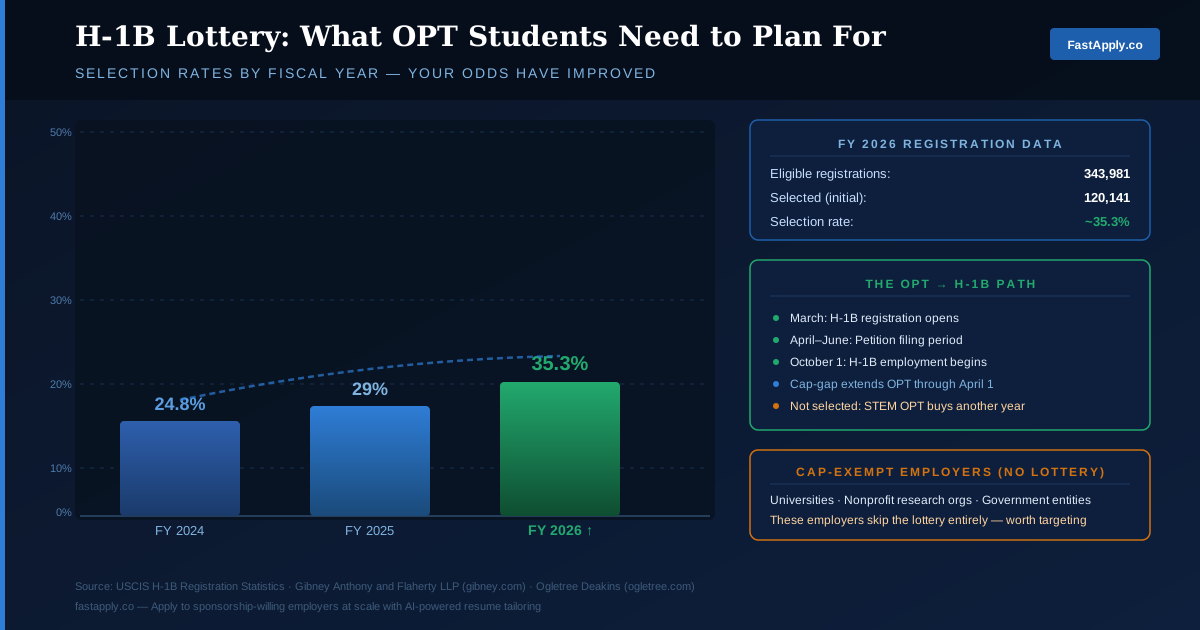
The H-1B lottery is not a guarantee. For FY 2026, USCIS reported a selection rate of approximately 35% among 343,981 eligible registrations. That is better odds than in recent years, but two out of three registrations still do not get selected.
Plan for both outcomes. If your H-1B is selected, you and your employer file the full petition. If it is not, your options include staying on STEM OPT through the next lottery window, applying at cap-exempt employers (universities, nonprofit research organizations, government-related entities), or exploring other visa categories like O-1A for extraordinary ability or EB-2 NIW for national interest.
The Week-by-Week OPT Job Search Plan
-
90 days before graduation: Apply for OPT authorization with USCIS. Begin actively applying to jobs. Target companies in your industry with H-1B filing history.
-
60 days before graduation: Ramp up application volume. Attend virtual and in-person career fairs. Request informational interviews at target companies. Ensure your LinkedIn profile is complete and set to “Open to Work.”
-
30 days before graduation: Follow up on applications. Schedule interviews. Prepare your visa status explanation and H-1B timeline for hiring conversations.
-
Graduation to EAD arrival (approximately 90 days): Continue applying. USCIS processing takes time. Use this window to build your pipeline so you have multiple interviews in motion when authorization arrives.
-
EAD arrives: Start working immediately or on the start date your employer and timeline require. Begin the unemployment clock with employment, not searching. Report your employer to the SEVP Portal within 10 days.
-
Month 9 of OPT (if STEM eligible): File your STEM OPT extension application with USCIS. You must file at least 90 days before your EAD expiration.
-
March of your first full year of OPT: Ensure your employer registers you for the H-1B lottery if that is your long-term path.
Frequently Asked Questions
-
Is it possible to start working before my EAD arrives? No. Work does not begin until USCIS approves your OPT application and you receive your Employment Authorization Document. The EAD includes a start date; you cannot work before that date even if the EAD has arrived.
-
What counts as employment during OPT? Qualifying employment must be directly related to your degree program and require at least 20 hours of work per week. This includes paid employment, multiple part-time positions that together meet the 20-hour threshold, and self-employment in some cases. Volunteer work does not count.
-
What happens if I lose my job during OPT? Your unemployment clock starts the day after your employment ends. You have a maximum of 90 days of unemployment on standard OPT. Report your change in employment status to your DSO and update the SEVP Portal promptly. If you find a new qualifying job before the 90-day limit, the clock resets.
-
Do I need to tell employers upfront that I am on OPT? You do not have a legal obligation to disclose your authorization status before an offer, but most career advisors recommend transparency early in the process. This avoids reaching the offer stage only to lose the role because the company does not sponsor. Early disclosure filters out non-sponsors quickly, which is valuable when your time is limited.
-
What if my OPT expires and I have not found a job? Your 60-day grace period begins. You remain in the US legally for 60 days while you pursue a change of status, transfer schools to start a new program, or prepare to depart. You are not authorized to work during this period. Talk to an immigration attorney about your specific options before the grace period expires.
-
Is applying to the same company multiple times acceptable? Applying to multiple relevant roles at the same company is standard practice. Keep track of what you apply for to avoid duplicate applications to the same role, which flags your profile in their ATS.
-
How do I find employers enrolled in E-Verify for STEM OPT? The E-Verify website maintains a public employer search. Search by company name to confirm enrollment. For STEM OPT, E-Verify participation is a hard requirement, not optional.
This article provides general information about OPT job search strategies. Immigration regulations change frequently. Consult your Designated School Official (DSO) and, where appropriate, a licensed immigration attorney for advice specific to your situation.
#OPT job search
#opt job search tips
#f1 student job search
#opt grace period find job

Fastapply Team
Career Experts