
UK Visa Sponsorship Jobs 2026: How to Find Employers Who Actually Sponsor
Most international job seekers approach the UK market the wrong way. They apply broadly, hope a company offers sponsorship, and only discover later that the employer does not sponsor visas at all.
That approach wastes time quickly in 2026.
UK sponsorship rules have become stricter, salary thresholds have shifted, and many roles that previously qualified no longer meet the requirements for a Skilled Worker visa. At the same time, companies that actively sponsor are receiving far more applications from overseas candidates than before.
The challenge is no longer just finding jobs. It is identifying employers that are genuinely willing and able to sponsor international hires.
This guide explains how UK visa sponsorship works in 2026, how to find employers with active sponsorship pipelines, how to verify sponsorship before applying, and how to focus your search on roles where international candidates actually have a realistic chance.
What Changed for UK Visa Sponsorship in 2026
The biggest mistake international job seekers make is using outdated information. The rules that applied in 2023 or even 2024 are not the rules today. Here is what shifted.
- Salary Threshold
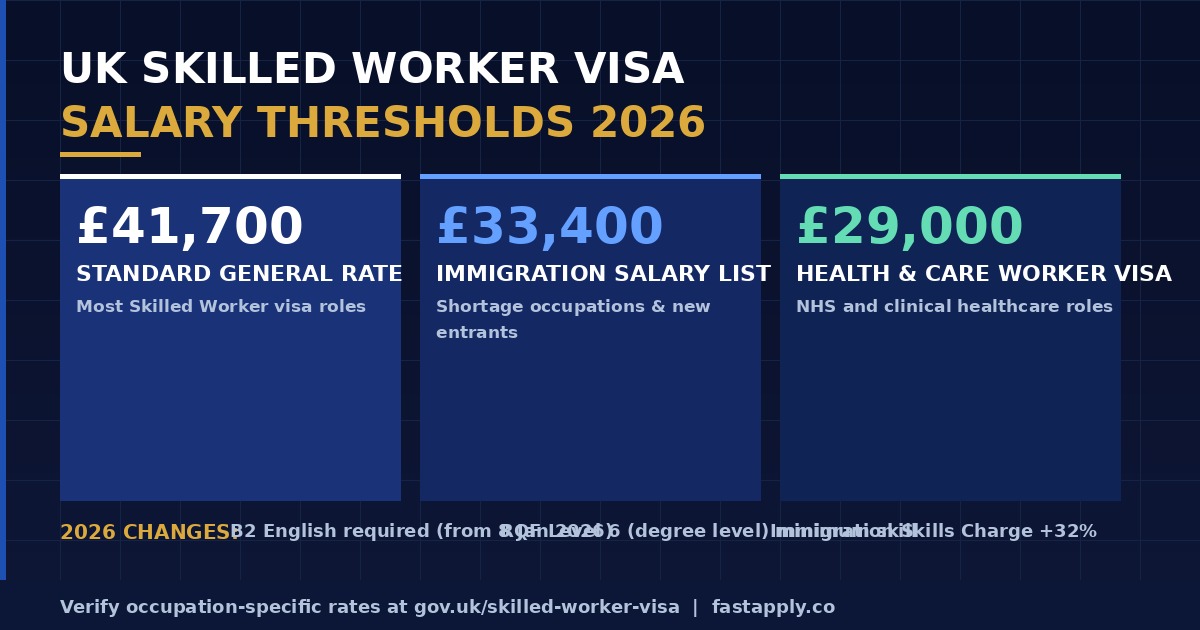
The minimum salary for most Skilled Worker visa roles is now £41,700 per year. This is the baseline. If a role pays less than that, it will not qualify unless the occupation falls into a specific lower-threshold category.
Some exceptions apply. Healthcare and shortage occupations qualify for a discounted threshold of £33,400. New entrants, meaning workers under 26 or switching from a Graduate or Student visa, also qualify at the lower rate.
- Skill Level Requirement
Since July 2025, only roles at RQF Level 6, which is degree level or above, qualify for Skilled Worker sponsorship. This significantly reduced the number of eligible occupations. Sub-degree roles can still be sponsored in limited cases where the occupation appears on the Temporary Shortage List, but that list is under review and the Migration Advisory Committee is expected to publish final recommendations in July 2026 on which sub-degree roles remain sponsorable after December 2026.
- English Language
New Skilled Worker applications made on or after 8 January 2026 require B2 English proficiency on the CEFR scale, up from B1. If you already proved English in a previous successful visa application, you may not need to prove it again for extensions.
- Care Worker Route Closed
The overseas recruitment pathway for care workers and senior care workers closed in July 2025. This route will not reopen. Anyone targeting this sector needs to plan around it.
- Sponsorship Costs Rose
The Certificate of Sponsorship fee increased by 120% to £525. The Immigration Skills Charge rose by 32%. These costs fall on employers, not workers. However, higher costs mean some smaller employers are now reluctant to sponsor roles they previously would have.
How the Skilled Worker Visa Actually Works
Before you search for jobs, understand what you are actually asking an employer to do. This changes how you approach every application.
- The Points-Based System
To successfully apply for a Skilled Worker visa, you must accumulate 70 points. Some criteria are mandatory, others are tradeable. The mandatory points come from having a job offer from an approved sponsor and meeting the skill level requirement. Tradeable points relate mainly to salary.
- The Certificate of Sponsorship
Your employer applies for a Certificate of Sponsorship through the Home Office Sponsorship Management System. Once issued, you receive a reference number to use in your visa application. You cannot begin your application without it.
The CoS is a virtual document with a unique reference number valid for 3 months. The salary listed on it must match what you will actually be paid. Any mismatch is a common reason for refusal.
- What Employers Pay
Employers pay the Immigration Skills Charge at £1,000 per year per sponsored worker, or £364 for small or charitable sponsors. They also assign a Certificate of Sponsorship and must maintain compliance records throughout the sponsorship period.
Employers cannot pass these costs to you. It is illegal for an employer to ask you to pay the sponsor licence fee or Immigration Skills Charge. If a company asks you to cover these costs, walk away.
- Processing Times
You can expect a decision within 3 weeks if applying from outside the UK. Applications made from within the UK can take up to 8 weeks. Priority and Super Priority services cut this to 5 working days or next-day decisions for an additional fee.
How Many Employers Actually Sponsor
The scale of the UK sponsorship market often surprises people. This is not a small, closed club.
The Home Office register includes over 125,522 licensed organisations across all industries and regions of the United Kingdom.
To put that in context: in early 2021, the register listed just 32,019 organisations. The number has nearly quadrupled in five years. Three forces drove this growth: the end of EU free movement, post-pandemic labour shortages, and a temporarily lower skill threshold between 2020 and July 2025.
However, having a licence and actively sponsoring are two different things. A licence alone is not enough. Look for active job postings that explicitly mention visa sponsorship, because many licensed employers are not currently recruiting internationally.
Industries With the Most UK Visa Sponsorship Jobs in 2026
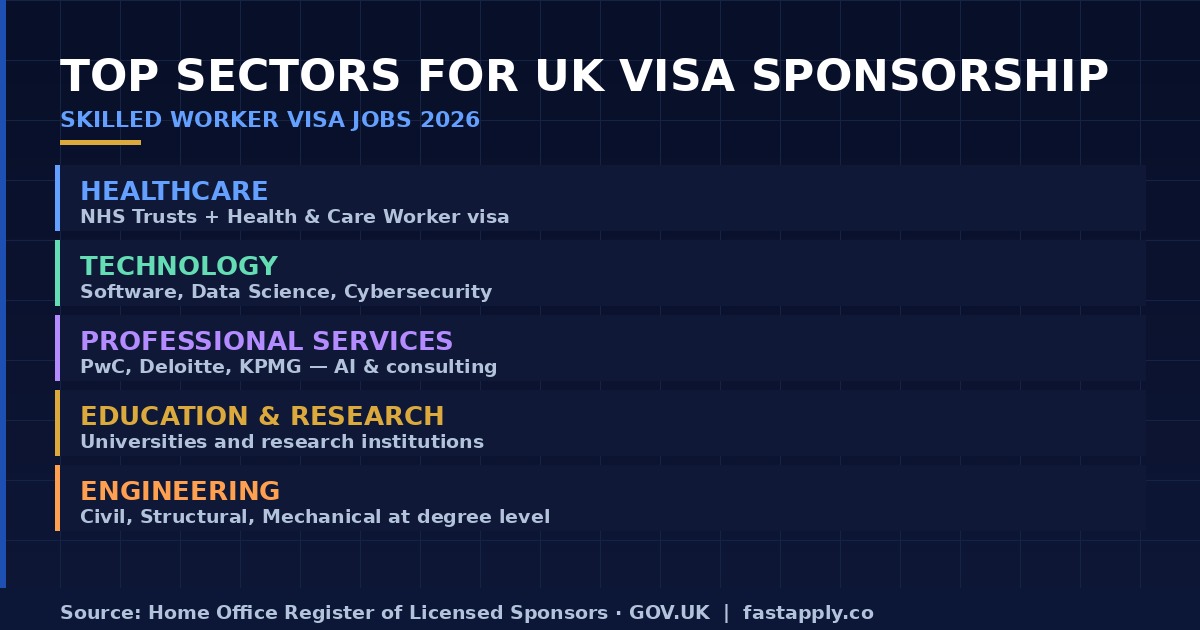
Not all sectors sponsor equally. Targeting the right industries dramatically improves your odds.
- Healthcare
The NHS stands as the UK’s largest employer and visa sponsor, employing 1.4 million staff. Every NHS Trust in England holds a sponsor licence, creating a direct pathway for international healthcare professionals.
The highest demand is in areas like mental health nursing, emergency medicine, oncology, and psychiatry. International recruitment now prioritises roles such as registered nurses, doctors, pharmacists, radiographers, and allied health professionals.
The Health and Care Worker visa is a subcategory of the Skilled Worker visa. It offers lower application fees and a faster process for eligible clinical roles. If you work in healthcare, this is the route to target first.
- Technology
Tech remains one of the most active sponsorship sectors in 2026. Roles in software engineering, data science, cybersecurity, and AI are in consistent demand. PwC, KPMG, and Deloitte are actively sponsoring roles in technology transformation, data architecture, and intelligent automation.
Large tech companies with global operations have established HR processes for international hiring. They sponsor at scale, understand the paperwork, and do not treat each application as an unfamiliar task. This reliability matters.
- Professional Services
PwC processes thousands of visa applications annually. The firm sponsors roles at both entry-level, such as graduate programmes, and for experienced professionals.
Deloitte operates with an A-rated licence and a specialised immigration team that handles thousands of international hires each year. Unlike smaller employers that tackle sponsorship on a case-by-case basis, Deloitte’s structured approach ensures a more consistent experience for international applicants.
- Education and Research
Universities, research institutions, and schools frequently sponsor international talent. Academic roles at degree level or above qualify squarely under the current skill threshold. Many universities hold active A-rated sponsor licences and recruit internationally for both teaching and research positions.
- Engineering and Construction
Structural, civil, and mechanical engineering roles at degree level qualify. The construction sector has faced persistent shortages in senior project and technical roles. Employers in this sector are often smaller than NHS or Big Four firms, but many hold active licences and sponsor regularly.
How to Find Companies That Sponsor UK Visas in 2026
The search strategy matters as much as the target sector. Here is a reliable approach.
Step 1: Check the Government Register
Your employer must hold a valid Skilled Worker sponsor licence issued by the Home Office. You can check whether an employer has a licence on the GOV.UK register of licensed sponsors.
The register is public and searchable. You can filter by company name, location, and industry. Before spending time on any application, confirm the company appears on this list with an A rating.
B-rated employers are unable to issue new Certificates of Sponsorship until they meet the Home Office’s compliance requirements and are upgraded to an A rating. An A rating is non-negotiable.
Step 2: Confirm the Role Meets the New Eligibility Rules
Being on the register is necessary but not sufficient. Even if a company has a sponsor licence, it may not issue new Certificates of Sponsorship for every position. The job description should clearly indicate whether sponsorship is available. If the vacancy states that the candidate must already have the right to work in the UK, the company will not sponsor a visa for a new employee.
Check the salary too. If the salary offered is significantly lower than the threshold and the profession is not included in the list of roles with reduced thresholds, the job will not qualify for a visa.
Step 3: Use Specialised Job Platforms
Generic job boards waste time. Most postings do not clarify sponsorship status, forcing you to apply blind. Platforms built specifically for visa sponsorship jobs filter for this from the start.
Here is where searching for UK visa sponsorship jobs gets genuinely inefficient fast. You switch between the NHS Jobs portal, LinkedIn, sector-specific boards, and direct company career pages. Each platform has its own search syntax. You repeat the same searches across five tabs. You lose track of what you applied to and where.
FastApply solves this problem at the discovery stage. Instead of running fragmented searches across multiple job boards, FastApply’s job board aggregates listings from across platforms in one place. You search once, filter by sponsorship status where available, and see roles across Indeed, Glassdoor, and company career pages without the tab-switching. For a job search where every application requires careful verification, cutting the discovery overhead matters.
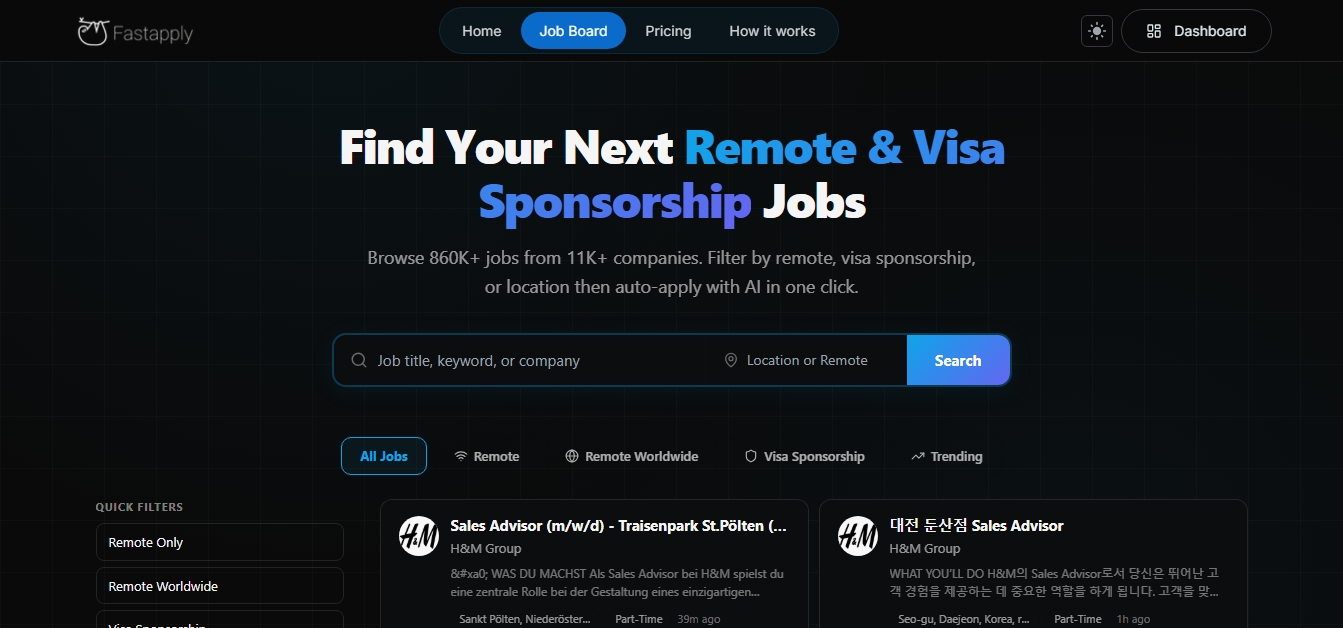
From there, the FastApply Chrome extension reads each job description, tailors your resume to match the role’s keywords and requirements, and pauses before submission so you review everything. A 30-minute application process becomes a 3-minute review. For a search where you need volume without sacrificing the care each application deserves, this is where the time saving shows up.
Step 4: Check Employer Compliance Status
An A-rated sponsor with a clean compliance history is worth more than a marginally higher salary from a company with a shaky record. If a sponsor licence is revoked, all currently sponsored workers have their visas curtailed, typically to 60 days. Choosing a stable, well-established sponsor reduces this risk substantially.
Companies That Sponsor UK Visas: Notable Active Sponsors
This is not an exhaustive list. Every employer’s sponsorship status should be verified against the live GOV.UK register before you apply.
-
NHS Trusts: Every NHS Trust in England holds a sponsor licence. For clinical roles, the Health and Care Worker visa offers a faster and cheaper process.
-
Amazon UK: Amazon UK’s investment plan is creating thousands of new jobs across fulfilment centres and corporate offices. Amazon holds an active sponsor licence for both warehouse and corporate roles.
-
PwC: Consistent sponsor, well-established immigration process, covers Immigration Skills Charge for most roles.
-
Deloitte: Operates with an A-rated licence and a specialised immigration team. Typically covers visa-related costs including the Immigration Skills Charge and Immigration Health Surcharge.
-
KPMG: Active sponsor, currently prioritising AI-driven consulting, data resilience, and technology transformation roles.
-
University NHS Trusts and Academic Medical Centres: Consistent sponsorship for senior clinical and research roles.
-
UK Universities: Most research-intensive universities hold active licences and recruit internationally.
-
BT Group: Active sponsor, though BT Group’s workforce has declined by approximately 7% year on year as the company pursues automation. Confirm active hiring before applying.
Red Flags and Scams to Avoid
A legitimate UK employer will always use an official email address and proper recruitment process. Red flags include: someone selling you a Certificate of Sponsorship, WhatsApp-only recruitment, requests for money to process sponsorship, fake UK company websites, and job offers without interviews.
A real CoS is issued by your employer through the Home Office system. It is not sold. It is not transferable. If anyone offers to sell you one, it is a scam.
FAQ: UK Visa Sponsorship Jobs 2026
- What is the minimum salary for a UK skilled worker visa in 2026?
The standard general salary threshold is £41,700 per year. Roles on the Immigration Salary List qualify at a lower rate of £33,400. New entrants may qualify at 70% of the going rate. Always confirm the specific threshold for your occupation code before applying.
- How do I check if a company is a licensed UK sponsor?
Go to the GOV.UK register of licensed sponsors. Search by company name. Confirm the employer holds an A-rated Skilled Worker licence. Any B-rated sponsor cannot issue new Certificates of Sponsorship until their rating is restored.
- Can my employer charge me for the visa sponsorship costs?
No. Employers pay the Immigration Skills Charge at £1,000 per year per sponsored worker. This charge cannot legally be passed on to you. If an employer asks you to cover sponsorship fees, this is illegal.
- How long does the Skilled Worker visa application take?
You can expect a decision within 3 weeks if applying from outside the UK. Applications made from within the UK can take up to 8 weeks. Priority processing is available for an additional fee and reduces this to 5 working days.
- What English level do I need for a Skilled Worker visa in 2026?
New Skilled Worker applications made on or after 8 January 2026 require B2 English proficiency on the CEFR scale. This is upper-intermediate. You can prove this through an approved Secure English Language Test or an eligible qualification taught in English.
- Does the Skilled Worker visa lead to permanent residency?
Yes. The Skilled Worker visa allows you to work in the UK for up to 5 years, then apply for Indefinite Leave to Remain. After gaining ILR, you can apply for British citizenship after a further qualifying period.
- Can I change employers on a Skilled Worker visa?
Yes. You need a new Certificate of Sponsorship from the new employer and must apply for a change-of-employment visa update. Plan this carefully, particularly around timing, as your current visa is tied to your current employer.
#uk visa sponsorship jobs 2026
#uk sponsor licence list
#companies that sponsor uk visa
#skilled worker visa jobs

Fastapply Team
Career Experts