FAANG Meaning: The 5 Companies and How to Get Hired (2026)
FAANG means Facebook (now Meta), Amazon, Apple, Netflix and Google (Alphabet): five U.S. tech companies grouped into one acronym by CNBC’s Jim Cramer, now used as shorthand for elite tech employers.
That is the FAANG meaning in one line. The rest of this guide covers what people usually want next: the five companies as they stand in 2026, how FAANG relates to MAANG, MAMAA and the Magnificent Seven, what FAANG jobs pay by level (from levels.fyi, retrieved September 2026), and a realistic route from application to offer.
What FAANG stands for
The full form of FAANG is Facebook, Amazon, Apple, Netflix, Google. Each letter is one company. Two of the names have changed since the acronym was coined: Facebook renamed its parent company to Meta in 2021, and Google reorganized under a new parent, Alphabet, in 2015. The acronym never caught up, which is why you still see FAANG in 2026 even though no company called Facebook is on the list.
Here are the FAANG companies today:
| Letter | Company today | Parent company | Founded | Headquarters | Employees (latest filing) | Careers site |
|---|---|---|---|---|---|---|
| F | Meta (formerly Facebook) | Meta Platforms, Inc. | 2004 | Menlo Park, California | 75,472 (June 30, 2026) | metacareers.com |
| A | Amazon | Amazon.com, Inc. | 1994 | Seattle, Washington | about 1.58 million (Sept 30, 2025) | amazon.jobs |
| A | Apple | Apple Inc. | 1976 | Cupertino, California | about 166,000 (Sept 27, 2025) | jobs.apple.com |
| N | Netflix | Netflix, Inc. | 1997 | Los Gatos, California | about 16,000 (Dec 31, 2025) | explore.jobs.netflix.net |
| G | Alphabet Inc. | 1998 | Mountain View, California | 198,933 across Alphabet (June 30, 2026) | Google Careers |
Headcount sources: Meta’s Q2 2026 results, Alphabet’s Q2 2026 results, CNBC’s January 2026 report on Amazon, Apple’s fiscal 2025 Form 10-K and Netflix’s 2025 Form 10-K. Each company reports on its own schedule, so the dates differ.
Together the five employ just over 2 million people, but that total is misleading if you are job hunting. Amazon alone accounts for about 1.58 million of it, mostly warehouse and logistics workers; its corporate and tech workforce is about 350,000, according to the same CNBC report. The engineering hiring pools are far smaller than the headline number suggests.
Where the FAANG acronym came from
Jim Cramer popularized the term on CNBC’s Mad Money in 2013, but the original version was FANG, with only one A. It covered Facebook, Amazon, Netflix and Google, four consumer-internet stocks growing much faster than the rest of the market. Apple was added in 2017, turning FANG into FAANG (NerdWallet’s history of the acronym). That second A is why you will occasionally see the two A’s expanded in either order. Both readings describe the same five companies.
FAANG started as a stock grouping, not a hiring category. It stuck in career conversations because the same five companies also paid the most, ran the most copied interview processes, and carried the most weight on a resume. Today “FAANG” in a job context usually means “top-tier Big Tech employer,” and some people stretch it to include Microsoft and Nvidia.
FAANG vs MAANG vs MAMAA vs Magnificent Seven
The acronym keeps changing for two reasons. Facebook renamed itself Meta in October 2021, which broke the F. And the list of the most valuable U.S. tech companies shifted, with Microsoft and later Nvidia growing large enough that a list without them looked out of date.
| Acronym | Companies | Where it came from |
|---|---|---|
| FAANG | Facebook, Amazon, Apple, Netflix, Google | Jim Cramer, 2013 as FANG; Apple added in 2017 |
| MAANG | Meta, Apple, Amazon, Netflix, Google | FAANG with the F updated after the 2021 Meta rename |
| MAMAA | Meta, Apple, Microsoft, Amazon, Alphabet | Cramer’s own replacement, announced on CNBC in October 2021 |
| MANGA | Meta, Apple, Nvidia, Google, Amazon | A newer career-community variant; definitions vary |
| Magnificent Seven | Alphabet, Amazon, Apple, Meta, Microsoft, Nvidia, Tesla | Bank of America’s Michael Hartnett, May 2023 |
FAANG vs MAANG is the comparison people search for most, and the answer is short: there is no difference in the companies. MAANG is FAANG with Meta’s current name. Tech hiring writing leans toward MAANG, while finance writing and most search traffic still use FAANG.
MAMAA and the Magnificent Seven are investor terms. They drop Netflix, whose market value is much smaller than the others, and add Microsoft (plus Nvidia and Tesla for the Magnificent Seven). If you want the full history of every variant and when to use which, read FAANG vs MAANG vs MAMAA explained.
Is FAANG still a useful term in 2026?
As shorthand, yes. As a description of who is hiring, less than it used to be. The FAANG companies no longer move together:
- Meta cut about 8,000 jobs, roughly 10% of its workforce, starting on May 20, 2026, as it redirected money toward AI (NPR, May 20, 2026). Its own Q2 2026 release reported headcount of 75,472, down 1% year over year, and noted that most of the affected employees would drop out of that count by the end of the third quarter.
- Amazon confirmed 16,000 corporate job cuts on January 28, 2026, bringing its total to about 30,000 since October 2025 (CNBC, January 28, 2026).
- Alphabet went the other way, ending June 2026 with 198,933 employees, up from 187,103 a year earlier.
- Apple and Netflix report headcount once a year. Their latest annual filings list about 166,000 employees at Apple and about 16,000 at Netflix.
So is FAANG outdated? The letters are: there is no Facebook, and Google trades as Alphabet. The grouping is not. These companies still pay at the top of the market (see the tables below), and all five still hire engineers, data scientists and product managers. The practical lesson for 2026 is to treat each company separately. A hiring freeze at one tells you nothing about the other four, and teams tied to AI infrastructure and cloud are hiring while others are cutting.
What FAANG jobs pay
FAANG salary figures are usually quoted as total compensation: base salary plus annualized stock plus bonus. The table below uses U.S. software engineer averages by level from levels.fyi, retrieved on September 11, 2026.
| Company | Entry level | Mid level | Senior |
|---|---|---|---|
| L3: $202K | L4: $287K | L5: $431K | |
| Meta | E3: $180K | E4: $298K | E5: $433K |
| Amazon | SDE I (L4): $191K | SDE II (L5): $274K | SDE III (L6): $383K |
| Apple | ICT2: $168K | ICT3: $238K | ICT4: $378K |
| Netflix | L3: $213K | L4: $325K | L5: $507K |
Sources: levels.fyi software engineer pages for Google, Meta, Amazon, Apple and Netflix, September 11, 2026.
Other common roles pay in the same range. Median U.S. total compensation on levels.fyi, same retrieval date:
| Company | Software engineer | Product manager | Data scientist |
|---|---|---|---|
| $290K | $494K | $296K | |
| Meta | $421K | $502K | $363K |
| Amazon | $265K | $328K | $250K |
| Apple | $320K | $300K | $270K |
| Netflix | $450K | $589K | $485K |
Read total compensation carefully. Base salary is a smaller share than the headline suggests. A Google L5 averages about $230K in base inside that $431K total, and an entry-level Amazon SDE I averages about $143K base inside $191K. Most of the gap is stock, which vests over several years and rises or falls with the share price. Netflix is the exception: its reported packages are almost entirely salary. Two more caveats: levels.fyi data is self-reported, and it skews toward high-cost U.S. cities, so offers in lower-cost locations and outside the U.S. run lower.
How FAANG hiring actually works
There is no shared FAANG application. Each company runs its own portal, and each needs its own account:
- Amazon hires through amazon.jobs, its own system. Interviews are built around its published Leadership Principles, and a “Bar Raiser” from outside the hiring team sits in on the loop.
- Google uses its own careers site. Candidates on Blind consistently report a cap of three applications per rolling 30 days, so choose your strongest matches.
- Apple posts everything on jobs.apple.com, and its process varies more by team than the others.
- Meta lists roles on metacareers.com; many engineering hires interview first and are matched to a team afterward.
- Netflix lists roles at explore.jobs.netflix.net and, with about 16,000 employees, hires in far smaller numbers than the other four.
The funnel looks similar across all five:
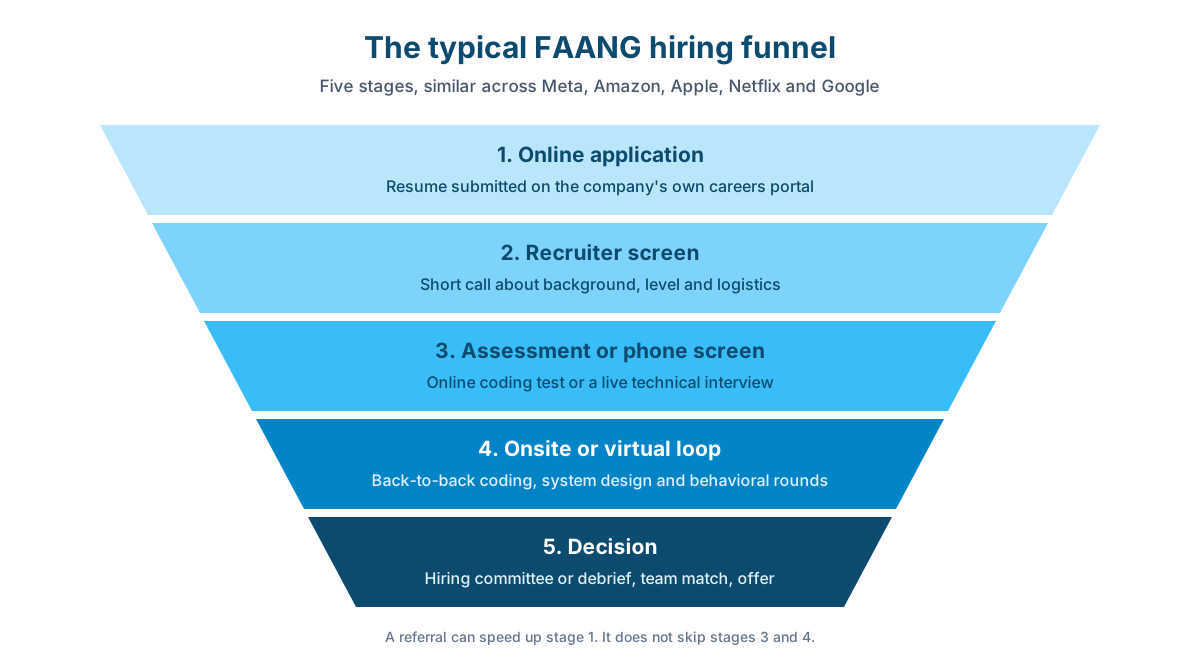
| Stage | What happens | What decides it |
|---|---|---|
| 1. Online application | Resume submitted on the company portal | Match between your resume and the posting’s requirements |
| 2. Recruiter screen | Short call about background, level and logistics | Fit for the level and role, salary and location alignment |
| 3. Assessment or phone screen | Online coding test or a live technical interview | Correct, clearly explained solutions |
| 4. Onsite or virtual loop | Several back-to-back interviews: coding, system design, behavioral | Consistent signal across interviewers |
| 5. Decision | Hiring committee or debrief, then team match and offer | Written interviewer feedback, not a single interviewer’s opinion |
What a referral changes, and what it does not. A referral from a current employee usually gets a recruiter to look at your resume sooner, which matters when a posting draws thousands of applicants. It does not skip interviews, lower the bar, or override a weak loop. Treat referrals as a way past step 1, and put your preparation time into steps 3 and 4.
How to get hired at a FAANG company
Pick the right level and role
Level names differ, but they map to each other. Applying at the wrong level is one of the most common reasons strong candidates get rejected or down-leveled.
| Level band | Meta | Amazon | Apple | Netflix | |
|---|---|---|---|---|---|
| Entry | L3 | E3 | SDE I (L4) | ICT2 | L3 |
| Mid | L4 | E4 | SDE II (L5) | ICT3 | L4 |
| Senior | L5 | E5 | SDE III (L6) | ICT4 | L5 |
| Staff | L6 | E6 | Principal (L7) | ICT5 | L6 |
As a rough guide, levels.fyi’s reported median experience at the senior band is 8 years at Google and Meta and 10 years at Amazon, Apple and Netflix. If you have 3 to 5 years, the mid band is usually the realistic target.
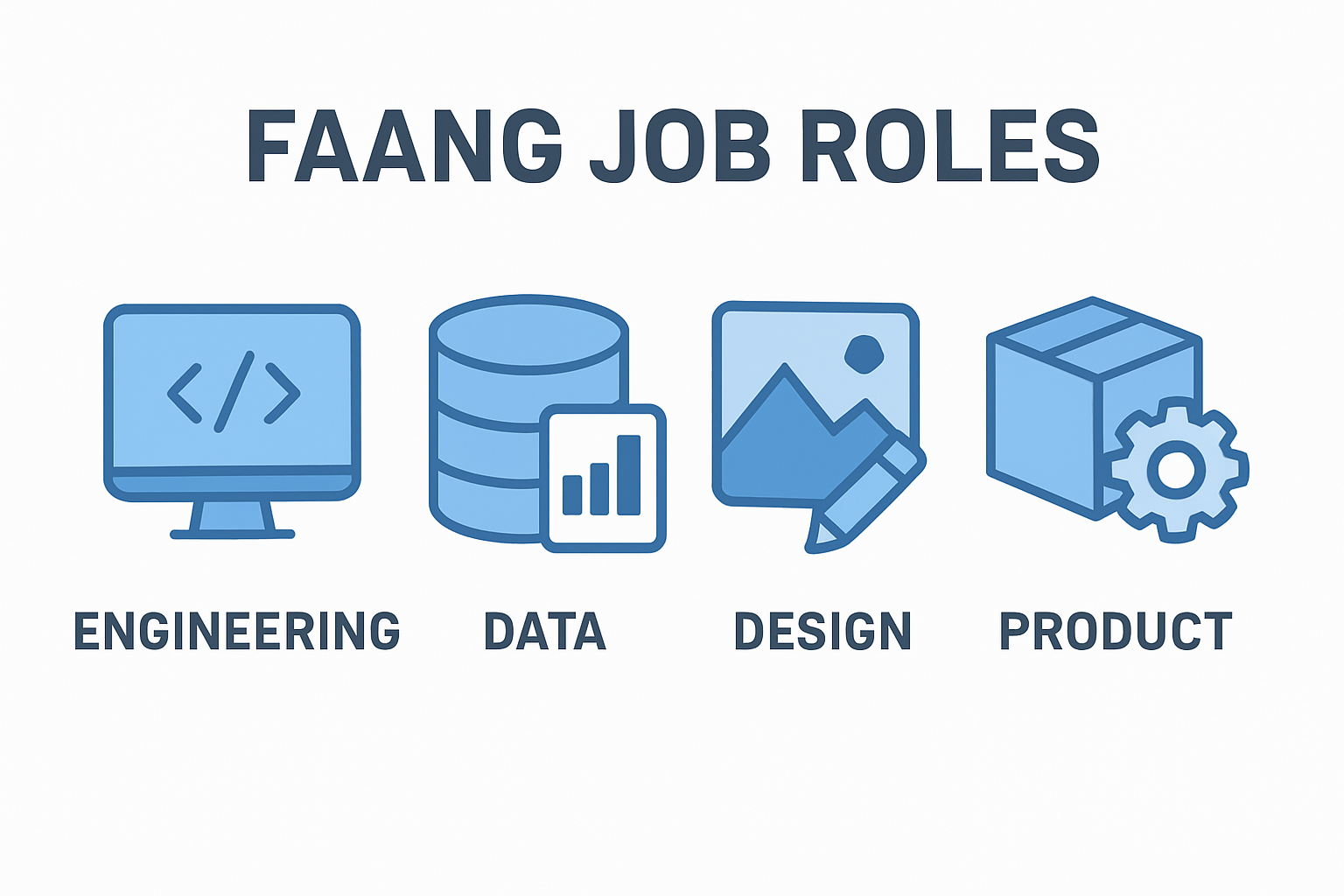
Engineering dominates FAANG jobs, but data science, machine learning, product management, design, security and cloud infrastructure all hire at scale, alongside sales, operations, finance and legal.
Get past the application step
Tailor the resume to each posting. Recruiters at Amazon and Google review applicants inside their own systems and search by the language in the posting, so a resume that uses the posting’s terms for your real experience gets found more often. Our ATS resume format guide covers what parses cleanly.
Apply to every relevant opening across all five, not one dream role. A single application to a single team is a lottery ticket. Build a shortlist across all five portals and submit in one sitting. Our guide on how to apply to all five FAANG companies in one day lays out the order and setup.
The slow part is typing the same work history, education and work-authorization answers into five different portals. The FastApply auto-apply extension fills those repeated fields automatically and, on the Pro and Elite plans, tailors your resume to each posting, so what is left for you is the handful of role-specific questions that actually differ.
Prepare for the loop
Interview prep takes months, not weekends. One resource per round is enough to start:
- Coding: LeetCode, working through problems by pattern (arrays, graphs, dynamic programming) rather than at random.
- System design: the free System Design Primer on GitHub, which covers the building blocks mid and senior loops expect.
- Behavioral: Amazon’s Leadership Principles. Even if you are not interviewing at Amazon, writing one STAR story for each principle gives you material for every behavioral round at the other four.
Company-specific loops differ in the details. For one worked example, see how to get a job at Google, which covers hiring committees and the signals interviewers score.

Without a CS degree
A computer science degree is common at FAANG companies, but most of their engineering postings ask for a CS degree or equivalent practical experience. What replaces the degree is evidence: shipped projects, open-source contributions, or several years of engineering work at a smaller company that shows you can do the job at the level you are applying for.
The most reliable routes are a lateral move from an adjacent role (support engineering, QA, data analysis, IT) or a first engineering job elsewhere followed by a move at the mid level. The full plan is in our guide to how to get a FAANG job without a CS degree.
If you are applying from outside the U.S., all five have sponsored H-1B visas, and you can look up any employer’s approval history on the USCIS H-1B Employer Data Hub. Start with the best visa sponsorship job boards for 2026 to find sponsor-confirmed openings.
Frequently Asked Questions
What does FAANG stand for?
FAANG stands for Facebook, Amazon, Apple, Netflix and Google. The meaning of FAANG today is Meta (formerly Facebook), Amazon, Apple, Netflix and Alphabet (Google). Jim Cramer popularized it on CNBC in 2013 as FANG, and Apple was added in 2017.
Is Microsoft a FAANG company?
No. Microsoft is not one of the five FAANG companies. It is in MAMAA (Meta, Apple, Microsoft, Amazon, Alphabet), the replacement acronym Jim Cramer announced in 2021, and in the Magnificent Seven. In everyday career talk, many people treat Microsoft as FAANG-tier because its pay and hiring bar are similar.
What is the difference between FAANG and MAANG?
There is no difference in the companies. MAANG is FAANG with the first letter updated after Facebook renamed its parent company to Meta in 2021: Meta, Apple, Amazon, Netflix, Google. FAANG remains the more widely searched version.
How much do FAANG engineers make?
U.S. software engineer total compensation on levels.fyi (September 2026) averages about $168K to $213K at entry level and about $378K to $507K at senior level, depending on the company. Medians range from about $265K at Amazon to about $450K at Netflix. Stock makes up a large share of the total everywhere except Netflix.
How hard is it to get a FAANG job?
Hard, mainly because each posting draws a large volume of applicants and the interview loop tests coding, system design and behavioral skills over several rounds. Most successful candidates prepare for months, apply to many roles across all five companies rather than one, and apply at the level that matches their experience.
Can I apply to all FAANG companies at once?
Not through one form, because each company runs its own careers portal with its own account. You can apply to all five in one sitting by preparing one resume and one plain-text work history, shortlisting roles across all five portals first, then submitting in a single batch. Auto-fill tools like FastApply handle the repeated fields.
Conclusion
FAANG means Facebook (now Meta), Amazon, Apple, Netflix and Google, and in 2026 it works best as shorthand for top-paying tech employers rather than a group that hires in lockstep. The candidates who get in pick the right level, tailor each application, and apply broadly across all five portals instead of waiting on one dream role.
When you are ready, install FastApply free and apply to open FAANG roles today with a tailored resume for each. The first 5 applications are free, no card required.
Related guides
- FAANG Jobs 2026: How to Apply to All 5 in One Day
- FAANG vs MAANG vs MAMAA: Big Tech Acronyms Explained
- How to Get a Job at Google in 2026
- How to Get a Job at Amazon in 2026
- How to Get a Job at Meta in 2026
- How to Get a Job at Apple in 2026
- How to Get a FAANG Job Without a CS Degree
- Best AI Job Search Tools in 2026
#faang meaning
#what is faang
#what does faang stand for
#faang full form
#faang companies
#faang vs maang
#faang jobs
#faang salary
#FAANG

FastApply Team
Career Experts