Why Am I Not Hearing Back from Jobs? The Truth About ATS Filters and Employer Ghosting in 2026
The most frustrating part of job hunting in 2026 is not rejection, it is silence.
You tailor your resume, write the cover letter and submit the application. Then nothing happens.
No response can mean several different things: your resume failed an ATS screen, a recruiter never reached your application, the role was overwhelmed with applicants, or the company simply ghosted.
Ghosting is becoming more common, not less. More than half of job seekers reported being ghosted in the last year alone.
This guide explains where applications actually go after you hit submit and how to improve your chances of hearing back.
The Volume Problem: You Are Competing Against Hundreds of People
Before we talk about ATS, let’s start with the most uncomfortable truth.
In 2024, employers received an average of 180 applicants for every hire they made, based on an analysis of over 10 million job applications at 60,000+ small businesses. At larger companies and for remote roles, that number climbs far higher. Entry-level and customer service roles average 400–600 applicants. Remote tech and support jobs often exceed 1,000 applicants in the first week. Software engineering roles can hit 2,000+ before screening begins.
That is not a typo. Two thousand resumes, one job opening.
Recruiters are not ignoring you personally, they are drowning. Internal Greenhouse data shows that recruiter workload increased by 26% in the past quarter alone, partly because AI tools have made it easier than ever for candidates to apply for jobs, with 38% of job seekers mass-applying to roles.
When a single recruiter manages 50 open roles and hundreds of daily applications, something has to give. What gives is communication. In a survey of 1,024 candidates, the top reason for ghosting was “after submitting my application” (28%), followed by “after one interview” (20%) and “after an initial phone screen” (16%).
This means most ghosting happens right at the point where your resume hits the inbox, before you ever speak to anyone. Your application disappears into what job seekers call “the black hole.”
What ATS Actually Does (And What It Does Not Do)
Here is where a lot of job seekers get the wrong idea.
The popular claim that “75% of resumes are automatically rejected by ATS before a human ever sees them” is widely repeated on LinkedIn and TikTok. But this statistic traces back to a defunct company that has not been in business since 2013, and it has been professionally debunked by HR experts and consultants.
The truth is more nuanced and actually more useful to understand.
What ATS Does
An Applicant Tracking System is software that helps companies organize and manage large numbers of applications. ATS platforms allow recruiters to filter for certain candidates (such as those with 2+ years of experience), score candidates based on set criteria, and track the progress of applicants through the hiring process.
Nearly 98% of Fortune 500 companies use ATS platforms as part of their recruiting process. But here is the part that matters for you as a job seeker.
What ATS Does Not Do (Usually)
A 2025 study by Enhancv interviewed 25 U.S. based recruiters across industries and found that 92% confirmed their ATS platforms do not auto-reject resumes based on formatting, design, or content. Only 8% said their system was configured to automatically reject resumes based on content or match scores.
While 44% of systems offer AI “fit scores,” 56% of recruiters either disable the feature or disregard it. Only 8% use it as a hard filter.
So ATS is not the mechanical gatekeeper most people imagine. It does not scan your resume, award you a score of 47 out of 100, and automatically dump you in the trash.
What ATS Does That Actually Hurts You
There are two real ATS-related ways your application disappears.
-
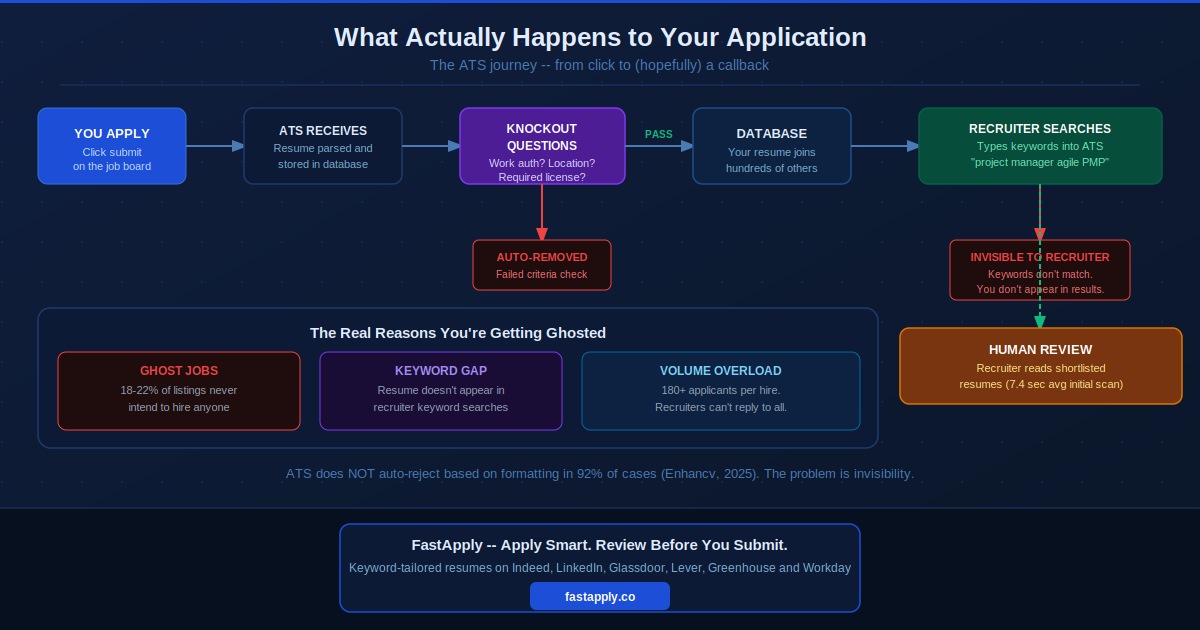
Knockout questions: 100% of recruiters use eligibility filters, such as work authorization status, required licenses, or location to screen candidates, but these are compliance checks, not formatting tests. If you answer “No” to “Are you authorized to work in the US?” you are out immediately, regardless of your resume quality.
-
Search and keyword matching: After your resume is stored in the system, recruiters search it. According to Jobscan’s State of the Job Search 2025 report, 99.7% of recruiters use keyword filters in their ATS to sort and prioritize applicants. If your resume does not contain the exact words or phrases the recruiter searches for, you do not show up, even if you have the exact skills they need.
This is the real ATS problem, not auto-rejection or invisibility.
Why Your Resume Is Invisible: The Keyword Gap
Imagine a recruiter opening Workday or Greenhouse and typing “project manager PMP agile” into the search bar. If your resume says “led cross-functional teams using iterative delivery methods” instead of “PMP-certified project manager with agile experience,” you will not appear in results.
ATS systems do not always recognize synonyms, abbreviations, or alternative wording. If your resume says “Adobe Creative Cloud” but the job description says “Adobe Creative Suite,” your resume might not appear in search results, even though you have the exact skill set they want.
This is why tailoring your resume to each job posting is not optional, it is the baseline.
How to Close the Keyword Gap
-
Mirror the job description language: Read every job posting carefully. ATS keywords can include words that identify qualified candidates based on education, skills, experience, and the industry or position. Look for terms that appear more than once in the posting and use them in your resume, naturally and truthfully.
-
Use both acronyms and full terms. Include long-form and acronym versions of important terms, for example, “Search Engine Optimization (SEO)” or “Customer Relationship Management (CRM)”, because ATS systems do not always equate one with the other.
-
Add a dedicated Skills section: A skills section provides a clear, concise way to highlight your most relevant abilities to the ATS. Without one, the ATS may not recognize your qualifications even if they appear elsewhere in the document.
-
Fix your file format. Plain .docx format has the lowest parsing failure rate at just 4%, while PDF carries an 18% failure rate. Text boxes, tables, and multi-column layouts dramatically increase your odds of being misread or ignored.
-
Keep contact info out of headers and footers. Not all ATS platforms can properly read information stored in headers or footers. One study confirmed the ATS was unable to identify contact information 25% of the time when it was placed in a header or footer.
The Ghost Job Problem: Applying to Positions That Do Not Exist
Here is a reason you may be getting no response that has nothing to do with your resume at all.
About 81% of recruiters said their employer posts “ghost jobs”, roles that either do not exist or have already been filled.
Why? About 38% of recruiters reported posting fake positions to maintain a presence on job boards when they are not actively hiring, 36% did so to assess the effectiveness of their job postings, and 26% hoped to gain insight into the job market and competitors.
Greenhouse data shows that in any given quarter, 18–22% of the jobs posted on their platform are classified as ghost jobs.
If you are applying to a ghost job, no amount of resume optimization will get you a response.
Signs a Job Posting May Be a Ghost
According to Jobright analysis of 4.4 million job applications:
- Jobs that send you through a redirect maze during the application process result in ghosting 83% of the time.
- When a company keeps deleting and reposting the same job, they are 78% more likely to ghost.
- Job descriptions shorter than a tweet correlate with ghosting 92% of the time.
If you see these patterns, move on quickly. Do not invest hours customizing your application.
The Timing Problem: When You Apply Matters
Even a perfectly optimized resume gets buried if it arrives too late.
52% of recruiters say applying within the first 48–72 hours significantly boosts visibility, as many pause postings or fill shortlists early.
Most job seekers wait. They see a posting, they think about it, they spend two days perfecting their resume, and then they submit. By then, the recruiter has already shortlisted their first 20-30 candidates and is not reviewing new applications with the same attention.
Speed does not mean carelessness. It means having a strong, tailored resume ready to go so you can apply fast.
The Quality vs. Volume Trap
Here is the frustrating math of the modern job search.
Research shows many job seekers submit anywhere from 32 to over 200 applications before receiving an offer, with most online applications resulting in a 0.1%–2% success rate. Before you conclude that something is wrong, check your numbers against what a normal application-to-interview ratio looks like.
You need volume. But you also need tailoring. Sending the same generic resume 200 times is not a strategy, it just generates 200 rejections faster.
And yet, spending 30-45 minutes tailoring your resume and cover letter for every application is not sustainable either. The average active job seeker cannot realistically customize 100 applications at that rate without burning out.
This is the trap most job seekers are stuck in: not enough applications to get traction, or not enough tailoring to get responses.
Tailoring resumes works, but it takes forever. Spending 20-30 minutes tailoring each resume means 50-100 hours just on resume customization during an active search, and that is before you account for the time spent searching across multiple job boards, opening dozens of tabs, and filtering through duplicate or irrelevant listings.
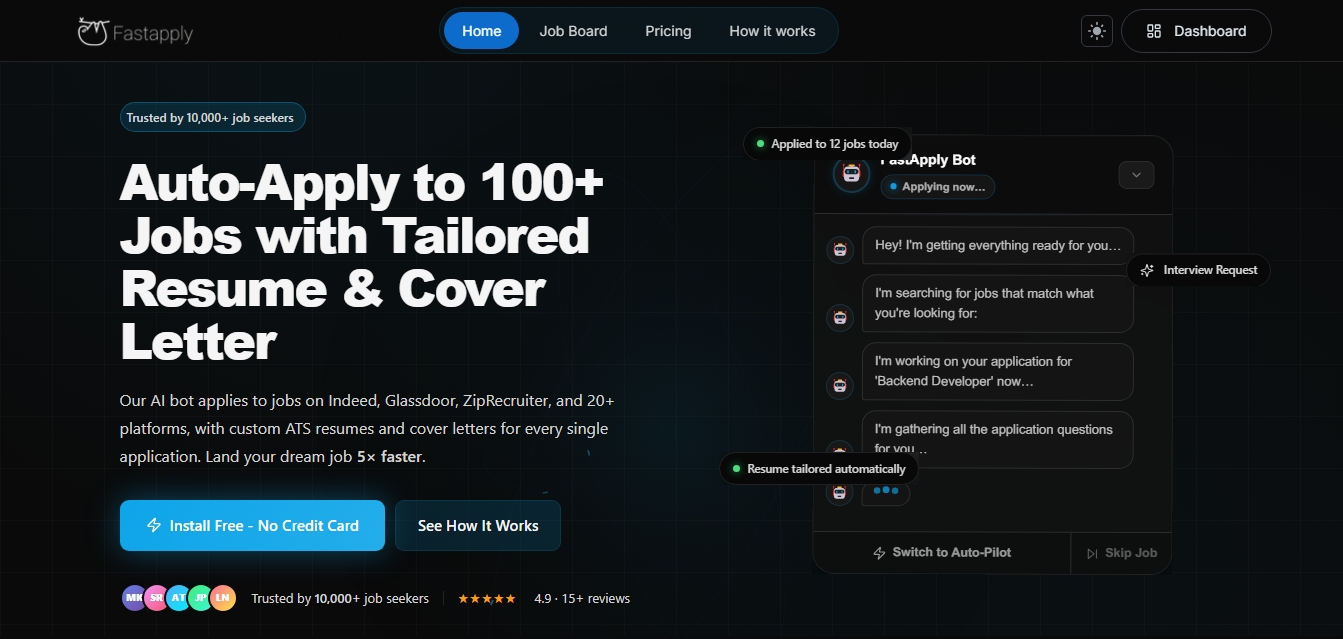
FastApply solves the quality vs. volume problem directly. The Chrome extension reads each job description and automatically tailors your resume to match. Keywords get aligned to the posting. Relevant experiences move to the top.
It also simplifies job discovery by bringing 800,000+ listings from multiple platforms into one place, so you can find relevant roles and move directly into applying without repeating the same searches across tabs.
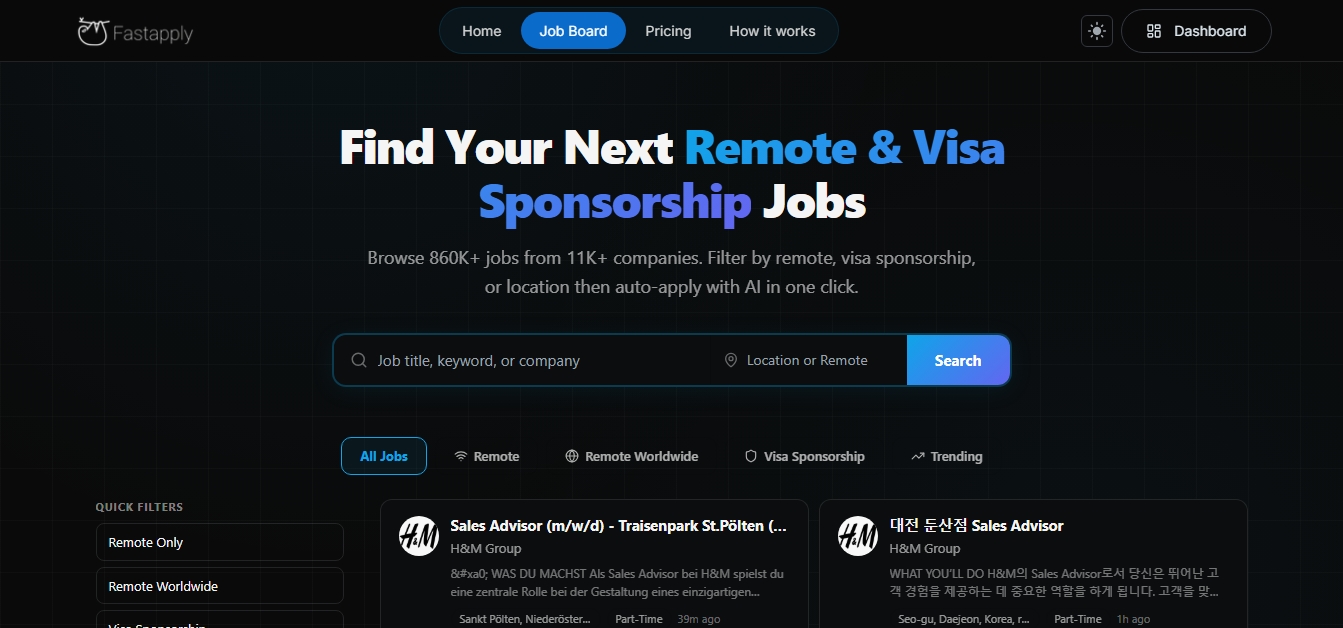
Before submission, FastApply pauses. You review the tailored resume, make adjustments if needed, and approve. A 30-minute manual tailoring process becomes a 3-minute review. You apply to more roles without sacrificing the quality that actually gets responses.
FastApply works across the platforms where most jobs live: Indeed, Glassdoor, Lever, Greenhouse, and Workday. It also generates cover letters and tracks your applications, so you always know where you stand.
What Actually Gets You Responses: A Practical Checklist
After cutting through the myths, here is what the data actually supports.
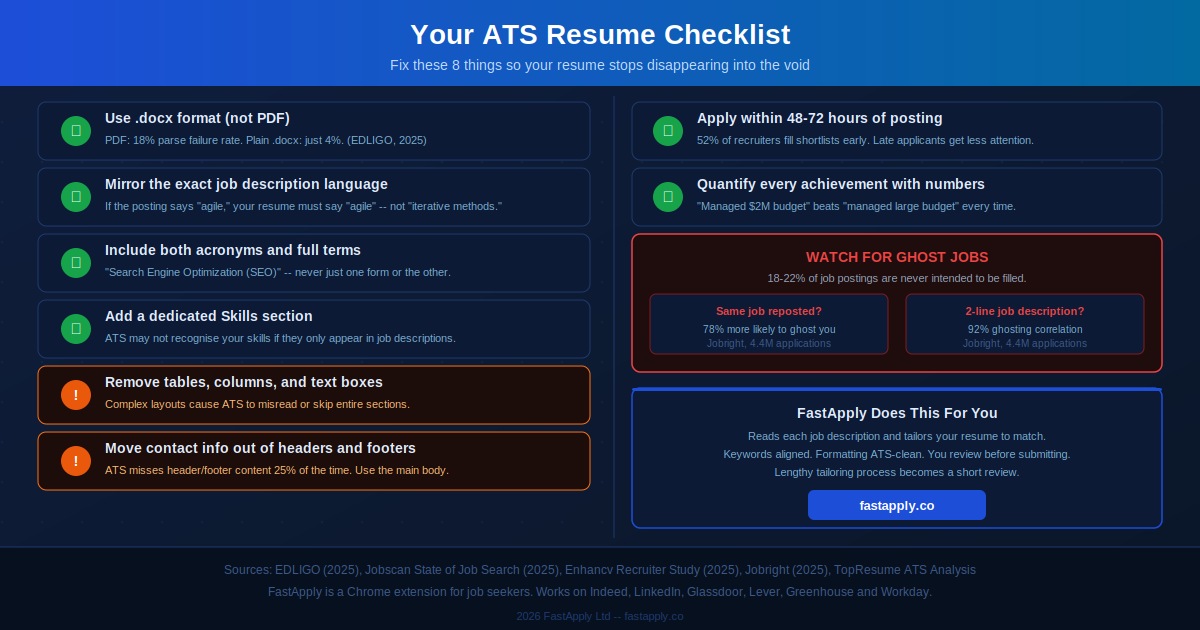
Resume Fundamentals
- Use a single-column layout in .docx format
- Mirror the exact language from the job description
- Include both acronym and full-term versions of skills (e.g., “SQL” and “Structured Query Language”)
- Place your contact information in the main body, not in headers or footers
- Quantify your achievements, numbers stand out to both ATS keyword searches and human reviewers
- Add a dedicated Skills section near the top of the document
Application Strategy
- Use keywords from the job description throughout your resume and online application, not just in a skills section, keywords are graded both by how often they appear and the extent to which they get used in context.
- Apply within 48–72 hours of a posting going live
- Avoid job postings with signs of being ghost jobs (see above)
- Check whether the role has been reposted repeatedly, that’s a signal the company is not serious
- Target companies where you have a mutual connection, many organizations have employee referral systems that fast-track your application through the ATS.
Follow-Up
Not hearing back does not always mean rejection. After 5-7 business days, send a brief, professional follow-up email to the recruiter (find them on LinkedIn). Keep it to two sentences: confirm your interest and ask if there is anything additional they need. This alone puts you ahead of the vast majority of applicants who never follow up.
FAQ
-
Why am I not hearing back from jobs I am clearly qualified for?
Multiple factors can explain this. You may be applying to ghost jobs that were never meant to be filled. Your resume may be missing the exact keywords a recruiter searches for when sorting applications. You may be applying too late after a posting goes live. Or your resume may contain formatting that breaks ATS parsing. Start by checking whether the job has been reposted multiple times, then review your resume against the job description for keyword alignment.
-
Does ATS automatically reject my resume?
Almost certainly not. A 2025 Enhancv study found that 92% of recruiters confirmed their ATS does not auto-reject resumes based on formatting or content. The real risk is invisibility, if your resume does not include the keywords a recruiter searches for, it simply does not appear in results.
-
How long should I wait before following up after applying?
Four to five business days is a reasonable window. Do not follow up the next day, it creates a poor impression. If a recruiter’s LinkedIn is public, a brief, professional message after that window is appropriate.
-
What file format should I use for my resume?
Plain .docx format has the lowest ATS parsing failure rate at just 4%, compared to 18% for PDFs. Avoid tables, text boxes, and multi-column layouts. Send PDF only if the job posting specifically requests it.
-
Are there really jobs posted that no employer intends to fill?
Yes. In any given quarter, 18–22% of the jobs posted on the Greenhouse platform are classified as ghost jobs. Before investing significant time in an application, check for repeated repostings, vague job descriptions, and redirect-heavy application flows, all signals that a role may not be a genuine opening.
-
What is the biggest mistake job seekers make with their resume?
Using the same resume for every application. Aligning your resume title with the job title increased interview rates approximately 3.5 times in a 2024 analysis of over one million applications. Tailoring does not mean rewriting everything, it means mirroring the language and priorities of the specific job posting.
-
How many applications does it typically take to get a job?
Research shows many applicants submit anywhere from 32 to over 200 applications before receiving an offer, with most online applications resulting in a success rate of 0.1%–2%. The wide range reflects differences by industry
#why am I not hearing back from jobs
#employer ghosting
#ats rejection
#resume not getting past ats

Fastapply Team
Career Experts