Work From Anywhere Jobs: The Complete Guide for Digital Nomads and Global Job Seekers (2026)
Remote work has become common, but often with limited flexibility. You may need to stay in a specific country, work within certain time zones, or remain close to a company office for tax and compliance reasons.
True work-from-anywhere jobs are different. They allow you to choose where you live while continuing to work legally and consistently from almost anywhere in the world.
That is why these roles attract so much attention in 2026. They offer a level of freedom most remote jobs still do not, but they are also fewer in number and more competitive than standard remote roles.
This guide explains what work-from-anywhere jobs really are, where companies are hiring for them, the best platforms to find legitimate openings, and how to position yourself as a strong candidate in a global talent market.
What “Work From Anywhere” Means (and What It Does Not)
The term gets misused constantly. Before you spend hours applying, understand the difference.
-
Standard remote jobs require you to live in a specific region. A “remote” role at a San Francisco company might demand California residency for tax compliance. A “remote” UK position often wants candidates in GMT timezone. These jobs are remote but not location-free.
-
Work from anywhere (WFA) jobs place zero geographic restrictions on where you live and work. Your employer does not care if you are in Lisbon or Bangkok or Buenos Aires. You get paid the same regardless of where your laptop opens each morning.
The distinction matters legally. When employers hire across borders, they take on compliance risk. Payroll taxes, employment laws, and contractor classifications vary by country. Most companies avoid this complexity by limiting remote roles to specific regions. Genuinely WFA-friendly employers have built the infrastructure to handle it.
This also explains why WFA roles skew toward seniority. A 2025 study shows that only 3% of work-from-anywhere jobs listed in 2025 were entry-level, while 76% required experienced-level qualifications. These employers trust experienced professionals to manage their time across time zones without supervision.
The Top 10 Fields Hiring for Work From Anywhere Jobs in 2026
FlexJobs analyzed over 60,000 companies between September 2025 and March 2026 to identify where WFA opportunities concentrate. These are the top career fields by volume:
- Computer and IT
- Project Management
- Marketing
- Technical support
- Python
- Communications
- Consulting
- Product
- Software Development
- Operations
The top three job titles with the most WFA listings in 2026 are customer service manager, executive assistant, and data scientist. The previous top three were account executive, content writer, and data analyst.
Why Tech Dominates
Software engineers and data analysts lead in sheer volume because their work is inherently async-friendly. A developer pushing code to GitHub does not need to be in the same timezone as the team reviewing it. Output is measurable. Collaboration happens through documentation and tools, not physical proximity.
Project-based and digital-driven roles like software engineer and data analyst lend themselves naturally to asynchronous work, but even client-facing jobs like account manager or social media manager are performable across locations and time zones, according to FlexJobs career expert Toni Frana.
Roles With Surprising WFA Growth in 2026
Operations, communications, and business development are emerging fields. All three grew enough to enter the WFA top 10 in 2025, displacing roles that held spots in previous years. If you work in ops or communications, this is an opening to position yourself for location-free roles.
The 7 Best Platforms for Finding Work From Anywhere Jobs
The challenge with work from anywhere jobs is that they are scattered. General job boards list millions of positions, most of which include geographic restrictions buried in the fine print. Specialized platforms filter this for you.
1. FlexJobs
FlexJobs remains the most comprehensive vetted platform for WFA roles. The team researches and vets every company posting jobs, so you get peace of mind that listings come from legitimate employers. Their advanced search filters let you specify “work from anywhere” explicitly, separating true WFA roles from standard remote jobs.
The platform covers more than 50 career categories from entry-level to executive. Beyond job listings, members get skills tests, career coaching, and resume reviews.
2. We Work Remotely
One of the largest remote job boards globally, We Work Remotely attracts high-quality employers in tech, design, marketing, and customer support. Listings often specify whether a role is genuinely location-free or restricted to certain regions
3. Remote.co
Remote.co curates job posts carefully, categorizing them by industry. The platform focuses on educating job seekers on remote work alongside the listings themselves. Good for professionals in writing, design, and operations who want context alongside the job search.
4. Remotive
Remotive focuses on tech-adjacent roles: software development, marketing, design, and customer success. The platform publishes a popular weekly newsletter and a searchable job board. Many listings here come from companies that built remote-first cultures before it became common.
5. Jobspresso
Jobspresso differentiates itself through quality control. Listings are reviewed before posting, which reduces noise significantly. Useful for professionals who would rather spend an hour reviewing 20 strong listings than an afternoon sorting through 200 questionable ones.
6. Working Nomads
Working Nomads focuses exclusively on location-independent opportunities. The platform sends a daily newsletter of fresh, curated listings. Clean interface, minimal distraction, and a tight focus on genuinely portable roles.
7. No Visa Jobs
No Visa Jobs specifically aggregates global remote roles that do not require US, EU, or UK visa sponsorship. Built for professionals in regions where visa barriers typically limit access to WFA opportunities. A strong resource if you are searching from outside traditional talent markets.
The Real Problem With WFA Job Hunting: Fragmentation
Here is the actual challenge no one talks about.
Finding work from anywhere jobs is not about picking the right job board and spending a morning there. The roles are spread across FlexJobs, company career pages, We Work Remotely, LinkedIn, startup job boards, and niche industry-specific platforms. An opening on a company’s Greenhouse ATS might not appear on any aggregator for days.
Most job seekers end up with six tabs open, running the same search across different platforms, copying and pasting job titles and keywords, and losing track of what they have already reviewed. It is tedious and easy to miss the best opportunities.
FastApply approaches this differently. The platform aggregates listings from major job boards and company career pages into a single searchable interface, so you see relevant WFA and remote roles without switching between platforms. Instead of managing parallel searches across multiple sites, you run one search and work through results in a single tab.

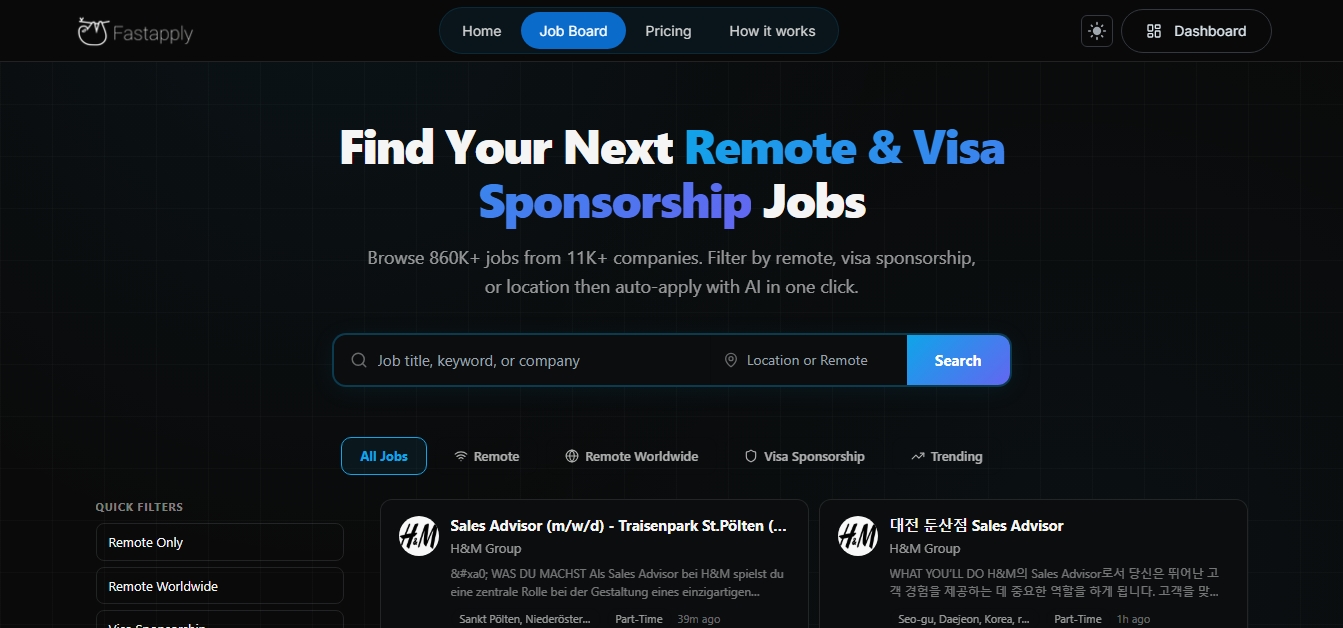
When you find a role worth applying to, FastApply’s Chrome extension reads the job description and automatically tailors your resume to match the requirements. Keywords get emphasized. Relevant experience surfaces to the top. But you review everything before submission. The extension pauses before submitting, so you see exactly what goes out under your name. A tailoring process that typically takes 20-30 minutes per application drops to a 2-3 minute review.
For WFA job seekers who need to apply at volume to stand out in a competitive market, that time difference adds up fast.
How to Write a Resume That Gets WFA Interviews
Work from anywhere roles receive more applications than standard remote positions. Fewer openings, more candidates, and global competition. Your resume needs to signal specific things to get through.
- Lead With Remote-Ready Credentials
Hiring managers for WFA roles look for evidence that you work well without physical oversight. Your resume should surface this evidence explicitly, not leave it to inference.
Show specific results from remote work: “Led a cross-timezone team of 8 engineers across 5 countries to ship a product on schedule.” Not “experienced with remote collaboration.”
- Demonstrate Async Communication Skills
WFA companies rely on written communication. Slack messages, documentation, Notion pages, async Loom videos. If your resume signals that you default to real-time meetings and phone calls, it signals misalignment with how distributed teams operate.
Include examples: documentation you have written, wikis you have built, reports you have produced independently.
- Address Time Zone Flexibility
Many WFA roles come with expectations around overlap hours with a home team. If you are flexible, say so. “Available for overlap with US Eastern business hours” removes a common objection before it gets raised.
- Optimize for ATS Systems
Most WFA employers at established companies run applications through Applicant Tracking Systems. Before your resume reaches a human, it gets parsed by software checking for keyword matches. The job description tells you exactly which keywords to use. Mirror the language from the posting in your experience bullets.
Digital Nomad Visas: Where to Base Yourself in 2026
Getting a WFA job is step one. Figuring out where to live legally while you work remotely is step two.
As of 2026, over 60 countries offer digital nomad visa programs, with more expected to announce programs through the year. This is a significant structural shift. The “grey area era” where remote workers quietly worked on tourist visas has largely closed. Spain, Portugal, Croatia, and the UAE have all tightened enforcement.
Top Countries to Consider in 2026
-
Spain tops the 2026 Digital Nomad Visa Index from Immigrant Invest, ranking first for quality of life, a visa offering up to 5 years with a path to permanent residency, and favorable tax treatment for foreign income under the “Beckham Law”. Spain’s income requirement sits at approximately €2,849/month. Applications have surged 40% year-on-year, so apply at least three months before your planned move date.
-
Portugal ranks sixth globally and remains a top European hub. Lisbon is estimated to host over 16,000 remote workers. The D8 visa offers a pathway to permanent residency, with citizenship possible after 5 years. The income threshold has increased to approximately €3,680/month for 2026.
-
Croatia offers the lowest income requirement among EU countries at approximately €2,540/month and has become popular with European and American nomads who want EU access without the higher cost of Western European capitals.
-
Colombia and Thailand provide affordable options outside Europe. Colombia’s income requirement starts at approximately $750/month, making it accessible for professionals in the early stages of a remote career.
The Legal Requirement Most People Miss
On a digital nomad visa, you generally cannot work for local employers or local clients. Your income must come from outside the host country. Spain’s rule requires at least 80% of income to come from foreign sources. Violating this can result in deportation and future visa bans.
Consult a tax advisor familiar with your target country before applying. The rules change regularly and the consequences of getting them wrong are significant.
How Competitive Are Work From Anywhere Jobs in 2026?
Demand for flexible work keeps rising. According to FlexJobs, 58% of workers say they want to be fully remote. Among professionals actively job searching, only 16% say their top choice is an in-office role, and only 25% would even consider a five-day-in-office requirement.
WFA roles sit at the peak of this preference curve. They are the most desired type of flexible work. They are also genuinely scarce, representing less than 5% of remote job postings in recent data.
That gap between demand and supply creates meaningful competition. Expect more applicants per role, longer hiring processes, and stronger screening for remote-work competency than you would face in a standard remote role.
The people who succeed in this market apply strategically, not just at volume. They target their skills to industries with the highest WFA concentration, tailor every application to the specific role, and build portfolios of async work samples that demonstrate what remote employers want to see.
FAQ
- What is the difference between a remote job and a work from anywhere job?
A remote job allows you to work outside a company’s office but typically requires you to live in a specific city, state, or country for tax and legal compliance. A work from anywhere job places no geographic restriction. You choose your location, and your employer has built the infrastructure to legally employ or contract you regardless of where you live.
- Are work from anywhere jobs entry-level friendly?
Rarely. FlexJobs data from 2025 shows that only 3% of WFA job listings are entry-level, while 76% require experienced-level qualifications. Most employers offering genuine WFA flexibility want professionals who have already demonstrated independent work without in-person oversight.
- What qualifications do I need for work from anywhere jobs?
This depends entirely on the role. Software engineers, data scientists, and project managers make up the largest share of WFA listings. Strong async communication skills, a track record of remote work, and demonstrable self-direction matter across all fields. Certifications in your area of expertise strengthen your application significantly.
- Do I need a digital nomad visa if I work from anywhere?
If you plan to stay in a country for more than a tourist visa allows (typically 90 days in most countries), yes. Over 60 countries now offer digital nomad visa programs specifically for remote workers. Working on a tourist visa in countries with enforcement is a legal risk, and enforcement has tightened significantly in Spain, Portugal, Croatia, and the UAE in 2026.
- Which countries are best for digital nomads in 2026?
Spain tops the 2026 Digital Nomad Visa Index from Immigrant Invest, followed by Malta, Portugal, Germany, and Hungary. Outside Europe, popular choices include Colombia, Thailand, Indonesia (Bali), and Mexico for their combination of affordable living, established nomad communities, and workable visa frameworks.
- How do I stand out when applying for WFA roles?
Lead your resume with specific remote work results, not vague mentions of “remote collaboration.” Show evidence of async communication skills, independent output, and cross-timezone coordination. Tailor every application to the exact language in the job description, since ATS systems filter based on keyword matches before a human reads your resume.
- How many WFA jobs should I apply to per week?
There is no universal answer, but quality beats quantity in this market. Applying to 20 well-tailored applications beats applying to 80 generic ones. WFA hiring managers review more applications than typical remote roles and are good at identifying copy-paste cover letters and unmodified resumes.
#work from anywhere jobs
#digital nomad jobs
#remote jobs worldwide
#global remote work

Fastapply Team
Career Experts