Auto-Apply for Jobs in 2026: AI Agents vs. Human Agents vs. Doing It Yourself
Applying for jobs properly is slow work. Finding a relevant opening, tailoring a resume, writing a focused cover letter, and completing a long applicant tracking system (ATS) form can take roughly 20–45 minutes per application. At the 45-minute end of that range, 54 applications add up to more than a 40-hour workweek.
That math is why auto-apply for jobs has gone from a niche hack to a standard part of the modern job search. But “auto-apply” now describes three very different approaches: software you operate yourself, an AI job application agent that applies for you, or a human agent who manages the work personally. They differ significantly in cost, effort, control, and application quality.
We build application automation for a living. FastApply’s auto-apply platform powers automated job applications for job seekers, platforms, and application services, so here is our practical breakdown of the trade-offs.
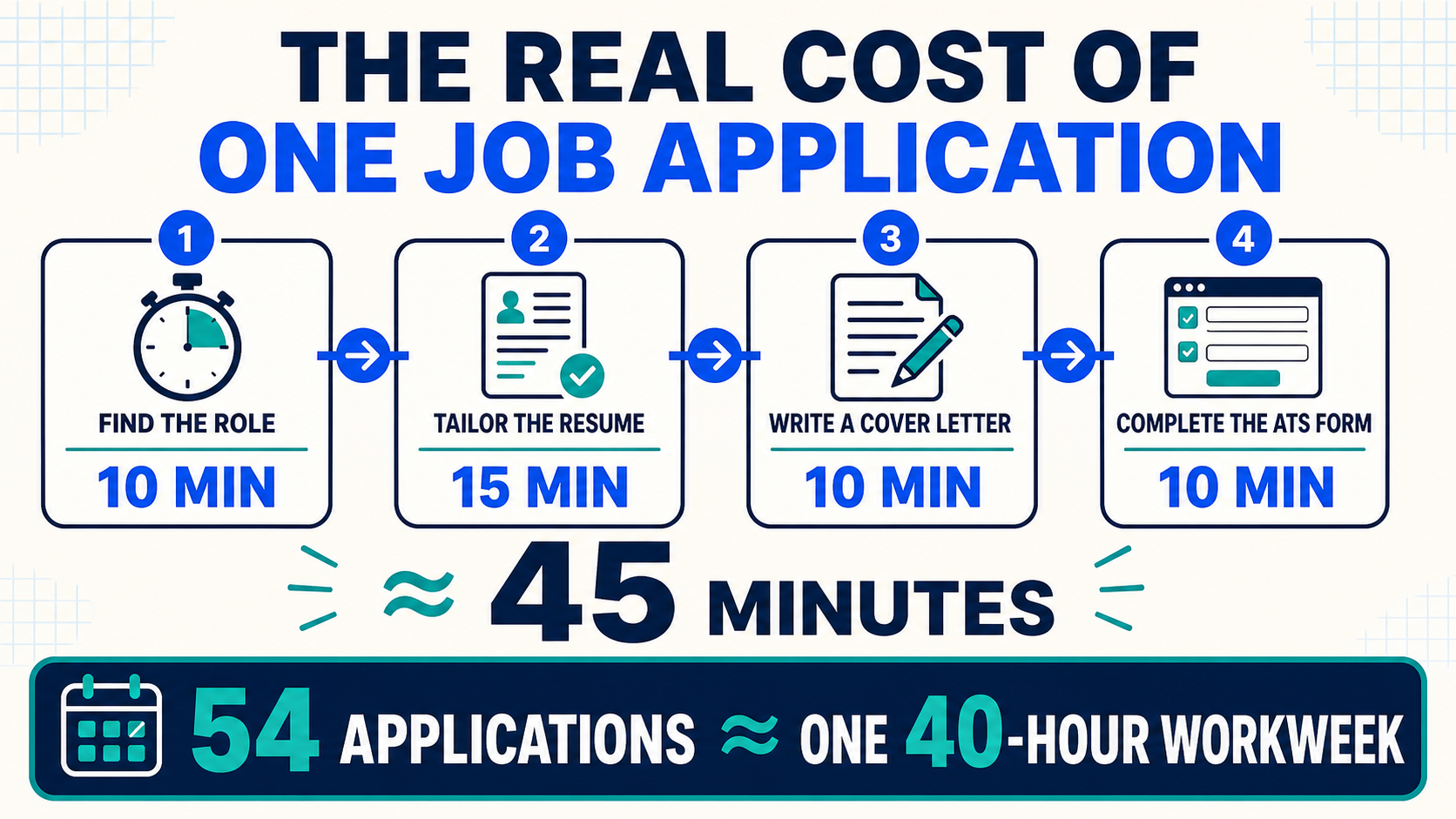
These times are planning estimates, not fixed benchmarks. A short application may take less time; a highly tailored or assessment-heavy application may take considerably more.
Option 1: Doing it yourself
The default approach is still the right choice for some people.
Where DIY wins. You have full control over every application. Nothing goes out under your name that you did not review. For senior roles, small industries, or jobs reached through referrals, that control matters. A thoughtful note to a hiring manager or a carefully positioned resume can beat a generic automated submission.
Where it breaks down. Volume and consistency are the challenge. At 20–45 minutes per application, submitting 20 strong applications takes about 7–15 hours before networking and interview preparation. That pace is difficult to sustain, especially while employed. As fatigue builds, it is easy to reuse the same resume everywhere and apply less selectively.
Best for: senior candidates targeting a short list of companies, people with strong networks, and anyone applying to fewer than about 10 roles in total.
Cost: free in money, expensive in time.
Option 2: AI agents that apply for you
An AI job application agent uses your resume and preferences to find relevant openings and complete applications on your behalf. Depending on the service, it may match roles to your profile, tailor application materials, fill ATS fields, and submit applications continuously.
Where AI agents win. Volume, speed, and consistency. An agent does not get tired on application number 40, skip repetitive form fields, or stop searching over the weekend. For candidates with a clear target role, automation can keep a search moving while they focus on networking and interviews.
Where they are weaker. Nuance and oversight. An auto apply bot is only as good as its matching rules, source data, and tailoring system. A weak tool can submit irrelevant or obviously generic applications. A stronger service should let you define strict filters, tailor materials to each role, answer screening questions accurately, and avoid applying when the fit is poor. Before paying, ask what gets customized, which questions require your input, and how you can review application history.
Best for: active job seekers who want steady application volume without the administrative grind, especially people who are currently employed.
Cost: typically a monthly subscription and usually less than a dedicated human service.
Option 3: Human agents and done-for-you application services
For people searching for “someone to apply to jobs for me,” reverse recruiters and done-for-you application services provide the most hands-on option. A real person may find roles, select opportunities, tailor applications, maintain a tracker, and help with search strategy or interview preparation.
Where human agents win. Judgment. A capable human can read between the lines of a job description, position a non-linear career story, and handle unusual questions that do not fit a standard workflow. That can be especially valuable for executives and career changers.
Where they are weaker. Price, capacity, and consistency between providers. A dedicated person can only complete so many thoughtful applications each week. Service scope also varies widely: some providers offer strategic reverse recruiting, while others primarily perform data entry. Ask for a clear deliverables list, application logs, privacy practices, and an approval process before sharing account access.
Best for: senior candidates, career changers, and anyone whose search requires more judgment than volume and whose budget supports personal service.
Cost: generally the most expensive option because you are paying for human time and judgment.
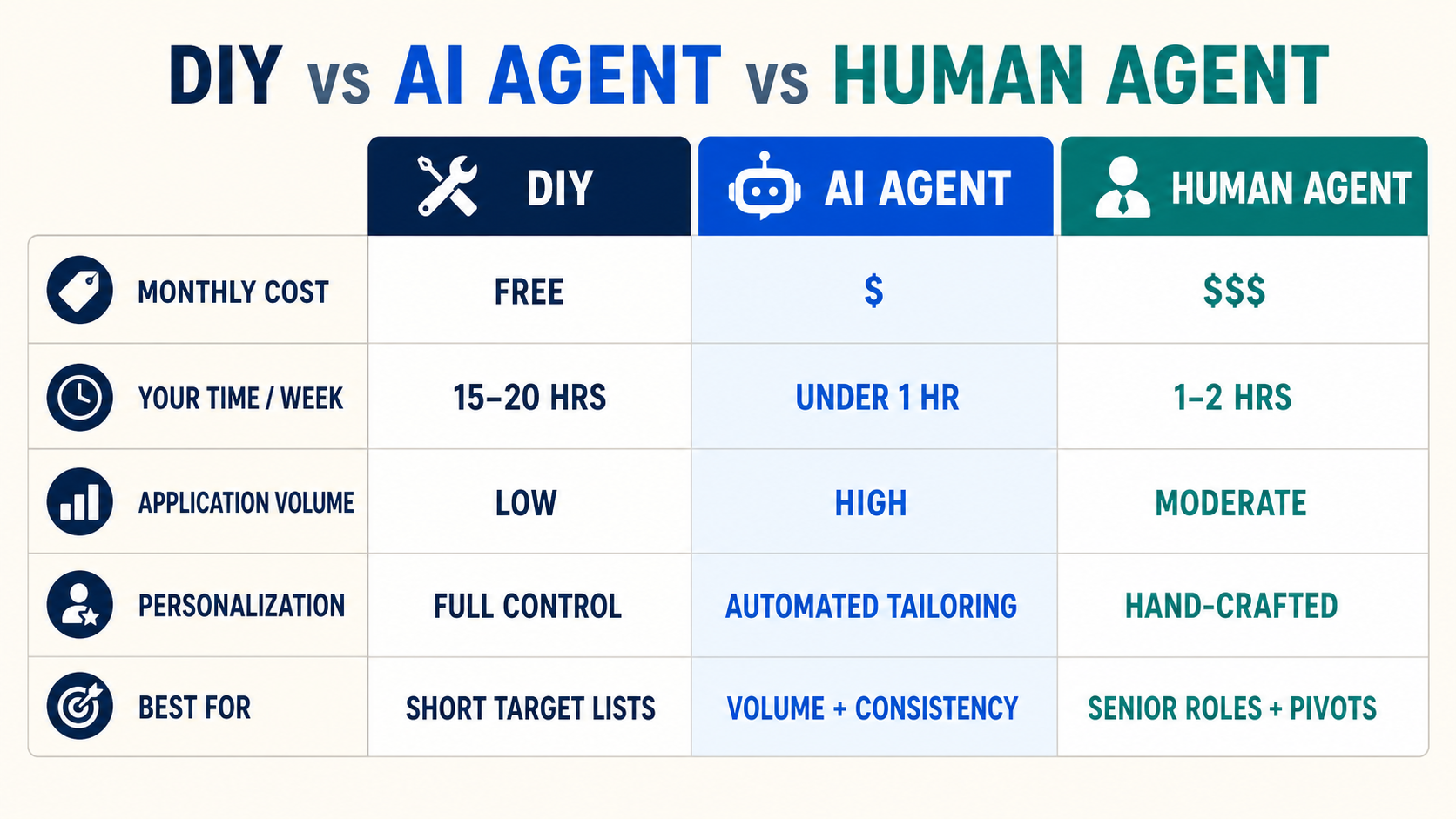
The comparison at a glance
| DIY | AI agent | Human agent | |
|---|---|---|---|
| Monthly cost | Free | $ | $$$ |
| Your time per week | 15–20 hrs at sustained volume | Under 1 hr for setup and review | 1–2 hrs for briefing and review |
| Application volume | Low to moderate; burnout risk | High and continuous | Moderate and curated |
| Personalization | Full control | Automated tailoring | Hand-crafted |
| Best for | Short target lists | Volume and consistency | Senior roles and career pivots |
The time and cost symbols above compare the approaches directionally. Actual totals depend on application volume, provider, and service scope.
So which approach should you choose?
Ask yourself two questions.
How much time do you actually have? Not in theory—in practice, this week. If the honest answer is “a couple of hours,” a high-volume DIY search is unlikely to be sustainable. Use those hours where your involvement matters most instead of spending them re-entering the same employment history.
Does your situation need judgment or volume? If you have a straightforward profile and are applying within your current field, consistent volume may offer the better trade-off, which favors an AI agent. If you are making a career pivot, pursuing executive roles, or explaining an unusual work history, human judgment may justify the higher price.
If the answer is “a bit of both,” consider a service that lets you choose the level of assistance. Scout is a done-for-you job application service where you can choose an AI agent that applies continuously or a dedicated human agent who manages your search personally. Applications continue while your subscription is active, leaving you to focus on networking and interviews.
The best choice is not the one that sends the most applications at any cost. It is the approach that produces relevant, accurate applications at a pace you can sustain.
FastApply provides the auto-apply infrastructure behind job platforms and application services. Scout is our done-for-you service for individual job seekers, built on the same application engine.
#auto apply for jobs
#AI job application agent
#someone to apply to jobs for me
#auto apply bot

Fastapply Team
Career Experts