How Reverse Recruiters Scale Faster With Job Application Automation in 2026
The reverse recruiting market is booming. Job seekers are paying anywhere from $1,500 a month to have professionals run their job search end-to-end: finding roles, tailoring applications, and submitting everything on their behalf. That demand is not slowing down.
If you are a job seeker rather than an agency, and you are weighing up whether to pay for this, read what a reverse recruiter costs and when software is enough. This post is written for the agencies.
But there is a ceiling hiding inside this growth story. If your agency promises 50 to 100 applications per client per week, and each application takes 20 to 40 minutes to complete manually, you run out of hours before you run out of clients. The economics break down fast. More clients means longer hours, more stress, and eventually lower quality work. That is exactly what your clients are paying you to avoid.
This guide is for reverse recruiting agencies and career services that want to take on more clients, deliver better results, and stop trading every dollar of revenue for an extra hour of manual form-filling. The answer is job application automation: specifically, reverse recruiting software built around a human-in-the-loop model.
The Real Bottleneck Killing Reverse Recruiting Revenue
Most reverse recruiting agencies are not limited by demand. Demand is strong. A typical job opening in 2025 attracted an average of 244 applications, more than double the number in 2022, according to Greenhouse data. By late 2025, unemployed workers outnumbered job openings by roughly one million, marking the widest gap since 2017, excluding the pandemic period. Job seekers are motivated and willing to pay.
The bottleneck is execution capacity. Consider what one client actually requires:
- A target list of 15 to 25 companies and role types
- A tailored master resume plus 2 to 3 variants
- A cover letter framework adapted for each application
- 50 to 100 completed applications per week across Workday, Greenhouse, Lever, iCIMS, Ashby, Indeed, and other platforms
- Status tracking and client updates
- Revisions when feedback comes in
Reverse Recruiting Agency, one of the sector’s most-publicized firms, charges $1,500 a month for services that include personalized resume editing, 50 to 100 applications per week, career coaching, and interview prep. That is a significant commitment to deliver if every application is being completed by hand.
One reverse recruiting firm founder noted that his agency submits 50 to 100 applications crafted “by a human” per week on behalf of each client, in addition to sending emails or LinkedIn messages to five to ten people at each company being applied to.
If one recruiter manages 5 active clients at that volume, they are completing 250 to 500 applications per week. At even 15 minutes per application (optimistic for complex ATS platforms like Workday), that is 63 to 125 hours of application work alone per week, for one recruiter.
That math does not work. Not without a better system.
What Reverse Recruiting Software Actually Needs to Do
Generic automation tools do not solve this problem. Most browser automation and RPA tools are built for identical, repeatable tasks across a single platform. Job applications are not that.
Each ATS platform has a different form structure. Each job description requires different keyword emphasis. Each client has a different resume, different work history, and different target companies. A tool that automates the wrong things, like spraying identical resumes across dozens of postings, destroys the quality your clients are paying for.
The right reverse recruiting software for agencies needs to do three specific things well:
1. Handle Multi-Platform Application Submission
Your clients need applications submitted across the platforms where jobs actually exist. That means Workday for enterprise companies, Greenhouse and Lever for tech-forward firms, iCIMS for healthcare and manufacturing, Ashby for startups, and the major job boards like Indeed and Glassdoor for volume.
Each of these platforms has different form logic, different field names, and different required uploads. A tool that covers only one or two platforms forces your team to do the rest manually. That is still most of the work.
2. Tailor Each Application, Not Just Submit It
Volume without tailoring is a fast path to low interview rates, which means client churn. The ATS systems on the employer side scan for keyword match, and hiring managers notice when a resume describes “enterprise software sales” for a role in “clinical trial coordination.”
Your software needs to read the job description and adjust the resume before submission by moving relevant experience forward, matching terminology, and flagging mismatches before the application goes out.
3. Keep Your Team in Control Before Each Submission
This is the differentiator that separates professional reverse recruiting from the “spray and pray” models that are drawing criticism. Reverse Recruiting Agency founder Alex Shinkarovsky clarified that his company’s workers do not use AI to submit applications on behalf of clients automatically, aside from some resume optimization functions. The human review step matters for quality and for the trust your clients place in you.
Your software should pause before each submission. Your team reviews the tailored resume, approves the application, and sends. This is not a speed limitation. It is a quality control feature that protects your agency’s reputation.
How FastApply Fits the Reverse Recruiting Workflow
FastApply is built exactly for this use case. The Chrome extension connects to the ATS platforms where your clients need to apply (Workday, Greenhouse, Lever, iCIMS, Ashby, Indeed, Glassdoor) and handles the form completion work that currently eats your team’s hours.
Here is how it fits into a professional reverse recruiting operation:
Step 1: Discover the Right Roles
Before your team applies to anything, you need a focused list of relevant openings. Switching between eight browser tabs, running the same search on Indeed and then Greenhouse and then Ashby, wastes 30 to 45 minutes per client before a single application gets submitted.
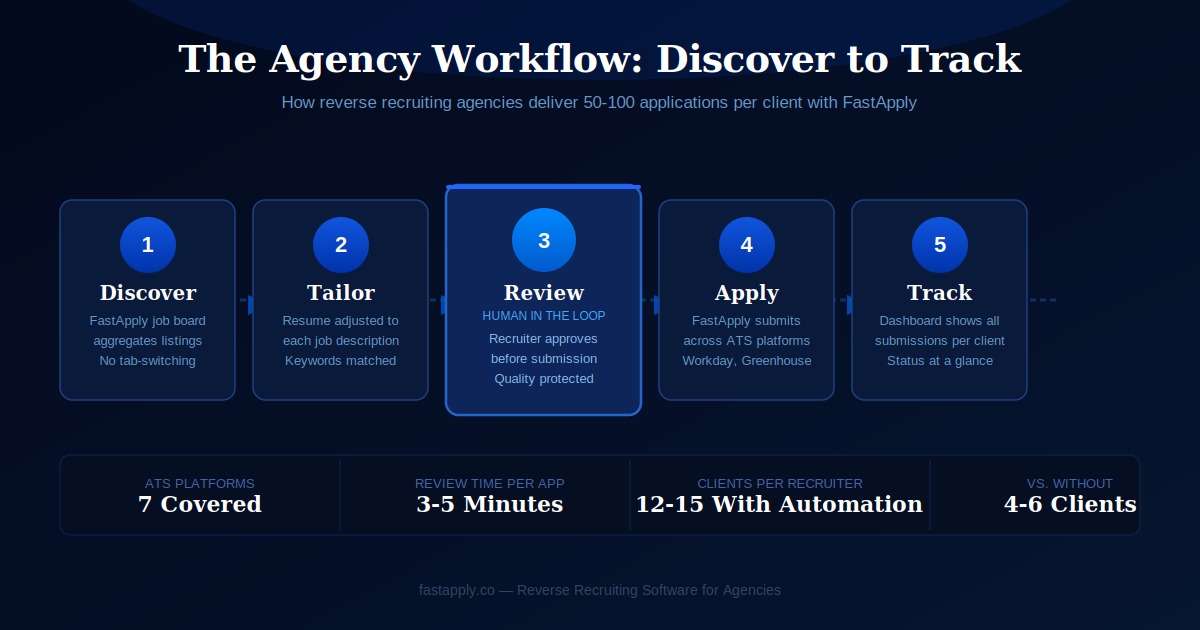
FastApply’s job board aggregates listings across platforms and company career pages into one place. Your team runs one search, filters by role type, location, and industry, and builds the application queue for each client without the tab-switching overhead. This is where the workflow starts: Discover, then Tailor, then Review, then Apply, then Track.
Step 2: Tailor the Resume for Each Role
FastApply reads the job description and automatically adjusts the client’s resume, bringing relevant experience forward, matching keywords from the posting, and flagging sections that do not align with the target role. The adjustment happens in seconds rather than the 15 to 20 minutes it would take a recruiter to do it manually.
Your team sees the before and after. They approve the changes, adjust anything that does not feel right, and move on.
Step 3: Review Before Submitting
This is the human-in-the-loop step that keeps your agency out of trouble. FastApply pauses before each submission and presents the complete, tailored application for review. Your team checks the resume, reviews any auto-generated cover letter text, and approves the submission. No application goes out without a human sign-off.
This protects your clients from the embarrassing mismatches that damage their candidacy. It protects your agency from the reputational risk of sending off incorrect or low-quality applications at scale.
Step 4: Submit Across ATS Platforms
Once approved, FastApply handles the form completion on the target ATS. Workday, Greenhouse, Lever, iCIMS: the extension navigates the platform-specific form fields, uploads the tailored resume, and completes the submission. What took 20 to 40 minutes per application manually now takes the time it takes your team member to review and click approve.
Step 5: Track Everything
FastApply’s application tracking dashboard records every submission: the role, the platform, the date, the resume version used, and the current status. Your team gets a clean view of what is in flight for each client. Client updates become a matter of pulling the dashboard rather than reconstructing a log from memory and browser history.
The Capacity Math After Automation
One recruiter managing 5 active clients, each receiving 50 applications per week equals 250 applications.
With manual application completion at 20 minutes each, that is 83 hours per week and that’s almost impossible.
With FastApply handling the form completion and the review step taking 3 to 5 minutes per application rather than 20 to 40, the same 250 applications take roughly 13 to 21 hours of active review time. Achievable for one person. Comfortable at two.
More importantly, the time your recruiter saves on form-filling goes somewhere better: identifying higher-quality target roles for each client, crafting stronger positioning, doing the outreach work that no software replaces, and managing client relationships properly.
Reverse Recruiting Agency’s data shows an average time to job offer of about 12.7 weeks for a standard role switch, compared with 24.3 weeks across the broader market. When your team spends time on strategy and positioning instead of data entry, those outcome numbers move in the right direction.
Protecting Quality at Scale: The Human Review Model
The reverse recruiting industry is facing real scrutiny. Concerns about application integrity, candidate equity, and the ethics of charging job seekers have been raised by HR professionals and talent acquisition leaders across the sector. Some hiring professionals are openly skeptical of agencies submitting high volumes of applications on behalf of clients.
The agencies that survive this scrutiny, and those building long-term reputations, will be the ones that combine volume with quality. That means:
- Every application reflects the client’s actual qualifications and voice
- No application is submitted without a professional reviewing it first
- The client knows what is being submitted on their behalf
- Application data is tracked and available to the client at any time
FastApply’s pause-and-review architecture is not a workaround. It is the right model for professional reverse recruiting. Automation handles the mechanical work. Your team handles the judgment.
Pricing and Capacity: What Scaling Actually Looks Like
Once your team stops spending most of their hours on manual form completion, you gain two levers:
-
Take on more clients. If one recruiter goes from managing 5 clients to managing 12 to 15 at the same quality level, revenue per headcount increases significantly without adding staff.
-
Improve margins. The cost to deliver services drops when automation absorbs the repetitive work. Reverse recruiting packages at the executive level are running $10,000 to $15,000 flat-fee in 2026. The economics support investment in tools that protect quality at scale.
-
Add a tech-powered tier. Some agencies are beginning to differentiate their service tiers based on application volume and turnaround speed. A mid-tier package promising 30 applications per week at a certain price, and a premium tier promising 75 to 100 with faster turnaround, becomes a real offering when the infrastructure supports it. Without automation, that tier pricing is aspirational at best.
What to Look for in Reverse Recruiting Software
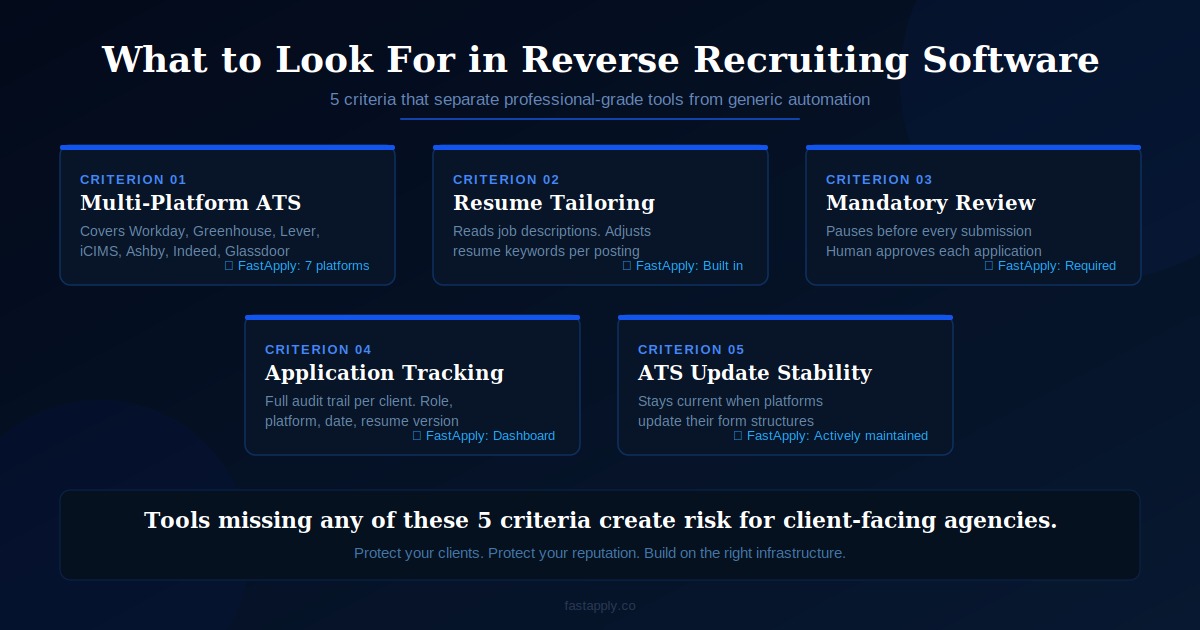
Not every application automation tool is suitable for professional use in a client-facing service. Before selecting a job application tool for your agency, evaluate these criteria:
-
Multi-platform ATS coverage. If the tool covers only one or two ATS platforms, it does not solve the problem. You need coverage across Workday, Greenhouse, Lever, iCIMS, Ashby, and the major job boards.
-
Resume tailoring built in. The tool should read job descriptions and adjust the resume before submission. If tailoring is a manual step layered on top of the tool, the time savings disappear.
-
Mandatory review step. Any tool that submits applications without human review is a liability for an agency. Protect your clients and your reputation by requiring approval before each submission.
-
Application tracking. Client-facing services require audit trails. The tool needs to record what was submitted, when, and the version of the resume used.
-
Stability across ATS updates. ATS platforms update their form structures regularly. A tool that breaks every time Workday pushes an update will disrupt client delivery. Look for tools with active maintenance and quick response to platform changes.
FastApply checks all five of these requirements. It was built for the exact workflow reverse recruiting agencies need to operate professionally.
FAQ
- What is reverse recruiting software?
Reverse recruiting software is a job application tool used by agencies and career services to submit applications on behalf of their clients. It handles the form completion work across Workday, Greenhouse, Lever, iCIMS, and other platforms. Recruiters spend their time on strategy, positioning, and client management rather than data entry.
- How do reverse recruiting agencies apply to jobs for clients at scale?
Most agencies use a combination of job boards, curated role lists, and application software to build and execute application queues. The most effective model pairs automation for form completion with human review before each submission so applications are fast to produce but still reflect the client’s qualifications accurately.
- Does automating job applications reduce quality?
When done correctly, no. Tools like FastApply read each job description and tailor the resume before submission. A recruiter then reviews the tailored application before it goes out. This process produces higher-quality applications than rushing through manual form-filling, because the review step becomes the focused work rather than the typing.
- How many clients does one reverse recruiter manage with automation software?
Without automation, one recruiter realistically manages 4 to 6 active clients at full application volume. With job application automation handling form completion, the same recruiter manages 12 to 15 clients at similar or better quality. The time freed from data entry moves toward client communication, outreach, and strategy.
- Is it ethical for reverse recruiting agencies to use automation?
Yes, with the right model. Automated form completion that includes human review before submission is professional practice, no different from how legal teams use document assembly software while a lawyer reviews before filing. The ethics issue arises when agencies submit bulk generic applications without any professional review. The human-in-the-loop model addresses this directly.
- What ATS platforms does FastApply cover?
FastApply covers Workday, Greenhouse, Lever, iCIMS, Ashby, Indeed, and Glassdoor. This covers the majority of professional job applications at mid-market and enterprise companies.
- What makes a bulk apply tool suitable for client-facing agency use?
Three things: it must support multiple ATS platforms, it must tailor each application to the job description, and it must require a human review step before submission. Tools that lack any of these three features create risk for agencies operating in a professional, client-paid context.
#reverse recruiting software
#job application tool for agencies
#apply to jobs for clients
#bulk apply for clients

Fastapply Team
Career Experts