How to Tailor Your Resume for Each Job in Under 2 Minutes (Using AI) - 2026 Guide
Most job seekers know they should tailor their resume, and few do it consistently.
The problem is not awareness, it is time. Customizing a resume for every role takes effort, and when you are applying to dozens of jobs, that effort compounds quickly. What starts as a good strategy becomes difficult to sustain.
But skipping tailoring is not a real option either. Generic resumes are easier to send, but they are far less likely to pass screening or get noticed.
The challenge is finding a way to balance speed and relevance.
This guide shows you how to tailor your resume for each job in under two minutes using AI, what to change, which tools handle it well, and how to stay in control of every application you submit.
Why You Need to Tailor Your Resume for Each Job
Generic resumes do not work in 2026. The evidence is clear.
Research cited by Zety shows that more than 63% of employers prefer receiving resumes tailored to the open role. Yet the majority of job seekers still send one version everywhere. That gap is your competitive advantage, if you act on it.
According to TopCV, tailored resumes receive 40% more interview requests than generic submissions. The math is straightforward: if your generic resume produces one callback per 20 applications, a tailored resume could bring that same result from 14.
The recruiter side of the equation matters too. An Enhancv study of 25 U.S. recruiters conducted in late 2025 found that nearly all of them review applications manually, but they are overwhelmed by volume. One talent acquisition manager reported receiving 130+ applications in a single night for a single role. When a recruiter has 10 seconds per resume, alignment with the job description is what catches their eye.
Recruiting research cited by Story.cv also found that 61% of hiring managers view a tailored resume as the most effective strategy a candidate can use. With some postings pulling hundreds of applications, a generic resume blends into the noise.
What “Tailoring” Actually Means
Tailoring does not mean rewriting your entire resume. It means making surgical edits that align your existing experience with a specific job description. That includes:
- Summary/headline - Reflect the exact role title and one or two priority skills from the job description
- Skills section - Match the terminology in the posting (e.g., “Agile project management” vs. “project management”)
- Experience bullets - Move the most relevant achievements to the top of each role
- Keywords - Include exact phrases the recruiter used, particularly for ATS screening
According to SSR’s ATS statistics report, 98% of Fortune 500 companies use applicant tracking systems to organize applications. While these systems do not auto-reject resumes, Enhancv found that only 8% of recruiters configure content-based auto-rejection, they do sort candidates by keyword relevance. A resume that matches the job description’s language surfaces first. One that does not gets buried at the bottom of a 400-application pile.
Why Manual Tailoring Is Unsustainable
Here is the problem most job seekers face.
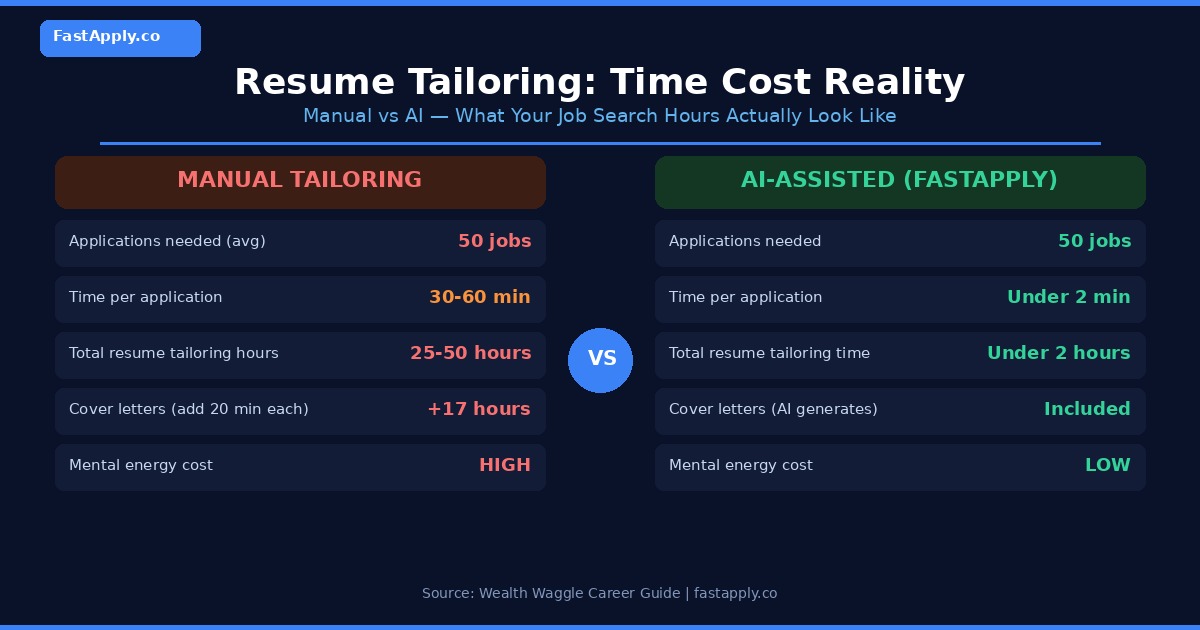
Career experts recommend spending 30–60 minutes per application when you factor in reading the job description, adjusting your resume, and writing a cover letter. Some suggest up to 1–2 hours for roles you genuinely want.
Now multiply that by a realistic job search. LifeShack research aggregated by The Interview Guys puts the upper range of applications at 100–200 before landing an offer for many job seekers. Even at a conservative 50 applications with 30 minutes each, you are looking at 25 hours of resume tailoring alone.
That is before you count the job searches, cover letters, follow-ups, and interviews.
A 2025 survey cited by Passive Secrets found that 72% of U.S. job seekers said the job-hunting process negatively affected their mental health. Volume combined with manual effort is a primary driver of that exhaustion.
The trade-off has always been stark: tailoring well takes time you do not have, but skipping it means lower callback rates. AI breaks that trade-off.
How AI Lets You Tailor Your Resume for Each Job in Under 2 Minutes
Modern AI resume tools do not just swap words. They read a job description, extract the priority requirements, and restructure your existing content to match while keeping your voice and your facts intact.
Here is what the 2-minute workflow looks like in practice:
Step 1: Start With a Solid Base Resume (One-Time Setup)
Before AI tailoring works well, you need a master resume that includes everything: every role, every skill, every achievement. This is not the resume you send anywhere. It is the source document from which AI pulls.
Spend 1–2 hours building this once. Include quantified achievements wherever possible (“reduced churn by 18%,” “managed a $400K budget”). The more specific your master resume, the more useful the AI-tailored output.
Step 2: Paste the Job Description Into the AI Tool
Open your AI tool of choice and paste in the full job description. Good AI resume tools will:
- Identify the required and preferred skills
- Flag exact keyword phrases the employer uses
- Score your resume against the posting
- Suggest edits to your summary, skills, and bullets
This analysis takes seconds. You do not read and cross-reference manually, the tool does it.
Step 3: Review the Suggested Edits
The AI produces a tailored version. Your job now is a 60–90 second review:
- Does the summary accurately represent you?
- Are the keyword insertions natural, not forced?
- Did the tool preserve your actual achievements (not invent new ones)?
- Is the tone consistent with the rest of the resume?
This is where the human review step earns its value. AI is fast. Humans catch inaccuracies.
Step 4: Approve and Apply
Once you confirm the resume accurately represents you and aligns with the role, you submit. Total time: under 2 minutes per application after the base resume is built.
What to Prioritize When You Tailor Your Resume for Each Job
Not every section needs the same attention. Here is where to focus for the biggest impact:
1. The Summary or Headline
Recruiters read this first. A generic “Results-driven professional with 8 years of experience” wastes your most visible real estate. Replace it with something role-specific:
-
Generic: Results-driven marketing professional with 8 years of experience in digital campaigns.
-
Tailored: Digital marketing manager with 8 years in B2B SaaS, experienced in demand generation, HubSpot workflows, and paid LinkedIn campaigns.
The tailored version speaks to the actual role. It uses the same language a recruiter scanning for candidates would use.
2. The Skills Section
This section directly influences how ATS systems rank your application. According to CoverSentry’s ATS statistics compilation, using plain DOCX format with standard sections produces the best parsing accuracy. But formatting alone does not matter if the keywords are off.
Match the exact terms in the job posting. If the posting says “Salesforce CRM,” use that phrase, not just “CRM experience.” If it says “cross-functional collaboration,” use that term rather than “teamwork.”
3. Your Top 3 Bullet Points Per Role
You do not need to rewrite every bullet. Move the most relevant achievement to the first position under each role. Recruiters spend more time on the top of each section. Put your most applicable work front and center.
Discover First, Then Tailor: The Full Application Workflow
One reason job seekers waste time is fragmented discovery. You search Indeed, Ashby, Glassdoor, then back to Indeed. You end up dealing with duplicate listings, missed roles, wasted tabs.
FastApply’s job board solves the discovery problem before tailoring begins. It aggregates listings across job boards and company career pages into one place, so you find relevant roles without bouncing between 6 tabs. That alone cuts wasted time at the top of your workflow.
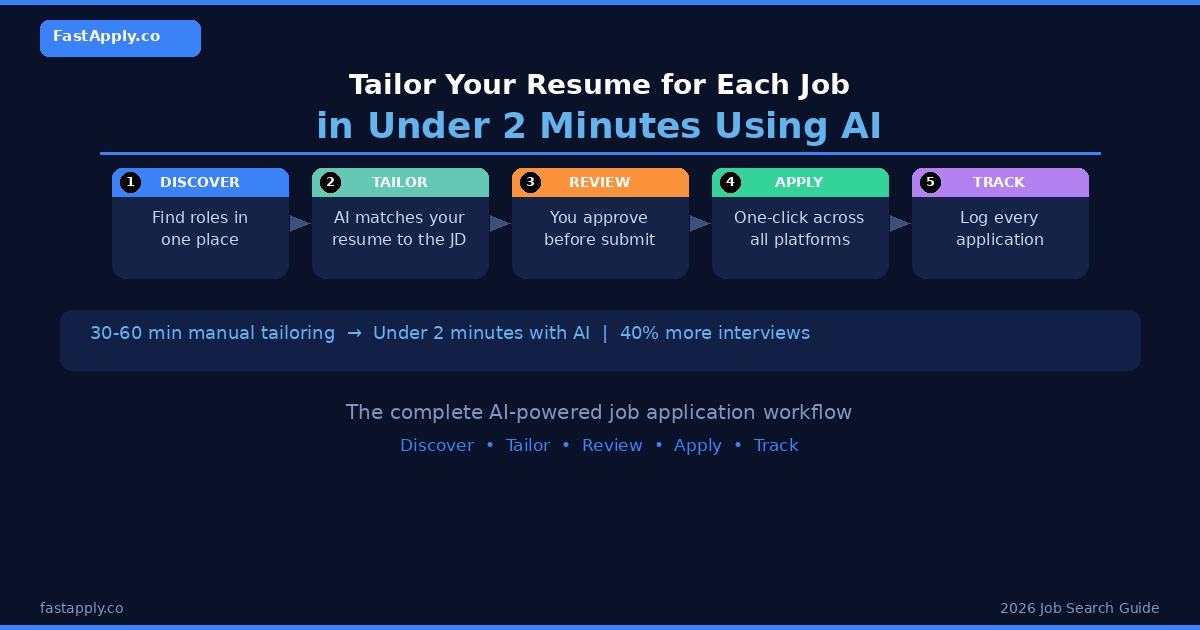
From there, the full workflow looks like this:
-
Discover: Find roles in one place, filtered to what actually matches your background.
-
Tailor: FastApply’s Chrome extension reads the job description and tailors your resume automatically. Keywords get matched. Relevant experience surfaces. Your cover letter gets generated to match.
-
Review: FastApply pauses before submitting. You see exactly what will be sent. You approve, adjust, or reject the tailored version. Nothing goes out without your sign-off.
-
Apply: One click submits across platforms including Indeed, Glassdoor, Lever, Greenhouse, Workday, and Ashby. No manual form-filling.
-
Track: Every application logs automatically, so you know what you sent, where, and when.
The 30-minute-per-application process becomes a 2-minute review. At 50 applications, that is the difference between 25 hours and under 2 hours of resume work, with better tailoring quality than most people achieve manually.
Common Mistakes That Ruin AI-Tailored Resumes
AI does most of the heavy lifting, but these errors still derail applications:
-
Accepting outputs without reading them: AI tools occasionally introduce inaccuracies. They might describe experience you do not have or use a job title you have never held. Always read the output before approving.
-
Over-stuffing keywords: Adding every keyword from a job description makes a resume feel unnatural and recruiters notice. Per Enhancv’s recruiter research, even when match scores exist, 36% of recruiters manually verify them anyway. Human eyes still read these resumes.
-
Ignoring the cover letter. A tailored resume with a generic cover letter is a missed opportunity. The cover letter is where you explain the “why”: why this company, why this role, why now. AI handles the draft. You add the specific context.
-
Using a weak base resume: AI amplifies what is already there. If your base resume has vague bullets like “responsible for sales,” AI output will be vague too. Invest in specific, quantified achievements in your master document.
ATS Optimization: What You Do and Do Not Need to Worry About
A lot of advice around ATS is outdated or exaggerated. Here is an accurate picture:
What matters:
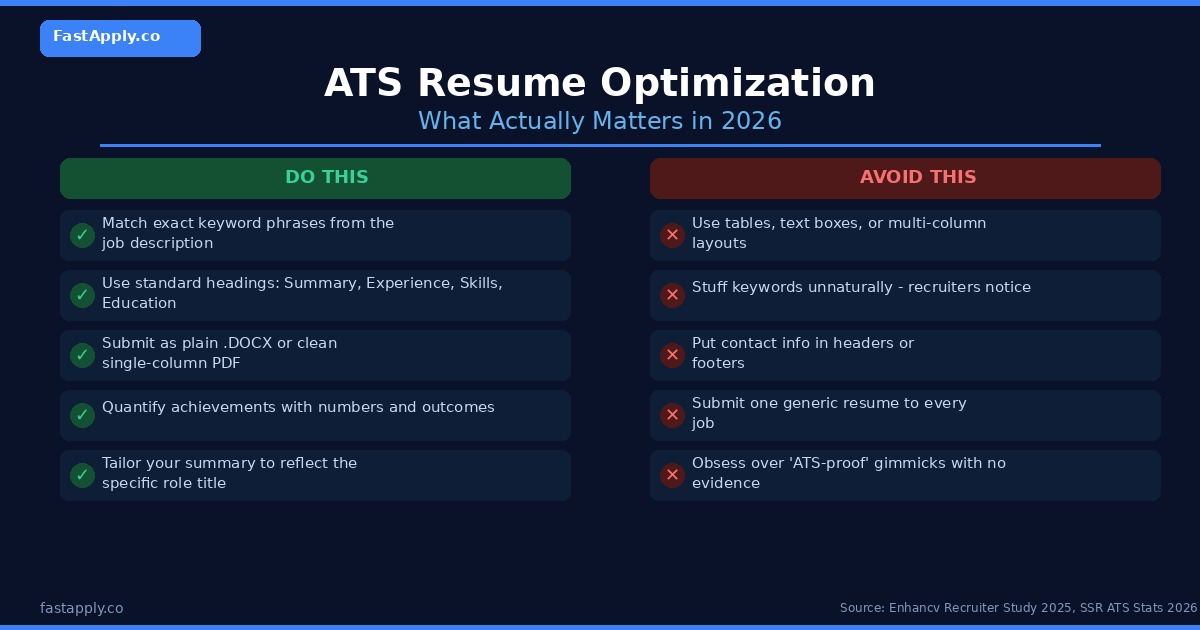
- Keyword alignment with the job description
- Standard section headings (Summary, Experience, Skills, Education)
- Clean formatting: no tables, text boxes, or multi-column layouts
- Plain DOCX or clean PDF format (DOCX performs better with most ATS)
What does not matter (much):
- Magical “ATS-proof” templates marketed by resume services
- White text keyword stuffing (actively harmful, some recruiters flag it)
- Obsessive keyword counting
The Enhancv recruiter study found that 92% of companies rely on human review, guided by knockout questions and optional scores, not automated content rejection. The real gatekeeper is a human who is busy and overwhelmed. Make their job easy: write clearly, match the language, and get to the point fast.
FAQ: Tailoring Your Resume for Each Job
- Does tailoring your resume actually make a difference?
Yes. TopCV cites research showing tailored resumes receive 40% more interview requests than generic ones. More than 63% of recruiters prefer receiving applications tailored to the role. The difference is measurable.
- How long does it take to tailor a resume manually?
Most career experts recommend 30–60 minutes per application for a proper manual tailoring. Some advise up to 1–2 hours for roles you are serious about. With AI tools, this drops to under 2 minutes once your base resume is set up.
- Do I need a different resume for every single job?
Not a completely different resume. But meaningful edits to your summary, skills section, and top bullet points for every job posting. Roles in the same function at similar companies will need less adjustment. Roles at different seniority levels or in different industries need more.
- Can AI tailor my resume better than I can?
AI is faster at keyword matching and restructuring than humans. It does not replace your judgment. You know your experience. AI helps you frame it in the right language for each role. The best approach is AI drafts, human review.
- Will recruiters know I used AI to tailor my resume?
A properly reviewed AI-tailored resume is indistinguishable from a well-written manual one. The issue comes when job seekers accept AI output without reading it, resulting in inaccuracies, awkward phrasing, or inflated claims. Review everything before you send it.
- Does tailoring help with ATS systems?
Yes, keyword matching helps your resume appear relevant in ATS sort orders. But per Enhancv’s recruiter research, ATS systems primarily organize rather than reject. The keyword alignment matters most for the human reviewer who then scans the top results.
- What parts of my resume should I tailor first?
Start with the summary/headline, then the skills section, then the top bullet point under each relevant role. These sections get the most attention from recruiters and have the biggest impact on both ATS ranking and human first impressions.
#tailor resume for each job
#customize resume fast
#ai resume tailoring
#ats resume optimization

Fastapply Team
Career Experts