Auto-Apply to Jobs Tools Compared: Which Job Application Bot Actually Works in 2026?
Most job application tools optimize for the wrong thing; they optimize for speed.
The assumption is simple: if you can apply to more jobs, you will get more interviews. So these tools fill out forms, submit applications in bulk, and promise to save you time.
But job searching is not a pure numbers game.
Applications are filtered, ranked, and screened long before a human sees them and when quality drops, scale stops working.
That is why many job seekers using auto-apply tools end up with more activity but not more responses.
This guide compares the leading auto-apply tools in 2026, what they actually do well, where they fail, and what a more effective approach looks like.
Why So Many Job Seekers Are Looking for an Auto Apply Tool
The math of the modern job search is genuinely punishing.
According to data from CareerPlug covering over 10 million applications, only about 3% of applications result in a job interview, down from roughly 1 in 8 a decade ago. For every 180 people who apply to a typical role, approximately 5 get an interview.
Entry-level and remote roles are worse. Some openings attract 400 to 1,000+ applications within the first week. Software engineering roles at major companies regularly pass 2,000 applications before screening begins.
Compounding this, a 2025 LinkedIn study found that personalized resumes are 2.3 times more likely to earn interview. That means you need both volume AND quality, a combination that is nearly impossible to achieve manually.
The average job seeker who applies to 50 positions manually spends over 37 hours on repetitive form-filling. That is a full working week spent on mechanical data entry rather than interview preparation or networking.
Auto-apply tools emerged to solve this but they have not all solved it equally well.
The Three Types of Auto-Apply Tools (And Why the Distinction Matters)
Before comparing specific products, it helps to understand that “auto-apply tool” is not a single category. These tools fall into three distinct approaches, each with different tradeoffs.
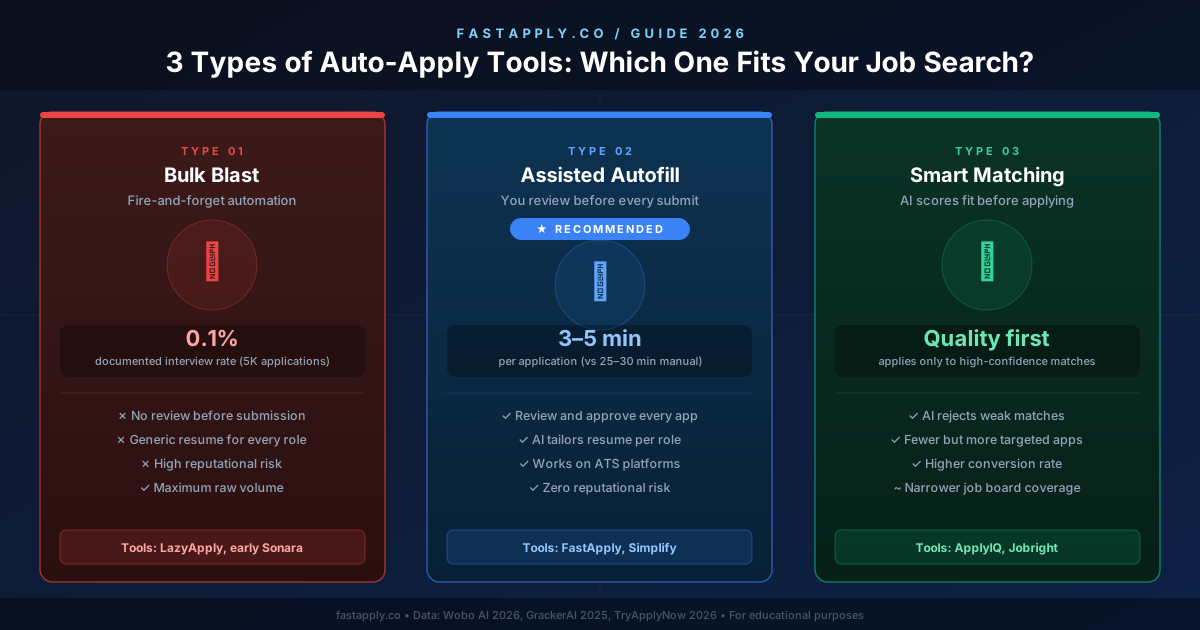
Type 1: Bulk Blast Tools
These tools apply your resume to as many jobs as possible, as fast as possible. You set some filters, upload your resume, and the bot does the rest without stopping for your review.
The pitch is compelling: send 100+ applications per day with no effort. The reality is a poor return on investment. Mass-blast applications tend to look generic because they are. Recruiters and hiring managers flag them quickly. Wonsulting, an early player in this category, shut down its bulk auto-apply feature in August 2025 after clients averaged just one interview per 50 applications, roughly a 2% hit rate.
Tools in this category: LazyApply, early versions of Sonara.
Type 2: Assisted Autofill with Review
These tools handle form-filling and resume tailoring but pause before submitting. You see what gets sent before it goes. This means fewer applications per day but a dramatically higher quality per application.
This is the approach most serious job seekers should use. It gives you speed on the mechanical parts of the process while preserving your judgment on what goes out.
Tools in this category: Simplify, FastApply.
Type 3: Matching + Selective Auto-Apply
These tools use AI to score your fit for each role before applying. They reject weak matches, tailor materials to strong ones, and apply on your behalf only when confidence is high. The volume is lower than bulk blast tools but the conversion rate is higher.
Tools in this category: ApplyIQ, Jobright, newer versions of LoopCV.
Understanding which type you need before choosing a tool will save you time, money, and potential reputational damage.
The Leading Auto-Apply Tools in 2026: An Honest Comparison
1. LazyApply
LazyApply is a Chrome extension that automates form-filling and job applications across platforms including Indeed, Glassdoor, ZipRecruiter, and Dice. It uses a “Job GPT” engine to generate responses and mimic human input cadence. Pricing runs from $99/month (Standard, up to 50-300 applications per day) to $249/month (Premium) for higher volume.
Recent 2025 user feedback on Reddit describes the tool as “buggy” and “a waste of money,” with consistent reports of forms being incorrectly filled out. LazyApply does not offer a free trial and bills annually, which makes it a high-stakes commitment given the reliability concerns.
In practice, LazyApply is built for volume-first job seekers who prioritize speed over precision. It can be useful for high-volume, entry-level roles where visibility matters more than personalization. But for mid- to senior-level positions, where a single poor application can hurt your chances, the trade-off becomes more significant. Applications can appear generic or contain errors, which may negatively impact how recruiters perceive your candidacy..
2. LoopCV
LoopCV scans job boards, filters listings based on your criteria, and either auto-applies or queues roles for manual approval. It covers 20+ job boards and includes an email outreach tool to contact recruiters directly. Paid plans start at approximately $5.16/month (Standard Looper) up to $87.75/month (Done For You). A free plan with limited features is available.
LoopCV gets mixed reviews, its on-platform automation (filling out applications directly on sites like Indeed) works better than its off-platform flows. Users on Product Hunt gave it 2.0 out of 5 stars, with one reviewer writing that after purchasing the premium plan they received “zero job matches, nothing at all.” Support responsiveness is frequently cited as a deciding factor in whether the tool works for any given user.
LoopCV is built around passive automation, and its recruiter outreach feature stands out. However, it does not hold up for roles that require consistent, well-tailored applications.
3. Sonara
Sonara continuously scans millions of job listings, matches roles to your profile, and submits applications automatically. It promises “apply until you’re hired” with no manual intervention required. Pricing starts at $2.95 for a trial period, then $23.95/month on the base plan.
Sonara has faced significant criticism for opacity and inconsistency. The tool is frequently described by users as a “black box”. One Business Insider journalist paid $79.99 for Sonara’s top-tier plan expecting 420 applications; the actual results fell well short. A user on the highest plan (15 applications per day) reported only one screening interview from approximately 700 automated applications, while 200 manual applications from the same person landed three interviews.
As of mid-2025, there were also reports of the service being temporarily discontinued, raising concerns about reliability.
Sonara is built for complete hands-off automation, but that comes with trade-offs. When you have no control over what gets submitted, quality drops and in competitive roles, that cost shows up quickly in low response rates and missed opportunities..
4. Simplify
Simplify is a free Chrome extension that autofills job applications across 100,000+ company career pages. It tracks every application automatically and provides basic resume keyword checking. It does not auto-submit - you fill out the form with Simplify handling the data entry, then review and click submit yourself.
Simplify earns consistently positive feedback for what it promises: faster manual applications, not autonomous submissions. The free tier is genuinely functional. Application tracking alone saves hours of spreadsheet maintenance for active job seekers.
Sonara is built for job seekers who want faster manual applications without giving up control, but not for those who need to scale to hundreds of applications.
5. Jobright
Jobright is an AI-powered job search platform that handles role discovery, resume customization, and application submission in one workflow. It uses an AI agent to match jobs to your profile, assign skill-based fit scores, and tailor your resume before applying. It also includes application tracking, with pricing typically in the $20–40/month range.
Compared to most auto-apply tools, Jobright performs better on the quality side. Its job matching and skill scoring reduce the number of irrelevant applications, and the resume customization is more aligned with the roles it targets. The platform leans toward a more curated approach rather than pure volume, positioning itself as a premium option for tech-focused job seekers.
That said, it still operates with a level of automation that limits control. For users who prefer to review every application before submission or who are optimizing for cost, it may not be the best fit.
6. ApplyIQ
ApplyIQ uses what Adzuna describes as “responsible AI.” Instead of applying broadly, it focuses on roles where your profile shows a strong match, submitting a smaller number of targeted applications each week. The tool is currently free to use, with no subscription tiers.
This quality-first approach sets it apart from most auto-apply tools. By limiting applications to higher-fit roles, it tends to generate better response rates compared to bulk automation. However, because it relies on Adzuna’s job network, its coverage is more limited than tools that pull from multiple platforms.
ApplyIQ prioritizes precision over reach. That works well if your profile already aligns closely with available roles, but it can be restrictive for job seekers who need wider exposure across different platforms and ATS systems.
7. BetterApply
BetterApply (betterapply.co) markets unlimited auto-apply, unlimited AI-tailored resumes, AI interview preparation, and a job tracker, with public claims of 150,000+ users and a 4.8/5 rating. Its lowest entry point is a $19.99 introductory first month, after which the regular rate is $50/month on the 1-month plan. There’s no free trial, so the cheapest way to actually try the tool is to commit $19.99 upfront.
The product itself is a real, working AI auto-apply tool, but the buying decision usually comes down to price and trial access. For most job seekers comparing it to alternatives, the question is whether the unlimited model justifies the entry cost versus credit-based tools that let you validate fit first. For a deeper breakdown including pricing tables, feature differences, and which type of job seeker each tool actually fits, see our honest BetterApply review and FastApply comparison for 2026.
The Real Problem with Fully Automated Job Application Bots
Here is what the most compelling auto-apply marketing misses: volume does not compensate for quality at the level of individual review.
The research on ATS (Applicant Tracking Systems) bears this out. A 2025 Enhancv study of 25 U.S. recruiters across industries found that 92% of ATS platforms do not automatically reject resumes based on content. The actual problem is human overload: when a data analyst role receives 400-500 applications, the recruiter manually reviews the top candidates sorted by match score. Being ranked 150th is functionally equivalent to rejection.
Timing also matters significantly. According to the same study, 52% of recruiters say applying within the first 48-72 hours of a posting significantly increases visibility, as many pause postings or fill shortlists early.
This means the winning formula is not “more applications” in isolation. It is “more relevant, timely applications.” Fully automated tools that apply without tailoring send you to position 150+ in every queue. Smarter tools that match, tailor, and apply early get you to position 5-15.
Where FastApply Takes a Different Approach
FastApply takes a different approach, It integrates directly with major job platforms like Workday, Greenhouse, Lever, iCIMS, Ashby, Indeed and more, where most real applications happen.
It also simplifies job discovery, instead of switching between multiple tabs, FastApply pulls listings from different platforms into one place, so you can filter and find relevant roles without repeating the same searches.
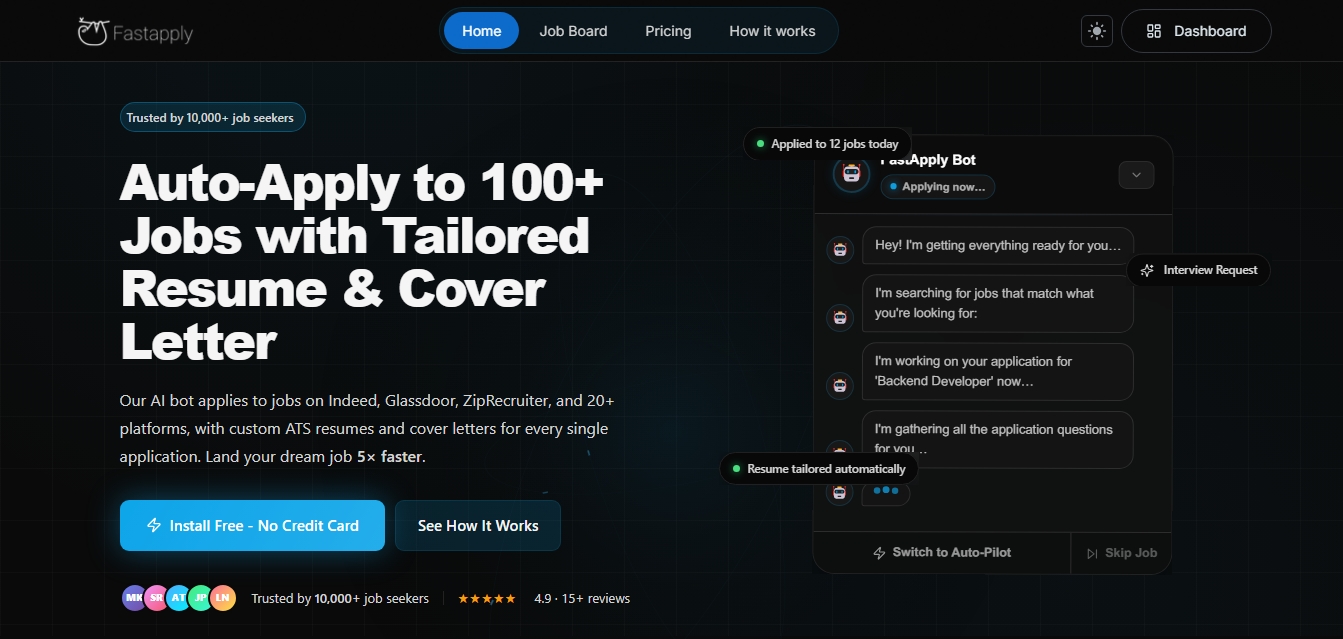
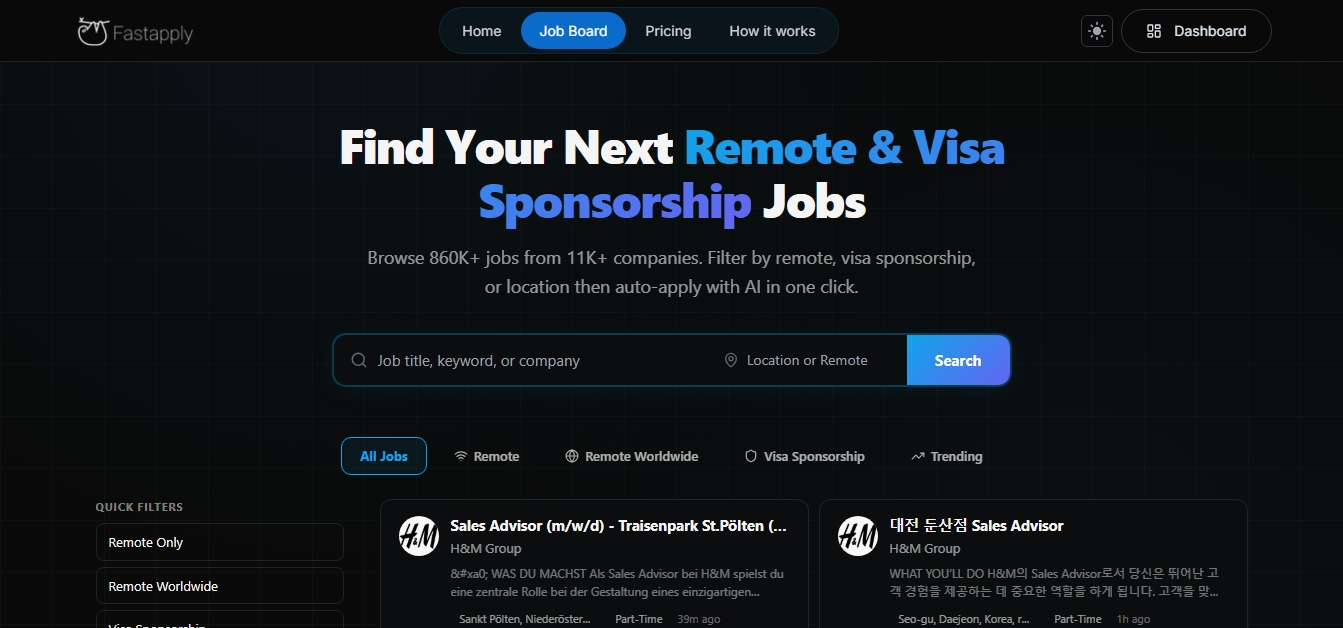
When you select a role, FastApply reads the job description and tailors your resume to align with the keywords, it also prioritizes relevant experience. A role-specific cover letter is generated alongside it.
But before anything is submitted, you review the application, make any adjustments, and approve. FastApply handles the form-filling across these platforms, including company career pages powered by ATS systems while you stay in control of what gets sent.
This changes the math. What typically takes 25–30 minutes per application becomes a 3–5 minute review. You get the speed of automation without giving up quality, making it possible to maintain both volume and precision.
Everything from discovering roles to submitting applications is handled in one place. The platform also tracks every application in a centralized dashboard, so you always know what was sent, when, and what happened next. For job seekers managing dozens of applications, this removes the confusion and chaos of manual tracking.
How to Choose the Right Auto-Apply Tool for Your Situation
Different situations call for different tools. Here is a straightforward guide.
-
You are applying broadly at entry level and want maximum volume
Start with Simplify (free) to handle autofill and tracking. Add LazyApply if you want fully automated submission and understand that quality per application will be low. Accept that response rates will reflect the volume-over-quality approach.
-
You are a mid-level professional targeting specific companies
Use FastApply for the ATS platforms where your target companies post (Workday, Greenhouse, Lever). Each application gets tailored to the specific role and reviewed before submission. You get speed without sacrificing quality on the roles that matter.
-
You want completely hands-off automation and accept lower conversion rates
LoopCV or ApplyIQ both offer this with different cost structures. LoopCV has more platform coverage and the recruiter outreach feature. ApplyIQ is free and applies only to high-match roles.
-
You are a tech professional targeting software roles
Jobright provides the job matching and resume customization that tech hiring managers expect. Its AI scoring helps you focus on roles where your profile fits rather than applying broadly.
-
You want to understand the market before committing to paid tools
Start with Simplify (free) and ApplyIQ (free). These give you real data on which job boards produce results for your profile before spending $30-250/month on premium tools.
The Risk That Nobody Talks About: Platform Policy
Every major job board has policies against automated tools. LinkedIn’s User Agreement explicitly forbids third-party software that automates activity. Accounts that violate this policy get locked until users disable the tool.
This matters when evaluating fully automated tools. Tools that submit applications without review run a higher risk of being detected through behavioral patterns. Applications sent in irregular volumes or at non-human speeds flag platform monitoring systems.
Browser-based Chrome extensions that work within your active session and mimic human timing patterns carry a lower risk profile than server-side agents that run while your computer is off. When assessing any tool, ask: Does this run in my browser with me present, or does it run autonomously in the background?
Assisted-autofill tools like Simplify and FastApply stay well within acceptable use - they fill forms in your browser session and require your approval before submitting. Fully autonomous background agents operate in grayer territory and carry proportionally higher platform risk.
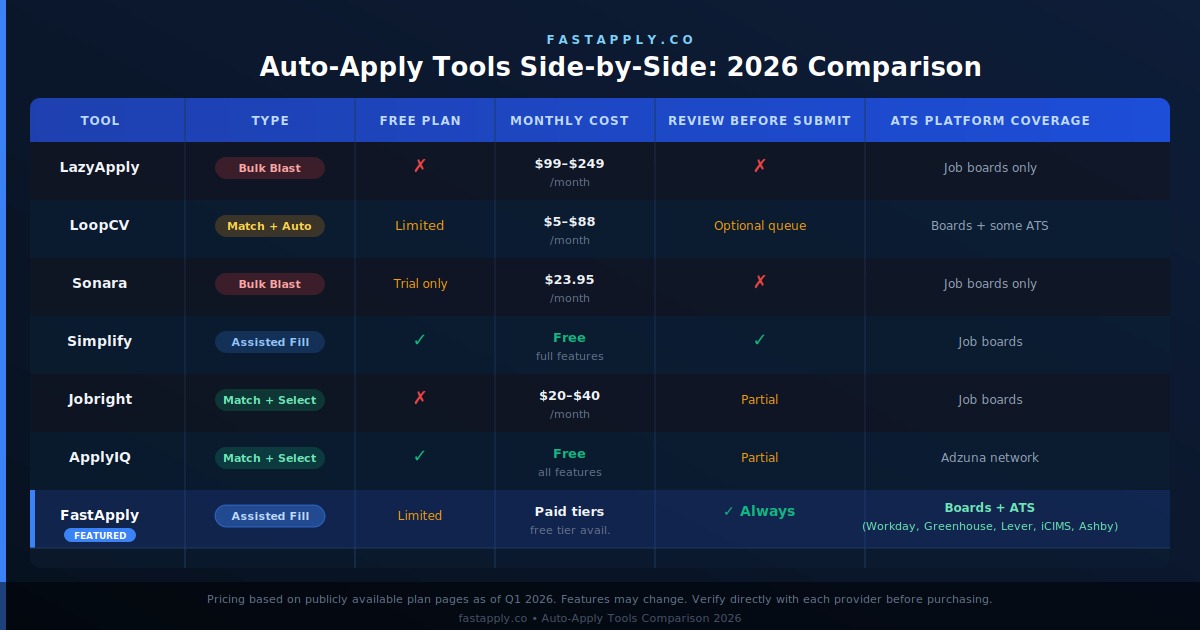
Side-by-Side Comparison: Auto Apply to Jobs Tools in 2026
| Tool | Type | Free Plan | Monthly Cost | Review Before Submit | ATS Platform Coverage |
|---|---|---|---|---|---|
| LazyApply | Bulk blast | No | $99-$249 | No | Job boards only |
| LoopCV | Matching + auto | Yes (limited) | $5-$88 | Optional | Job boards + some ATS |
| Sonara | Bulk blast | Trial only | $23.95 | No | Job boards only |
| Simplify | Assisted autofill | Yes (full) | Free | Yes | Job boards |
| Jobright | Matching + selective | No | $20-$40 | Partial | Job boards |
| ApplyIQ | Matching + selective | Yes (full) | Free | Partial | Adzuna network |
| FastApply | Assisted autofill | Yes (limited) | Paid tiers | Yes | Job boards + ATS platforms |
FAQ: Auto Apply to Jobs Tools in 2026
- Do job application bots work?
They work, but not equally for all job seekers. Bulk blast tools produce low interview rates - one documented case showed 5 interviews from 5,000 applications (0.1%). Tools that combine AI matching with per-application tailoring and human review before submission produce substantially better results. The honest answer is that no tool replaces a well-tailored application from a qualified candidate.
- Is using an auto-apply Chrome extension against the rules?
LinkedIn’s User Agreement prohibits automation tools that submit applications without human interaction. Other platforms have similar policies. Tools that assist your workflow within your active browser session carry far less risk than background agents that operate without you present. Always check the terms of service for each platform you use.
- Will a job application bot hurt my chances with employers?
A poorly filled-out automated application can permanently disqualify you with a specific employer. Many companies track previous applications. If a bot submits a garbled or mismatched application on your behalf, you do not get to undo it. This is why review-before-submit tools matter - they give you the speed benefit without the reputational risk.
- How many applications should I send per day?
Research points to quality over quantity as the winning formula in 2026. Rather than maximizing volume, focus on applying early (within 48-72 hours of posting) to well-matched roles with tailored materials. Ten targeted applications per week outperform 100 generic ones in most markets.
- What is the best free auto-apply tool in 2026?
Simplify and ApplyIQ are both genuinely free with meaningful functionality. Simplify is the stronger choice for autofill and tracking across any site. ApplyIQ is the stronger choice for automated job discovery and selective application within Adzuna’s network.
- Does an auto-apply tool work on Workday or Greenhouse?
Most bulk-blast tools work only on job boards (LinkedIn, Indeed, Glassdoor), not on company ATS platforms. Workday and Greenhouse require handling complex multi-step forms, dropdown logic, and custom questions that generic autofill tools fail to navigate. FastApply is built specifically to handle ATS platforms including Workday, Greenhouse, Lever, iCIMS, and Ashby.
- Do I need to tailor my resume for every application?
Yes, according to the data. A 2025 LinkedIn study found personalized resumes are 2.3 times more likely to earn interviews than generic versions. Tools that apply the same resume to every role are working against the data regardless of how many applications they send.
#auto apply to jobs tool
#job application bot
#auto apply chrome extension
#best auto apply tool 2026

Fastapply Team
Career Experts