FastApply vs Jobright 2026: Honest Side-by-Side Comparison
Short answer: Jobright is a match-quality platform that surfaces 10 free daily jobs and pre-fills applications you still click submit on (Level 2 assisted apply). FastApply is a full auto-apply platform that submits 80 to 200 applications daily across 20+ job platforms and ATS systems without your click (Level 3 hands-off). Pick Jobright if you want fewer, higher-relevance matches and are willing to review each application. Pick FastApply if you want volume, ATS coverage beyond LinkedIn, and a hands-off Auto-pilot workflow. Full pricing math and feature comparison below.
Both tools solve a real problem. They just solve different ones. Jobright’s users are typically applying to 5 to 15 roles per week and want the tool to surface relevance. FastApply’s users are typically applying to 100 to 500 roles per week and want the tool to handle submission. Below is the side-by-side on pricing, ATS coverage, match logic, and where each one wins.
The Core Difference: Volume vs Curation
Every AI apply tool sits somewhere on a spectrum from “high volume, hands-off” to “low volume, high curation.” Jobright and FastApply sit at opposite ends of that spectrum, which is why the choice between them is not really about features. it is about your job search strategy.
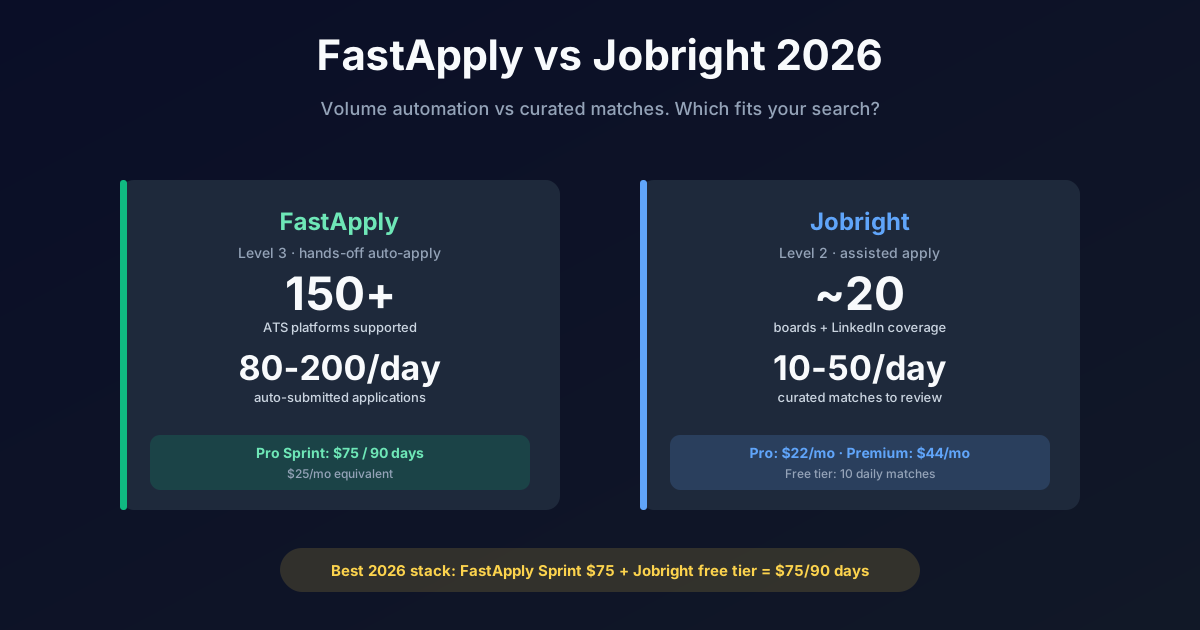
Jobright is a curation platform. The core loop is: AI scans job boards continuously, scores each posting against your profile, and surfaces the 10 to 50 highest-relevance matches per day. You click into each match, review the pre-filled application, and click submit on the ones you want. The AI does the discovery and matching heavy lift. You retain final quality control on every submission.
FastApply is a submission platform. The core loop is: AI scans job boards continuously, filters by your match criteria threshold, and auto-submits every match above the threshold. You set the daily cap (60 LinkedIn, 50 Indeed, 100 direct ATS) and match criteria once, then check a daily summary email. The AI does discovery, matching, and submission end-to-end. You retain control only through the match-criteria tuning.
Both approaches work. Which one fits depends on how you value throughput vs review time. If your ideal week is 30 carefully-reviewed applications, Jobright fits. If your ideal week is 500 auto-submitted applications across every ATS, FastApply fits.
Pricing Side-by-Side
Pricing tells you which market segment each tool is priced for.
Jobright pricing (2026):
- Free tier: 10 daily job matches, basic pre-filled applications
- Pro: $22/month, unlimited matches + AI resume review
- Premium: $44/month, unlimited + mock interview coaching + priority support
Jobright’s pricing is priced for a monthly recurring subscription over an average 4-to-8-month job search. Annual cost at Pro tier: $264. Annual cost at Premium: $528.
FastApply pricing (2026):
- Free credits: 5 full auto-submitted applications (one-time trial)
- Starter monthly: $14
- Starter 90-Day Interview Sprint: $38 (equivalent to $12.67/month over 3 months)
- Pro monthly: $29
- Pro 90-Day Interview Sprint: $75 (equivalent to $25/month over 3 months)
- Elite monthly: $49
- Elite 90-Day Interview Sprint: $132 (equivalent to $44/month over 3 months)
FastApply’s Sprint tiers are priced for the specific 3-month window most active job searches actually take. The typical FastApply user pays once (Sprint plan) and lands a role within the 90 days, rather than paying monthly for 4 to 8 months.
Effective cost per successful outcome. At typical conversion rates, Jobright Pro at 20 curated applications per week over 3 months = 240 applications, roughly 8 to 12 recruiter conversations, 2 to 4 offers, total spend $66. FastApply Pro Sprint at 100 auto-applications per day over 30 active days = 3,000 applications, roughly 30 to 50 recruiter conversations, 3 to 5 offers, total spend $75. See the full 90-Day Auto-Pilot Strategy breakdown for how the Sprint math plays out.
Same order-of-magnitude cost, different volume approach.
Feature Comparison Matrix
The features that most affect outcomes:
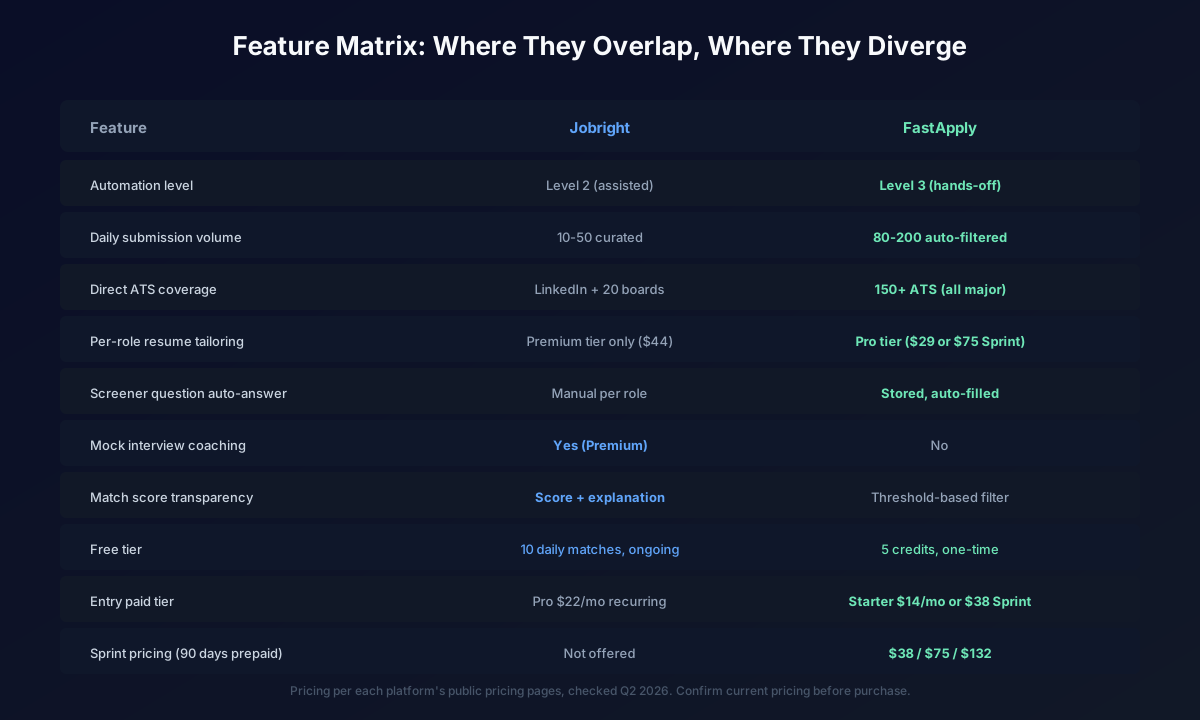
| Feature | Jobright | FastApply |
|---|---|---|
| Automation level | Level 2 (assisted apply, you click submit) | Level 3 (hands-off auto-apply) |
| Daily match volume | 10 free / unlimited paid, curated | 80 to 200 applications/day, filtered |
| ATS coverage | LinkedIn + 20 major boards | LinkedIn plus 20+ job platforms and ATS systems (Workday, Greenhouse, Lever, Ashby, iCIMS, Taleo, BambooHR, and more) |
| Resume tailoring per role | Static resume, tailoring on Premium tier | Per-role AI bullet rewriting on Pro and Elite |
| Screener question auto-answer | Manual per role | Stored answers, auto-filled per submission |
| Cover letter generation | AI-generated per role | AI-generated per role on Pro and Elite |
| Match scoring | Detailed relevance score with explanation | Match threshold, score not surfaced |
| Resume review + coaching | Included on Pro/Premium | Elite tier includes AI resume tailoring |
| Mock interview coaching | Premium tier only | Not included |
| Chrome extension | Yes | Yes |
| Server-side auto-submit | No | Yes on Pro and Elite |
| Free tier volume | 10 daily matches | 5 one-time credits |
The features are not overlapping. Jobright is stacked on curation and coaching. FastApply is stacked on submission volume and ATS coverage.
Where Each Tool Wins
Five common job-search scenarios and which tool fits better.
Scenario 1: Currently employed, applying to 10 to 15 select roles per week. Jobright wins. The curation model matches your throughput. 10 daily matches is more than you can review with quality anyway. Match scores let you skip the middle 60 percent and focus on the top 20 percent.
Scenario 2: Laid off, need offers in 60 to 90 days. FastApply wins. The 60-day USCIS grace period math and typical hiring timeline math both require 500+ applications in the first 30 days. Jobright’s 240-application ceiling over 3 months is not enough. See the H1B Auto-Apply guide for the grace-clock version.
Scenario 3: New grad, no strong network, applying broadly. FastApply wins for volume. Jobright wins for polish. Practical setup: FastApply on Auto-pilot for volume across ATS, Jobright’s free tier for the 10 highest-relevance matches you actually tailor manually.
Scenario 4: Senior IC or leadership candidate, executive search. Jobright wins. At the senior IC and above level, application count matters less than match quality and executive-recruiter surfacing. Jobright’s coaching features on Premium also fit better here.
Scenario 5: You want the tool to handle everything hands-off. FastApply wins. Jobright is not designed for hands-off. Every application requires your click. If your job search needs to run while you work full-time or handle other responsibilities, that per-application click adds up to 10+ hours per week. FastApply Auto-pilot needs about 55 minutes/day total.
For most active job seekers in 2026 the practical stack is: FastApply for the volume base, Jobright’s free tier for the curated 10 you actually tailor manually. The two tools do not conflict.
ATS Coverage Reality Check
The single largest feature gap between the two tools is direct ATS coverage.
Jobright surfaces roles from LinkedIn, Indeed, and about 20 major job boards. Its pre-filled application queue works cleanly on LinkedIn Easy Apply and some direct ATS integrations, but for Workday, Greenhouse, Lever, Ashby, iCIMS, Taleo, BambooHR, SmartRecruiters, JazzHR, and other direct ATS forms, you get the job link and manual instructions rather than auto-fill.
FastApply covers 20+ job platforms and ATS systems with active auto-fill and Auto-pilot support. That includes the Workday career sites many large employers run, most YC and post-IPO startups (Greenhouse, Lever, Ashby), most SMB and mid-market employers (BambooHR, JazzHR, SmartRecruiters, Recruitee), and specialty verticals (healthcare on iCIMS, government contractors on Taleo).
The coverage gap matters because roughly 60 percent of new job postings in the US in 2026 first appear on a direct ATS careers page before syndicating to LinkedIn or Indeed. Those first-4-hour listings convert 3 to 5x higher than listings that have been live for 48 hours. If your tool cannot reach them, you compete only for the 40 percent that syndicate broadly. See our Workday ATS guide for why the Workday-first strategy matters specifically at Fortune 500 scale.
Match Quality: How Different Are the Scores?
Both tools score match quality. Jobright surfaces the score. FastApply uses it as a filter threshold. But the underlying logic is similar.
Both look at title match, seniority match, salary alignment, location fit, work-authorization fit, and skill-keyword overlap. Jobright weights recruiter-reachability signals higher (roles from active-hiring recruiters get a bump). FastApply weights posting recency higher (roles less than 4 hours old get a bump).
In practice, when a role is a good match, both tools flag it. When a role is a poor match, both tools skip it. The middle band (60 to 75 percent match score) is where the tools diverge. Jobright surfaces those middle-band roles with a score attached so you can decide. FastApply skips them unless you loosen the threshold.
Neither approach is objectively better. Curated review works when you have time. Threshold filtering works when you do not.
What Jobright Does Better
Jobright’s coaching and review features are a real differentiator.
Resume review. Jobright Pro’s AI resume review flags specific formatting and content issues with per-line suggestions. It is more detailed than FastApply’s resume tailoring, which focuses on per-role keyword optimization rather than baseline improvement.
Mock interview coaching. Jobright Premium’s mock interview feature does behavioral and technical practice with feedback. FastApply does not have this. If you know your interview prep is the bottleneck, not application volume, Jobright Premium delivers real value.
Match explanations. Jobright shows why each match scored the way it did. That transparency helps you refine your search criteria in a way FastApply’s threshold-based filtering does not.
Lower-commitment free tier. Jobright’s 10-daily-matches free tier is actually useful ongoing, not just a one-time trial. If you are early-stage in your search and testing the waters, Jobright’s free tier gives you more runway.
What FastApply Does Better
FastApply’s submission volume and ATS coverage are also real differentiators.
Hands-off Auto-pilot. FastApply Pro and Elite run without your click. That saves 8 to 12 minutes per application, which is the difference between 30 applications a week (manual) and 300 applications a week (auto-pilot).
Direct ATS coverage. Workday, Greenhouse, Lever, Ashby, iCIMS, Taleo, BambooHR, and the rest of its 20+ supported platforms. Direct ATS is where 60 percent of new US job postings first appear, and it is where the freshest listings live.
Per-role resume tailoring on Pro. FastApply Pro’s AI rewrites your bullets per job description for keyword-match lift. Jobright’s per-role tailoring is only on Premium at $44/month, and it’s presented as a suggestion rather than an auto-applied rewrite.
Sprint pricing. FastApply’s Pro Sprint at $75 for 90 days is the lowest cost per submission in the category. See the full pricing page for tier breakdown and the 500 jobs per week guide for what daily cadence that unlocks.
Realistic free trial. FastApply’s 5-credit free tier lets you test full Auto-pilot before spending. Jobright’s free tier tests curation but not the paid submission features.
When to Use Both
The two tools are not mutually exclusive.
The practical stack: FastApply on Auto-pilot for 80 to 100 applications per day of ATS coverage and volume. Jobright’s free 10 daily matches for the highest-relevance roles you tailor manually and personalize with a cover letter.
Cost: $75 FastApply Pro Sprint + $0 Jobright free = $75 for 90 days combined. Total submissions: roughly 3,000 auto-applied + 300 manually-tailored = 3,300 quality applications. Interview yield at typical conversion rates: 30 to 50 recruiter conversations, 5 to 10 first-round interviews, 2 to 4 offers.
Compare that to Jobright Premium alone at $132 for 3 months ($44 x 3) with 20 curated applications per week x 12 weeks = 240 applications total, roughly 6 to 10 interviews, 1 to 3 offers. Same order-of-magnitude outcome, 12x fewer submissions, no volume floor if the market softens.
The stacked approach costs less and generates more submission surface area. That is the recommendation for most active 2026 job searches.
FAQ
Is FastApply better than Jobright? Neither is universally better. FastApply wins on submission volume (80 to 200 daily vs 10 to 50 daily), ATS coverage (end-to-end submission on Workday, Greenhouse, iCIMS and other direct ATS forms vs mostly LinkedIn Easy Apply), and hands-off automation (Auto-pilot vs click-to-submit). Jobright wins on match curation, resume coaching (Pro tier), and mock interview practice (Premium tier). Pick FastApply for volume and coverage. Pick Jobright for curation and coaching.
How much does Jobright cost vs FastApply? Jobright is $22/month Pro or $44/month Premium (recurring). FastApply is $14/month Starter, $29/month Pro, or $49/month Elite (recurring), with 90-Day Interview Sprint tiers at $38 Starter, $75 Pro, or $132 Elite (3-month prepaid). For a 3-month active search, FastApply Pro Sprint ($75) is roughly equivalent cost to Jobright Pro monthly ($66), with significantly higher submission volume and ATS coverage.
Does Jobright auto-submit like FastApply? No. Jobright is Level 2 assisted apply. It pre-fills your application, but you click submit on each one. FastApply is Level 3 full auto-apply on the Pro and Elite tiers. Auto-pilot submits without your click and logs to your dashboard. This is the largest workflow difference between the two tools.
Which tool has better ATS coverage? FastApply. FastApply covers 20+ job platforms and ATS systems, including LinkedIn Easy Apply, Workday, Greenhouse, Lever, Ashby, iCIMS, Taleo, BambooHR, SmartRecruiters, JazzHR, and Recruitee, and submits on the direct ATS forms. Jobright covers LinkedIn, Indeed, and about 20 major boards, with auto-fill working cleanly on LinkedIn Easy Apply but requiring manual submission on most direct ATS.
Can I use FastApply and Jobright together? Yes. The practical stack for active 2026 job searches is FastApply Pro Sprint for hands-off volume across 20+ job platforms and ATS systems, plus Jobright’s free 10-daily-matches tier for the highest-relevance roles you manually tailor with a cover letter. Combined cost: $75 for 90 days. Combined submissions: roughly 3,300 total across both tools.
Does Jobright have a free tier? Yes. Jobright’s free tier includes 10 daily matched jobs and basic pre-filled applications. It is ongoing rather than time-limited. FastApply’s free tier is 5 one-time credits that test the full Auto-pilot workflow before upgrading to a paid plan.
Which tool is better for laid-off H1B holders? FastApply. The 60-day USCIS grace period makes volume math critical. FastApply Pro on the 90-Day Sprint ($75 for three months) includes 500 applications a month, about 1,000 inside a 60-day grace period, and Elite doubles that, across 20+ job platforms and ATS systems. Jobright’s 10-to-50 daily curated matches is not designed for compressed high-volume timelines. See our H1B Auto-Apply strategy for the full grace-period playbook.
Related reading
- AI Apply for Jobs 2026: The Free Tools That Actually Work
- AI Auto-Apply for Jobs: How It Works in 2026
- Passive Job Search: The 90-Day Auto-Pilot Strategy
- H1B Auto-Apply Strategy: Reach 1,000 Sponsors
- FastApply vs LinkedIn Easy Apply Limit
- FastApply vs JobCopilot 2026
- Auto-Apply to Jobs Tools Compared 2026
- Install FastApply on the Chrome Web Store
#fastapply vs jobright
#jobright vs fastapply
#jobright review
#jobright alternative
#Jobright
#AI job application
#auto apply tools

Ekekenta Clinton
Founder, FastApply