Jobscan Review 2026: Pricing, Limits, and Alternatives
Is Jobscan worth it? For a handful of high-priority applications a month, the free plan is enough and costs nothing. For a full search, it gets expensive fast: unlimited scans cost $29.98 a month on a 3-month commitment or $49.95 month to month, and the tool still leaves you to edit and submit every application yourself. This Jobscan review covers what the free version really includes, what each paid tier costs, where the match score helps and where it misleads, and the Jobscan alternatives worth considering.
Disclosure: this blog belongs to FastApply, an auto-apply tool that overlaps with Jobscan on resume tailoring. Every Jobscan figure below links to where you can check it.
The verdict up front
Our editorial score: 7 out of 10. Jobscan does one thing well. It compares your resume with a job description and shows you the keyword gaps in a clear, numeric way, and it has been doing that longer than anyone else in the category. The two complaints that come up most in other Jobscan reviews are the same two we found: the cost of a paid plan, and a free plan capped at 5 scans a month.
- Buy Jobscan if you tailor a small number of applications with care, you want a consistent way to check each one against the posting, and you can use the Quarterly plan’s 7-day trial to run a batch of scans before paying.
- Skip Jobscan if you apply at volume. At 30 or more applications a month, the scan-edit-rescan loop becomes the bottleneck, and $89.95 a quarter buys a score, not a submitted application.
- The one fact to know before paying: Jobscan is a resume optimiser, not an auto-apply tool. Its Auto Apply feature is sold as separate credits, and the paid plans only give you a 20% discount on them.
How this Jobscan review was done. On 22 September 2026 we checked Jobscan’s live plan page, read its applicant tracking system explainer, and read its Trustpilot profile. Pricing and feature lists below come from those pages on that date. We did not run a paid Jobscan account for this update, so nothing here describes scans we bought ourselves.
What Jobscan does
Jobscan (jobscan.co) is a web app plus a Chrome extension. The core workflow has three steps: paste your resume, paste a job description, and read the results. The results page gives you a match rate from 0 to 100, a list of hard skills and soft skills that appear in the posting but not in your resume, and a set of “ATS and recruiter findings” about formatting, section headings, dates and contact details.
Around that core, Jobscan bundles a resume builder, a job tracker, an AI cover letter generator, a LinkedIn optimizer, AI Job Match (job suggestions based on your profile) and interview practice. The Chrome extension scans against a posting on a job board without copying it over.
Two things it does not do. It does not submit applications: you take the edited resume to the employer’s form yourself. And it does not rewrite your resume per job unless you pay. “Unlimited AI optimizations”, the one-click rewrite of bullets to close keyword gaps, is a paid, desktop-only feature. Auto Apply is sold as separate credits, not included in any plan.
Jobscan pricing in 2026
Jobscan pricing on 22 September 2026, from app.jobscan.co/plan:
| Plan | Price | Billing | Trial | Scans | What you get |
|---|---|---|---|---|---|
| Free | $0 | Forever | n/a | 5 resume scans a month | 5 ATS and recruiter findings per scan, job tracker, resume builder, Chrome extension |
| Quarterly | $29.98 a month | $89.95 every 3 months (“Save 40%“) | 7-day free trial | Unlimited | Unlimited AI optimizations (desktop only), AI cover letter generator, LinkedIn optimizer (after trial), AI Job Match, 20% off Auto Apply credits (after trial), 20% off Interview Practice |
| Monthly | $49.95 a month | Monthly | No trial | Unlimited | Same features as Quarterly |
A few details that matter before you enter a card:
The 7-day trial only exists on the Quarterly plan. It converts to an $89.95 charge every 3 months unless you cancel. There is no trial on Monthly. Two headline features, the LinkedIn optimizer and the 20% Auto Apply discount, are listed as “after trial”, so you cannot evaluate them during the free week.
Monthly costs 67% more per month than Quarterly. $49.95 against $29.98; the advertised 40% saving is measured against that Monthly price. If your search will run 3 months, Quarterly is the only sensible paid option. If it might end in 3 weeks, you either pay $49.95 once or accept an $89.95 charge you may not use.
Cancellation. The plan page says you can cancel any time and keep access until the end of the billing period. It does not mention pro-rated refunds. Trustpilot reviewers report that cancelling needed an email to support rather than a button, and one reported a charge attempt during the trial. Diary the trial end date.
What we found
Where the match score helps
The match rate makes an invisible problem visible. Most people write one resume and send it everywhere. Paste it next to a real posting and Jobscan lists the exact skills and phrases the employer wrote that you never used. For someone who has never tailored a resume, that first scan is often the moment they understand why they get no replies.
The ATS and recruiter findings catch the formatting mistakes that break parsing: skills hidden in tables or headers, non-standard section titles, missing dates. Our ATS resume format guide covers the same rules free.
Where it falls short
The score measures keyword overlap, not fit. Jobscan’s own ATS explainer describes what an applicant tracking system actually does: it “pulls out key details, like your work experience, education, and skills,” stores them in a database, and recruiters then “search the database using keywords to find the best matches.” Note what is missing. The ATS does not compute a Jobscan-style percentage and reject anyone under a threshold. A recruiter searches for three or four terms, and your resume either contains them or it does not. Pushing a score from 72% to 91% by adding every listed soft skill does nothing for that search and makes the resume worse when a human reads it.
It creates a scan-edit-rescan loop. Every improvement means editing, re-uploading and rescanning. For one dream job that is fine. At 10 roles a week it is 20 to 30 minutes per application before you have opened the employer’s form, and our data on how many applications it takes to get an interview suggests most people need more volume than that loop allows.
The free plan runs out in an afternoon. Five scans a month is one job description scanned five times, or five jobs scanned once, with the top five findings each. Free is a good demo of the paid product, not a version you can run a search on.
It stops at the score. No Jobscan plan takes the tailored resume into Workday, Greenhouse or Lever for you. If beating Workday applications is your actual problem, a match score does not touch it.
Is Jobscan worth it?
Yes for a targeted search of a few applications a month, and no for a high-volume one. Here is the maths.
Say you apply to 30 roles a month for 3 months, 90 in total, and scan and tailor each one. On Quarterly that is $89.95 for 90 tailored resumes, about $1.00 per application in cash, plus roughly 20 minutes of your own editing each time. Tailoring by hand with a free checklist costs $0 and about the same time. A tool that both tailors and submits changes the equation: FastApply Pro is $29 a month for 500 applications with a tailored resume and cover letter written for each one, about $0.06 per application at full use, and the form is filled for you.
So the answer to “is Jobscan worth it” depends on where your time goes. If your bottleneck is not knowing what to change, Jobscan is worth a quarter. If your bottleneck is the number of applications you can get out the door, it is not, because it does not help with that part at all.
Best Jobscan alternatives in 2026
Five Jobscan alternatives, each solving a different part of the problem. Prices were checked on 22 September 2026 unless noted.
| Tool | What it does better than Jobscan | Price | Best for |
|---|---|---|---|
| FastApply (ours) | A different category: writes a tailored resume and cover letter per job, then fills and submits the form on 20+ platforms including Workday, Greenhouse, Lever, Ashby and iCIMS | Free 5 applications, then $14, $29 or $49 a month | Anyone applying at volume who wants tailoring done for them |
| Teal | Free tier with unlimited resumes and unlimited job tracking, keyword matching built into the resume builder | Free; Teal+ was $13 a week, $29 per 30 days or $79 per 90 days when we compared it in May 2026 (tealhq.com blocked our check on 22 September 2026, so confirm on their site) | People who want one place to store, track and edit resumes |
| Rezi | Cheaper long term: a $149 lifetime plan instead of a subscription, with a keyword-targeting builder and a money-back guarantee | Free; Pro $29 a month; Lifetime $149 one-time (rezi.ai/pricing) | Anyone who expects to reuse a resume builder for years |
| Huntr | Tracker-first, with job-tailored resumes on the free plan (2 included) and unlimited on Pro | Free; Pro $40 a month, $90 every 3 months or $160 every 6 months (huntr.co/pricing) | Organised job seekers who want tracking and tailoring together |
| ChatGPT or another free chatbot | Costs nothing, rewrites bullets in seconds, and can explain why a phrase matters | Free tier | Anyone on a zero budget who can supply the judgement themselves |
We covered Teal, Rezi and Huntr in their own comparisons, and our roundup of AI resume tailoring tools has a longer list. If you only want a scan, Teal’s and Huntr’s free plans give you keyword matching without a monthly cap, which is the main thing Jobscan’s free plan lacks.
Jobscan vs FastApply
This Jobscan vs FastApply comparison is short, because the two tools mostly do different jobs. Jobscan is a scoring layer. FastApply is an application layer with tailoring built in. FastApply prices below were checked on fastapply.co/pricing on 22 September 2026.
| Jobscan | FastApply | |
|---|---|---|
| Main job | Score a resume against a job description, list keyword gaps | Write a tailored resume and cover letter per job, then fill and submit the application |
| Free plan | 5 scans a month, forever | 5 applications, one time, no card |
| Paid entry | $29.98 a month, billed $89.95 every 3 months | $14 a month for 200 applications (Starter) |
| Mid tier | $49.95 a month, month to month | $29 a month for 500 applications, tailored resume and cover letter per job (Pro) |
| Top tier | Same features on both paid plans | $49 a month (Elite); 90-Day Sprint pricing also exists at $38, $75 and $132 for 3 months |
| Submits the application | No (Auto Apply credits sold separately, 20% off on paid plans) | Yes, on 20+ job platforms and ATS systems including Workday, Greenhouse, Lever, Ashby, iCIMS, Taleo and BambooHR |
| Review before submit | Not applicable | Co-pilot mode reviews each application; Auto-pilot runs hands-off |
| Numeric ATS score | Yes, 0 to 100 | No visible score; tailoring is done per job automatically |
| LinkedIn profile optimizer | Yes, paid plans, after trial | No |
Where Jobscan wins. The visible score. If you want a number and a checklist before you send one important application, Jobscan gives you that and FastApply does not. The LinkedIn optimizer has no FastApply equivalent either.
Where FastApply wins. Everything after the score. Pro writes the tailored resume and cover letter for each posting and submits the form, so the 20 minutes per application disappears, and it costs $29 a month for 500 tailored applications against $29.98 a month for scans you still act on by hand. Read how auto-apply actually works before deciding.
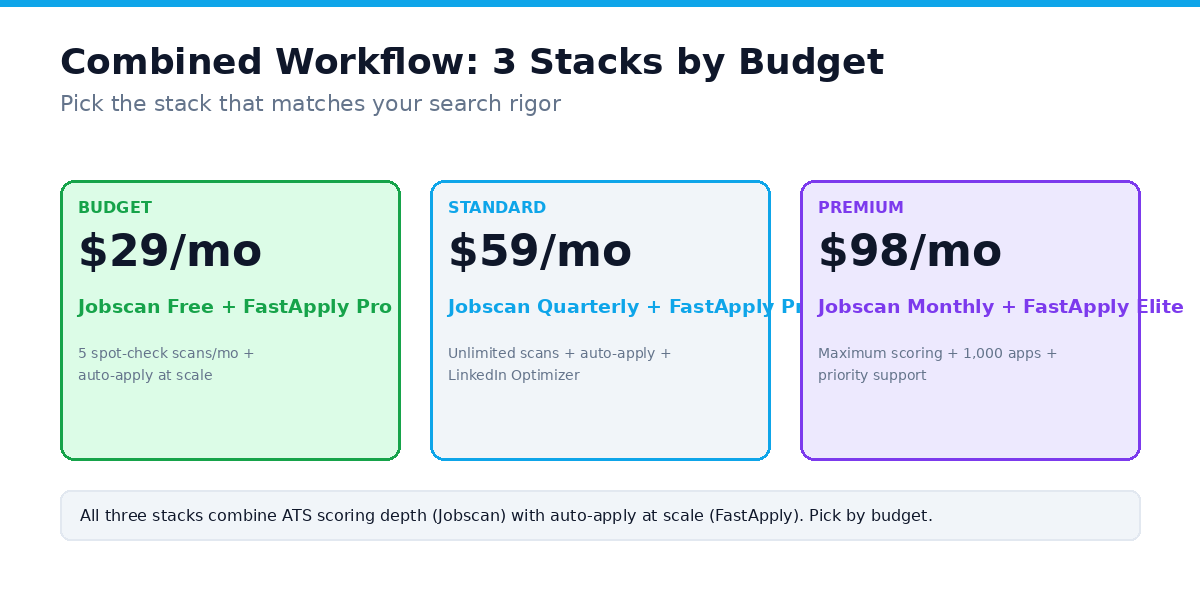
Using both. The cheapest combined setup is Jobscan Free plus FastApply Pro at $29 a month: scan your five most important applications, let FastApply handle the rest. Adding Jobscan Quarterly takes that to about $59 a month.
Frequently asked questions
How much does Jobscan cost in 2026?
As of 22 September 2026, Jobscan has three plans: Free at $0 with 5 resume scans a month, Quarterly at $29.98 a month billed as $89.95 every 3 months, and Monthly at $49.95. Both paid plans include unlimited scans, unlimited AI optimizations, the AI cover letter generator, AI Job Match and the LinkedIn optimizer. Only the Quarterly plan has a 7-day free trial.
Is the Jobscan free version enough?
It is enough to learn what tailoring means and to check a few applications a month. Five scans with the top five findings each is a demo of the paid product, not a tool you can run a search on. If you apply to more than five roles a month and want to check each one, you will hit the cap in the first week.
Is Jobscan legit?
Yes. Jobscan is an established company with public pricing, a working free plan and a Trustpilot score of 4.3 from 341 reviews on 22 September 2026, with 83% five-star and 11% one-star ratings. The recurring complaints are about billing rather than the product: cancellation needing an email to support, and a charge attempt during the free trial. Check the cancellation process before starting a trial.
What is the best Jobscan alternative?
It depends on what you want to replace. For a free scan and tracker with no monthly cap, Teal or Huntr. For a builder you pay for once, Rezi’s $149 lifetime plan. If the problem is getting tailored applications submitted rather than scored, FastApply is the closest full replacement: Pro is $29 a month for 500 applications, each with a tailored resume and cover letter, submitted for you on 20+ platforms.
Does a high Jobscan match score get you interviews?
Not by itself. A high score means your resume repeats the posting’s keywords, which helps when a recruiter searches the ATS database for those terms. It does not mean an ATS ranked you above other candidates; that search is a person typing a few terms, not a percentage threshold. Interviews come from relevant experience, a readable resume and enough applications sent early, and the score helps with one of those three.
Is Jobscan better than ChatGPT?
They do different things. Jobscan measures overlap between your resume and one posting with a consistent rubric and shows you the gaps. ChatGPT rewrites text on request and is free, but it does not score consistently and will invent skills if you let it. A good pairing is a Jobscan scan to find the gaps and a chatbot to rewrite the bullets, followed by your own judgement on what is true.
Is 80% a good ATS score?
On Jobscan’s scale, yes. Jobscan tells users to aim for a match rate of 75% or higher, so 80% means your resume covers most of the posting’s listed skills. Going from 80% to 95% usually means adding keywords you cannot back up in an interview, which hurts more than it helps. Treat 75% to 85% as the sensible range and spend the remaining time on the applications themselves.
Which is better, Jobscan or Teal?
Jobscan has the deeper single scan: a numeric score, hard and soft skill gaps and ATS findings. Teal has the better free plan: unlimited resumes, unlimited tracking and keyword matching inside its builder, with the full match score on Teal+. If you tailor a few applications carefully, Jobscan. If you want to manage a whole search in one free tool, Teal. Our Teal comparison covers the pricing.
Can ATS detect ChatGPT resume?
No. An applicant tracking system parses your resume into fields and lets recruiters search those fields by keyword. Neither function identifies who or what wrote the text, and we found no ATS documentation describing an AI-writing detector. What a recruiter can spot is generic AI phrasing with no numbers, so use a chatbot for drafts and put your own specifics back in.
Bottom line
Our Jobscan review comes down to this: it is a well-made scoring tool with a free plan that runs out after 5 scans and paid plans that cost $89.95 a quarter or $49.95 a month for a number you still have to act on by hand. If you send a few careful applications a month, use the free plan and the Quarterly trial and you will get value. If you need to send many tailored applications through real application forms, the score is the smallest part of the job. Try FastApply free with 5 applications and no card, and see whether tailored, submitted applications get you more replies than a higher match rate did.
Stop filling the same form twice
FastApply writes a tailored resume and cover letter for every job on Pro and Elite, then fills the real application form on Workday, Greenhouse, Lever, Ashby, Taleo, BambooHR and the rest of its 20+ supported platforms.
Free tier: 5 applications, no credit card.
#jobscan review
#jobscan
#jobscan pricing
#jobscan pricing 2026
#is jobscan worth it
#jobscan free version
#jobscan alternative
#jobscan vs teal
#jobscan vs fastapply
#ATS resume scanner

Ekekenta Clinton
AI/ML Engineer