Passive Job Search: The 90-Day Auto-Pilot Strategy (2026)
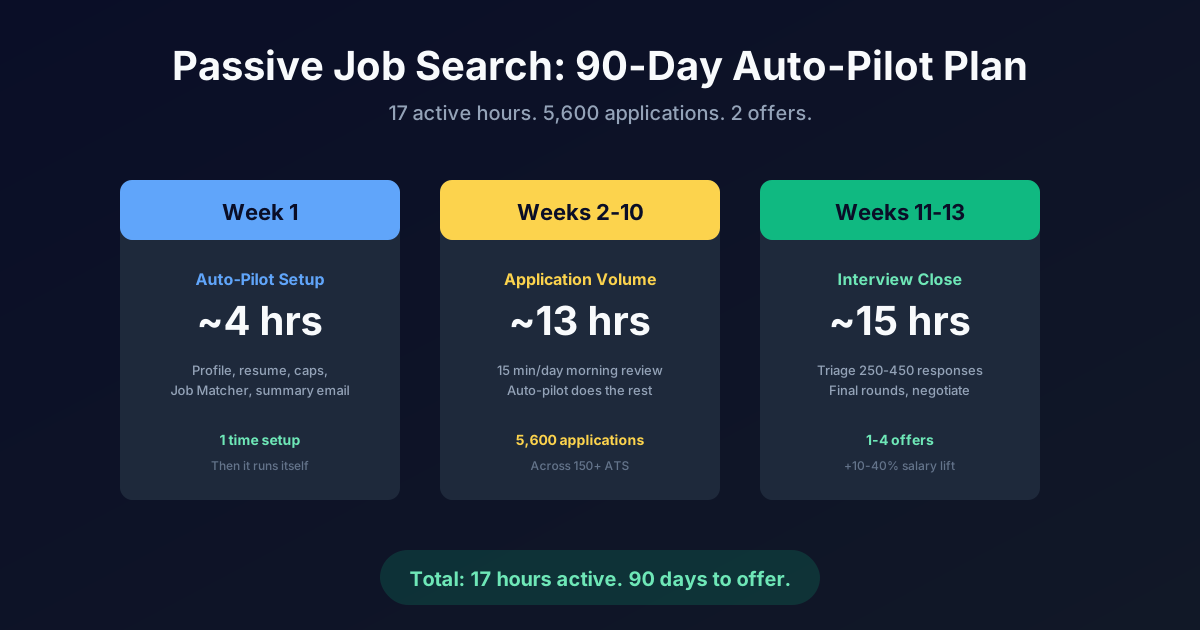
Short answer: A passive job search runs for 90 days, requires roughly 17 hours of your active time across the full period, and produces 1 to 4 offers depending on profile. The structure: Week 1 is one-time Auto-pilot setup (about 4 hours), Weeks 2-10 are background application volume (15 minutes a day of review, no active searching), Weeks 11-13 are the interview close (triage 250-450 recruiter responses, run final rounds, sign). Realistic median outcome is 2 offers at a +18% salary lift versus your current role. The full week-by-week playbook is below.
This works because the math compounds. Per-job AI-tailored resumes plus first-mover advantage (applying within 4 hours of a posting) plus direct ATS coverage (Workday, Greenhouse, Lever, iCIMS, Taleo and more) produces a 4-8% recruiter response rate. At 5,600 applications across 90 days, that is 250 to 450 conversations, more than enough volume to filter into 2 offers.
This is also the strategy the 90-Day Interview Sprint plan is built around. Pricing is calibrated to one full passive search cycle, not monthly subscriptions.
What Makes This Search “Passive”
Active job hunting is the standard 8 to 11 hours a week most candidates spend on applications. You browse job boards, copy-paste your resume into each ATS, write a cover letter, and submit. Sustained over a 90-day search, that is 100 to 140 hours of your evenings and weekends.
Passive job hunting flips the model. Auto-pilot does the volume in the background while you work, sleep, or live your life. You spend roughly 12 minutes a day on quality control and roughly 4 hours on Week 1 setup. That is the entire human time investment.
The passive search is not about doing less. It is about doing different. Volume goes up 5 to 10x. Active time drops to about 12% of an active search. Conversion stays the same per application because each one is AI-tailored to the role.
Week 1: Auto-Pilot Setup (One-Time, About 4 Hours)
The entire success of the 90-day plan depends on Week 1. Skimp here and the next 12 weeks produce noise. Spend the hours.
Day 1 (90 minutes): Profile and preferences. Install FastApply and complete every field. Target titles (be specific: not “Software Engineer” but “Senior Backend Engineer” or “Staff ML Engineer”). Seniority. Locations (with miles-radius). Salary floor. Must-haves (remote, healthcare benefits, 401k match). Deal-breakers (relocation, on-call rotations, equity-only comp). Work authorization status. Willingness to relocate (and within what radius).
Day 2 (60 minutes): ATS-clean resume. Upload your resume and confirm it parses cleanly. Use a single-column layout, sans-serif font at 10-11pt, standard section headings (“Work Experience,” “Education,” “Skills”), no tables or graphics, and a text PDF. See the ATS Resume Format guide for the parsing rules across the 5 major ATS platforms.
Day 3 (30 minutes): Auto-pilot daily caps. Set the caps that match your search aggressiveness. Recommended baseline: 30 LinkedIn Easy Apply per day + 50 direct ATS per day = 80/day = roughly 5,600 applications across 70 search days. For aggressive searches, bump to 60 LinkedIn + 100 ATS = 160/day. Choose “Distributed” submission timing so applications spread through the day rather than burst at the top of the hour.
Day 4 (45 minutes): 24/7 AI Job Matcher. Enable the Job Matcher across all 12+ job boards. Set match criteria: title keywords, location radius, salary floor, exclude contract/internship. The Matcher scans continuously and feeds newly-posted roles into your Auto-pilot queue. First-mover advantage on a job posting is 4-5x the interview rate of late applications.
Day 5 (30 minutes): Notifications and auto-responder. Configure the daily summary email (single email at 7 AM listing yesterday’s submissions, today’s queue, and any recruiter responses). Set up an inbox auto-responder for interview-scheduling requests if you want recruiters to book directly into a calendar slot.
Days 6-7 (30 minutes total): Sanity-check audit. Auto-pilot has been running for 2-3 days. Open the dashboard and review the first 50 applications submitted. Are they on-role? On-salary? On-location? If 90%+ pass the sniff test, you are set. If not, tighten your match criteria.
Total Week 1 time: roughly 4 hours of active work. After this, Auto-pilot runs unattended.
Weeks 2-10: Application Volume Runs Automatically
This is the part people do not believe until they see it.
Auto-pilot submits about 80 applications per day. The 24/7 Job Matcher catches newly-posted roles within hours. Per-job AI tailoring generates a fresh resume and cover letter for every submission. You do nothing.
Your active time during this 9-week stretch:
- 15 minutes each morning. Open the daily summary email. Skim yesterday’s submissions for any obvious off-target matches. Approve anything sitting in the Co-pilot queue (roles flagged for manual review because of unusual screener questions or required attachments).
- 5 minutes mid-day if a recruiter replies. Schedule the call, or send a one-line “Yes, here is my calendar link” reply.
- 10 minutes Sunday evening. Tune match preferences if last week’s submissions were skewing toward one industry or seniority you do not want.
Total per week: about 100 minutes. Across 9 weeks: roughly 15 hours.
In that time, Auto-pilot submits:
- 30 LinkedIn applications per day x 7 days x 9 weeks = ~1,890 LinkedIn applications
- 50 direct ATS applications per day x 7 days x 9 weeks = ~3,150 ATS applications
- Plus 24/7 Job Matcher catches (newly-posted roles outside the daily cap): ~500-700 additional applications
Total submitted across Weeks 2-10: roughly 5,500 to 5,700 applications.
This is the part where active job search candidates working the same 9 weeks would have submitted 90 to 120 applications. The volume difference is 50x. The active time difference is 10x in your favor.
Weeks 11-13: The Interview Close
By Week 10 you should have 250 to 450 recruiter responses sitting in your inbox (5-8% response rate on tailored applications). This is where the active work happens.
Week 11: Triage and book. Sort the responses by company match. Top 30 (best-fit companies + roles + comp) get a first-screen call scheduled in Week 11. Next 50 get scheduled into Week 12. Reject the rest with a polite one-liner (“I am currently in process with a few other opportunities and would not be a good fit for this one, but thank you for reaching out”).
Week 12: First-screen calls and second rounds. Run 5-10 first-screen calls per day across the 50 from Week 11’s next-tier list. By end of Week 12, top 10 candidates from these calls have advanced to second-round (technical, take-home, panel, or manager interview).
Week 13: Final rounds, offer, negotiate. Run final rounds on the top 10. Expect 1 to 4 offers depending on aggressive vs. conservative profile. Negotiate. Sign.
The reason this works in 3 weeks of interview time: you compressed the funnel by going volume-up on the front end. 90 days of active search produces maybe 50 applications and 5 interviews. 90 days of passive search produces 5,600 applications and 250-450 responses. The interview close phase is dense because the funnel is full.
Real-Number Outcomes by Profile
The 90-day outcome varies by search profile. Honest tier ranges:
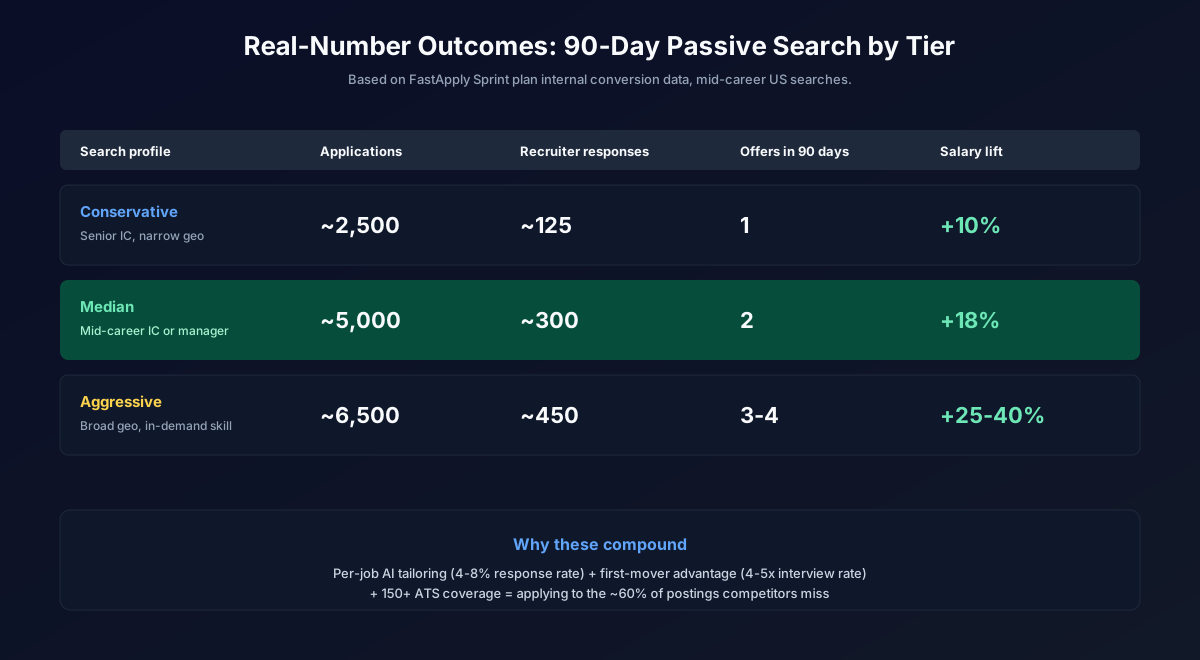
Conservative. Senior IC or executive role, narrow geo (single city, no remote). 1 offer in 90 days, +10% salary lift versus current. Lower volume because the role pool is smaller.
Median. Mid-career IC or manager role, hybrid or remote open. 2 offers in 90 days, +18% salary lift. The typical FastApply Sprint plan outcome.
Aggressive. Broad geo (remote-friendly), in-demand skill (SWE, ML, data, security, sales). 3-4 offers in 90 days, +25-40% salary lift. These are the case studies that get screenshotted.
What makes the numbers compound: AI per-job tailoring (4-8% response rate vs 0.5-1.5% for untailored) + first-mover advantage (4-5x interview rate when applying within 4 hours of posting) + direct ATS coverage across 20+ platforms (applying to the ~60% of postings that live on Workday, Greenhouse, Lever, Ashby, and other direct ATS platforms instead of just LinkedIn).
The 90-Day Interview Sprint Plan
The Sprint plan exists because the 90-day passive search is the right cycle length and the right cost shape. Three tiers:
Starter ($38 for 90 days, or $14/month). 30 LinkedIn + 50 ATS per day. No AI tailoring (uses your uploaded resume as-is). Best for: candidates with already-strong ATS-clean resumes, applying to roles where keyword match is high without rewrites, or testing the Sprint approach before upgrading.
Pro ($75 for 90 days, or $29/month). Recommended for most. 60 LinkedIn + 100 ATS per day. Per-job AI resume tailoring on every submission. 24/7 AI Job Matcher across 12+ boards. This is the tier the median outcome above is based on.
Elite ($132 for 90 days, or $49/month). 100 LinkedIn + 200 ATS per day. Per-job AI tailoring + AI cover letter generation. Priority Job Matcher (catches roles within 30 minutes of posting). Best for: candidates running aggressive searches, H1B candidates on shorter timelines, or candidates targeting saturated markets.
For a 90-day passive search, the Sprint pricing is between $38 and $132 total. Monthly billing across 3 months would be $42 to $147. The savings on the Sprint bundle are small in absolute terms but the Sprint structure also includes pause/resume credits if you get an offer in Week 8 and want to bank the remaining weeks for a future search.
When Passive Search Does Not Work
Two scenarios where passive search underperforms:
Executive and VP-level roles. These almost never get posted publicly. They go through executive recruiters and warm intros. Passive search via Auto-pilot will hit very few of these. Run a hybrid model: 50% Auto-pilot on posted roles for fallback options, 50% manual networking with executive recruiters.
Single-city specialty roles. If your target is “in-house counsel at a healthcare company in Boston” and there are 8 such roles open across the year, no tool will produce 5,600 relevant applications. Drop the volume goal and run a curated 10-application week with deep tailoring on each.
For everyone else (mid-career IC, manager, senior IC across most functions, all locations including remote-only), the 90-day passive plan works as described.
Related guides
- Find a Job While Working Full-Time in 2026
- How to Apply to 500 Jobs in a Week (Sustainably)
- How AI Auto-Apply Works in 2026
- Best AI Resume Tailoring Tools 2026
- Workday ATS Hack: 7 Tactics for 2026
- How to Apply to 100 Remote Jobs Per Week
Start Your 90-Day Sprint
Five free applications, no card on file. Install the FastApply Chrome extension and run the first batch on us. Works on LinkedIn, Indeed, ZipRecruiter, Workday, Greenhouse, Lever, Ashby, iCIMS, Taleo, and the rest of its 20+ supported platforms.
Recommended tier for most passive searches: FastApply Pro 90-Day Interview Sprint at $75 total. Covers 60 LinkedIn + 100 ATS per day with per-job AI tailoring across the full 90 days. The plan ends. There is no auto-renewal lock-in.
#passive job search
#passive job hunting
#auto job search
#90 day job search plan
#set and forget job hunt
#auto apply
#FastApply

Ekekenta Clinton
Founder, FastApply