FAANG vs MAANG vs MAMAA: Big Tech Acronyms Explained (2026)
There used to be one Big Tech acronym. Now there are at least six, and half of them are technically wrong depending on who you ask. FAANG, MAANG, MAMAA, MANGA, CFAANG. They all describe roughly the same set of companies, but the differences matter when you’re applying for a job, writing a finance report, or trying to sound like you know what you’re talking about.
This post walks through every variant. What each one means, when it was coined, which companies are actually in it, and which one you should be using in 2026 depending on context. By the end, you’ll know exactly which acronym fits your situation, and which Big Tech companies are still on the list (Microsoft and Nvidia are, Netflix mostly isn’t).
If your goal is to actually get hired at one of these companies, this is the explainer post. Once you know the acronyms, jump to the company-specific deep-dives we link at the bottom.
FAANG: The Original (Where It All Started)
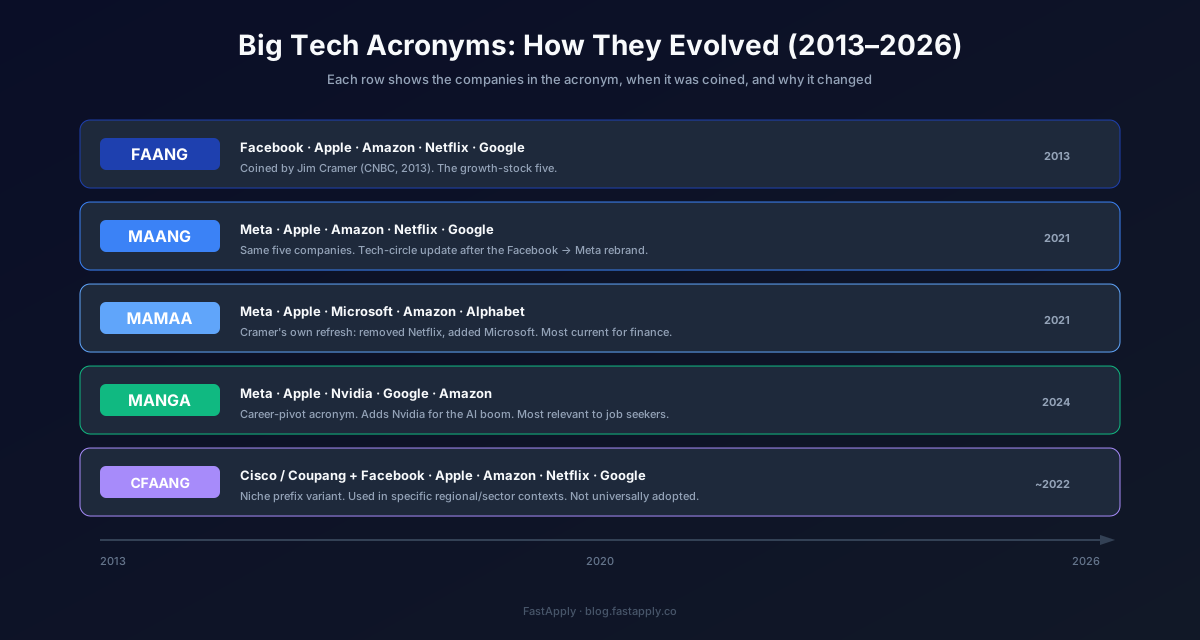
FAANG: Facebook, Apple, Amazon, Netflix, Google.
Jim Cramer popularized the term on CNBC’s Mad Money in 2013, originally as “FANG” without Apple, adding the second A in 2017 when Apple’s growth recovered. It described the five highest-growth large-cap consumer-internet stocks of the 2010s.
This guide is about the acronyms that came after it. For what FAANG stands for in detail, which companies are in it today, what they pay, and how to get hired there, see the full guide to FAANG meaning and the five companies.
What matters here is why FAANG stopped being sufficient. The acronym started showing strain around 2021 for two reasons. Facebook rebranded to Meta, which broke the F. And Netflix’s growth slowed enough that it stopped being an obvious member of any “five dominant growth stocks” list. That is what set off the cascade of replacements below.
MAANG: The First Update (Same Companies, New Letter)
MAANG: Meta, Apple, Amazon, Netflix, Google.
MAANG is what FAANG became after the Facebook → Meta rebrand in October 2021. Same five companies. Different first letter. The acronym MAANG started showing up in tech-career circles around 2022 and is now what most engineering hiring blogs use when discussing the original FAANG cohort.
When to use MAANG: any time you’re writing about the original five companies and you want to use the current name for Facebook. Common in software engineering hiring contexts, where the audience tracks Meta’s rebrand and updates their vocabulary accordingly. Less common in finance reporting, which often still uses FAANG out of habit.
MAANG isn’t a different list of companies. It’s the same list with corrected branding. If someone uses MAANG and someone else uses FAANG in the same conversation, they’re talking about the same thing.
MAMAA: Jim Cramer’s Own Refresh
MAMAA: Meta, Apple, Microsoft, Amazon, Alphabet.
Cramer himself coined MAMAA in 2021 to update FAANG for the actual market reality. Two changes from FAANG: Netflix is out (its growth had decelerated relative to the rest), and Microsoft is in (its Azure cloud and AI investments made it impossible to ignore as a top-tier growth stock by 2021). Google is also relabeled as Alphabet, its parent company name, which is how it trades on the stock market.
MAMAA is the most current acronym for finance and investing contexts. If you’re reading the Wall Street Journal, an investor letter, or a Goldman Sachs research note in 2025-2026, MAMAA is what you’ll see. It reflects the actual top-five largest US tech companies by market cap and revenue growth, which the original FAANG list no longer does.
What MAMAA gets wrong for job seekers: Microsoft hires very differently from the FAANG cohort. Microsoft has more emphasis on enterprise sales, professional services, and Azure infrastructure roles. If you’re using MAMAA to plan a job search, just be aware that the cultures and hiring processes are not interchangeable between, say, Meta engineering and Microsoft sales engineering.
MANGA: The Career-Pivot Acronym
MANGA: Meta, Apple, Nvidia, Google, Amazon.
MANGA emerged in 2024 from the tech-career YouTube and TikTok ecosystem. The substitution is Nvidia for Netflix. The reasoning: by 2024, Nvidia was the single most important AI-infrastructure company in the world, with hiring volume and compensation that started rivaling the traditional FAANG cohort. Netflix kept hiring but at a much smaller scale and at lower comp bands. For job-seeker context, swapping Netflix for Nvidia made the acronym more useful.
MANGA is the acronym to use in 2026 if your context is job search. It reflects the AI-era hiring reality. Nvidia’s CUDA, hardware, and AI/ML teams are some of the most aggressively-recruited talent pools in tech right now, with comp packages that compete directly with Meta and Google’s top tiers.
The downside of MANGA: it’s less universally recognized than FAANG. If you use MANGA on a finance team or talking to your parents, you’ll need to explain it. If you use it in a tech career community, you’ll be understood instantly.
A related acronym sometimes seen: “MANGA + M” to include Microsoft, which gets you to six companies. That hasn’t standardized into a clean acronym yet.
CFAANG and Other Less-Common Variants
CFAANG: Cisco/Coupang + FAANG (Facebook, Apple, Amazon, Netflix, Google).
CFAANG is a regional and sector-specific variant. The C is most commonly Cisco (when referring to networking-hardware leaders) or Coupang (when discussing Asia-Pacific consumer-internet leaders, since Coupang is South Korea’s Amazon-equivalent). What is CFAANG used for: signaling that you’re discussing a broader cohort than the original FAANG five, typically in industry-specific contexts.
CFAANG meaning in practice: it’s a niche acronym. You’ll see it in specific contexts (Korean tech market analysis, networking-hardware sector coverage) but not in general career conversations. If you’re a software engineer searching for “what is CFAANG,” the honest answer is: it’s a regional variant that doesn’t apply to most US-based career planning.
Other variants you may encounter:
TANMAM: Tesla, Apple, Nvidia, Microsoft, Alphabet, Meta. Adds Tesla, drops Amazon. Less popular but occasionally seen in EV-adjacent investor coverage.
BAANG: Replaces F with B for Baidu, a Chinese-internet variant. Used in Asia-tech coverage.
The MAGMA cohort: Microsoft, Apple, Google, Meta, Amazon. An alternate ordering of MAMAA without Netflix and without Nvidia. Used in some research reports.
The proliferation is the point. There isn’t a single right answer to “what are the FAANG companies” in 2026 because the original list has fragmented into context-specific variants. Pick the variant that matches your audience.
Which Acronym Should YOU Use in 2026?
The honest decision tree.
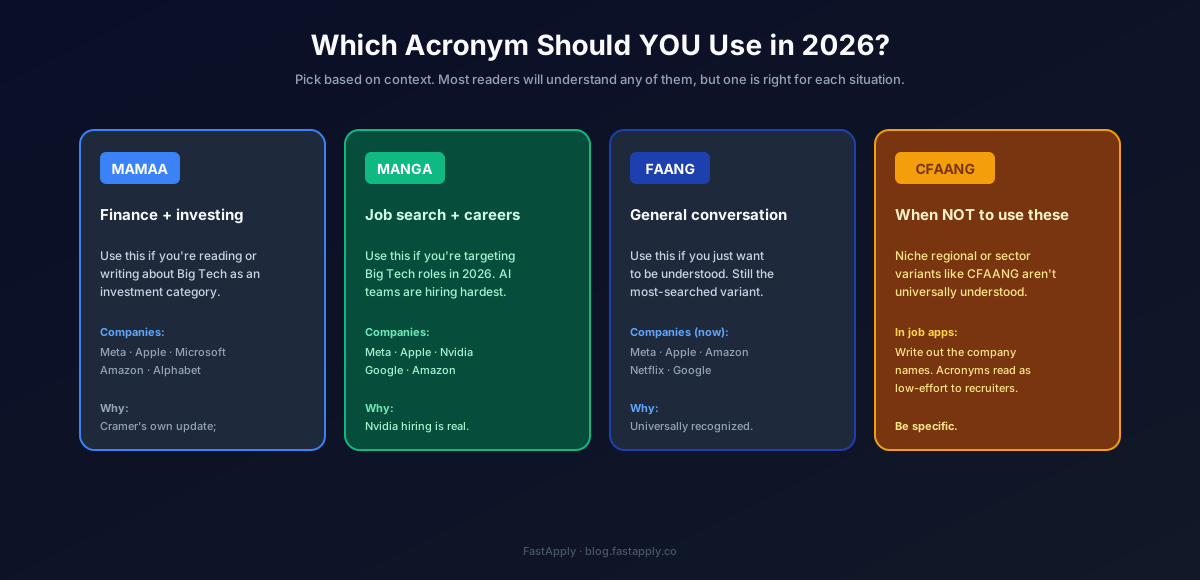
For finance and investing context: use MAMAA. It’s Cramer’s own current acronym, it includes Microsoft (which a 2026 Big Tech list has to), and it’s what serious financial media uses now. Meta, Apple, Microsoft, Amazon, Alphabet.
For job search context: use MANGA. Nvidia is the single most aggressive Big Tech hiring story of 2024-2026, and any career framing that excludes it is outdated. Meta, Apple, Nvidia, Google, Amazon.
For general conversation: use FAANG. It’s still the most-searched, most-recognized acronym, and most listeners will understand it without translation. The companies have changed (Meta replaced Facebook), but FAANG remains the lingua franca.
In a job application or cover letter: don’t use any of them. Recruiters reading “I want to work at a FAANG” parse it as a low-effort signal. Write out the specific company name and the specific reason. “I want to work at Google because [specific reason]” beats “I want a FAANG role” every time.
How to Actually Get Hired at a FAANG Company
Knowing the acronym is the easy part. Getting hired is the rest of the website. The good news for 2026 applicants: the interview prep, application process, and resume requirements are well-documented for each of these companies, and we’ve written dedicated guides for every major FAANG/MANGA/MAMAA company.
Google. Google hires across software engineering, product management, design, sales, and dozens of other tracks. The interview process has its own rhythm and prep requirements. How to get a job at Google in 2026 covers the L-levels, the interview loop, and the specific behaviors recruiters look for.
Amazon. Amazon’s interview process is famous for its leadership principles. Every interview question maps back to one of 16 documented behaviors. Preparing for Amazon means preparing for the principles, not just the technical questions. How to get a job at Amazon in 2026 walks through the principles, the interview structure, and the writing samples Amazon requires for many roles.
Apple. Apple’s hiring process is the most opaque in the FAANG cohort. Information sharing is limited even after offer, and the interview varies widely by team. How to get a job at Apple in 2025 covers what we know from public sources and offer-receiver interviews.
Meta. Meta runs one of the most structured interview processes in tech. The behavioral, coding, and system design rounds each have their own rubric. How to get a job at Meta in 2025: insider tips covers the levels, the calibration meetings, and what separates a “hire” recommendation from a “no hire” at each round.
No CS degree? This is the most common follow-up question we get on FAANG hiring content. The honest answer: yes, you can get hired at a FAANG company without a CS degree, but the path is different from the standard new-grad funnel. How to get a FAANG job without a CS degree (2026 playbook) covers the bootcamp-plus-portfolio path, the lateral-from-adjacent-roles path, and the prep timeline.
If you’re at the very beginning, our primary FAANG hiring guide is the right starting point. It’s the umbrella post that connects all the deep-dives above.
Try FastApply Free
If you’re applying to multiple FAANG/MANGA/MAMAA companies (or planning to), the application volume gets brutal fast. Each company has its own ATS, its own resume formatting requirements, and its own custom screener questions. Install the FastApply Chrome extension and run 5 free applications on us. It fills the repetitive parts of each application (work history, education, work authorization questions), and on Pro and Elite it tailors your resume to each posting.
You stay in control with Co-pilot mode (review each application before it submits), or hand it off to Auto-pilot for volume. Plans start at $14/month after the free credits run out.
Frequently Asked Questions
What is the difference between FAANG and MAANG?
There is no difference in the companies. MAANG is FAANG with the first letter updated after Facebook rebranded to Meta in October 2021: Meta, Apple, Amazon, Netflix, Google. Tech hiring writing tends to use MAANG, while finance writing often still uses FAANG out of habit. If two people use different acronyms in the same conversation, they are describing the same five companies.
Is FAANG still relevant in 2026?
Yes, FAANG remains the most-searched and most-recognized Big Tech acronym in 2026, even though the underlying market has shifted. For finance contexts, MAMAA (which includes Microsoft and drops Netflix) is more current. For job search contexts, MANGA (which includes Nvidia) better reflects the AI-era hiring landscape. For general conversation, FAANG is still understood by everyone.
What’s the difference between FAANG and MANGA?
FAANG is Facebook, Apple, Amazon, Netflix, Google (2013). MANGA is Meta, Apple, Nvidia, Google, Amazon (2024). Two changes: Facebook is renamed to Meta, and Netflix is swapped out for Nvidia. The change reflects the rise of Nvidia as the dominant AI-infrastructure company and Netflix’s slowing growth relative to the rest of Big Tech. For job seekers in 2026, MANGA is the more useful acronym.
Is Microsoft in FAANG?
No. Microsoft is not in FAANG (Facebook, Apple, Amazon, Netflix, Google) or in MAANG (Meta, Apple, Amazon, Netflix, Google). Microsoft is in MAMAA (Meta, Apple, Microsoft, Amazon, Alphabet), which is Jim Cramer’s 2021 update of FAANG that swaps Netflix for Microsoft. If you’re asking whether Microsoft is one of the major Big Tech employers, the answer is yes, regardless of which acronym you use.
Is Nvidia in FAANG?
No, Nvidia is not in FAANG. Nvidia is in MANGA (Meta, Apple, Nvidia, Google, Amazon), the career-focused acronym that emerged in 2024 to reflect Nvidia’s rise as a top Big Tech employer in the AI era. If you’re targeting AI/ML roles, Nvidia hires aggressively and pays at the top of the market, so MANGA is the relevant acronym for your search rather than FAANG.
How do I get a FAANG job?
Each FAANG company hires differently. Google focuses on its L-level structure and a defined interview loop. Amazon centers everything on its 16 leadership principles. Apple is the most opaque, with team-by-team variation. Meta runs the most structured rubric-based interviews. Without a CS degree, the path runs through portfolio projects, adjacent-role lateral moves, or bootcamp-plus-internship combinations. Each FAANG company has its own dedicated hiring guide on this blog.
#faang vs maang
#maang meaning
#mamaa meaning
#manga acronym
#what is cfaang
#big tech acronyms

Ekekenta Clinton
Founder, FastApply