How to Get a FAANG Job Without a CS Degree (2026 Playbook)
Roughly 1 in 6 engineers at FAANG companies don’t have a CS degree. That’s not a marketing line, it’s what the data from internal hiring leaks, LinkedIn profile sampling, and engineers’ own public AMAs has settled at over the last few years. The path is real. It is also harder than the credentialed path, takes 4 to 8 months of focused prep, and requires you to over-perform on every other signal the credential normally covers for.
This is the 2026 playbook. It’s built for working developers (bootcamp grads, self-taught engineers, career switchers from adjacent fields, and Computer Engineering / Math / Physics majors whose degree wasn’t strictly CS) who want to land an L3 or L4 software engineering role at Google, Meta, Amazon, Apple, or Nvidia within 6 to 9 months. It is not built for absolute beginners, and it is not a “30 days to FAANG” gimmick. The honest version is a multi-month grind with specific milestones.
If you’re still figuring out which FAANG companies actually exist in 2026, read our FAANG vs MAANG vs MAMAA explainer first. The acronym matters because Nvidia is in MANGA, and Nvidia hires aggressively for non-CS profiles in ML infrastructure.
Why FAANG Companies Hire Non-CS Grads
The skill-based hiring shift that started around 2018-2019 is now baked into the FAANG recruiting funnel. Google made the loudest public commitment in 2020, when its then-VP of People Operations Laszlo Bock said in interviews that the company’s internal data showed “no correlation between GPA, test scores, and on-the-job performance” past the two-year mark. Google removed degree requirements from most software engineering postings in 2020 and never reinstated them.
Amazon’s recruiting copy lists “Bachelor’s degree in Computer Science OR equivalent practical experience” on virtually every SWE listing. The “OR equivalent practical experience” clause is the door. It’s been there since 2017, and Amazon recruiters do honor it when the portfolio and interview performance back it up.
Meta is more degree-friendly than its peers but still hires non-CS grads. The Meta E3 (entry-level engineer) ladder explicitly accepts “demonstrated programming proficiency through projects, contributions, or work experience” as an alternative to a CS degree.
Apple has historically valued craft over credentials more than any other FAANG company. Engineering managers at Apple are known for prioritizing portfolio depth on specific platforms (iOS, macOS, Swift) over the degree pedigree.
Nvidia, which is in MANGA, is the most non-CS-friendly of the AI-era hires. Its CUDA, AI/ML infrastructure, and hardware-software interface teams hire heavily from Physics, Math, Electrical Engineering, and self-taught backgrounds.
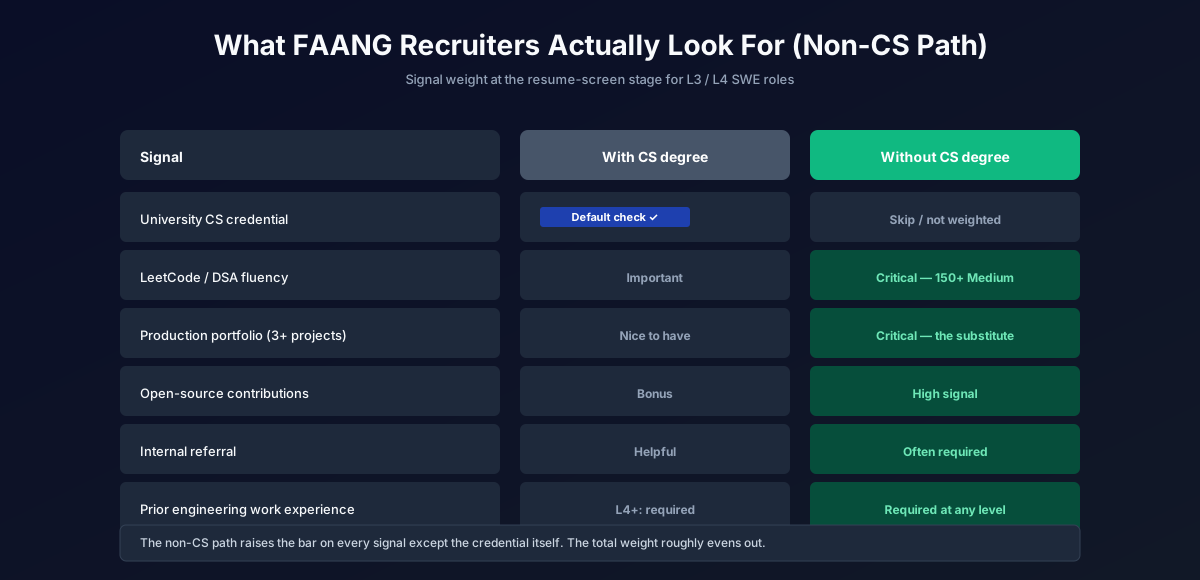
The thing all of these companies share: they screen on signal, not on credential, once you get past the initial recruiter pass. The hard part isn’t convincing the engineer interviewing you. The hard part is getting your resume past the keyword filter at the recruiter stage. The rest of this playbook is about over-indexing on the signals that get you past that filter.
The 6-Month Skills Foundation
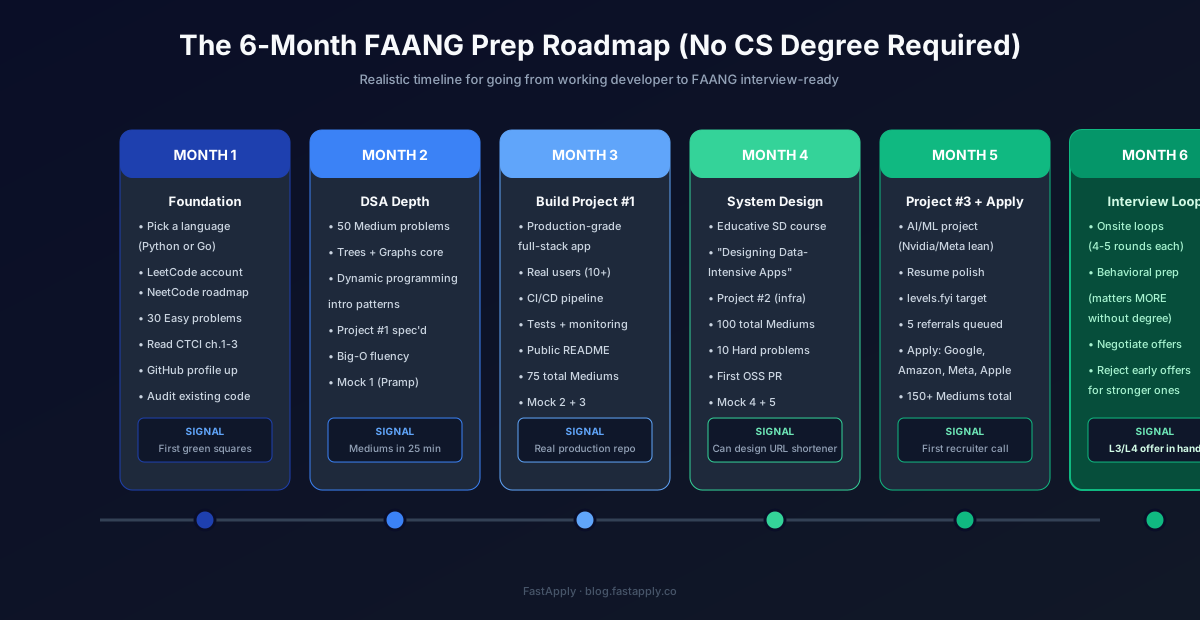
Six months is the realistic prep window if you’re already a working developer. If you’re earlier in your career, double it.
Programming language fluency. Pick one and go deep. The languages that matter for each company: Python or Go for Google, Meta, and Nvidia ML teams; Java or Python for Amazon; Swift for Apple iOS/macOS teams; C++ for low-level Nvidia and Google Cloud infrastructure. Pick the language that matches your target company and become deeply fluent. Fluent means: you can write a binary search tree from memory, you understand the language’s concurrency model, you know which standard library functions are O(n) versus O(log n), and you can read someone else’s idiomatic code in that language without having to look things up.
Data structures and algorithms. This is non-negotiable. The realistic LeetCode target for a non-CS candidate going into FAANG interviews is 150-200 Medium problems solved in under 30 minutes each, with about 30 Hard problems on top. Use the NeetCode 150 list as your spine. It covers every pattern that shows up in FAANG interviews (Two Pointers, Sliding Window, Trees, Graphs, Dynamic Programming, Backtracking, Greedy, Heap/Priority Queue). Don’t grind random problems. Work the patterns, then test yourself with random problems from the same patterns.
System design (for L4 and above). If you’re targeting L4 (mid-level) or L5 (senior), you need system design fluency. Resources that work: Educative’s Grokking System Design Interview, Martin Kleppmann’s “Designing Data-Intensive Applications,” and ByteByteGo’s YouTube series. Practice designing common systems (URL shortener, Twitter feed, Uber dispatch, distributed cache) until you can do the whiteboard pass in 45 minutes without notes.
Specific paid resources worth the money: LeetCode Premium ($35/month, gives you company-tagged problems), AlgoExpert ($99 one-time, structured DSA path), Educative.io ($59/month, great system design and language deep-dives), and Pramp/Interviewing.io for mock interviews (free or $99 per session).
Build a Portfolio That Substitutes for the Degree
This is the section most non-CS candidates underinvest in. Your portfolio is the substitute for the credential, not a bonus.
Three production-grade projects. Not three tutorials. Not three Hello-World apps. Three projects that real people use, with real infrastructure decisions, real deployment, real monitoring, and real test coverage. The bar is: an engineer at a FAANG company should be able to look at your project and say “OK, this person has built something at production quality.”
What counts as production-grade in 2026: deployed on a real cloud (AWS, GCP, Azure, or Vercel), has a working CI/CD pipeline (GitHub Actions is fine), has automated tests covering core business logic, has at least basic observability (logging at minimum, ideally a metrics dashboard), uses a real database (Postgres, not just SQLite in a side file), and has a documented README that explains the architecture choices.
Strong project ideas for 2026:
- A semantic search engine over a real dataset (Wikipedia, arXiv papers, your own document collection). Demonstrates ML, vector databases, and information retrieval.
- A real-time collaboration tool (think mini-Figma, mini-Notion, mini-Google-Docs). Demonstrates WebSockets, conflict resolution, and database design.
- A developer tool with traction (CLI, VS Code extension, GitHub Action). Even 50 GitHub stars is meaningful signal.
Open-source contributions. Pick a project FAANG engineers actually maintain. PyTorch (Meta), TensorFlow (Google), Kubernetes (Google), Roslyn (Microsoft), or React Native (Meta). Don’t aim for one giant contribution. Aim for 3-5 merged PRs over 4 months. The signal isn’t the impact, it’s that you can read a real codebase, follow contribution guidelines, and ship working code that passes review.
GitHub and blog presence. Public commit graph, well-documented repos, a technical blog with 6-12 posts showing how you think. The blog isn’t to attract recruiters directly. It’s so that when a recruiter Googles you, they find evidence of original thought.
How to Apply Strategically
You need both volume and targeting. Most non-CS candidates do one or the other, which is why most FAANG attempts fail.
Apply to L3 (new grad) postings even if you have work experience. L3 is skill-based, not pedigree-based, and the interview loop is more standardized. Once you have an L3 offer in hand, you can negotiate up to L4 in many cases, especially at Amazon and Google. Don’t self-disqualify by applying only to L5 roles.
Use the right tooling to scale your application volume. Each FAANG company has its own ATS, its own resume format requirements, and its own custom screener questions. Apple uses an internal portal. Google uses a custom variant of Greenhouse for some teams and a proprietary system for others. Amazon uses Workday extensively. Meta has its own internal system. Manually filling out 30 of these forms takes a full week, which is a week you could spend on LeetCode. Install the FastApply Chrome extension to handle the form-fill, screener questions, and resume tailoring across the portals and ATS forms FAANG companies use. You stay in Co-pilot mode (review each application before submission) so quality stays high.
Internal referrals are the single highest-leverage move you can make. Aim for 5 referrers per company. Find them via LinkedIn (look for current engineers at the target company who went to the same school as you, share a hometown, or have a shared interest visible on their profile). Send a short, specific message explaining what you’re working on and why you’re targeting that team specifically. Most engineers are happy to refer once a quarter. Be the one they refer this quarter.
Apply at the right cadence. Front-load applications to top-choice companies. Apply to 5 backup companies in week 1 to get interview reps before the loops that matter. Pace yourself: 8-12 applications per week is sustainable. 50 per week is not.
The Interview Loop: What’s Different Without a Degree
The loop itself is the same. The scrutiny is different.
Recruiters will study your portfolio more carefully. Expect questions in the recruiter screen about specific projects on your GitHub. Be ready to walk through architectural choices. “Why did you use Postgres instead of MongoDB?” or “How does your system handle 100 concurrent users?” Have answers ready.
Behavioral interviews matter more without the degree signal. The degree functions as a heuristic for “can adapt to ambiguous problem-solving environments and follow through on long projects.” Without the degree, you need to demonstrate those behaviors in your stories. Use the STAR method (Situation, Task, Action, Result). Prepare 8-12 concrete stories from your work history, each covering one of the common behavioral themes (leadership, conflict, failure, ambiguity, scope expansion, technical disagreement).
Technical interviews will probe your fundamentals harder. The interviewer wants to know that your LeetCode performance reflects real understanding, not memorization. Expect follow-up questions like “What’s the time complexity?” “Can you do it without that data structure?” “What if the input was 10 million elements?” Don’t memorize solutions, understand the patterns deeply enough that you can adapt them in real time.
System design at L4+ will weight your judgment. You can compensate for the lack of formal CS training by showing strong judgment about trade-offs. Talk through what you would NOT do and why. Reference real systems you’ve built and what you’d do differently at scale. Authenticity beats theoretical correctness here.
Salaries and Career Trajectory
The honest data on non-CS comp at FAANG, sourced from levels.fyi reports.
L3 / new grad SWE total comp at FAANG in 2026: $190K-$220K (base $150K-$170K + equity vested over 4 years + sign-on). Identical for CS grads and non-CS hires. There is no detected pay gap at the L3 level.
L4 / mid-level SWE total comp: $290K-$370K. Slight bias toward CS grads at the very top of the band (top-quartile L4 packages) but the median is identical. Non-CS hires often negotiate slightly less aggressively in their first FAANG offer, which is a leverageable skill, not a structural disadvantage.
L5 / senior SWE total comp: $420K-$580K. This is the level where the structural gap appears. Promo committees at most FAANG companies still weight “depth of CS fundamentals” in promotion decisions, and non-CS-degree candidates report needing 6-12 extra months on average to reach L5 from L4. The gap closes by L6 because by then your performance reviews dominate the signal.
Career advice: Don’t worry about the L5 gap on day one. Get the L3 or L4 offer first. The gap is small relative to the leverage of being in the FAANG ecosystem, and you can close it by being deliberate about which projects you take on. Pick infrastructure or systems-heavy projects, not pure feature work.
Real Stories: Non-CS Hires at FAANG
Three composite profiles based on real public stories and conversations with non-CS FAANG hires over the last 3 years.
The bootcamp-to-Meta path. Mid-twenties graduate of a 14-week immersive bootcamp (think App Academy, Hack Reactor, Codesmith). After bootcamp, took a $75K junior dev role at a Series B startup for 18 months to build production experience. While there, contributed to React Native’s open-source repo (3 merged PRs over 6 months). Spent 4 months grinding LeetCode (180 Mediums + 22 Hards). Got a Meta E3 offer via cold-applying through a referral from a bootcamp alum. Total comp: $210K. Time from bootcamp to FAANG: 24 months.
The career-switcher-to-Amazon path. Former mechanical engineer at an aerospace company. Took two Coursera specializations (Stanford ML, Princeton Algorithms). Built a portfolio of 4 production-grade Python data tools, one of which got picked up by a small open-source community. Applied to Amazon SDE I (L4) postings directly through their portal. Passed the OA, then the loop. Amazon’s leadership-principles interview style suited the engineering background. Total comp: $260K. Time from mechanical engineering to FAANG: 30 months.
The math-major-to-Google path. Math PhD candidate who left their program at the end of year 3. Used their TA experience as the work-history signal. Picked up Go fluency over 5 months. Contributed to Kubernetes (the SIG-Networking subproject). LeetCode-grinded for 4 months to 160 Mediums. Got a Google L3 offer through a referral from a graduate-school colleague who’d already been hired. Total comp: $215K. Time from leaving the PhD program to FAANG offer: 8 months. This is the fastest of the three paths because the math background is treated as a strong signal at Google specifically.
The pattern across all three: strong LeetCode performance, real production portfolio, at least one strategic OSS contribution, and an internal referral. None of these candidates skipped any of those four ingredients.
Apply to Each FAANG Company Specifically
Each FAANG company has its own playbook within this larger playbook. We’ve written dedicated guides for each:
- How to get a job at Google in 2026 covers the L-level structure, the interview loop specifics, and how Google evaluates non-traditional backgrounds.
- How to get a job at Amazon in 2026 walks through the leadership principles, the bar-raiser system, and the writing samples Amazon now requires for many SDE roles.
- How to get a job at Apple in 2025 is the closest we can get to documenting Apple’s notoriously opaque process.
- How to get a job at Meta in 2025: insider tips covers the structured rubric, the calibration process, and the specific behavioral themes Meta interviewers are trained on.
If you have zero traditional work experience yet, our guide to getting a job with no experience in 2026 covers the bridging strategies (internships, freelance, OSS as work history). If you have the work experience but need to compress your prep into a short window, how to get a tech interview in 30 days is the sprint version.
For the broader Big Tech context, our primary FAANG hiring guide is the umbrella post.
Try FastApply Free
Applying to all four major FAANG companies plus Nvidia means clearing 30-50 application forms across at least 4 different ATS systems (Workday, Greenhouse, internal Apple portal, Meta’s internal system). Each form takes 12-20 minutes manually. Install the FastApply Chrome extension and run 5 free applications on us. Each FAANG application drops to about 90 seconds with per-job tailored resumes and screener-question handling.
You stay in Co-pilot mode (review each application before it submits), so quality stays high even at volume. Plans start at $14/month after the free credits run out.
Frequently Asked Questions
Do FAANG companies require a CS degree?
No, none of the major FAANG companies require a CS degree as of 2026. Google removed degree requirements from most SWE postings in 2020. Amazon explicitly accepts “equivalent practical experience” on every SWE listing. Meta accepts demonstrated programming proficiency at the E3 level. Apple has historically valued craft over credentials. Nvidia hires heavily from non-CS technical backgrounds. The credential helps as a filter signal but is not strictly required at any of these companies.
What’s the best programming language for FAANG without a CS degree?
Pick the language that matches your target company and become deeply fluent. Python or Go are the highest-leverage choices for Google, Meta, Amazon backend, and Nvidia ML teams. Swift if you’re targeting Apple iOS or macOS. Java for Amazon’s mainstream services. C++ for Google infrastructure or Nvidia hardware-adjacent work. Going deep in one language beats surface fluency in three. The interviewers will probe whichever language you list as your primary.
How long does it take to prepare for FAANG without a degree?
Six to nine months of focused prep is realistic if you’re already a working developer. If you’re earlier in your career or career-switching, plan on 12 to 18 months. The non-negotiables: 150-plus LeetCode Medium problems solved in under 30 minutes each, three production-grade portfolio projects, 3-5 merged open-source contributions, and 4-6 mock interviews. Compressing these into less than 6 months is possible but only if you can dedicate 30+ hours per week to prep.
Which FAANG company is most likely to hire without a degree?
Amazon and Apple are historically the most open to non-CS backgrounds at the L3/L4 level. Amazon’s “equivalent practical experience” clause and its emphasis on the leadership principles over pure pedigree help. Apple’s craft-over-credential culture helps if your portfolio is strong on Apple-platform projects (iOS, macOS, Swift). Google is degree-friendly but increasingly skill-based since 2020. Nvidia, in MANGA, is the most non-CS-friendly of the AI-era FAANG-adjacent companies.
Can FastApply help me get a FAANG job?
FastApply can’t replace the LeetCode grind or the portfolio work. What it can do is compress your application volume from 12-20 minutes per FAANG form down to about 90 seconds per form, with per-job tailored resumes, custom screener question handling, and Co-pilot review before each submission. For a candidate applying to 40+ FAANG team postings during the active interview cycle, FastApply saves roughly 12-15 hours per week of pure form-filling time. Use that time on LeetCode and system design prep instead.
#faang jobs
#faang job
#faang without degree
#how to get into faang
#faang companies
#FAANG career

Ekekenta Clinton
Founder, FastApply