How to Get a Job at Amazon in 2026: Leadership Principles, Bar Raisers & The Hiring Loop Decoded
Amazon is one of the largest and most distinctive employers in tech. As one of the five FAANG companies (Meta, Apple, Amazon, Netflix, Google), Amazon hires aggressively across software engineering, AI/ML, AWS cloud, retail, devices, fulfillment, Alexa, Prime Video, and more. But what makes Amazon different from every other Big Tech employer isn’t just scale, it’s the 16 Leadership Principles that drive every interview question, every promotion decision, and the famous Bar Raiser who can veto any hire that doesn’t meet Amazon’s bar.
If you don’t understand the Leadership Principles, you will not get hired at Amazon. It’s that simple. This 2026 guide breaks down exactly how Amazon evaluates candidates: the 16 Leadership Principles in plain English, how the Bar Raiser interview works, how to map your past experience into STAR-format stories tied to specific Leadership Principles, and how to use tools like FastApply to apply across Amazon’s thousands of open roles efficiently.
What Makes Amazon Different: The Leadership Principles
At every other Big Tech company, behavioral interviews ask “tell me about a time when…” and recruiters mentally score you against vague rubrics. At Amazon, behavioral interviews are structured. Every question maps to one or more of Amazon’s 16 Leadership Principles. Every hiring debrief evaluates you against those same 16 principles. And every Amazon employee, from L3 software engineers to L10 senior vice presidents, is promoted based on demonstrated mastery of these principles.
If you walk into an Amazon interview without 12-15 prepared STAR-method stories pre-mapped to specific Leadership Principles, you have not actually prepared for the interview.
The 16 Leadership Principles, in Plain English
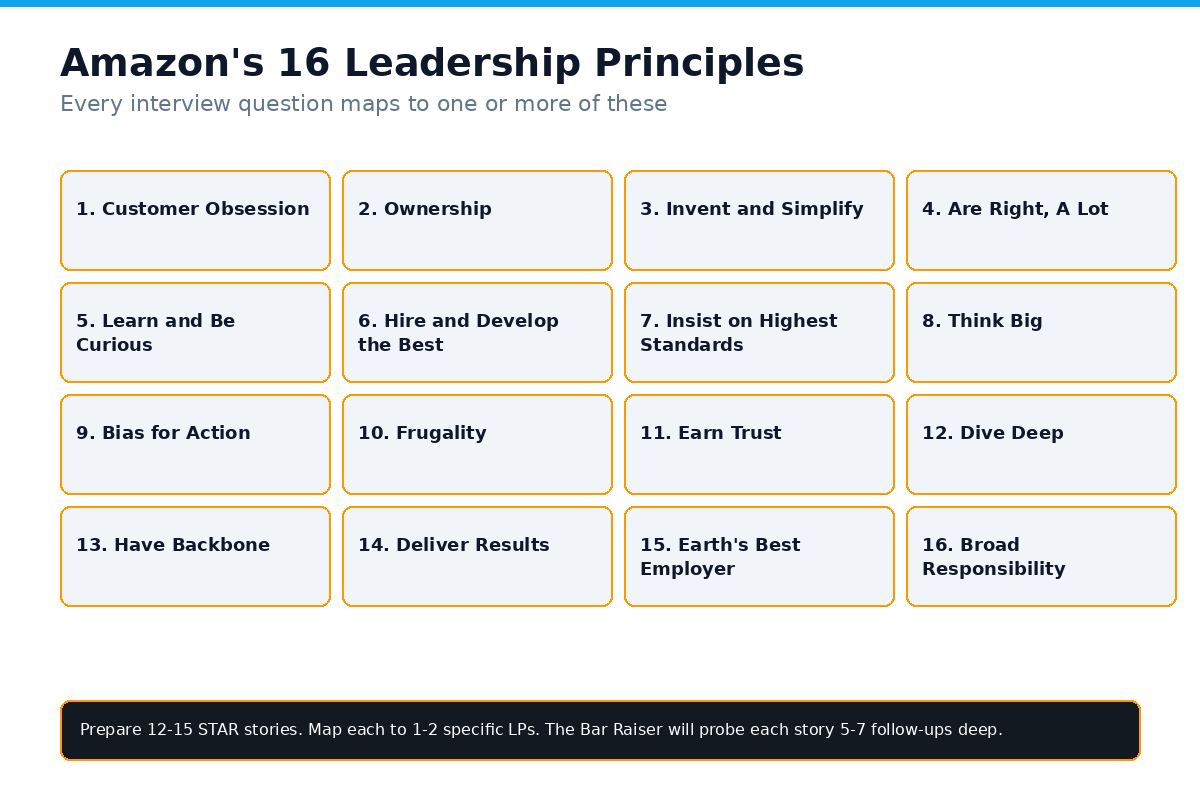
Memorize these. Understand the spirit of each one. Have at least one specific story (a real situation from your past) that demonstrates each principle.
1. Customer Obsession. Start with the customer and work backwards. Don’t lead with internal politics, internal metrics, or what’s easy to build. Lead with what makes the customer’s life better.
2. Ownership. Act on behalf of the entire company, not just your team. Never say “that’s not my job.” If something is broken and you can fix it, fix it.
3. Invent and Simplify. Build new things that delight customers, and aggressively simplify what already exists. Complexity is your enemy.
4. Are Right, A Lot. Have strong judgment and good instincts. Seek diverse perspectives and disconfirm your own beliefs. Be right more often than wrong.
5. Learn and Be Curious. Continuously learn. Be self-critical. Explore new possibilities. Amazon hires people who actively seek out things they don’t know.
6. Hire and Develop the Best. Raise the performance bar with every hire and promotion. Recognize people with exceptional talent and willingly move them around the org. Develop leaders.
7. Insist on the Highest Standards. Have relentlessly high standards. Continually raise the bar. Drive your teams to deliver high-quality products, services, and processes.
8. Think Big. Create and communicate a bold direction. Think differently and look around corners for ways to serve customers. Don’t pitch incremental improvements when transformational ones are possible.
9. Bias for Action. Speed matters. Many decisions and actions are reversible and don’t need extensive study. Calculated risk-taking is valued.
10. Frugality. Accomplish more with less. Constraints breed resourcefulness. Headcount, budget, and overhead are not signals of importance.
11. Earn Trust. Listen attentively, speak candidly, and treat others respectfully. Be vocally self-critical. Don’t bash competitors but also don’t sugarcoat your team’s struggles.
12. Dive Deep. Operate at all levels. Stay connected to the details. Audit frequently. No task is beneath you.
13. Have Backbone; Disagree and Commit. Respectfully challenge decisions when you disagree, even if it’s uncomfortable. Once a decision is made, commit fully.
14. Deliver Results. Focus on the key inputs for your business and deliver them with the right quality and in a timely fashion. Despite setbacks, rise to the occasion and never settle.
15. Strive to Be Earth’s Best Employer. Work to create a safer, more productive, more diverse, and more just work environment.
16. Success and Scale Bring Broad Responsibility. Operate in a way that’s worthy of public scrutiny. Be self-aware about Amazon’s impact on customers, employees, and communities.
For a deeper breakdown of how these principles map to actual interview questions, the Amazon Leadership Principles official page has Amazon’s own definitions.
How the Amazon Hiring Loop Actually Works
Amazon’s hiring process is structured, multi-stage, and faster-moving than most Big Tech companies. Knowing what each step is testing helps you prepare with intent rather than scrambling.
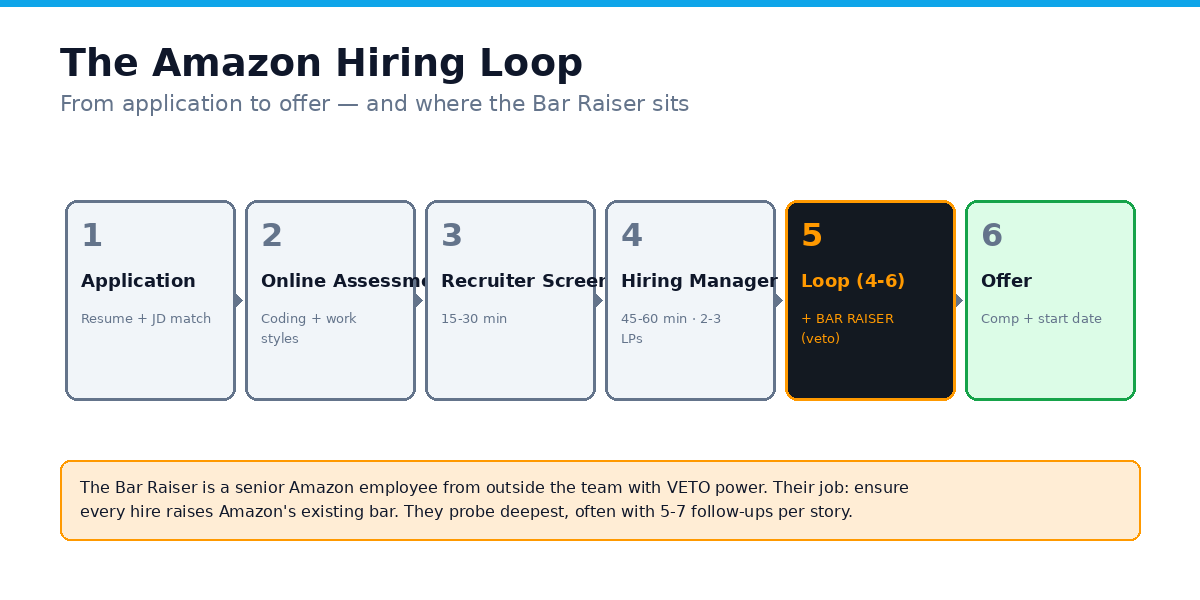
Step 1: Application & Resume Screen
Amazon receives millions of applications a year. Recruiters and automated screening tools look for evidence of impact, ownership, and alignment with the Leadership Principles in your resume, not just technical credentials.
What works on an Amazon resume:
- Bullet points written in STAR format: situation, task, action, result.
- Quantified impact in every bullet (“reduced latency by 40%,” “shipped feature to 12M users,” “saved $1.2M annually”).
- Action verbs that map to Leadership Principles (“invented,” “owned,” “simplified,” “delivered,” “raised the bar”).
- A clean, single-column format that the ATS can parse cleanly.
What gets you screened out:
- Generic responsibilities (“worked on backend systems,” “helped the team ship features”).
- Buzzwords without quantification (“synergized cross-functional initiatives”).
- Multi-column resumes that ATS parsers mangle.
Step 2: Online Assessment (for technical roles)
Most software engineering roles include an online assessment (OA) before the recruiter screen. The OA typically combines:
- 1-2 algorithmic coding problems (medium-hard LeetCode-style).
- A work styles assessment that maps your responses to Leadership Principles.
- A debugging or code-review section in some loops.
Strategy: Practice 2-3 medium-hard array, string, graph, and dynamic programming problems weekly leading up to the OA. For the work styles section, answer honestly, it’s measuring whether your natural disposition aligns with LPs like Bias for Action and Customer Obsession.
Step 3: Recruiter Screen (15-30 min)
A recruiter walks through your background, motivation, and 1-2 simple behavioral questions to confirm cultural alignment. They’re not the hiring decision-maker, but they’re the gatekeeper to the hiring manager screen.
Common questions:
- “Why Amazon?”
- “Tell me about your most impactful project.”
- “What’s your salary expectation?”, research the level (L4, L5, L6) on Levels.fyi before the call.
Step 4: Hiring Manager Screen (45-60 min)
The hiring manager assesses team fit, role fit, and asks 2-3 deep behavioral questions tied to specific LPs that matter most for the team. Expect “tell me about a time you owned an end-to-end delivery” (Ownership), “tell me about a time you disagreed with a peer or manager and how you resolved it” (Have Backbone; Disagree and Commit), and “tell me about a customer you went above and beyond for” (Customer Obsession).
Step 5: The Loop (4-6 interviews + 1 Bar Raiser)
The on-site (or virtual on-site) loop is the heart of Amazon’s process. You’ll have 4-6 back-to-back interviews, each 45-60 minutes. Each interviewer is assigned 2-3 specific Leadership Principles to evaluate you against. They will ask STAR-format questions for each LP and probe deeply on your responses.
For software engineering loops:
- 2-3 coding interviews (medium-hard algorithms, system design)
- 1 behavioral / leadership interview (deep LP probing)
- 1 system design (for L5+ roles)
- 1 Bar Raiser interview (see below)
For non-engineering loops (PM, marketing, ops):
- 4-5 interviews focused on case studies, leadership scenarios, and behavioral STAR questions
- 1 Bar Raiser interview
- 1 cross-functional interview with a peer team
The Bar Raiser: Amazon’s Hiring Veto
This is the unique part of Amazon’s process and the part most candidates underestimate.
A Bar Raiser is a senior Amazon employee from outside the hiring team who has been specially trained to evaluate candidates against Amazon’s hiring bar. They are not invested in filling the role. They have one job: ensure every hire raises Amazon’s overall bar.
Three things to know about the Bar Raiser:
1. They have veto power. If the Bar Raiser is not convinced you’d raise the bar of Amazon’s existing employees in the role, they can veto the hire, even if the hiring manager wants you. Their objection ends the loop.
2. They are evaluating LPs, not technical skills. The Bar Raiser is not your final coding interview. They’re typically the most experienced behavioral interviewer in your loop, asking the deepest probing questions about your past actions, decisions, and outcomes.
3. They will probe relentlessly. Expect 5-7 follow-up questions on every story you tell. “Why did you make that decision?” “What did the data look like?” “What would you do differently?” “What did the team think?” “What was the customer impact?” Surface-level STAR answers will fail. You need to know your stories cold, including details you wouldn’t normally share.
How to prep for the Bar Raiser:
- Pick your 12-15 best stories. Stories where you owned something end-to-end, where you delivered measurable impact, where you faced real conflict, where you had to make a hard call with incomplete data.
- For each story, write out the full STAR breakdown plus 5+ follow-up answers (the data, the alternatives you considered, the team dynamics, the trade-offs, the long-term outcome).
- Map each story to 1-2 specific Leadership Principles. The same story can demonstrate Ownership AND Bias for Action AND Earn Trust depending on how you frame it.
- Practice telling each story in 2-3 minutes followed by handling 4-5 minutes of probing questions.
Writing STAR Stories That Map to Leadership Principles
The biggest mistake candidates make is telling stories that don’t have a clear LP anchor. Here’s the framework that works:
Situation (15 seconds): Set the scene. What was the company, the team, the problem?
Task (15 seconds): What was your specific responsibility?
Action (90 seconds): What did YOU do? Use “I” not “we.” Be specific about decisions, trade-offs, and the actions you personally took. This is where the LP shows up, your actions should demonstrate the principle in action.
Result (30 seconds): What was the measurable outcome? Customer impact, revenue impact, retention impact, latency improvement, headcount saved, time saved.
Example: Ownership-themed STAR story
Bad version: “On my last team, we noticed our build pipeline was slow. We worked together to fix it and made it faster.”
Good version: “At my previous company, our nightly CI pipeline was taking 3 hours to complete, blocking 40 engineers from shipping in the morning. It wasn’t owned by any single team, infra was overloaded, my team was busy with feature work, and DevOps was understaffed. I decided to take it on. Over six weeks, I instrumented the pipeline, found that 70% of the time was in unit tests, parallelized them across 8 nodes, and rewrote the slowest 30 tests. Result: pipeline went from 3 hours to 45 minutes, unblocking my entire eng org and saving an estimated $180k/year in engineering time. I also documented the runbook so it would stay maintained after I rotated off.”
The good version demonstrates Ownership (took on something nobody else owned), Dive Deep (instrumented and analyzed the actual data), Deliver Results (measurable impact), and Bias for Action (acted instead of waiting for someone else to fix it). One story, four LPs covered.
What Roles Amazon Is Hiring For in 2026
Amazon’s hiring footprint in 2026 spans far beyond AWS. Here’s where the volume is:
AWS engineering, Software engineers, solutions architects, DevOps, ML engineers, security. AWS continues to be Amazon’s largest profit center and hires aggressively. Skills in demand: Rust, Go, Python, distributed systems, Kubernetes, Terraform, generative AI infrastructure.
Generative AI / Bedrock / Q, Amazon’s AI products (Bedrock, Q, Titan) are hiring AI/ML researchers, applied scientists, and infrastructure engineers. These roles are highly competitive, with deep technical screens.
Retail / e-commerce, Software engineering, data science, and product management for amazon.com, Prime, and the marketplace. Hiring continues at scale.
Devices, Echo, Alexa, Kindle, Ring, Fire TV. Hardware engineers, embedded software, voice/NLP engineers.
Fulfillment & Operations, Operations managers, area managers, logistics roles, robotics engineers for warehouses. High-volume non-tech hiring.
Whole Foods, Pharmacy, Healthcare, Amazon’s vertical expansions are hiring in retail leadership, healthcare ops, and consumer health.
Marketing, PR, Legal, Finance, Corporate functions hire continuously across all geographies.
To navigate the volume efficiently, our guide to beating the Workday ATS covers the application platform many of Amazon’s contractor and partner roles use, and our how many jobs to apply to per day in 2026 guide breaks down the volume math.
How to Apply: The Practical Playbook
1. Don’t apply to one Amazon job. Apply to 15-30 in your category.
Amazon’s recruiters operate at scale. Different recruiters source for different orgs (AWS vs retail vs devices), and your resume going into one application doesn’t transfer to others. Apply broadly across your skill match, then optimize the recruiter outreach when you start getting screens.
2. Tailor each application to the team.
Amazon job descriptions explicitly call out which Leadership Principles matter most for that role. Read the JD carefully. If the role emphasizes “Customer Obsession” and “Deliver Results,” your resume bullets should foreground stories that demonstrate those LPs. Tools like FastApply can auto-tailor your resume per posting on Pro and Elite plans, generating per-application resumes that surface the right LPs for each role.
3. Use referrals where you have them.
Amazon employees can refer candidates, and referred candidates get a faster recruiter screen. If you know anyone at Amazon (LinkedIn search “Amazon” + your school or previous employer), reach out with a tight 2-paragraph note: who you are, what role you’re targeting, why you’d be a fit. Don’t ask “for a referral”, ask “if my background looks like a fit” and let them volunteer the referral.
4. Prep for the loop the moment you get the OA invite.
The on-site loop is 6-9 hours of intense behavioral interviewing. Once you get an OA invite, assume the loop is 2-3 weeks away and start your STAR story prep immediately. Don’t wait until you pass the OA.
Resume Optimization for Amazon
Amazon’s ATS and recruiters skim resumes in 6-15 seconds. Make every line count.
Format: Single column, plain text, ATS-friendly. No tables, no graphics, no fancy fonts. Save as .docx or .pdf (both work).
Structure:
- Name + contact at top
- 1-2 line headline (“Senior Software Engineer with 8 years building distributed systems”)
- Experience section (most important, list jobs in reverse chronological order)
- Skills section (technical keywords for ATS match)
- Education
Per-bullet pattern (use this for every line in Experience):
[Action verb] + [what you built/did] + [for whom/at what scale] + [measurable result]
Examples:
- “Architected and shipped a real-time pricing service handling 50K req/sec, reducing customer-facing latency from 240ms to 80ms.”
- “Owned and delivered the migration of 12 microservices to Kubernetes, cutting infrastructure cost 35% ($1.4M/year).”
- “Mentored 4 junior engineers, two of whom were promoted to L5 within 18 months.”
Keyword optimization: Read 5-10 Amazon JDs in your target role and extract the technical keywords that appear in 3+ of them. Make sure those keywords appear naturally in your skills section and ideally in 2-3 experience bullets.
For deeper resume tactics, see our Workday ATS guide, many Amazon contracting partners use Workday and the optimization principles transfer.
Compensation: What Amazon Actually Pays
Amazon’s compensation structure is famous for being front-loaded with stock that vests heavily in years 3 and 4. Understand this before negotiating.
Typical L5 software engineer comp (US, 2026):
- Base salary: $175k-$200k
- Sign-on bonus (year 1 + year 2, paid quarterly): $100k-$150k total
- Stock (vests 5/15/40/40 over 4 years): $200k-$400k
The “5/15/40/40” vesting schedule is critical: you get only 5% of your stock in year 1 and 15% in year 2. The big vests (40% each) are in years 3 and 4. The sign-on bonus exists to bridge the early-year gap, but it expires after 2 years.
Practical implication: If you’re considering leaving Amazon at year 2, you walk away from 80% of your equity. Plan accordingly.
Levels overview:
- L4: Entry-level (new grad)
- L5: Mid-senior (3-7 years experience)
- L6: Senior (7-12 years)
- L7: Principal (12+ years)
- L8/L10: Director / VP / SVP
For real-time comp data, Levels.fyi has the most accurate Amazon offer data, segmented by level and location.
How FastApply Helps You Land an Amazon Interview
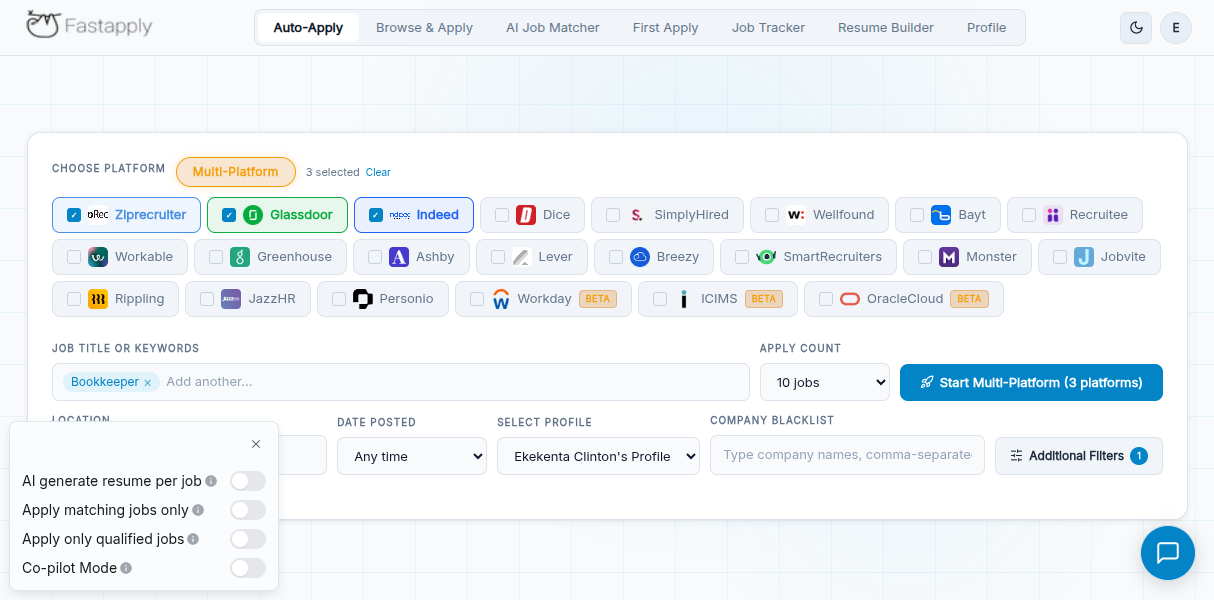
Amazon hires across thousands of open roles globally, and applying to enough of them manually is exhausting. FastApply is an AI-powered job application tool that:
- Auto-applies to Amazon roles (and roles at every other major employer) across LinkedIn, Indeed, Workday, Greenhouse, Lever, Ashby, and more, 12+ supported job boards.
- Tailors your resume per posting using AI on Pro and Elite plans, so each application surfaces the keywords and Leadership Principles that match the specific Amazon JD.
- Runs a 24/7 AI Job Matcher that auto-applies the moment a high-fit Amazon role drops, putting you in front of the recruiter as one of the first applicants, a position that consistently delivers 5-10x higher response rates.
- Tracks every application, response, and interview in a single dashboard.
Every new FastApply account gets 5 free application credits with no card required, so you can validate the tool against your real Amazon (and other Big Tech) target list before paying anything. Paid plans start at $14/month with cancel-anytime monthly billing.
For a comparison against other AI auto-apply tools, see FastApply vs BetterApply, FastApply vs Sonara, and FastApply vs LazyApply.
Common Mistakes That Sink Amazon Interviews
After thousands of Amazon interviews, these are the recurring failure patterns:
1. STAR stories without a clear LP anchor. Telling a story that doesn’t obviously demonstrate a specific Leadership Principle. Interviewers can’t score it, so they default to a “no hire.”
2. “We” instead of “I.” Amazon wants to hire individual operators with strong ownership. Saying “we shipped the feature” obscures what you did. Use “I” and own your actions.
3. Surface-level answers without depth. “I built the service, it improved latency, the customer was happy.” That’s three sentences, not a STAR story. The Bar Raiser will probe and your story will fall apart.
4. Bashing competitors or former employers. Amazon’s Earn Trust LP includes “don’t bash competitors.” Speak respectfully about every team and every employer in your past.
5. No questions for the interviewer. Always have 2-3 specific questions about the team, the role, the customer, the technical architecture. “I have no questions” signals lack of curiosity (Learn and Be Curious).
6. Negotiating from emotion instead of data. Amazon recruiters expect data-backed comp negotiation. Use Levels.fyi numbers, your competing offers, and your prior comp to anchor your ask. Don’t say “I want more”; say “based on Levels.fyi data for L5 in Seattle, I’d target $X base + $Y sign-on + $Z stock.”
Frequently Asked Questions
What are Amazon’s 16 Leadership Principles?
Amazon’s 16 Leadership Principles are: Customer Obsession, Ownership, Invent and Simplify, Are Right A Lot, Learn and Be Curious, Hire and Develop the Best, Insist on the Highest Standards, Think Big, Bias for Action, Frugality, Earn Trust, Dive Deep, Have Backbone (Disagree and Commit), Deliver Results, Strive to Be Earth’s Best Employer, and Success and Scale Bring Broad Responsibility. Every interview question and every promotion decision at Amazon maps to one or more of these principles.
What is an Amazon Bar Raiser?
A Bar Raiser is a senior Amazon employee from outside the hiring team who has been specially trained to evaluate candidates against Amazon’s hiring bar. They have veto power over any hire and are typically the most experienced behavioral interviewer in your loop. The Bar Raiser’s job is to ensure every Amazon hire raises the bar of the existing team, they are not invested in filling the role.
How hard is it to get a job at Amazon?
Amazon’s acceptance rate for software engineering roles is generally estimated at 1-3%, similar to other FAANG employers. The hiring bar is high but the volume of openings is also large, Amazon hires thousands of engineers globally each year. The hard part isn’t getting an interview; it’s preparing thoroughly enough for the Leadership Principles loop and Bar Raiser to convert it into an offer.
How long is the Amazon interview process?
The full Amazon interview process typically runs 4-8 weeks from initial application to offer. Stages: application (1-3 days for response), online assessment (1 week), recruiter screen (1-2 weeks scheduling), hiring manager screen (1-2 weeks), full loop (1-2 weeks), debrief and offer (1-2 weeks). Senior roles (L6+) can take longer due to scheduling complexity.
What’s the STAR method and why does Amazon use it?
STAR stands for Situation, Task, Action, Result. It’s a structured way to tell stories about your past behavior. Amazon uses STAR because it forces candidates to articulate measurable actions and outcomes rather than abstract claims. Every behavioral question in an Amazon loop expects a STAR-format answer mapped to one or more Leadership Principles.
How many STAR stories should I prepare for an Amazon interview?
Prepare 12-15 distinct stories, each 2-3 minutes long. Map each story to 1-2 specific Leadership Principles. The same story can demonstrate multiple LPs depending on how you frame the action. For each story, also prepare 5+ follow-up answers (data points, alternatives considered, trade-offs, long-term outcomes) because the Bar Raiser will probe.
Does Amazon use Workday?
Amazon uses a custom internal ATS for most roles, though some contractor and vendor roles route through Workday or other ATS platforms. The good news: tools like FastApply work across Amazon’s ATS, Workday, Greenhouse, Lever, Ashby, and 8+ other major job boards on the same plan. For a Workday-specific deep dive, see our guide to beating Workday applications.
What’s the salary at Amazon for a software engineer?
For an L5 software engineer in the US (2026), typical comp is $175k-$200k base, $100k-$150k sign-on bonus over 2 years, and $200k-$400k in stock vesting on Amazon’s 5/15/40/40 schedule over 4 years. L6 roles add 30-50% across all components. Levels.fyi has the most accurate real-time data segmented by level and location.
Can I apply to multiple Amazon teams at the same time?
Yes, and you should. Amazon’s recruiters source for specific orgs, so applying to one role doesn’t surface you for others. Apply broadly across your skill match (15-30 roles is reasonable) and let the recruiter screens narrow you down. Tools like FastApply auto-apply across all major job boards, making this scale of application volume practical.
What if I fail an Amazon interview?
Amazon typically requires a 6-12 month cooldown before you can re-interview for the same level. Use the time productively: gather more impactful project experience, prepare more thoroughly for the LPs, and reapply to a slightly different team or role when the cooldown ends. For how cooldowns work across companies and what has to change before a second attempt, see reapplying for a job you were rejected from.
Is auto-applying to Amazon jobs ethical?
Yes, as long as the tool submits accurate information tailored to the role, which FastApply does. The ethical line is misrepresentation, not automation. See our full write-up on job application automation ethics.
Does FastApply do AI resume tailoring?
Yes. FastApply Pro ($29/mo) and Elite ($49/mo) include per-job AI resume tailoring as a core feature, alongside the auto-apply workflow across 12+ job boards. The AI rewrites your resume’s summary, skills, and bullet-point emphasis per application to match each posting’s keywords. AI cover letters are generated per-job on the same plans. Unlike standalone resume builders (Kickresume, Rezi, Teal), FastApply combines AI tailoring with auto-apply in a single workflow. For the full breakdown of the AI resume tailoring landscape, see our How to Tailor Your Resume with AI in 2026 guide.
Your Next Step: Land the Amazon Interview
The Leadership Principles framework is the same whether you’re applying to L4 or L8. The Bar Raiser is the same gatekeeper at every level. The STAR method is the same structure that lets your past actions speak louder than your resume credentials.
What changes is the volume of preparation and the breadth of stories you bring. Most candidates underestimate how many roles they should apply to. They underestimate how many STAR stories they should prepare. They underestimate how deeply the Bar Raiser will probe.
If you’re applying broadly across Amazon teams (and you should be), FastApply handles the application volume and per-job tailoring so you can spend your time preparing the loop instead of rewriting your resume for each posting. 5 free application credits to start, no card required, then $14/month Starter with cancel anytime.
Your next Amazon interview is one well-prepared loop away.
#Amazon
#Amazon Leadership Principles
#Amazon Bar Raiser
#Amazon Interview
#Amazon Hiring Process
#Job Hunting
#Career
#Big Tech

FastApply Team
Career Experts