How to Get a Job at Google in 2026: Hiring Committees, the Four Signals & The Technical Bar Decoded
Google consistently ranks as one of the most competitive employers in tech. As one of the five FAANG companies (Meta, Apple, Amazon, Netflix, Google), Google’s hiring bar is famously high, entry-level L3/L4 software engineering roles are among the hardest interview loops in the industry. But what makes Google different from every other Big Tech employer isn’t a single principle or a Bar Raiser. It’s the combination of three distinctive elements: a hiring committee of senior engineers who review your interview packet without ever meeting you, a four-signal evaluation framework that scores you on dimensions most candidates don’t even know exist, and a team-matching process that happens after you pass the loop.
If you don’t understand the hiring committee model, the four signals, and the team match step, you will not optimize your prep correctly. This 2026 guide breaks down exactly how Google evaluates candidates: how the committee actually decides, what the four signals are and how each one is scored, the technical bar by level (L3/L4/L5/L6+), the role-specific tracks, and how to use tools like FastApply to apply efficiently across Google’s thousands of open roles.
What Makes Google Different: The Hiring Committee + Four Signals
At most companies, the hiring manager makes the final call. At Google, the hiring manager doesn’t. Instead, your interview packet, the written feedback from every interviewer, goes to a hiring committee of senior Google engineers (typically L6 or above) who have never met you and don’t know which team is hiring you.
The committee reads the packet, scores you on four signals, and makes the hire/no-hire recommendation. Their decision is then ratified (or rarely overridden) by senior leadership.
This means three things matter more at Google than at most companies:
1. Your interview signal must come through clearly in the written packet. The committee is reading text. Vague feedback (“the candidate seemed strong”) gets you a no-hire. Specific feedback with example responses gets you a hire. Your job during interviews is to give your interviewers material they can quote directly.
2. Pleasing the hiring manager isn’t enough. Even if the hiring manager loves you, the committee can no-hire you. Don’t optimize for charisma with one person; optimize for crisp technical signal that survives translation into a written packet.
3. The four signals are weighted. You can be brilliant on three of them and the committee will still no-hire if you fail the fourth. Know what the four signals are and prep deliberately for each.
The Four Signals Google Evaluates
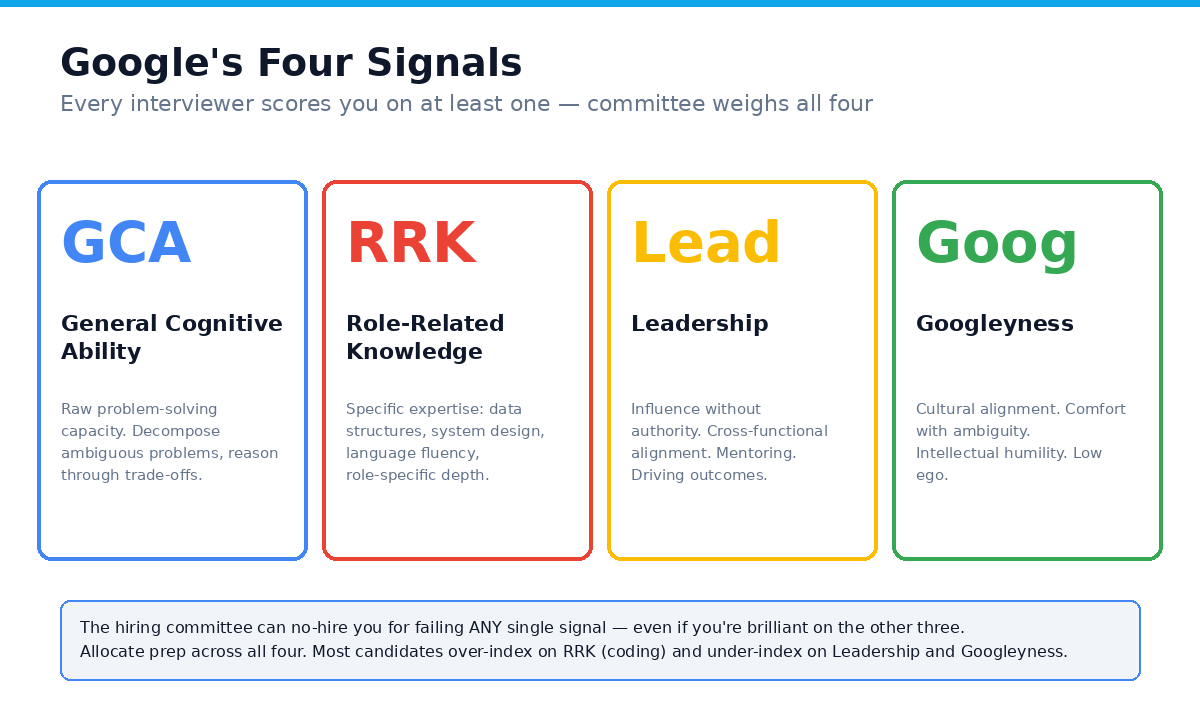
Signal 1: General Cognitive Ability (GCA). Your raw problem-solving capacity. Can you decompose ambiguous problems? Can you reason through trade-offs? Can you handle scale-related complexity? GCA is tested through coding, system design, and case-style behavioral questions.
Signal 2: Role-Related Knowledge (RRK). Your specific expertise for the role. For a software engineer, RRK is data structures, algorithms, system design, debugging, language fluency. For a PM, RRK is product judgment, prioritization frameworks, metrics literacy. For an ML engineer, RRK is model architectures, training infrastructure, evaluation methodologies.
Signal 3: Leadership. Not just managerial leadership, also influence without authority. How do you align peers? How do you drive cross-functional decisions? How do you mentor or unblock teammates? Even L3/L4 engineers are evaluated on this; senior roles are evaluated on this heavily.
Signal 4: Googleyness. This is Google’s term for cultural alignment. Comfort with ambiguity, intellectual humility, bias for action, collaborative problem-solving, low ego. Googleyness gets dismissed as fluffy by candidates who don’t understand it, but it’s the signal that catches “technically strong but team-corrosive” candidates and removes them from consideration.
The committee assigns an overall recommendation, typically Strong No-Hire, No-Hire, Leaning No, Leaning Hire, Hire, Strong Hire, based on how all four signals net out across all interviewers. To get an offer, you generally need at least Hire, with no Strong No-Hire signals on any single dimension.
For Google’s own description of the process, Google’s careers site has a hiring overview.
How the Google Hiring Loop Actually Works
Google’s process is structured, multi-stage, and slower-moving than Amazon or Meta. Knowing what each step is testing helps you prepare with intent.
Step 1: Application & Resume Screen
Google’s recruiters review hundreds of thousands of applications a year using a mix of automated screening and manual review. The signal recruiters look for:
What works on a Google resume:
- Quantified impact in every bullet (“reduced p99 latency from 240ms to 80ms,” “shipped feature to 12M users,” “saved $1.4M in infra cost”).
- Evidence of scale (“system handles 50K req/sec,” “team of 8 engineers,” “shipped to 30+ countries”).
- Specific technologies that match the role’s stack (don’t list 40 languages; list the 5-7 most relevant to the role you’re targeting).
- ICs at L4+ should show evidence of leadership, designed something, drove a roadmap decision, mentored a junior, owned a launch.
- A clean single-column format that the ATS parses cleanly.
What gets you screened out:
- Generic responsibilities (“worked on backend systems”) with no quantification.
- Multi-column resumes that ATS parsers mangle.
- Buzzwords without substance (“synergized cross-functional initiatives”).
- Career gaps without explanation (Google won’t reject you for a gap, but unexplained gaps create friction).
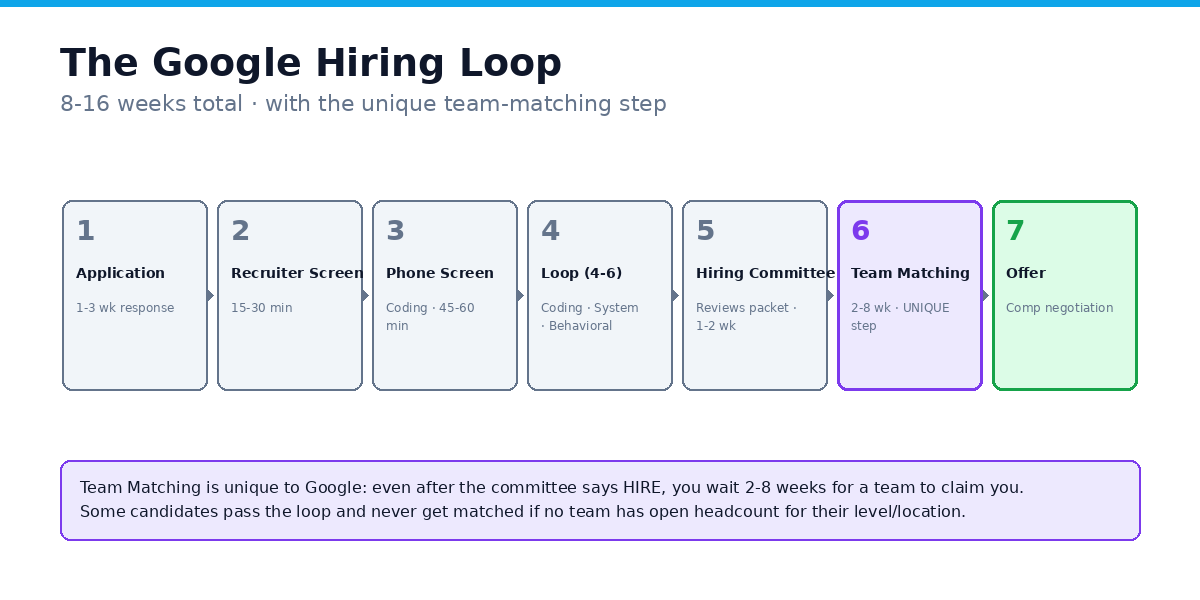
Step 2: Recruiter Screen (15-30 min)
A Google recruiter walks through your background, motivation, and target level. They’re not the technical decision-maker; they’re checking that you’re realistically in the right level band and that you have basic motivation/fit.
Common questions:
- “What attracted you to Google specifically?”
- “Walk me through your most impactful project.”
- “What level are you targeting?”, research the level (L4, L5, L6) on Levels.fyi before the call. Don’t undersell.
Step 3: Phone Screen / Initial Technical (45-60 min)
For SWE roles, this is typically one coding interview on a shared editor (Google Docs or a coding pad). One medium or medium-hard problem in your preferred language. The interviewer evaluates GCA + RRK on the coding signal.
The bar: You should solve the problem with optimal time/space complexity, communicate trade-offs as you go, write production-grade code (not pseudo-code), and handle 1-2 follow-up extensions of the original problem.
Step 4: The On-site / Virtual Onsite Loop (4-6 interviews)
For SWE L4-L5, the typical loop is:
- 2-3 coding interviews (medium-to-hard algorithms, often graph, DP, or system-y problems)
- 1 system design (L5+ only, for L3/L4 it’s usually a single moderate-design problem instead)
- 1 behavioral / Googleyness interview (focused on collaboration, ambiguity, conflict)
- 1 cross-functional / role-fit interview (specific to your target track)
Each interviewer is responsible for one or more of the four signals and writes a detailed packet immediately after the interview. The packet is what the hiring committee reads.
Step 5: Hiring Committee Review
After all interviewers submit packets, the hiring committee reviews them in batch (typically 1-2 weeks after your loop). The committee gives an overall recommendation. You don’t talk to them; you don’t see the packet; you don’t know the result until your recruiter calls.
Step 6: Team Matching (this is the unique step)
If the committee says hire, you don’t get an offer immediately. You enter team matching, a phase where Google’s recruiting works to place you on a specific team. This can take 2-8 weeks depending on the level, location, and which orgs are actively hiring.
During team match:
- You’ll have informal conversations with multiple team leads
- Both sides assess fit (you’re choosing as much as they are)
- Compensation is finalized once you commit to a team
This is also where offers fall through. A candidate can pass the loop and never get matched if no team has open headcount for the level/location. Plan for the timeline: from initial application to signed offer, expect 8-16 weeks for L4-L5, longer for L6+.
The Technical Bar by Level (Software Engineering)
Google’s leveling determines what you’re expected to demonstrate technically. Calibrate your prep to your target level, overshooting is fine, but undershooting kills the loop.
L3, University Graduate / Entry Level
Coding bar: Solve medium LeetCode problems in 25-30 minutes with optimal complexity, clean code, edge case handling. 2 problems in a 45-minute interview is the norm.
System design bar: Light. May get one moderate-design question (design a URL shortener, a rate limiter) but mostly evaluated on coding.
Leadership bar: Communication skills, intellectual humility, ability to learn from feedback. Not expected to have led teams.
L4, Software Engineer (typical 1-3 years experience)
Coding bar: Medium to medium-hard. Often a graph, DP, or recursion problem requiring careful complexity analysis. Communication of approach is graded as heavily as the solution.
System design bar: One ~45-min design exercise on a problem at moderate scale (e.g., design a chat system, a notification service).
Leadership bar: Demonstrate that you’ve owned a feature end-to-end. Mentored someone, even informally. Influenced a non-trivial technical decision.
L5, Senior Software Engineer (typical 5-8 years experience)
Coding bar: Hard problems. Often custom or non-LeetCode-canonical. Multi-part problems where you must extend your solution as the interviewer adds constraints.
System design bar: Significantly harder. You’re designing systems at scale (millions of users, partitioning, replication, durability, multi-region). Trade-off analysis is the focus, not just the diagram.
Leadership bar: Concrete examples of driving cross-team alignment, owning ambiguous projects, mentoring multiple engineers. Influence-without-authority stories must be specific and recent.
L6, Staff Engineer (typical 10+ years)
Coding bar: Still tested but not the focus. The committee assumes coding is solved.
System design bar: This is where L6 lives or dies. Designing org-wide infrastructure, multi-system architectures, migration plans. Identifying second-order failure modes.
Leadership bar: L6 is primarily a leadership signal. Cross-org influence, technical strategy, mentoring at scale, driving outcomes through other engineers’ work.
Specialty Tracks and Role-Specific Loops
Google has multiple ladders beyond generalist software engineering. Each has its own loop and bar.
ML / AI Research (DeepMind and Google Research), One of the most competitive ladders in tech. Loop includes ML coding (PyTorch, JAX), ML system design (training infrastructure, distributed training), and a research paper deep-dive interview. PhDs and strong publication records are common but not strictly required.
Site Reliability Engineering (SRE), Strong systems and Linux fundamentals required. The loop includes a “Troubleshooting” interview where you debug a hypothetical production incident in real time. Less algorithm-heavy than SWE; more systems-heavy.
Product Manager, Different loop entirely. Case-style product design questions, analytical/metrics interviews, prioritization frameworks. The Googleyness signal is weighted heavily. Read books like Cracking the PM Interview if targeting this track.
Cloud / GCP Solutions Engineer, Customer-facing, technical depth on GCP services, plus communication and consulting skills. Less LeetCode, more architecture-and-conversation.
Data Scientist / Analytics, SQL fluency, A/B testing methodology, causal inference, statistical communication. Loop includes case studies on real Google product metrics scenarios.
What Roles Google Is Hiring For in 2026
Google’s hiring footprint in 2026 spans far beyond the core search and ads business:
Generative AI / Gemini / DeepMind, Google’s AI products (Gemini, Bard’s successor agents, Vertex AI, NotebookLM) are hiring AI/ML researchers, applied scientists, and infrastructure engineers at scale. These roles are highly competitive with deep technical screens.
Google Cloud (GCP), Cloud engineers, solutions architects, security engineers. Google Cloud has been growing share against AWS and Azure and is hiring aggressively.
Search / Ads / Core Infrastructure, The legacy stack still hires steadily. Distributed systems, search ranking, ads delivery, latency optimization.
YouTube, Video infrastructure, recommendation systems, creator tools, monetization. YouTube has its own hiring track and slightly different culture.
Android / Pixel / ChromeOS, Mobile and device engineering, Tensor chip team, ChromeOS integration. Highly platform-specific roles.
Google for Startups, GFiber, Project Starline, Smaller bets within Alphabet that hire periodically.
To navigate Google’s volume efficiently, our guide to beating the Workday ATS covers the application platform many Google contractor and partner roles use, and our how many jobs to apply to per day in 2026 guide breaks down the volume math.
How to Apply: The Practical Playbook
1. Apply directly through careers.google.com
Google accepts direct applications and doesn’t penalize candidates who apply without a referral. Referrals get a slightly faster recruiter screen but they don’t bypass the loop or the committee. If you don’t have a referral, apply anyway.
2. Apply to multiple Google teams in parallel
Google’s recruiters source for specific orgs (Search, Cloud, YouTube, DeepMind, etc.). Your application to one role doesn’t surface you for others. Apply to 10-20 roles across Google teams that match your skill set, and let the recruiter screens narrow you down.
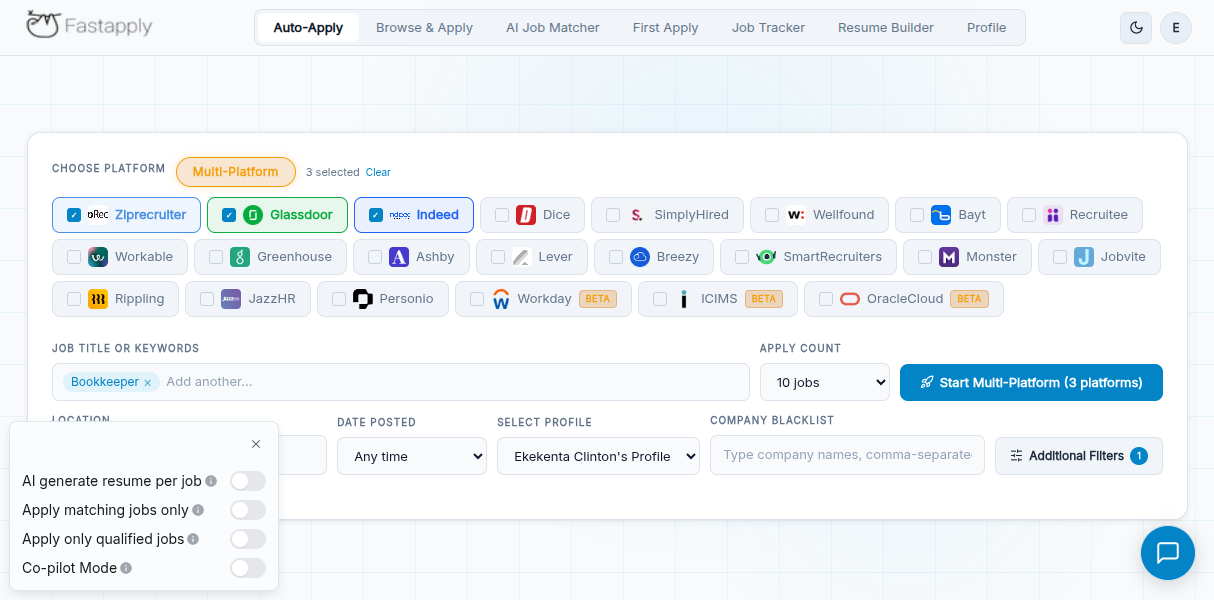
Tools like FastApply auto-apply across major job boards on your behalf, generating per-job tailored resumes that emphasize the specific keywords each posting calls out. Every new FastApply account starts with 5 free application credits with no card required.
3. Use referrals where you have them
Google employees can refer candidates and get a small bonus if you’re hired. If you know anyone at Google (LinkedIn search “Google” + your school or previous employer), reach out with a 2-paragraph note: who you are, what role you’re targeting, why the team interests you. Don’t lead with “ask for a referral”, lead with showing you’d be a fit and let them volunteer.
4. Prep deliberately for each of the four signals
Most candidates over-index on coding (RRK) and under-index on leadership and Googleyness. Allocate prep time across:
- Coding (RRK): 50% of prep. LeetCode medium/hard, NeetCode 150, system design primer.
- System design (RRK + GCA): 20% for L4-, 30%+ for L5+.
- Behavioral / Googleyness (Leadership + Googleyness): 15-20%. Prepare 8-10 STAR stories covering collaboration, conflict, ambiguity, ownership.
- Mock interviews: 10-15%. Pramp, interviewing.io, or peers.
Resume Optimization for Google
Google’s ATS and recruiters skim resumes in 6-15 seconds. Make every line count.
Format: Single column, plain text, ATS-friendly. No tables, no graphics, no fancy fonts. Save as .pdf (preserves formatting better than .docx for Google’s ATS).
Structure:
- Name + contact at top
- 1-2 line headline (“Senior Software Engineer with 7 years building scalable distributed systems”)
- Experience section (most important, list jobs in reverse chronological order)
- Skills section (technical keywords for ATS match)
- Education
Per-bullet pattern (use this for every line in Experience):
[Action verb] + [what you built/did] + [scale/scope] + [measurable result]
Examples:
- “Designed and shipped a distributed cache reducing p99 latency from 240ms to 80ms across 4 production services.”
- “Led migration of 15 microservices from VMs to Kubernetes, cutting infrastructure cost 38% ($1.4M/year).”
- “Mentored 6 junior engineers across 2 teams; 3 were promoted to L4 within their first 18 months.”
Keyword optimization: Read 5-10 Google JDs in your target role and extract the technical keywords appearing in 3+ of them. Make sure those keywords appear naturally in your skills section and in 2-3 experience bullets.
For deeper resume tactics, see our Workday ATS guide, many Google contractor roles route through Workday and the optimization principles transfer.
Compensation: What Google Actually Pays
Google’s compensation is famously transparent because of the Levels.fyi dataset, but understand the structure before negotiating.
Typical L4 software engineer comp (US, 2026):
- Base salary: $165k-$185k
- Sign-on bonus: $30k-$60k (one-time)
- Stock (vests on Google’s modified schedule): $130k-$200k over 4 years
- Annual bonus: 15-20% of base
Typical L5 software engineer comp (US, 2026):
- Base salary: $200k-$240k
- Sign-on bonus: $60k-$120k
- Stock: $250k-$450k over 4 years
- Annual bonus: 15-20% of base
Typical L6 staff engineer comp (US, 2026):
- Base salary: $260k-$320k
- Sign-on bonus: $80k-$200k
- Stock: $500k-$1M+ over 4 years
- Annual bonus: 20-25% of base
Practical implication: Google’s stock vests more evenly than Amazon’s (typically 25/25/25/25 over 4 years rather than Amazon’s back-loaded 5/15/40/40), so leaving early is less punishing equity-wise. But the absolute dollar amounts at L5+ are some of the highest in the industry.
For real-time comp data, Levels.fyi has the most accurate Google offer data, segmented by level and location. Negotiate with data, not emotion.
How FastApply Helps You Land a Google Interview
Google hires across thousands of roles globally, and applying to enough of them manually is exhausting. FastApply is an AI-powered job application tool that:
- Auto-applies to Google roles (and roles at every other major employer) across LinkedIn, Indeed, Workday, Greenhouse, Lever, Ashby, and 8+ other major job boards.
- Tailors your resume per posting using AI on Pro and Elite plans, so each application surfaces the keywords and signals each Google JD specifically calls out.
- Runs a 24/7 AI Job Matcher that auto-applies the moment a high-fit Google role drops, putting you in front of the recruiter as one of the first applicants, a position that consistently delivers 5-10x higher response rates.
- Tracks every application, response, and interview in a single dashboard.
Every new FastApply account gets 5 free application credits with no card required. Paid plans start at $14/month with cancel-anytime monthly billing.
For comparison against other AI auto-apply tools, see the FastApply vs BetterApply, Sonara, and LazyApply reviews.
Common Mistakes That Sink Google Interviews
After thousands of Google loops, these are the recurring failure patterns:
1. Optimizing only for coding. Coding is necessary but not sufficient. Candidates who score Strong Hire on RRK but Leaning No on Leadership or Googleyness still get committee no-hires. Allocate 25-35% of prep to behavioral and system design.
2. Vague communication during coding. “I’ll just use a hash map here” buried in code without explaining why. The committee reads the packet, your interviewer can’t write down what you didn’t say. Narrate trade-offs out loud.
3. Overconfident system design at L4. L4 doesn’t need to nail Cassandra vs DynamoDB trade-offs. L4 needs to walk through the moderate problem cleanly and acknowledge what they don’t know. Confident wrong answers fail; humble correct ones pass.
4. Treating Googleyness as a soft signal. It’s not. Comments like “I argued my point and refused to back down” read as low Googleyness in the packet, even if you intended to demonstrate Backbone. Frame strong opinions through “we evaluated together; I advocated for X with the data; I committed to the team’s chosen direction”, that reads as collaborative.
5. Not prepping for the team match phase. Candidates who aced the loop get blindsided when team match takes 6+ weeks. Plan for the timeline; keep applying elsewhere in parallel.
6. Negotiating without data. Levels.fyi has the most accurate Google comp data. Use specific numbers (“for L5 in MTV, recent offers cluster at $X base + $Y stock”). Don’t say “I want more”; say “based on competitive offers and the Levels.fyi data band, I’d target $X.”
Frequently Asked Questions
What are Google’s four signals?
Google evaluates candidates on four signals: General Cognitive Ability (GCA), raw problem-solving capacity; Role-Related Knowledge (RRK), specific expertise for the role; Leadership, including influence without authority and collaborative driving of decisions; and Googleyness, cultural alignment, intellectual humility, comfort with ambiguity, and low-ego collaboration. The hiring committee scores you on all four; weak performance on any single signal can result in a no-hire.
What is a Google hiring committee?
The hiring committee is a panel of senior Google engineers (typically L6 or above) from outside the team you’re interviewing for. They review your interview packet, the structured written feedback from each of your interviewers, and make the hire/no-hire recommendation. They never meet you. The hiring manager doesn’t make the final call; the committee does.
How long is the Google interview process?
The full Google interview process typically runs 8-16 weeks from initial application to signed offer. Stages: application (1-3 weeks for response), recruiter screen (1-2 weeks), phone screen (2-3 weeks), full loop (2-3 weeks), hiring committee review (1-2 weeks), team matching (2-8 weeks). L6+ roles can take longer due to scheduling complexity.
What is Googleyness?
Googleyness is Google’s term for cultural alignment. It includes comfort with ambiguity, intellectual humility, bias for action, collaborative problem-solving, and low ego. It is explicitly evaluated as one of the four signals in every interview loop. Despite sounding “soft,” it’s the signal that catches “technically strong but team-corrosive” candidates and removes them from consideration.
How hard is it to get a job at Google?
Google’s acceptance rate for software engineering roles is generally estimated at 0.5-2%, depending on the level and team. Volume of openings is large (Google hires thousands of engineers globally per year), but the bar for any single role is high. The technical interview difficulty at L4+ is among the hardest in tech, medium-to-hard LeetCode is a baseline rather than a stretch goal.
What’s the salary at Google for a software engineer?
For an L4 software engineer in the US (2026), typical comp is $165k-$185k base, $30k-$60k sign-on, $130k-$200k stock over 4 years, and 15-20% annual bonus. For L5: $200k-$240k base, $60k-$120k sign-on, $250k-$450k stock. For L6: $260k-$320k base, $80k-$200k sign-on, $500k-$1M+ stock. Levels.fyi has the most accurate real-time data segmented by level and location.
Do I need a referral to apply to Google?
No. Google accepts direct applications and doesn’t penalize candidates who apply without a referral. Referrals can speed up the recruiter screen but they don’t bypass the loop, the committee, or team matching. Apply directly even if you don’t have a referral.
What is team matching at Google?
After you pass the hiring committee, you enter team matching, a phase where Google’s recruiting works to place you on a specific team. You’ll have informal conversations with multiple team leads; both sides assess fit. Team matching can take 2-8 weeks. A candidate can pass the loop and never get matched if no team has open headcount for your level and location, so the offer isn’t guaranteed even after a Hire recommendation.
Can I apply to multiple Google teams at the same time?
Yes. Google’s recruiters source for specific orgs (Search, Cloud, YouTube, DeepMind, etc.). Applying to one role doesn’t surface you for others, so applying to 10-20 roles across Google teams that match your skill set is the right strategy. Tools like FastApply auto-apply across major job boards, making this scale of application volume practical.
What if I fail a Google interview?
Google typically requires a 6-12 month cooldown before you can re-interview. Use the time to gather more impactful project experience, prepare more thoroughly for the four signals (especially the ones flagged in your debrief if your recruiter shares it), and reapply when the cooldown ends. Many candidates pass on their second or third attempt. For how cooldowns compare across companies and what has to change before you reapply, see reapplying for a job you were rejected from.
Is auto-applying to Google jobs ethical?
Yes, as long as the tool submits accurate information tailored to the role, which FastApply does. The ethical line is misrepresentation, not automation. See our full write-up on job application automation ethics.
Does FastApply do AI resume tailoring?
Yes. FastApply Pro ($29/mo) and Elite ($49/mo) include per-job AI resume tailoring as a core feature, alongside the auto-apply workflow across 12+ job boards. The AI rewrites your resume’s summary, skills, and bullet-point emphasis per application to match each posting’s keywords. AI cover letters are generated per-job on the same plans. Unlike standalone resume builders (Kickresume, Rezi, Teal), FastApply combines AI tailoring with auto-apply in a single workflow. For the full breakdown of the AI resume tailoring landscape, see our How to Tailor Your Resume with AI in 2026 guide.
Your Next Step: Land the Google Interview
The four-signal framework is the same whether you’re applying to L3 or L6. The hiring committee process is the same gatekeeper at every level. The team match step is the same checkpoint that catches candidates off-guard regardless of seniority.
What changes is the depth of preparation and the specificity of your stories. Most candidates underestimate how many roles they should apply to. They underestimate how much the Googleyness signal matters. They underestimate how long team matching takes.
If you’re applying broadly across Google teams (and you should be), FastApply handles the application volume and per-job tailoring so you can spend your time preparing the loop instead of rewriting your resume for each posting. 5 free application credits to start, no card required, then $14/month Starter with cancel anytime.
Your next Google interview is one well-prepared loop away.
#Google Hiring Committee
#Google Four Signals
#Googleyness
#Google Interview
#Job Hunting
#Career
#Big Tech

FastApply Team
Career Experts