FastApply vs LazyApply (2026): Honest LazyApply Review, Pricing & Which Wins
If you’re choosing between FastApply and LazyApply, you’re looking at two AI auto-apply tools that take very different approaches to the same problem. LazyApply leans into raw application volume at a low annual price. FastApply leans into per-job AI tailoring, free credits to start, and broader platform coverage on a monthly cancel-anytime model. The differences are real, and which one wins for you depends on whether you value volume or quality more.
This comparison pulls from each tool’s public pricing pages and feature documentation as of May 2026. No guessing, no speculation.
Short answer: LazyApply has the lowest raw entry price in the AI auto-apply category, $99/year on Basic ($8.25/mo equivalent) for 15 applications/day, scaling up to $999/year on Ultimate for 1,500 applications/day. The catch: every plan is annual-billed up front (no monthly), there’s no free trial, account access requires a Gmail address, and AI tailoring depth and platform coverage are narrower than alternatives. FastApply runs a 24/7 AI Job Matcher across 12+ job boards (LinkedIn, Indeed, ZipRecruiter, Glassdoor, Workday, Greenhouse, Lever, Ashby, and more), auto-applies the moment a matching role drops with a tailored resume and cover letter, gives every new user 5 free application credits with no card required, and bills monthly starting at $14/mo with no annual lock-in. For most job seekers prioritizing application quality, free trial access, and the ability to cancel anytime, FastApply is the stronger choice. LazyApply is a defensible pick only if you’re certain you want a year of high-volume spray-and-pray and don’t need premium AI tailoring or per-job cover letters. Full breakdown below.
What is FastApply?
FastApply is an AI-powered job application automation platform built as both a Chrome extension and a web dashboard. It does four things:
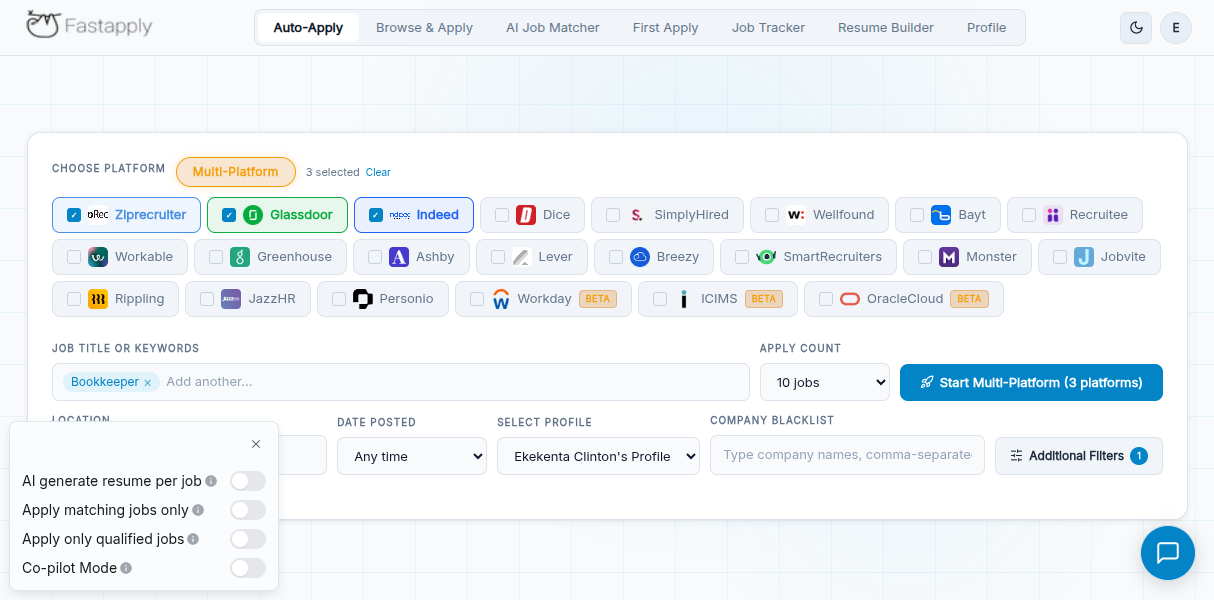
- Monitors the job market 24/7. The AI Job Matcher runs in the background, continuously scanning 12+ job boards (LinkedIn, Indeed, ZipRecruiter, Glassdoor, Dice, Workday, Greenhouse, Lever, Ashby, and more) for roles that match your profile, experience, and preferences.
- Applies the moment a match drops. When a high-fit job is posted, FastApply auto-applies in the background with a resume and cover letter tailored specifically to that posting. You become one of the first applicants, a proven conversion lever. Early applicants typically see 5 to 10x higher response rates than late ones.
- Tailors every submission. AI-generated per-job resumes and cover letters (available on Pro and Elite plans) make each application match the specific role’s keywords and requirements.
- Tracks everything. Every application, every response, in a central dashboard.
Every new FastApply account starts with 5 free application credits. You can test the product end-to-end across your actual target platforms before paying anything. After that, FastApply offers three individual plans plus a custom Enterprise/Teams tier with API access, SSO, and a dedicated account manager.
What is LazyApply?
LazyApply (lazyapply.com) is an AI-powered Chrome extension that automates job applications across major boards. Per LazyApply’s public positioning, the platform:
- Auto-applies to jobs across LinkedIn, Indeed, and ZipRecruiter
- Lets users configure daily application limits, role preferences, and search filters
- Generates AI-assisted application answers for common questions
- Provides a dashboard for tracking applications submitted
LazyApply is a real product with paying customers. The relevant question isn’t whether it works, it does, but whether the model (annual billing, high-volume caps, narrower AI tailoring) is the right fit for your job search.
LazyApply Pricing: How Much Does LazyApply Cost?
LazyApply’s pricing is annual, billed up front, with no monthly option and no free trial. Here are the current plans per LazyApply’s public pricing page as of May 2026:
| Plan | Discounted price | Regular price | Applications/day | Resume profiles | Analytics | Support |
|---|---|---|---|---|---|---|
| Basic | $99/year | $119/year | 15/day | 1 | Basic | |
| Premium (Most Popular) | $149/year | $179/year | 150/day | 5 | Basic | |
| Ultimate (10X Value) | $999/year | $1,099/year | 1,500/day | 20 | Advanced | Priority |
| Enterprise | Custom | Custom | Unlimited | Unlimited | Advanced | Priority + Training |
A few details worth understanding before you commit:
All plans are billed annually, up front. There is no monthly option. You pay $99 (Basic), $149 (Premium), or $999 (Ultimate) for a full year of access at signup. If you find a job in month two, you’ve paid for ten months you won’t use.
Account creation requires a Gmail address. LazyApply’s signup flow specifies that the email must be a Gmail account. If your primary email is on a custom domain ([email protected]) or another provider (Outlook, iCloud, Yahoo, ProtonMail), you’ll need to create or use a Gmail address to register.
There is no free trial. No free credits, no money-back guarantee window listed publicly, no $1 trial. The lowest entry point is the $99 Basic plan, paid for the full year up front.
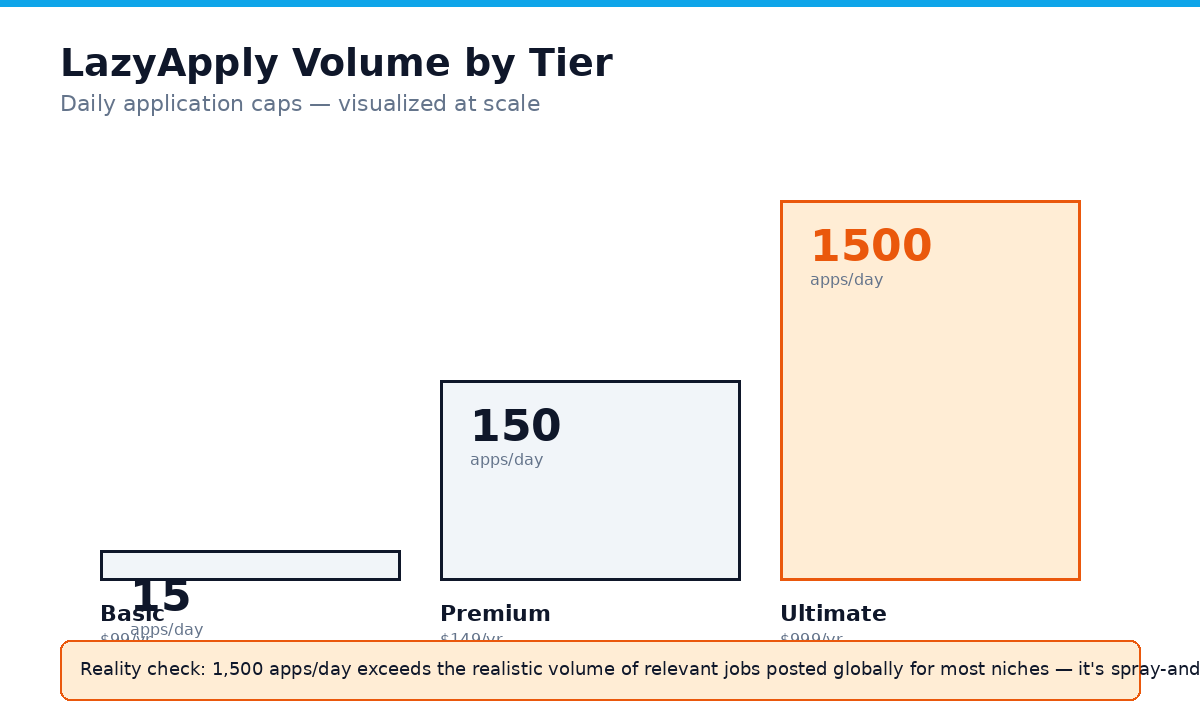
Application caps are aggressive. 15/day on Basic = ~5,475 applications/year. 150/day on Premium = ~54,750/year. 1,500/day on Ultimate = ~547,500/year. The Ultimate cap, in particular, exceeds the actual volume of relevant jobs posted globally per day for most niches, it’s a “spray and pray” tier rather than a realistic working volume.
FastApply vs LazyApply: Pricing Comparison
FastApply pricing (monthly, no annual lock)
Every new account gets 5 free application credits before any paid plan kicks in. If those 5 free applications prove the tool works for your search, you pick a plan that matches your volume.
| Plan | Price | Applications/mo | AI Resume Tailoring | AI Cover Letter | Support |
|---|---|---|---|---|---|
| Free credits | $0 | 5 credits (one-time) | - | - | |
| Starter | $14/mo | 200 | - | - | |
| Pro (most popular) | $29/mo | 500 | ✓ | ✓ | |
| Elite (best value) | $49/mo | 1,000 | ✓ | ✓ | Priority |
| Teams / Enterprise | Custom | Custom | ✓ | ✓ | 24/7 + SSO + API |
All paid plans include access to the 12+ supported job boards, smart application tracking, and multiple resume profiles (3 to 10 depending on tier).
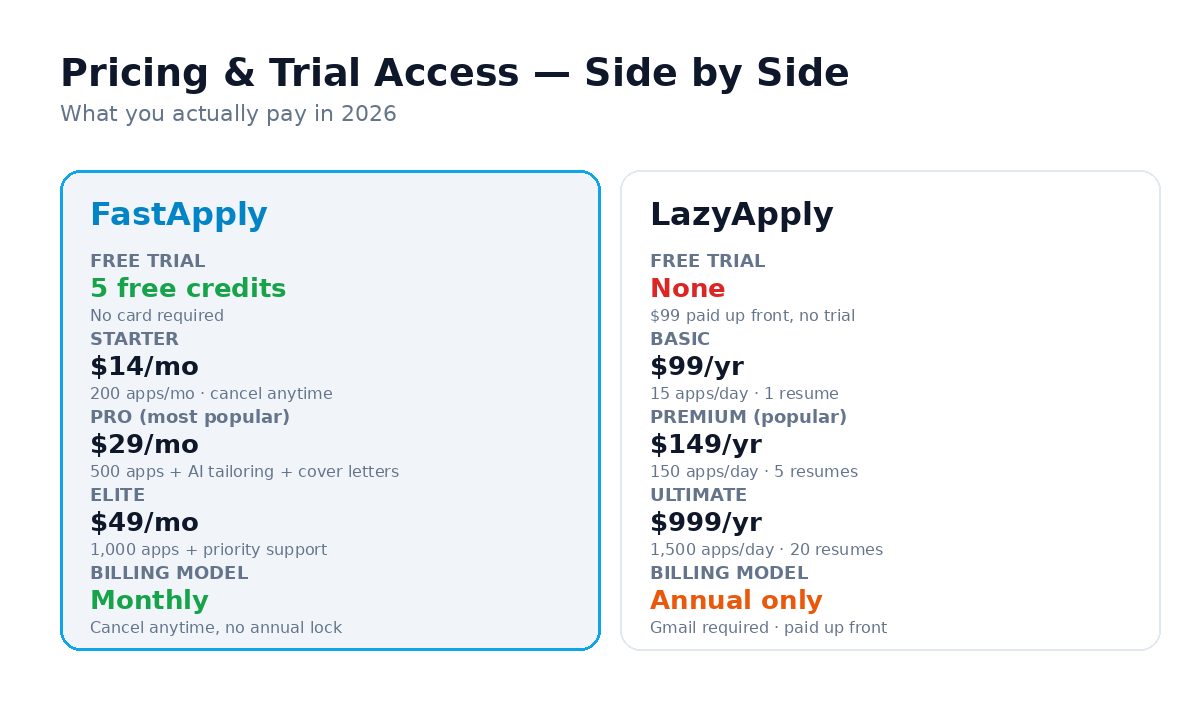
Side-by-side: what you actually pay in 2026
| Scenario | FastApply | LazyApply |
|---|---|---|
| Cost to test the tool | $0 (5 free credits, no card) | $99 up front (no free trial) |
| First-month cost | $0 (free credits) → $14 Starter only if you upgrade | $99 (Basic) annual, billed at signup |
| Lowest annual cost | ~$168/yr (Starter monthly × 12, cancel anytime) | $99/yr (Basic) annual, locked in |
| Pro/Premium tier (popular) | FastApply Pro $29/mo (~$348/yr), 500 apps/mo, AI tailoring, AI cover letters | LazyApply Premium $149/yr, 150 apps/day (~4,500/mo) |
| High-volume tier | FastApply Elite $49/mo (~$588/yr), 1,000 apps/mo, priority support | LazyApply Ultimate $999/yr, 1,500 apps/day |
| Cancel anytime | ✓ (monthly billing) | ✗ (annual paid up front) |
| Free trial | ✓ 5 free credits, no card | ✗ |
The honest pricing read
LazyApply wins on raw annual price. $99/year for Basic is cheaper than any FastApply tier at full year cost. If your only criterion is “lowest dollar amount on a year of auto-apply,” LazyApply Basic is the answer.
FastApply wins on price flexibility, trial access, and per-application quality. No card required to evaluate (5 free credits), $14/month with cancel anytime so you only pay for the months you’re job-searching, per-job AI resume tailoring + AI cover letters on Pro and Elite, and 12+ explicit job boards including enterprise ATS like Workday, Greenhouse, Lever, and Ashby.
The real question: are you optimizing for cheapest annual price, or for cheapest per-quality-application? If you’ll job-search for exactly 12 months and want raw volume, LazyApply Basic at $99 is hard to beat. If you’ll job-search for 1-4 months, want to test before committing, and want each application to be tailored to the role, FastApply costs less in practice and converts at a higher rate.
The Real Differences That Matter
1. AI Job Matcher + first-to-apply advantage (FastApply)
This is FastApply’s biggest functional edge over LazyApply, and it’s the difference most price-only comparisons miss.
FastApply’s AI Job Matcher runs continuously in the background. It’s not a feature you trigger, it’s a process that runs 24/7 on your behalf:
- Scans all 12+ job boards continuously for new postings
- Filters for your profile fit. Only roles where your experience, skills, and preferences align with the posting get surfaced
- Auto-applies the moment a matching job drops with a resume and cover letter tailored to that specific posting, generated at apply-time
Why this matters for interview rates: application timing is one of the most under-discussed conversion levers in job search. Data from LinkedIn, Indeed, and Jobscan shows that applications submitted within the first 24 hours of a job posting receive 5 to 10x more recruiter attention than applications submitted later.
LazyApply applies in batch when you trigger a session, you set up filters, you launch a run, the extension fires off applications until your daily cap is hit. There’s no always-on, first-to-apply-with-tailored-materials loop. FastApply makes you one of the first applicants on every relevant role; LazyApply makes you one of the most applicants overall. Different optimization, different outcomes.
For a deeper look at why being an early applicant matters, see our guide on how many jobs to apply to per day in 2026.
2. Trial access: FastApply gives you 5 free applications; LazyApply has no free trial
This is the sharpest practical difference between the two products at the start of your search.
Every FastApply account starts with 5 free application credits, no card required. You can run the product against your real target platforms, see the AI tailoring on actual resumes, watch jobs get applied to, check the dashboard, before paying anything. If those 5 free credits show the workflow works for you, you upgrade to a paid plan. If they don’t, you haven’t lost money.
LazyApply has no free trial. The lowest entry point is $99 paid up front for a full year. To validate whether LazyApply works for your specific job boards and role types, you commit a year of subscription cost.
Why this matters: Auto-apply tools perform very differently depending on your target platforms, role types, and resume format. With FastApply, you can validate fit at zero financial commitment. With LazyApply, you’re paying $99 (or $149, or $999) before you’ve confirmed whether the workflow even fits your search.
3. Application quality: per-job AI tailoring vs volume-first
The deeper difference between the two tools is what each one optimizes for.
FastApply optimizes for application quality. On Pro ($29/mo) and Elite ($49/mo), every application is generated with a per-job AI-tailored resume that rewrites the summary, skills, and bullet-point emphasis to match the specific posting’s keywords and requirements. AI cover letters are included on the same plans, also generated per-job. Tailored applications consistently score higher on ATS filters and earn higher recruiter response rates than generic ones.
LazyApply optimizes for application volume. The platform applies your existing resume and stored answers to a high volume of postings per day. AI-assisted answers help with common application questions, but per-job re-tailoring of the resume itself isn’t the workflow’s primary focus. The pitch is “1,500 applications a day at the Ultimate tier”, quantity-led, not quality-led.
For most job seekers, a smaller number of well-tailored applications outperforms a larger number of generic ones. Recruiters and ATS systems are trained to filter for keyword relevance and role-specific signals. Applying to 1,500 jobs/day with a generic resume typically yields the same or fewer interviews than 30 well-tailored applications/day on Pro tier. FastApply’s per-job tailoring math compounds over time.
4. Platform & job board coverage
FastApply explicitly supports 12+ job boards on every plan, including the major aggregators (LinkedIn, Indeed, ZipRecruiter, Glassdoor, Dice) and the enterprise/startup ATS systems (Workday, Greenhouse, Lever, Ashby). The Chrome extension is designed to handle the full mix on the same plan.
LazyApply’s primary supported platforms are LinkedIn, Indeed, and ZipRecruiter, the major US job aggregators. Per LazyApply’s public marketing, broader ATS coverage (Workday, Greenhouse, Lever, Ashby) isn’t currently a core feature of the product. If your target companies use enterprise or startup ATS systems alongside the major boards, FastApply gives you a single Chrome extension that covers all of them on one plan. With LazyApply, you may need a complementary tool for the boards LazyApply doesn’t cover, which erodes the cost-saving argument.
5. Billing model: monthly cancel-anytime vs annual lock-in
This is a subtle but real difference for short-term searches.
FastApply bills monthly. Cancel anytime. If you find a job in month two, you stop paying after month two. Your total cost for a 60-day search on Pro tier is ~$58. On Starter, ~$28.
LazyApply bills annually, up front. Even Basic at $99 represents a full year of commitment. If you find a job in month two, you’ve paid for ten months of service you won’t use. The per-month effective cost on Basic only matches FastApply Starter ($14/mo) if you actually use the tool for the full 12 months, and most job searches don’t last that long.
For job seekers in the 1-4 month search window (the majority of working professionals), FastApply’s monthly model is much cheaper in practice than LazyApply’s annual commitment, even though LazyApply’s headline annual price is lower. Run the math against your expected search timeline.
6. Enterprise / Teams option
FastApply offers a dedicated Teams / Enterprise plan with custom application volume, team member support, custom job board integrations, dedicated account manager, priority 24/7 support, API access, SSO, and advanced security.
LazyApply also offers an Enterprise tier with unlimited applications, unlimited resume profiles, advanced analytics, custom job board integrations, flexible seat management, and priority support. Both products support enterprise scale, the comparison here is closer than on individual tiers.
For small-to-mid teams (career coaches, bootcamps, small outplacement firms), FastApply’s individual Teams plan is structured around AI tailoring quality plus team management. For very-large-volume enterprise users, LazyApply’s Ultimate-and-up tiers may be appealing on raw cost.
Feature Comparison Table
| Feature | FastApply | LazyApply |
|---|---|---|
| Cost to start testing | $0 (5 free credits, no card) | $99 up front (no free trial) |
| Billing model | Monthly, cancel anytime | Annual only, paid up front |
| Entry annual cost | ~$168/yr (Starter monthly × 12) | $99/yr (Basic) |
| Most popular plan | Pro, $29/mo (500 applications, AI tailoring + cover letters) | Premium, $149/yr (150 apps/day) |
| High-volume plan | Elite, $49/mo (1,000 apps/mo, priority support) | Ultimate, $999/yr (1,500 apps/day) |
| Account email requirement | Any email (no restriction) | Gmail address required |
| 24/7 AI Job Matcher (always-on) | ✓ Continuous scan + auto-apply at posting time | Batch sessions on user trigger |
| First-to-apply with tailored resume + cover letter | ✓ Core workflow | Not the primary workflow |
| Job boards covered | 12+ (LinkedIn, Indeed, ZipRecruiter, Glassdoor, Dice, Workday, Greenhouse, Lever, Ashby, +) | LinkedIn, Indeed, ZipRecruiter |
| AI-tailored resumes per job | ✓ (Pro and Elite) | Limited, primarily applies stored resume |
| AI-tailored cover letters per job | ✓ (Pro and Elite) | Not a stated core feature |
| Application tracking dashboard | ✓ | ✓ (Basic on lower tiers, Advanced on Ultimate+) |
| Cancel anytime | ✓ | ✗ (annual lock-in) |
| Refund policy | Cancel anytime, no charge for unused months | Not publicly stated |
| Enterprise / Teams plan | ✓ (API, SSO, dedicated manager) | ✓ (Enterprise, Custom Pricing) |
| Application caps | 200 / 500 / 1,000 per month | 15 / 150 / 1,500 per day |
| Analytics | Standard / Priority | Basic / Advanced |
Real-World Scenarios: Which Tool Is Right for You?
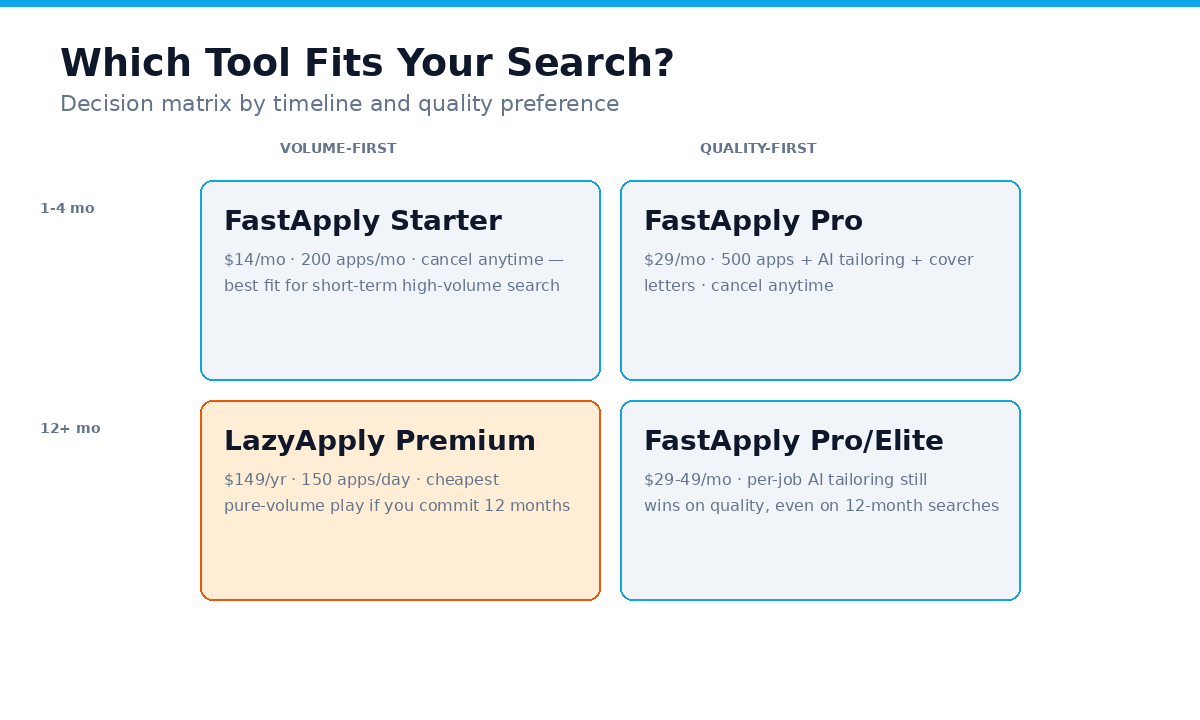
Scenario 1: The short-term job seeker (1-4 months)
You expect your search to take 1-4 months, which is typical for most working professionals. You don’t want to commit to a full year of any tool.
Recommendation: FastApply. 5 free credits to validate fit at $0. Starter at $14/mo or Pro at $29/mo with cancel anytime means you pay only for the months you’re searching. Total cost on a 3-month Pro search: ~$87. LazyApply Basic locks you into $99 for 12 months whether you use it or not.
Scenario 2: The price-first, long-search applicant
You expect to job-search for 12 months or longer (career transition, niche senior role, international relocation), you don’t need premium AI tailoring, and you want the cheapest annual price possible.
Recommendation: LazyApply Basic at $99/year. At a full 12-month horizon, it’s the cheapest way to access auto-apply functionality. Trade-offs you accept: no free trial, no per-job AI resume tailoring, narrower platform coverage (LinkedIn, Indeed, ZipRecruiter), Gmail-only account. If those trade-offs match your situation, the price is real.
Scenario 3: The serious applicant prioritizing quality
You’re targeting specific high-paying roles and want every application tailored (resume, cover letter, the whole package) to maximize ATS match rate and interview conversion.
Recommendation: FastApply Pro ($29/mo) or Elite ($49/mo). Both plans include per-job AI resume tailoring and AI cover letters across all 12+ supported boards. You’re paying for application quality, not application volume. A smaller number of tailored applications consistently beats a larger number of generic ones in real-world recruiter response rates.
Scenario 4: The high-volume, broad-net applicant who wants spray-and-pray
You want to fire off the maximum possible number of applications across a broad role set and aren’t optimizing for per-application quality. You’re playing a numbers game.
Recommendation: This is LazyApply’s strongest scenario. Premium at $149/year for 150/day or Ultimate at $999/year for 1,500/day are unmatched on raw application count. Caveats: response rates on generic high-volume applications are typically 5-10x lower than on tailored ones. Math the trade-off carefully against your specific roles and resume.
Scenario 5: The person who’s been burned by annual subscriptions
You’ve signed up for “lifetime” or “annual” deals before that turned out not to fit your needs and you couldn’t get refunded.
Recommendation: FastApply, by a wide margin. Monthly billing, cancel anytime, no annual commitment. The 5 free credits let you validate fit without entering a card. LazyApply’s annual-up-front model is the opposite of this, you commit a year of cost before knowing if the tool works for you.
Scenario 6: The team / career coach / outplacement firm
You’re managing job searches for multiple clients or team members.
Recommendation: Both tools offer Enterprise tiers. FastApply’s Teams plan is structured around per-job AI tailoring quality + team management + API/SSO. LazyApply’s Enterprise tier is structured around very-high-volume application caps. The right choice depends on whether your clients value tailored quality or raw application throughput.
What LazyApply Does Well
Being fair to LazyApply, here’s where it has real strengths worth noting:
- Lowest annual entry price in the category. $99/year on Basic is genuinely the cheapest way to access AI auto-apply functionality if you’ll use it for a full year. That’s a real value if your search timeline matches.
- Aggressive application volume caps. 1,500/day on Ultimate is the highest publicly stated daily cap among consumer auto-apply tools. For very-broad-net job seekers, that ceiling matters.
- Multiple resume profiles. 1 / 5 / 20 / Unlimited resume profiles by tier supports applicants with multiple target roles cleanly.
- Established Chrome extension on major boards. LazyApply has been operating on LinkedIn, Indeed, and ZipRecruiter for years and has a stable extension footprint.
- Tiered analytics. The Advanced Analytics on Ultimate and Enterprise is a real step up for users who want deep visibility.
If those match your needs and the annual lock-in doesn’t bother you, LazyApply is a legitimate choice.
The Verdict: FastApply vs LazyApply in 2026
For most job seekers, FastApply wins on three things that matter most:
-
Free credits to start, then monthly cancel-anytime. 5 free application credits with no card required, then $14/mo Starter you can cancel whenever you find a job. LazyApply requires $99 paid up front for a full year before you’ve confirmed the tool fits.
-
Per-job AI tailoring + AI cover letters. FastApply Pro at $29/mo includes per-job AI resume tailoring and AI cover letters generated for each specific role. LazyApply’s automation focuses on volume; per-job re-tailoring of the resume itself isn’t the primary workflow. Tailored applications convert at significantly higher rates than generic ones.
-
Broader platform coverage and the AI Job Matcher. 12+ explicit job boards (vs LazyApply’s primary LinkedIn/Indeed/ZipRecruiter footprint), plus the always-on AI Job Matcher that auto-applies the moment a matching role drops, making you one of the first applicants on every relevant posting.
LazyApply wins if: You’re certain about a 12-month or longer search, you want the lowest annual entry price ($99), you don’t need premium AI tailoring or per-job cover letters, and your target jobs concentrate on LinkedIn, Indeed, and ZipRecruiter. At Basic and Premium tiers in particular, LazyApply offers unmatched raw value if those trade-offs match your situation.
For everyone else, short-term searchers, applicants prioritizing per-job quality, anyone wary of annual lock-ins, and anyone who wants to test the tool before committing, FastApply is the stronger LazyApply alternative.
Weighing LazyApply specifically? See our deeper guides: Is LazyApply Legit?, the best LazyApply alternatives in 2026, and how to cancel LazyApply and try for a refund.
You can also compare against other major AI auto-apply tools in our BetterApply alternative guide, BetterApply review and comparison, and Sonara review and comparison.
Frequently Asked Questions
Is LazyApply legit?
Yes. LazyApply is a real, functional AI job application Chrome extension with paying customers, a published pricing page, and an established footprint on LinkedIn, Indeed, and ZipRecruiter. The relevant question isn’t whether LazyApply works, it does, but whether the model (annual billing, no free trial, narrower AI tailoring) is the right fit for your job search compared to alternatives like FastApply.
How much does LazyApply cost?
Per LazyApply’s public pricing as of May 2026: Basic is $99/year (regularly $119), Premium is $149/year (regularly $179), Ultimate is $999/year (regularly $1,099), and Enterprise is custom pricing. All plans are billed annually up front; there is no monthly billing option.
Does LazyApply have a free trial?
No. LazyApply does not offer a free trial. The lowest entry point is the $99 Basic plan, paid up front for a full year. FastApply, by contrast, gives every new account 5 free application credits with no card required.
Is LazyApply lifetime deal still available?
LazyApply’s pricing as of May 2026 is annual subscription, not lifetime. Older “lifetime deal” offers from previous years are no longer the active pricing model on LazyApply’s public pricing page. If you were searching for “LazyApply lifetime deal,” the current equivalent is the Basic ($99/year) or Premium ($149/year) annual plan.
Why does LazyApply require a Gmail account?
Per LazyApply’s signup flow, the email used to register the account must be a Gmail address. This is a hard product requirement at signup. If your primary email is on a custom domain or another provider (Outlook, iCloud, Yahoo, ProtonMail), you’ll need to create or use a Gmail address to register. FastApply does not have this restriction, any email works.
What’s the best LazyApply alternative in 2026?
For most job seekers, FastApply is the strongest LazyApply alternative. It gives every new user 5 free application credits with no card required (vs LazyApply’s $99 up-front commitment), bills monthly with cancel-anytime (vs LazyApply’s annual lock-in), supports 12+ explicit job boards including Workday, Greenhouse, Lever, and Ashby (vs LazyApply’s primary LinkedIn/Indeed/ZipRecruiter footprint), runs a 24/7 AI Job Matcher that auto-applies at posting time, and includes per-job AI resume tailoring + AI cover letters on Pro and Elite plans.
LazyApply vs FastApply, which is cheaper?
It depends on your search timeline. For a 12-month search, LazyApply Basic at $99/year is cheaper than FastApply Starter at ~$168/year (12 months × $14). For a 1-4 month search, FastApply is cheaper because you only pay for the months you’re searching: a 3-month Pro search costs ~$87 vs LazyApply Basic’s $99 commitment for a full year you won’t use. For applicants who want per-job AI tailoring, FastApply Pro ($29/mo) is the closest comparable feature set; LazyApply’s tiers don’t include the same depth of per-job re-tailoring.
Is LazyApply Premium worth it at $149/year?
LazyApply Premium at $149/year nets out to ~$12.42/month for 150 applications per day, which is competitive on raw price. The trade-offs to weigh: no free trial to validate fit, annual commitment, narrower platform coverage (LinkedIn/Indeed/ZipRecruiter primary), and per-job AI tailoring is not the primary workflow. If you specifically want high daily volume and don’t need per-job tailoring, Premium is reasonable. If you want quality-tailored applications, FastApply Pro at $29/mo offers a very different feature stack at a comparable annual cost.
Does FastApply work on Workday and Greenhouse?
Yes. FastApply supports Workday and Greenhouse, along with Lever, Ashby, LinkedIn, Indeed, ZipRecruiter, Glassdoor, Dice, and more, 12+ job boards and ATS platforms total. For a deep dive on Workday specifically, see our guide to beating the Workday ATS.
Can I cancel LazyApply mid-year and get a refund?
LazyApply’s public pricing page does not state a monthly refund or proration policy. Annual plans are typically billed up front and used through the term. Refund availability after signup is at LazyApply’s discretion, you’d need to contact LazyApply support directly to ask. FastApply, by contrast, bills monthly with no charge for unused months.
Is auto-applying to jobs ethical?
Yes, as long as the tool submits accurate information tailored to the role, which both FastApply and LazyApply do. The ethical line is misrepresentation, not automation. See our full write-up on job application automation ethics.
Does FastApply do AI resume tailoring?
Yes. FastApply Pro ($29/mo) and Elite ($49/mo) include per-job AI resume tailoring as a core feature, alongside the auto-apply workflow across 12+ job boards. The AI rewrites your resume’s summary, skills, and bullet-point emphasis per application to match each posting’s keywords. AI cover letters are generated per-job on the same plans. Unlike standalone resume builders (Kickresume, Rezi, Teal), FastApply combines AI tailoring with auto-apply in a single workflow. For the full breakdown of the AI resume tailoring landscape, see our How to Tailor Your Resume with AI in 2026 guide.
Try FastApply Today
Every new FastApply account gets 5 free application credits with no card required, so you can validate whether AI auto-apply actually works for your job search before paying anything. If it delivers, FastApply’s Starter plan at $14/month is the cheapest no-commitment monthly entry point in the AI auto-apply category, no annual lock-in, cancel anytime. Scale up to Pro ($29/mo) or Elite ($49/mo) only when the tool is earning its keep.
Your next interview is one tailored application away.
#FastApply vs LazyApply
#LazyApply review
#LazyApply alternative
#LazyApply pricing
#is LazyApply legit
#LazyApply vs FastApply
#AI job application
#auto apply tools
#job search automation

Ekekenta Clinton
AI/ML Engineer