How to Tailor Your Resume with AI in 2026: The Complete Workflow Guide
In 2026, sending the same resume to every job is a fast track to silence. Modern Applicant Tracking Systems (ATS) score every applicant against role-specific keywords before a human recruiter ever sees the resume. Generic resumes get filtered out at this stage even when the candidate is technically qualified. The result: the average job seeker sends 50-100 applications and lands 1-3 interviews, while a job seeker who tailors each resume to the role can send 30-40 applications and land 8-12 interviews.
The good news: AI has made resume tailoring fast enough to do at scale. The bad news: most AI resume tailoring tools optimize for one piece of the workflow and leave the rest manual. This guide breaks down the complete workflow, the best AI tools for each step in 2026, and the integrated approach that combines tailoring with auto-apply in a single tool.
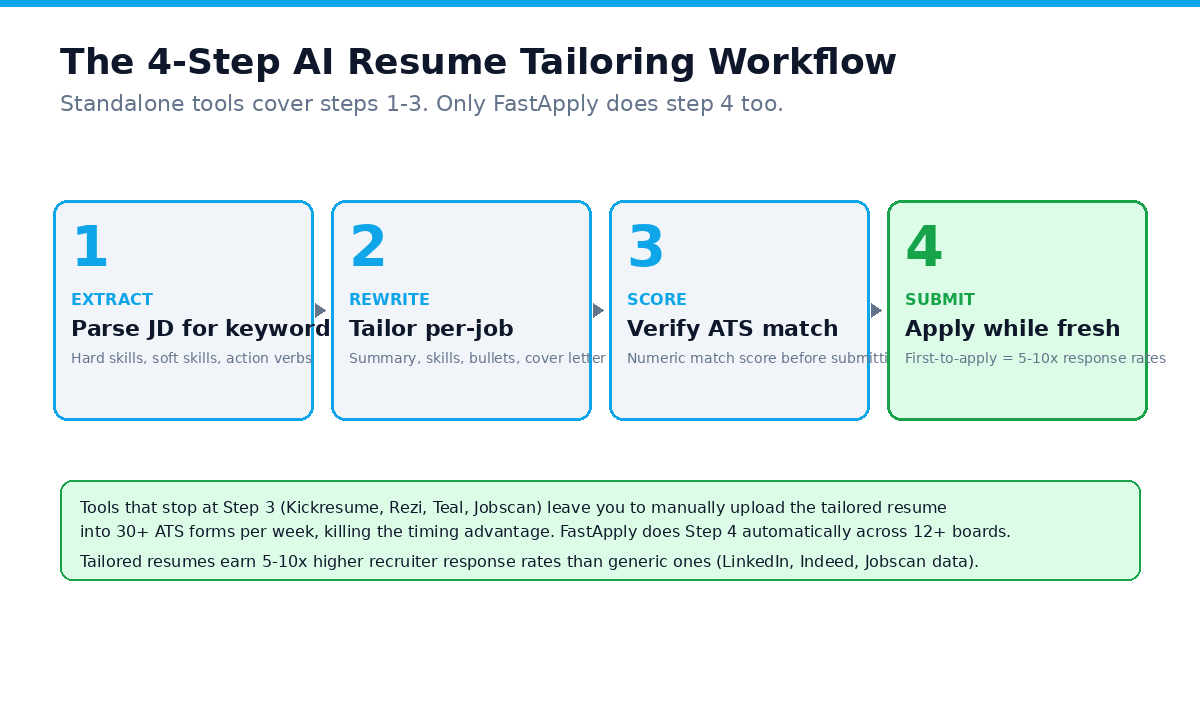
Short answer: The best AI resume tailoring workflow is a 4-step loop: (1) extract keywords from the job description, (2) rewrite your resume’s summary, skills, and bullet points to surface those keywords with quantified impact, (3) verify the ATS match score before submitting, and (4) submit while the posting is fresh. Standalone tools like Kickresume (best overall AI rewriter), Rezi (best ATS keyword optimizer, Forbes top pick), Teal (best for tracking + multi-resume management), Jobscan (best ATS match scorer), and ChatGPT/Claude (most versatile) cover individual steps well. FastApply is the only tool that does steps 1-4 end-to-end on the same plan: per-job AI resume tailoring (Pro and Elite tiers) plus auto-apply across 12+ job boards plus the 24/7 AI Job Matcher that submits the moment a matching role drops. Full breakdown below.
Why AI Resume Tailoring Matters in 2026
Three forces converged in 2024-2026 to make resume tailoring the single highest-leverage activity in modern job search:
1. ATS keyword filtering is now near-universal. Workday, Greenhouse, Lever, Ashby, iCIMS, and most other major ATS systems score resumes against the job posting’s keyword profile before a human ever reviews them. Resumes with low keyword match scores get auto-rejected or buried in the pile. The hiring manager never sees them.
2. AI generation made tailoring fast. Before 2023, tailoring a resume manually for each role took 30-60 minutes. With AI tools, it now takes 2-5 minutes. That changes the math: tailoring 30 applications a week is now realistic for an active job seeker, where it would have been impossible manually.
3. Application volume on major boards has 3-5x’d. Indeed, LinkedIn, and ZipRecruiter postings receive vastly more applicants than they did pre-2023. The job seeker pool grew faster than open headcount, especially in tech. Standing out requires both more applications AND higher quality per application, and that’s only possible with AI assistance.
The data is consistent across multiple studies: per-job tailored resumes earn 5-10x higher recruiter response rates than generic ones. That’s not a marginal optimization, it’s the difference between landing 1 interview per 50 applications and landing 1 per 5-10. Compounded over a 90-day search, it’s the difference between 2 offers and 20.
The 4-Step AI Resume Tailoring Workflow
Every effective resume tailoring approach follows the same four steps, regardless of which tool you use. Understand the steps and you can mix-and-match tools or pick the integrated tool that handles all four.
Step 1: Extract keywords from the job description
The first step is always the same: parse the job description for the keywords the ATS will score for. These typically fall into four categories:
Hard skills, specific technologies, languages, frameworks, certifications mentioned by name (e.g., “Python,” “AWS,” “Kubernetes,” “PMP”).
Soft skills, leadership, communication, ownership, cross-functional collaboration. ATS systems weight these less than hard skills but they still register.
Industry terms, vertical-specific jargon (“FedRAMP compliance,” “GAAP,” “GMP,” “PCI-DSS”). These signal domain expertise.
Action verbs, what the role expects you to do (“architected,” “owned,” “delivered,” “scaled”). Mirror the JD’s verbs in your bullets.
AI tools that handle Step 1 well:
- Jobscan is purpose-built for this, paste the JD and your resume, and it surfaces missing keywords with weighted importance.
- Rezi does similar keyword extraction with real-time scoring.
- ChatGPT or Claude with a structured prompt (“Extract the 15 most important keywords from this JD, separated by hard skills, soft skills, and industry terms”) works well for free.
- FastApply Pro and Elite do this automatically as part of the per-job AI tailoring on every application.
Step 2: Rewrite the resume to surface those keywords with quantified impact
Once you have the keyword list, rewrite the relevant parts of your resume to use them naturally. Three resume sections matter most:
The summary. Your top 2-3 lines. Should mirror the JD’s role title and 2-3 of the highest-priority keywords.
The skills section. A flat list of technical and domain keywords. Include every JD keyword you have legitimate experience with, don’t lie, but don’t omit either.
The experience bullets. Rewrite them to lead with action verbs from the JD and end with quantified outcomes. Pattern: [Action verb] + [what you built/did] + [scale/scope] + [measurable result].
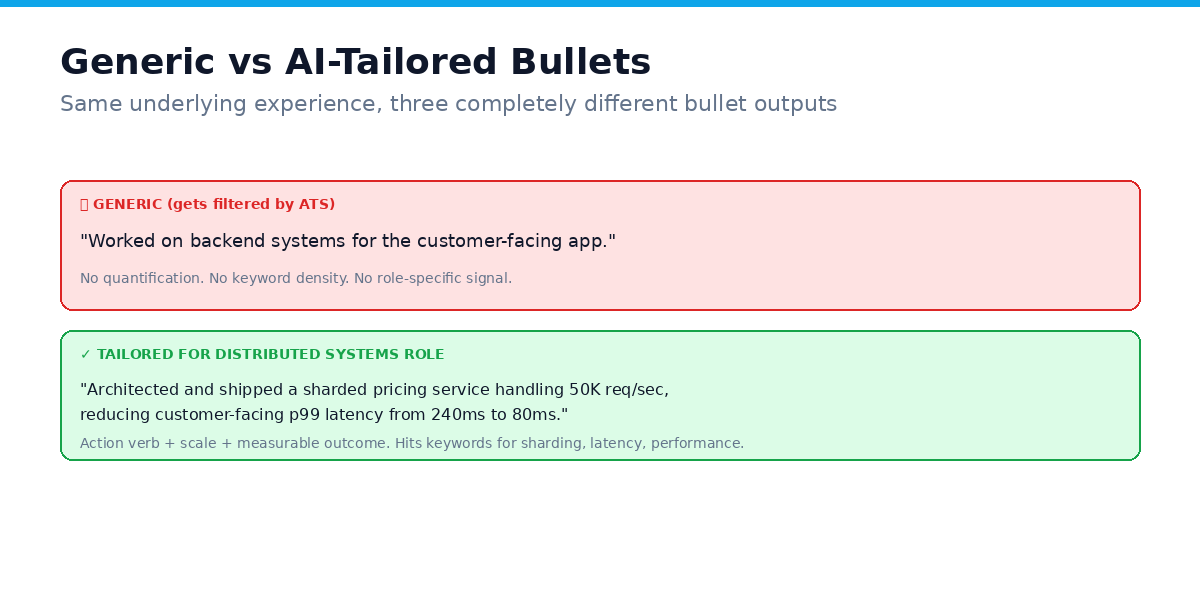
Example bullet rewrites for the same underlying experience:
❌ Generic: “Worked on backend systems for the customer-facing app.”
✓ Tailored for a Distributed Systems role: “Architected and shipped a sharded pricing service handling 50K req/sec, reducing customer-facing p99 latency from 240ms to 80ms.”
✓ Tailored for a Platform Engineering role: “Owned the migration of 12 microservices from VMs to Kubernetes, cutting infrastructure cost 38% ($1.4M/year) and onboarding 4 junior engineers on the new stack.”
The same underlying experience, two completely different tailored bullets, because the role priorities are different.
AI tools that handle Step 2 well:
- Kickresume is frequently cited as best-in-class for AI rewriting, its AI Career Coach paraphrases bullets to match a job description while preserving accuracy.
- Teal offers AI bullet-point suggestions built into a tracking dashboard, useful when you’re applying to multiple variants of the same role type.
- ChatGPT/Claude with a structured prompt (“Rewrite this bullet to emphasize [keyword 1, keyword 2] while preserving the original metric”) give you the most control.
- FastApply Pro and Elite rewrite the summary, skills, and bullets per application as part of the auto-apply workflow, no manual prompt engineering required.
Step 3: Verify the ATS match score before submitting
Before you hit submit, score the tailored resume against the JD one more time. The goal is a match score above 75% on Jobscan-style scoring, which puts you in the top tier of applicants the ATS surfaces.
AI tools that handle Step 3 well:
- Jobscan is the canonical tool for this. Paste resume and JD, get a numeric match score with specific gap recommendations.
- Rezi has built-in scoring with real-time feedback as you edit.
- TailoredCV offers semantic optimization scoring as part of its workflow.
Step 3 is optional if your tool already scores during Step 2 (Rezi does, Kickresume’s AI Coach does to some extent). If you’re using ChatGPT/Claude for tailoring, you should run Jobscan as a separate verification step.
Step 4: Submit while the posting is fresh
This step is where every standalone tool fails. You’ve tailored the resume. You’ve scored it. Now you have to submit it. And on every other major platform, that means logging into the ATS (Workday, Greenhouse, Lever, Ashby), creating an account, filling 47 form fields, uploading the resume, and clicking submit. By the time you’ve done all that, the posting is hours or days old, and you’re competing against the same handful of well-tailored resumes from other people who took the time.
Application timing matters more than most people realize. Data from LinkedIn, Indeed, and Jobscan consistently shows that applications submitted within the first 24 hours of a job posting receive 5-10x more recruiter attention than applications submitted later. By day 3, the recruiter has typically already shortlisted candidates and stopped reviewing new submissions actively.
This is where most resume tailoring workflows leak value. You did the work. You don’t get the timing benefit because the manual submission step ate your speed advantage.
AI tools that handle Step 4 well:
- FastApply is the only major tool that does Step 4 automatically as part of the same workflow. The 24/7 AI Job Matcher monitors 12+ job boards continuously and auto-applies the moment a high-fit role drops with the per-job tailored resume already generated. You’re one of the first applicants on every relevant role.
- Other auto-apply tools (BetterApply, LazyApply, Sonara, Loopcv) submit at scale but don’t all include per-job AI resume tailoring as the primary workflow. See our comparison hub for the trade-offs.
The Best AI Tools for Resume Tailoring in 2026, by Category
Different tools win different sub-categories. Here’s the honest breakdown.
Best Overall AI Resume Tailoring (Standalone): Kickresume
Kickresume’s AI Career Coach is frequently cited as the strongest standalone tool for AI rewriting. Paste a job URL, get rewritten resume sections that emphasize the role’s specific requirements while preserving your underlying experience. Strong template selection. Reasonable monthly pricing.
Best for: Job seekers who want a polished resume builder with AI tailoring built in, and who’ll handle Step 4 (submission) manually or via Indeed Easy Apply. Verify current pricing on kickresume.com.
Best for ATS Keyword Optimization (Forbes Top Pick): Rezi
Rezi is purpose-built for ATS optimization. Real-time match scoring as you edit, AI-suggested keyword inserts, ATS-friendly templates. Forbes named it a top pick. 4M+ users.
Best for: Job seekers whose target jobs have aggressive ATS filtering (Big Tech, Fortune 500, government), and who want maximum confidence the resume will pass automated screening before a human sees it. Verify current pricing on rezi.ai.
Best for Tracking + Multi-Resume Management: Teal
Teal combines a Chrome extension for saving job postings, an application tracking dashboard, an AI resume builder, and AI-generated bullet point suggestions per role. Free tier is generous; paid tiers unlock unlimited features.
Best for: Job seekers managing multiple resume variants for different role types (e.g., one resume for Senior PM roles, one for Director of Product roles), and who value pipeline tracking alongside the tailoring workflow. Verify current pricing on tealhq.com.
Best for ATS Match Scoring (Standalone Verifier): Jobscan
Jobscan is the canonical ATS match scorer. Paste your resume and any JD, get a numeric match score with specific keyword recommendations. It doesn’t rewrite for you, it tells you what to fix. Pair it with any AI rewriter for a complete workflow.
Best for: Verifiers who tailor resumes manually or with ChatGPT/Claude, and want a quantitative match score before submitting. Verify current pricing on jobscan.co.
Most Versatile (Free, Manual Control): ChatGPT / Claude
A general-purpose AI like ChatGPT or Claude with a well-structured prompt can rewrite resume bullets, extract JD keywords, and generate cover letters at near-zero cost. Trade-off: more manual prompt engineering, no built-in scoring or tracking.
Best for: Cost-conscious users with strong prompting skills who don’t mind the manual workflow, and who already pay for ChatGPT Plus or Claude Pro for other tasks.
Best Integrated Tailor-and-Apply Workflow: FastApply
FastApply is the only major tool in 2026 that combines per-job AI resume tailoring with auto-apply across 12+ job boards on the same plan. The workflow:
- Set up your base profile and target roles once.
- The AI Job Matcher continuously scans LinkedIn, Indeed, ZipRecruiter, Glassdoor, Workday, Greenhouse, Lever, Ashby, Dice, and more.
- When a high-fit role drops, FastApply Pro ($29/mo) or Elite ($49/mo) generates a per-job tailored resume + AI cover letter in real time.
- Auto-applies to the role within minutes of posting, putting you in front of the recruiter as one of the first applicants.
Pricing (May 2026): 5 free application credits with no card required → Starter $14/mo (200 apps, no AI tailoring) → Pro $29/mo (500 apps + per-job AI tailoring + AI cover letters) → Elite $49/mo (1,000 apps + priority support) → custom Teams/Enterprise tier.
Best for: Active job seekers who want all four steps of the AI resume tailoring workflow handled in one tool, who value the first-to-apply timing advantage, and who want to validate the workflow with 5 free credits before paying anything.
For deeper comparisons against other auto-apply tools, see FastApply vs BetterApply, Sonara, LazyApply, and Loopcv.
Why the Integrated Approach Beats the Stack Approach
You can build a workflow with multiple standalone tools, Jobscan to score, Kickresume to rewrite, Indeed Easy Apply to submit, Teal to track. It works. But it has three real problems:
Problem 1: The stack is expensive at full price. Kickresume Premium + Rezi + Teal+ + Jobscan paid stacks up to $80-120/month combined for full feature access. FastApply Pro at $29/mo or Elite at $49/mo handles the same workflow for less.
Problem 2: Manual submission breaks the timing advantage. Even if your tailoring is excellent, manually copying the tailored resume into 30+ different ATS forms each week kills the speed-to-apply advantage that makes tailoring valuable in the first place. By the time you submit, you’ve lost the first-to-apply window.
Problem 3: Multi-tool friction compounds. Each tool requires its own login, its own setup, its own export step. Multiply across 30 applications/week and the operational overhead becomes the bottleneck. You spend more time orchestrating tools than actually applying.
The integrated approach trades some feature depth (Jobscan’s match score is more granular than FastApply’s built-in tailoring scoring) for end-to-end speed. For most job seekers in an active 1-6 month search, that trade is correct.
Common Mistakes That Sink AI-Tailored Resumes
After reviewing thousands of AI-tailored resumes, these are the recurring failure patterns:
1. Keyword stuffing without context. AI tools sometimes inject keywords mechanically without weaving them into a story. A resume that lists “AWS, Kubernetes, Terraform, Python, Docker, CI/CD, Jenkins, Git” in three different sections looks like keyword spam to a human recruiter even if it scores well on ATS. Aim for natural integration.
2. Letting the AI rewrite quantified metrics. Always preserve your real numbers, the 240ms latency, the $1.4M cost saving, the 12M users. AI rewrites should change the framing around the numbers, never invent or modify the numbers themselves.
3. Single-resume-per-tool thinking. Most AI tools make it easy to generate ONE tailored resume per JD, but if you’re applying to 30 jobs/week, you need a workflow that scales. FastApply’s auto-tailor-per-application model handles this; manual workflows often regress to one or two resume variants because the per-job tailoring takes too long.
4. Skipping the ATS match score check. A high-quality AI rewrite that misses a critical keyword still gets filtered. Even if your tool does AI tailoring, verify the match score (via Jobscan or built-in scoring) before submitting on high-priority roles.
5. Tailoring without tracking. Without a tracking dashboard, you stop remembering which resume version you sent to which company. When the recruiter calls back two weeks later, you can’t recall what they read. Either use a tool with built-in tracking (Teal, FastApply) or maintain a simple spreadsheet.
6. Tailoring slow when tailoring fast wins. If your tailoring takes more than 5 minutes per application, you’re losing more in timing than you gain in quality. Speed up the workflow (better tool, better prompts, integrated automation) before you make tailoring “deeper.”
The Honest Verdict on AI Resume Tailoring in 2026
For most job seekers in an active 1-6 month search: FastApply Pro at $29/mo or Elite at $49/mo handles the complete 4-step workflow in a single tool. Per-job AI resume tailoring + AI cover letters + 12+ job board coverage + 24/7 AI Job Matcher + first-to-apply timing. 5 free credits to start, no card required.
For job seekers who want a standalone AI resume builder and will handle submission manually: Kickresume for AI rewriting, Rezi for ATS optimization, Teal for tracking, Jobscan for match score verification. Verify current pricing on each.
For cost-conscious or technical users: ChatGPT or Claude with structured prompts, plus Jobscan free tier for verification, plus Indeed Easy Apply for the subset of jobs where it works.
For enterprise / team use: FastApply Teams/Enterprise (API, SSO, dedicated account manager). Or build a custom workflow on top of Claude/ChatGPT API for very-high-volume use cases.
Frequently Asked Questions
What is AI resume tailoring?
AI resume tailoring is the process of using AI tools to rewrite specific parts of your resume (summary, skills, experience bullets) to match the keywords, requirements, and emphasis of a specific job posting. The goal is to maximize the resume’s match score against the role’s ATS keyword profile while preserving the underlying experience accurately. Done well, AI tailoring delivers 5-10x higher recruiter response rates than generic resumes.
What’s the best AI for resume tailoring in 2026?
The best AI for resume tailoring depends on your workflow. For end-to-end tailor-and-apply in one tool, FastApply Pro ($29/mo) handles per-job AI resume tailoring + auto-apply across 12+ job boards. For standalone resume building with AI rewriting, Kickresume is widely cited as the strongest. For ATS keyword optimization specifically, Rezi (Forbes top pick) and Jobscan are the canonical tools. For maximum flexibility at low cost, ChatGPT or Claude with structured prompts work well for technically inclined users.
Does FastApply do AI resume tailoring?
Yes. FastApply Pro ($29/mo) and Elite ($49/mo) include per-job AI resume tailoring as a core feature. The AI rewrites your resume’s summary, skills, and bullet-point emphasis per application to match each specific posting’s keywords and requirements. AI cover letters are generated per-job on the same plans. Unlike standalone resume builders (Kickresume, Rezi, Teal), FastApply combines AI tailoring with auto-apply across 12+ job boards in a single workflow. Every new account gets 5 free application credits to test the tailoring quality before paying anything.
How long does AI resume tailoring take per job?
With a good AI tool, per-job tailoring takes 2-5 minutes manually (extract keywords, rewrite bullets, verify score, submit). With an integrated tool like FastApply Pro/Elite that auto-tailors and auto-applies, per-job tailoring is effectively zero-click, you set up your base profile once and the AI Job Matcher handles tailoring + submission per role automatically.
Is AI-tailored resume considered cheating?
No, as long as the AI rewrites your real experience without inventing or fabricating it. AI resume tailoring is the same as having a career coach help you reframe your experience to highlight what’s most relevant for a specific role, a long-standing legitimate practice. The ethical line is misrepresentation. Don’t claim skills or experience you don’t have. AI tools rewrite how you present your experience, not what your experience is.
Will an AI-tailored resume pass ATS screening?
Yes, often more reliably than a manually-written generic resume. ATS systems score resumes against the job posting’s keyword profile, that’s exactly what AI tailoring optimizes for. Tools like Jobscan score the match before submission, so you can verify the resume will pass the ATS filter. The biggest mistake is keyword stuffing without context (which can fail human review even if it passes ATS), so good AI tailoring weaves keywords naturally rather than dumping them mechanically.
What’s the difference between an AI resume builder and AI resume tailoring?
An AI resume builder generates a base resume from scratch, useful when you’re starting fresh or transitioning industries. AI resume tailoring modifies an existing resume per-job to match each specific posting. Most active job seekers need tailoring more than building. Some tools (Kickresume, Teal) do both; some (Jobscan, Rezi) focus more narrowly on optimization.
How many resumes should I tailor per week in 2026?
For most active job seekers, 30-50 well-tailored applications per week outperforms 100+ untailored applications. Quality compounds. With a fast tailoring workflow (integrated tool like FastApply, or a tight ChatGPT prompt + Jobscan verifier loop), 30-50 tailored applications is achievable in 5-10 hours per week. See our deeper how many jobs to apply per day in 2026 guide for the math.
Can I tailor my resume with ChatGPT for free?
Yes, ChatGPT (free tier or paid) and Claude (free tier or Pro) can both rewrite resume bullets effectively with good prompts. The trade-off vs paid resume tailoring tools: no built-in ATS match scoring, no template management, no automation, no integrated submission. For technically inclined users who don’t mind the manual workflow, the ChatGPT + Jobscan free tier + Indeed Easy Apply stack is a legitimate $0/month workflow.
Does FastApply work on Workday and Greenhouse?
Yes. FastApply supports Workday and Greenhouse, along with Lever, Ashby, LinkedIn, Indeed, ZipRecruiter, Glassdoor, Dice, and more, 12+ job boards and ATS platforms total on every plan. For Workday-specific tactics, see our guide to beating the Workday ATS.
What’s the most common mistake in AI resume tailoring?
The most common mistake is letting the AI rewrite quantified metrics. Always preserve your real numbers (240ms latency, $1.4M saving, 12M users), the AI should change the framing around the numbers, never the numbers themselves. The second most common mistake is keyword stuffing without context, which can fail human review even when it passes ATS screening.
Try the Integrated Workflow Free
Every new FastApply account starts with 5 free application credits. No card required. Use them to validate the per-job AI tailoring quality against your actual target jobs before paying anything. If the integrated workflow saves you the time and friction of running a 4-tool stack manually, FastApply Pro at $29/mo (500 applications + per-job AI tailoring + AI cover letters) is the cheapest no-commitment monthly entry in the integrated category. Cancel anytime.
Your next interview is one tailored application away.
#AI resume tailoring
#tailor resume with AI
#tailor resume to job description
#AI resume tailoring tools
#best AI for resume tailoring
#AI resume builder
#ATS optimization
#job application AI

Ekekenta Clinton
AI/ML Engineer