
Current CTC and Expected CTC: What a Fresher Should Enter (2026)
Short answer: CTC stands for cost to company. It is everything an employer spends on you in a year: your salary and allowances, the employer’s share of provident fund, the gratuity it sets aside, insurance premiums and any variable pay. It is not the amount that reaches your bank account. If you are a fresher, enter 0 for current CTC (or “NA” where the field takes text) and never a made-up number. For expected CTC, enter a figure you have researched for that role, in the unit the form uses, which is usually lakhs per annum.
One line from our support chat sums up why this post exists: “my current ctc is 0 as i am a fresher”. The visitor was right, and the form still confused them, because the field sat next to an expected CTC box with no unit label and a dropdown that counted in lakhs. We see the same confusion from the other side too, in the fields that auto-fill tools get wrong: a monthly figure typed into an annual box, or rupees typed where the form wanted lakhs. So here is what CTC means, where the money goes, and what to type in each box.
What CTC actually means
Think of CTC as the employer’s budget line for you, not your pay. It bundles three different kinds of money:
| Part of the CTC | What it is | Do you see it monthly? |
|---|---|---|
| Basic salary | The fixed core, usually 40 to 50% of CTC | Yes |
| House rent allowance (HRA) | Usually 40 to 50% of basic; partly tax-exempt if you pay rent | Yes |
| Special and other allowances | Whatever balances the package: conveyance, meals, phone | Yes |
| Employer provident fund (PF) | 12% of basic paid into your PF account by the employer | No, it goes to PF |
| Gratuity provision | About 4.81% of basic set aside for a payout after five years of service | No |
| Insurance premiums | Group health and sometimes life cover | No |
| Variable pay or bonus | Paid only if targets are met, often quarterly or yearly | Only if earned |
| Joining bonus, ESOPs, retention bonus | Sometimes included to inflate the headline figure | Conditional |
The structure comes from salary guides published by greythr, Kredily and Aditya Birla Capital, and it matches the offer letters freshers send us for help. Two of those parts, employer PF and gratuity, never touch your bank account. Then your own PF contribution (another 12% of basic), professional tax (a state levy of up to ₹2,500 a year) and income tax come off the cash part. That is why in-hand salary is always lower than CTC divided by twelve.
How much lower depends on the structure and your tax. Guides disagree, from “10 to 20% lower” to “in-hand is 60 to 75% of CTC”, and both can be true for different packages. A worked example is more useful than a rule.
Where a ₹4.5 lakh CTC goes
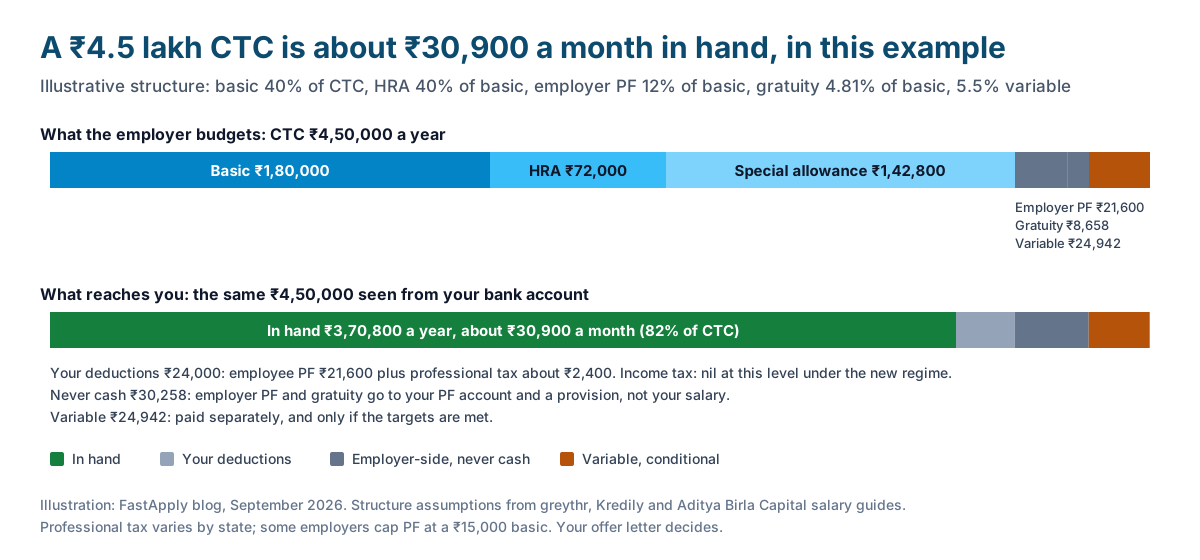
Take a typical fresher package of ₹4,50,000 a year with a plain structure: basic at 40%, HRA at 40% of basic, employer PF at 12% of basic, gratuity at 4.81% of basic, and 5.5% variable. The figures are illustrative; yours will differ.
| Line | Amount a year |
|---|---|
| Basic (40% of CTC) | ₹1,80,000 |
| HRA (40% of basic) | ₹72,000 |
| Special allowance (balancing figure) | ₹1,42,800 |
| Employer PF (12% of basic) | ₹21,600 |
| Gratuity provision (4.81% of basic) | ₹8,658 |
| Variable pay (about 5.5%) | ₹24,942 |
| CTC | ₹4,50,000 |
The cash you are paid before variable is basic plus HRA plus special allowance: ₹3,94,800 a year, or about ₹32,900 a month. From that, your own PF contribution of ₹21,600 and professional tax of roughly ₹2,400 come off. Income tax at this level is nil under the new regime for the current year, after the standard deduction and the rebate. In-hand is therefore about ₹3,70,800 a year, roughly ₹30,900 a month, which is 82% of the CTC. The variable ₹24,942 arrives separately, and only if the targets are met.
Two things change this picture. At higher packages, income tax widens the gap, which is where the “60 to 75%” figures come from. And employers only have to contribute PF on basic up to ₹15,000 a month; many contribute on the full basic anyway, some do not, and the offer letter will say which.
Current CTC: what a fresher should enter
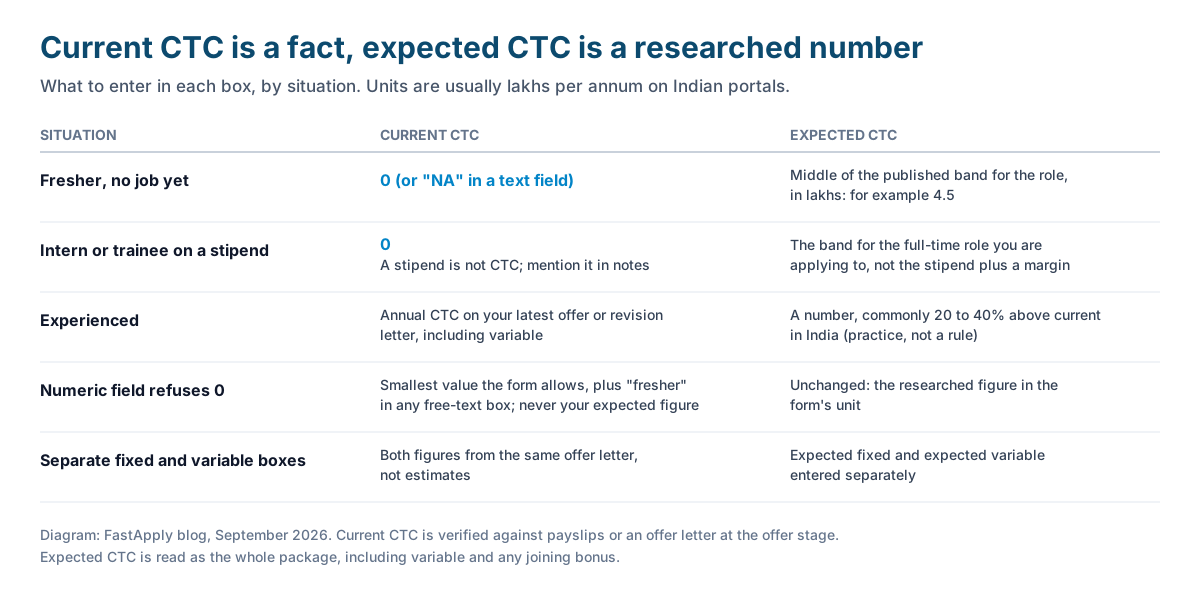
Enter 0. If the field accepts text, “NA” or “Fresher” also works. This is the honest answer and the one recruiters expect from campus and entry-level candidates; nobody is filtered out of a fresher role for having no salary history.
Three cases cause doubt:
- You did a paid internship. The stipend is not CTC. It was not a salary from an employer you are leaving. Enter 0 and mention the stipend in a notes or cover letter field if the role is at the same company.
- The field is mandatory and refuses 0. You are looking at a form built for experienced hires. Enter the smallest value the form allows and write “fresher” wherever free text is accepted. Do not type your expected figure into the current box to get past the validation; it will be read as a salary history.
- You are tempted to put a number so the offer starts higher. Do not. Current CTC is checked against payslips or an offer letter at the offer stage. A number you cannot document ends the process.
Expected CTC: how to pick a number
Expected CTC is the one box that moves your offer, so spend ten minutes on it. The recruiter reads it as the whole package, including variable and any joining bonus, because that is how they budget.
Find the band. Three sources give you a realistic range for a fresher role: the packages your college’s placement cell published for similar companies, the salary shown on Naukri postings for the same title (many mass recruiters state it), and the 0 to 1 year band on AmbitionBox or Glassdoor for the exact role. Where the samples are small, which they often are, take the middle of the range rather than the top.
Match the unit. Numeric expected CTC fields in India are usually in lakhs per annum. If the band is ₹4 to 5 lakh, type 4.5, not 450000, and not 37500. If the form has lakhs and thousands as two dropdowns, as the Naukri profile does, choose 4 lakh and 50 thousand. If the field asks for annual rupees, type 450000.
Use a range only where text is allowed. “₹4 to 5 lakh, open to discussion” is a good answer in a free-text box. “As per company standards” is acceptable on mass-recruiter forms that expect it, and weak anywhere a hiring manager will read it, because it tells them nothing.
Do not lowball to look flexible. A low expected figure does not win you the interview; the resume does that. It only lowers the opening offer. For the resume side, see our fresher resume format that passes ATS.
The units trap
Most of the CTC problems we see in support are not about the number. They are about the unit. The same salary has three legitimate spellings, and forms rarely label which one they want.
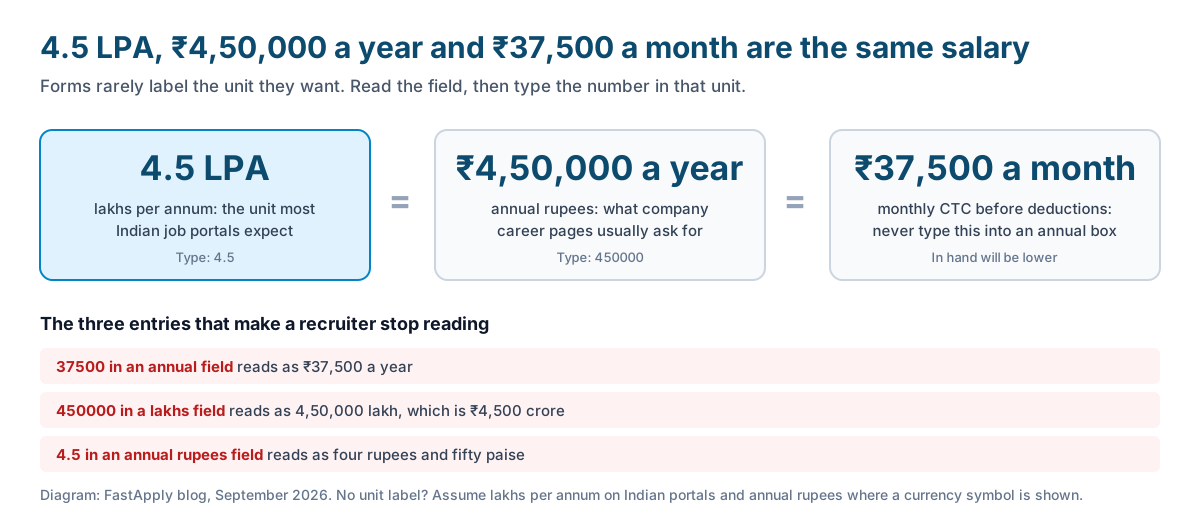
- 4.5 LPA means 4.5 lakh per annum, which is ₹4,50,000 a year.
- ₹4,50,000 a year is ₹37,500 a month of CTC, before any deduction.
- ₹37,500 a month is the figure you must never type into an annual box.
The three errors we see most: a monthly figure typed into an annual field (the form reads ₹37,500 a year), annual rupees typed into a lakhs field (450000 lakh is ₹4,500 crore, and the application is discarded as a typo or a joke), and lakhs typed into an annual rupees field (4.5 rupees). Each one makes a recruiter stop reading. Read the field label, and if there is none, assume lakhs per annum for Indian forms and annual rupees for company career pages that show a currency symbol.
Forms outside India ask the same question under a different name. US forms call it desired salary, and the format rules are different again; we cover them in what to put for desired salary.
If you are experienced
Current CTC is the annual CTC on your latest offer letter, revision letter or payslip, including variable. Enter the whole figure even if you never received the full variable, because that is what the recruiter will verify against. Where the form has separate boxes for fixed and variable, fill both from the same letter rather than estimating.
Expected CTC for experienced hires in India is commonly set 20 to 40% above current. That is practice, not a rule, and it moves with how scarce your skills are and whether you are changing cities or industries. If you are serving notice, the notice period field matters as much as this one, because a recruiter weighs joining date and cost together.
What this looks like at volume
If you are applying as a fresher through Naukri, LinkedIn and Indeed from India, you will meet the CTC question dozens of times a week, often with a different unit each time. Set the two values once, in lakhs, and let the tool convert. Check the first ten applications by hand, which is also the advice in our guide to mass applying with AI. After that the stored answer does the work, and you can spend the saved minutes on the fields that are different on every form.
For where the fresher roles actually are, read fresher jobs in 2026, and if you are aiming at analytics, data analyst jobs for freshers includes the salary bands we could find. FastApply in India starts free with 5 applications and no card, and paid plans start at ₹599 a month, or ₹433 a month on the 90-day plan.
FAQ
-
What is CTC in salary? CTC is cost to company: the total an employer spends on you in a year, including basic salary, HRA and other allowances, the employer’s provident fund contribution, the gratuity it sets aside, insurance premiums and any variable pay. It is a budget figure, not the amount paid into your bank account.
-
What is the difference between CTC and in-hand salary? In-hand salary is the cash left after the parts you never receive monthly (employer PF, gratuity, insurance, unearned variable) and the deductions from your pay (your own PF, professional tax, income tax). In the worked example above, a ₹4,50,000 CTC left about ₹30,900 a month in hand, though the gap widens at higher packages because of income tax.
-
What should a fresher write for current CTC? Write 0, or “NA” if the field takes text. An internship stipend is not CTC, so it stays at 0. If a numeric field refuses 0, enter the smallest value it allows and mention that you are a fresher in any free-text box, but never type your expected figure into the current CTC field.
-
What expected CTC should a fresher enter? Enter a figure from the middle of the published band for that role, found through your placement cell, the salary on similar Naukri postings and the 0 to 1 year band on AmbitionBox or Glassdoor. Type it in the unit the form uses, which is usually lakhs per annum, so 4.5 rather than 450000.
-
Does CTC include PF and gratuity? Yes. CTC includes the employer’s 12% provident fund contribution and the gratuity provision of about 4.81% of basic, and sometimes insurance premiums too. These are real costs to the employer, but they are paid into your PF account or set aside rather than paid to you each month.
-
What does ECTC mean on a job application? ECTC is expected cost to company, the annual package you are asking for at the new employer. It usually sits next to CCTC, current cost to company. Both are annual figures and both are normally entered in lakhs on Indian job portals.
Conclusion
CTC is the employer’s yearly cost for you, and it is always higher than what you take home. A fresher’s current CTC is 0, and the expected CTC should be a researched number typed in the unit the form uses. Get the unit right and the number consistent across applications, and you will have removed the most common way a good fresher application gets misread.
#current ctc meaning
#what is ctc
#expected ctc for freshers
#ctc vs in hand salary
#ctc full form
#current ctc for fresher
#job application form questions

Ekekenta Clinton
Founder, FastApply