
Notice Period Meaning: What to Enter on a Job Application (2026)
Short answer: A notice period is the time between telling your employer you are leaving (or being told you are) and your last working day. Your employment contract fixes it, not the law, and in India it is usually 30, 60 or 90 days. On a job application the notice period field is asking one thing: how soon can you start? Enter the number of days your contract binds you to, add “negotiable” if you can buy it out, give the date of your last working day if you are already serving notice, and write “Immediate” if you are not employed right now.
“What does notice period mean?” is one of the questions we get in FastApply’s support chat, usually from someone in India filling the field for the first time. It also turns up in a worse form. A visitor’s auto-filled applications all carried a notice period they never meant to give, because the tool reused one stored value on every form. So this guide covers the meaning first, then the exact wording for each situation, then the two mistakes that get applications filtered out before a person reads them.
Updated 2 October 2026 with figures from FastApply’s September 2026 application log.
What a notice period is
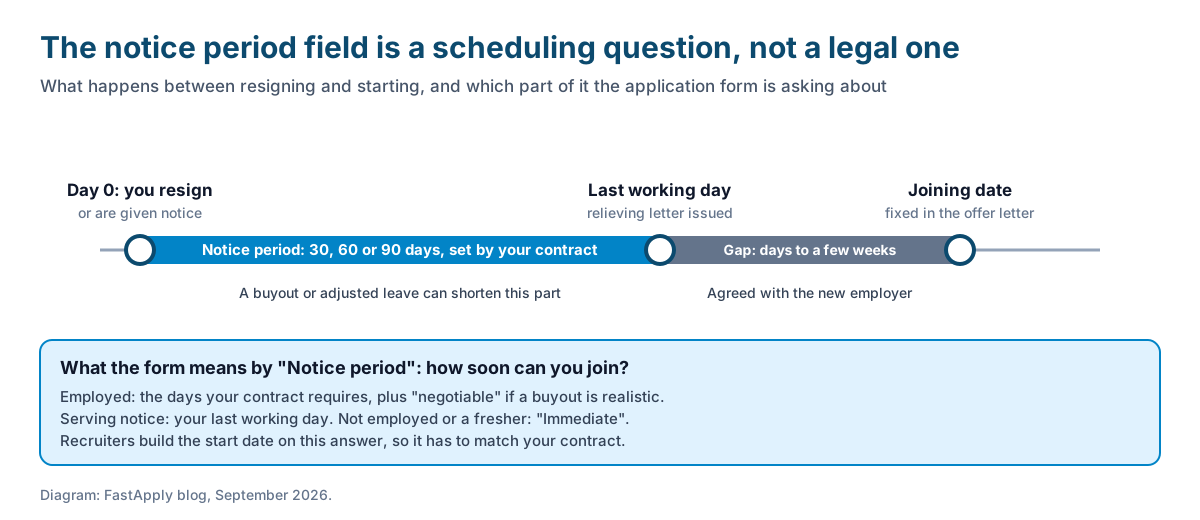
When you resign, you do not leave the same day. The contract you signed when you joined says how long you keep working after you hand in your resignation. That stretch is the notice period. It runs the other way too: if the company lets you go, it owes you the same notice, or pay in place of it.
The point of it is handover. Your employer gets time to hire or move someone into your work, and you get a predictable last day and a final salary that is not in dispute. In practice it is also the single biggest reason job offers take months to turn into start dates.
Three facts about the legal side, because the chat questions often assume a law that does not exist:
- In India, the contract decides. No national law sets a 90-day notice period. HR guides from hyring and Instahyre both make the same point: the length comes from your appointment letter, and company policy sets the buyout terms. The four new labour codes took effect on 21 November 2025, according to an employer-of-record guide from Wisemonk, and they do not fix a notice length for most private-sector employees either. An employer cannot force you to keep working, but it can withhold your relieving letter and recover notice pay if the contract allows it.
- In the United States, there is usually no notice period at all. Most employment is at will. Two weeks is a courtesy, not a rule, so “2 weeks” or “Immediately” are both normal answers on a US form.
- In the UK, the law sets a floor and the contract sets the real number. Once you have worked somewhere for a month, the statutory minimum notice you give is one week. Contracts usually ask for one to three months, and the contract wins.
Most of the confusion in applications comes from people answering a legal question when the form is asking a scheduling one.
What the field on a job application is really asking
Recruiters do not care about your contract. They care about a date. When a hiring manager has a vacancy that is already hurting the team, “90 days” reads as “end of next quarter”, and a candidate who can start in two weeks jumps the queue. Naukri even lets recruiters filter for immediate joiners, and many do.
So read every version of the question as “when can you join?”:
| How the form asks it | What it means | Type of answer |
|---|---|---|
| Notice period | Days until you are free to start | A number of days, or a dropdown |
| Earliest start date | The first Monday you could begin | A date |
| When can you join? | Same as above, phrased as a question | A date or “Immediately” |
| Availability | Start date plus any constraints | Short text |
| Currently serving notice? | Yes or no, then your last working day | Yes/no and a date |
Dropdowns are the easy case. Naukri, for example, offers a list that runs from 15 days or less up to 3 months, plus an option for people already serving notice. Pick the one that matches your contract, not the one you hope to negotiate. Free-text fields on Workday, Greenhouse and company career pages are where the wording matters, and that is what the next section is for.
What to type, by situation
The rule is simple. State the contractual number, then add the one piece of information that helps the recruiter plan.
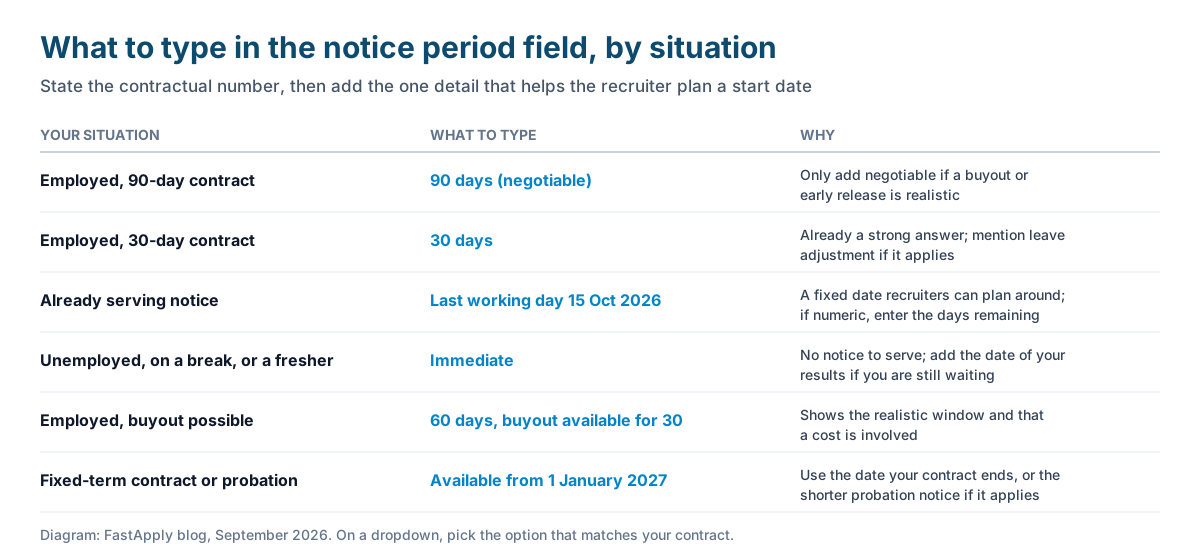
Employed, 90-day contract. Write “90 days (negotiable)” if your company allows a buyout or your manager has agreed to release you early. Write “90 days” if neither is true. Do not write 60 and hope. If the offer comes, the start date will be built on your answer, and a surprise at the offer stage is how candidates lose offers.
Employed, 30-day contract. “30 days” is fine, and it is already a strong answer in most Indian markets. If you have leave accrued that can be adjusted against notice, say so: “30 days, can be reduced with leave adjustment.”
Already serving notice. Give the date, not the length: “Serving notice, last working day 15 October 2026.” Recruiters love this answer because it is a fixed point they can plan around. If the form only takes a number, enter the days remaining, not the original contract length.
Unemployed, between jobs, or a fresher. “Immediate” or “0 days” or “Can join immediately.” If you are a fresher waiting for your final results, add the date you will have them. If you are on a career break, “Immediate” is still the right answer; there is no notice to serve.
Employed, buyout possible. “60 days, buyout available for 30” tells the recruiter the realistic joining window is one month and that a cost is involved. Many product companies and global capability centres reimburse that cost; some IT services firms refuse buyouts altogether. Check your HR policy before you promise it.
On a fixed-term contract or probation that ends on a date. Give the date: “Contract ends 31 December 2026, available from 1 January 2027.” If your probation notice is shorter than the standard one (often 15 days or one month), use the probation figure, because that is what applies to you today.
One formatting note that matters for numeric fields: type days as a number. “3” in a field that expects days means three days, and a recruiter will either believe you or discard the application as careless. If the field asks for months, type months. Read the label.
Typical notice periods, and why the contract decides
People ask what the normal notice period is, as if there were one. There is a pattern, but it is only a pattern. The 2026 HR guides we reviewed (Instahyre, hyring and Wisemonk, all secondary sources, not surveys) describe the same shape of the Indian market.
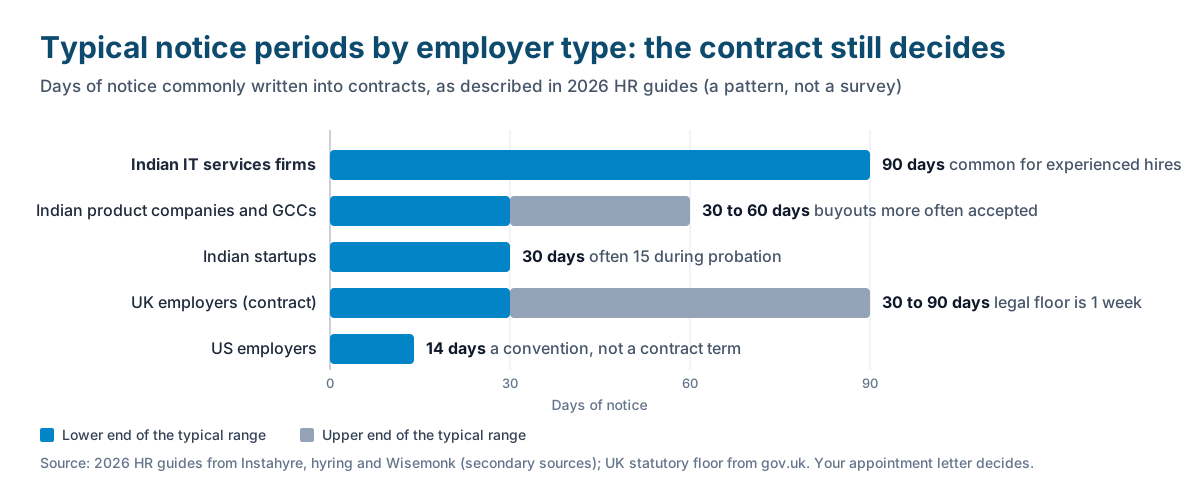
- Large Indian IT services firms commonly set 90 days for experienced hires. One guide cites an older NASSCOM figure that most IT firms mandate 90 days; we could not find the original report, so treat the number as an industry rule of thumb rather than a measured fact.
- Product companies and global capability centres usually set 30 to 60 days, and more of them accept buyouts.
- Startups often set 30 days, sometimes 15 during probation.
- UK employers sit between one and three months by contract, with the one-week statutory floor underneath.
- US employers mostly have no contractual notice. Two weeks is the convention.
What this means for your application: a 90-day answer is not unusual in India and will not get you rejected by companies that hire from IT services firms regularly. It will get you deprioritised by a startup that needs someone next month. You cannot change your contract for the application, but you can change which companies you spend your applications on.
Buyout, negotiation and the relieving letter
A buyout means paying for the days you do not serve. Most contracts price it at basic salary for the unserved days, some at the full cost to company on a pro rata basis, and a few add tax on top (some rulings have applied 18% GST to buyout amounts, so ask HR for the exact figure rather than estimating it). The new employer may reimburse it. Many product companies and global capability centres do, as a line in the offer letter. Ask before you accept, not after.
Negotiating the notice itself works better than people expect, if you do three things early. Tell your manager the same week you resign, not on the last day you can. Bring a handover plan with names and dates. Offer to stay available for questions for a few weeks after you leave. Managers release people early when the work is covered, and they dig in when they feel ambushed.
Whatever you agree, get the relieving letter. Background checks at the next employer ask for it, and the date on it should match the last working day you gave on your application. A missing or disputed relieving letter is a slow, avoidable problem.
The two mistakes that cost interviews
The first is writing “Immediate” or “None” when you have a contract. It gets you through the recruiter’s filter and then unravels at the offer stage, when the start date you implied turns out to be ten weeks away. Some companies withdraw the offer. Others keep it and remember. Either way you have spent an interview process on a role you could not start when you said you could.
The second is giving different answers on different applications, and this is the one we see most. Auto-fill tools and browser autocomplete store one value and reuse it. If that value is wrong, it is wrong on every form. One visitor told us their applications had all gone out with a notice period they never intended, and they only noticed when a recruiter replied about a start date. The fix is boring: set the value once, correctly, and check it on the first ten applications you send. That is step five of our guide to mass applying with AI, and it applies whether the tool is ours or a browser’s autofill.
The same stored-value logic applies to the other form fields that trip people up: current CTC and expected CTC for Indian forms, desired salary on US forms, and the question of whether to attach a cover letter. Each is a one-time decision that then repeats across every application.
If you are applying at volume
A notice period is one of roughly ten standard questions that appear on almost every form, and it is the one with the most expensive wrong answer. If you are applying for fresher jobs the right answer is almost always “Immediate”, which happens to be the answer recruiters like best. If you are employed and applying on Naukri at volume, the dropdown will be filled from your profile, so make sure the profile says what your contract says.
The time saved is real. Our September 2026 application log showed a submitted application taking a median of 79 seconds from opening the job to submission, across 24,567 timed submissions. Most of that saving comes from not retyping the same ten answers. For a longer look at where the minutes go, see how long a job application takes.
If you are in India, FastApply fills notice period, CTC and location fields on Naukri, LinkedIn and Indeed from one profile, with 5 free applications to start and paid plans from ₹599 a month.
FAQ
-
What does notice period mean in a job application? It is the number of days between your resignation and your last working day under your current contract, and on an application form it is the employer’s way of asking how soon you can start. Enter the contractual number of days, or a date if you are already serving notice, or “Immediate” if you are not employed.
-
What should a fresher write as notice period? Write “Immediate”, “0 days” or “Can join immediately”, because there is no employer to give notice to. If you are waiting for final exam results or a degree certificate, add the date you expect to have them.
-
What do I write if I am currently serving my notice period? Give the date of your last working day, for example “Serving notice, last working day 15 October 2026”. If the field only accepts a number, enter the days remaining, not the full length of your original notice period.
-
Is a 90-day notice period legal in India? Yes. No Indian law sets a maximum or a minimum notice period for most private-sector employees, so the length in your appointment letter is what applies. An employer cannot force you to keep working, but it can withhold your relieving letter and recover notice pay if the contract allows it.
-
Can a notice period be bought out? Often, but it depends on company policy. A buyout means paying for the unserved days, usually at basic salary, and some product companies and global capability centres reimburse it in the offer letter. Some IT services firms refuse buyouts, so check your HR policy before promising an early start.
-
What does “notice period negotiable” mean on an application? It means your contract sets a number but you believe you can leave sooner, through a buyout, adjusted leave or your manager’s agreement. Only write it if at least one of those is realistic, because the recruiter will plan the start date around it.
Conclusion
A notice period is a contract term, but the application field is a scheduling question. Answer it with the number your contract actually says, add a date or a buyout note if you have one, and write “Immediate” when you are free to start. Then make sure every application carries the same answer, because the stored value in a form-filling tool is only as good as the first time you typed it.
#notice period meaning
#notice period
#what is notice period in job application
#notice period negotiable
#notice period buyout
#immediate joiner
#job application form questions

Ekekenta Clinton
Founder, FastApply