Fresher Jobs in 2026: Where to Find Them and How to Apply at Volume
Short answer: Fresher jobs in 2026 are posted in three places that matter: Naukri (the largest volume, with a 0 to 1 year filter and a cap of 50 applications a day), company fresher portals and drives (TCS, Infosys, Wipro, Accenture and the other mass recruiters), and LinkedIn with the entry-level filter. Fresher hiring grew in every month Naukri reported for 2026, with February up 17% year on year. The way to apply at volume without becoming spam is one ATS-clean resume, three job titles, two cities plus a remote rule, applications within 48 hours of posting, and a weekly count of replies rather than submissions.
“I am a fresher” is one of the sentences we read most often in FastApply’s support chat. “Find me a job” is the request behind many of those messages, usually from India, usually with no idea where to start. This post is the answer we wish we could paste into every one of those conversations: where the jobs are, which roles take freshers in numbers, and a routine for applying that does not burn a week on ten applications.
Updated 2 October 2026 with figures from FastApply’s September 2026 application log.
Fresher hiring in 2026, by the numbers
Naukri publishes a monthly index of white-collar hiring on its platform, called JobSpeak. It is the best public read on the Indian fresher market because it counts postings, not survey answers. The 2026 releases say this:
- Financial year 2026 (April 2025 to March 2026) closed with white-collar hiring up 8%, against 2% the year before. Hiring for people with 0 to 3 years of experience rose 16%, the fastest of any experience band (JobSpeak, March 2026 release).
- Fresher hiring was up 8% in January 2026, driven by non-IT sectors while IT stayed flat.
- February 2026 was the strongest month: fresher hiring up 17%, led by BPO and ITES, insurance, retail and hospitality.
- May 2026: up 7%, mostly customer-facing roles such as relationship managers and loan officers.
- June 2026: up 8%, and 9% for the April to June quarter (JobSpeak, June 2026 release).
- The August 2026 release, published on 7 September, put overall white-collar hiring up 14% year on year, with fresher hiring and AI roles leading the growth.
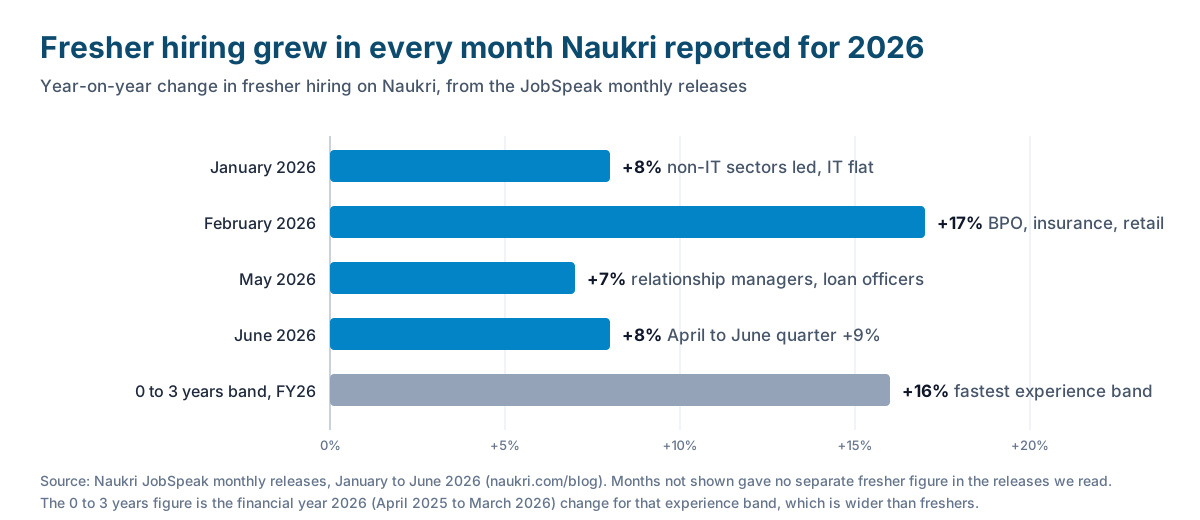
Two things to read into that. First, the growth is real, but it is not in the roles most engineering graduates picture. The months that grew fastest were carried by BPO, insurance, retail, banking sales and hospitality, not software development. Second, the 16% figure covers everyone with up to three years of experience, which is wider than “fresher”. Someone with 18 months in a support role counts in that band and competes with you for the same postings.
If you are a new graduate reading daily news about entry-level jobs disappearing, the Naukri data is the counterweight. The postings exist, in volume, in sectors that hire by the hundred.
Where fresher jobs are actually posted
A fresher does not need twenty job sites. You need the two or three where your roles are posted, checked daily. Here is where the volume is, with what each place is good for.
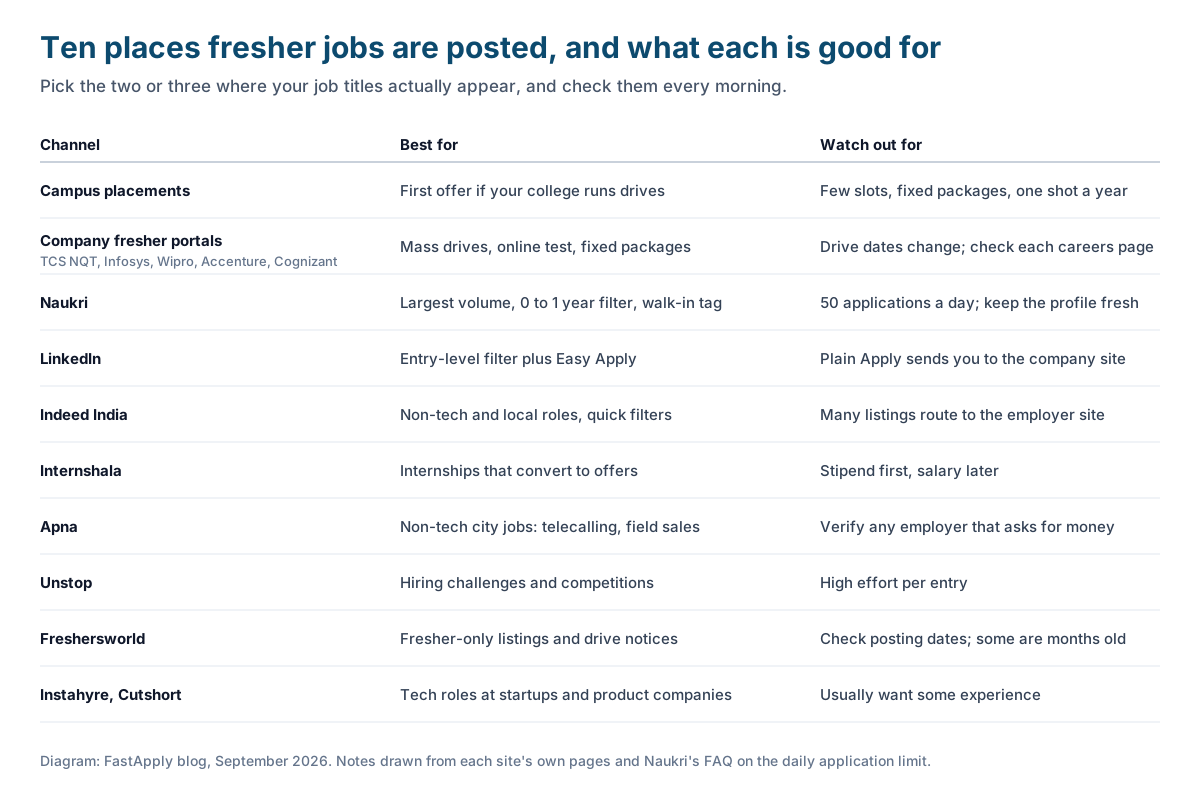
Campus placements. If your college runs drives, this is still the cheapest offer you will ever get. The packages are fixed, the process is standard, and the company has already decided to hire from your campus. The limit is slots. Treat placements as one channel, not the plan.
Company fresher portals and drives. The mass recruiters (TCS through its NQT, Infosys, Wipro, Accenture, Capgemini, Cognizant and others) hire freshers through their own portals, with an online test, fixed packages and intake dates that move around. Check each company’s careers page rather than a forwarded WhatsApp message, because drive dates and eligibility change from year to year.
Naukri. The largest pool of fresher postings in India. Use the experience filter (0 to 1 years), the “walk-in” tag for same-week interviews, and job alerts for your three titles. Naukri caps you at 50 applications a day (Naukri’s own FAQ says “maximum of 50 jobs in a day”), which is more than enough if your filters are tight. We wrote a separate guide to applying on Naukri automatically.
LinkedIn. Filter by experience level (entry level) and by Easy Apply. Postings with a plain “Apply” button send you to the company’s own site, which is fine, just slower. LinkedIn is also where recruiters at product companies and startups look for freshers with a visible project or two.
Indeed India. Strong for non-tech and local roles: customer support, back office, field sales, retail. Many listings route you to the employer’s site after you click apply.
Internshala. Internships that convert. If you have no offer by the end of final year, a paid internship with a conversion clause beats six months of waiting.
Apna. Non-tech city jobs: telecalling, field sales, delivery, retail, back office. Useful if you are a graduate outside the engineering track. Verify any employer that asks for money before you pay a rupee (more on that in our work from home jobs for freshers guide).
Unstop. Hackathons, case competitions and hiring challenges run by companies. High effort per entry, but a placed competition is a line on your resume that a recruiter actually reads.
Freshersworld. Fresher-only listings and drive announcements. Check posting dates; some entries sit for months.
Instahyre and Cutshort. Tech roles at startups and product companies. Most postings want some experience, so these come into their own after your first job.
For a wider ranking of job apps by situation, including the free ones, see our best job search apps list.
Which roles hire freshers in volume
The JobSpeak months that grew fastest tell you where the open seats are. In rough order of volume:
| Role family | What the work is | Where it is posted |
|---|---|---|
| BPO and customer support | Voice, chat and email support, often for international clients, in shifts | Naukri, Indeed, Apna, company pages (Concentrix, Teleperformance, Genpact, WNS) |
| Sales and relationship manager | Bank and NBFC sales, loan officers, insurance advisers, field sales | Naukri, Apna, bank careers pages |
| Insurance | Claims, underwriting support, agency sales | Naukri, company pages |
| Retail and hospitality | Store, front office, food and beverage, guest relations | Apna, Indeed, hotel and retail chain pages |
| IT support and testing | Service desk, manual testing, application support | Naukri, company portals, LinkedIn |
| Data and MIS | Reporting, Excel, SQL pulls, dashboards | Naukri, LinkedIn, company portals |
The last row is its own post. Data analyst jobs for freshers covers the skills, the salary bands and the employers that post those roles.
If none of these is the job you studied for, read them as the first job, not the only job. A year in application support or MIS reporting with a visible SQL project moves you into the 1 to 3 year band, where product companies start replying.
How to apply at volume without becoming spam
Volume works for freshers because the postings are similar and the forms are repetitive. It stops working the moment the applications stop matching. Here is the routine we recommend, in order.
Step 1: Build one resume that parses
Make one single-column resume with standard headings, saved as a text-based PDF, and test it by pasting the text into Notepad to confirm the order survives.
Every application reuses this file, so a parsing problem is multiplied by every submission. Our resume for freshers guide has the layout and a template you can copy.
Step 2: Pick three titles, two cities and a remote rule
Write down the three exact job titles you will apply for, the two cities you can actually live in, and whether you will take remote work.
Three titles, not ten. “Fresher” is not a title. “Customer support executive”, “MIS executive” and “junior data analyst” are titles. Postings outside the list are noise, and they use up your 50 Naukri applications for the day.
Step 3: Fix the fresher fields once
Set your notice period to Immediate, your current CTC to 0, and your expected CTC to the band for your target role, then use the same values on every form.
These three fields are where fresher applications go wrong, and they are the fields support visitors ask us about most. Our guides to what notice period means on an application and what a fresher should enter for current and expected CTC give the exact wording.
Step 4: Apply within 48 hours of posting
Check your three channels every morning, sort by date, and apply to postings from the last two days first.
Recruiters read early applications first and shortlist from them. A posting from last week with 400 applicants is worth less than one from this morning with 12.
Step 5: Keep a daily cap and a weekly count
Apply to the postings that pass your filters, stop when they run out, and once a week count replies from a person rather than submissions.
For most freshers that is 10 to 25 applications a day across Naukri, LinkedIn and company portals, well inside Naukri’s limit. If 50 applications bring zero replies, change the resume or the titles before sending the next 50. Our post on how many applications it takes to get an interview has the reply-rate numbers.
Step 6: Never pay to apply
Treat any request for a registration fee, training fee or security deposit as a scam, and report it at cybercrime.gov.in.
No genuine employer charges a candidate. This one rule would have saved most of the “job offer” complaints we read.
Where fresher applications actually go through
Not every application you start gets submitted. Long multi-page forms fail or stall part-way, and that changes where a fresher should spend time. FastApply’s application log for September 2026 gives the clearest picture we have.
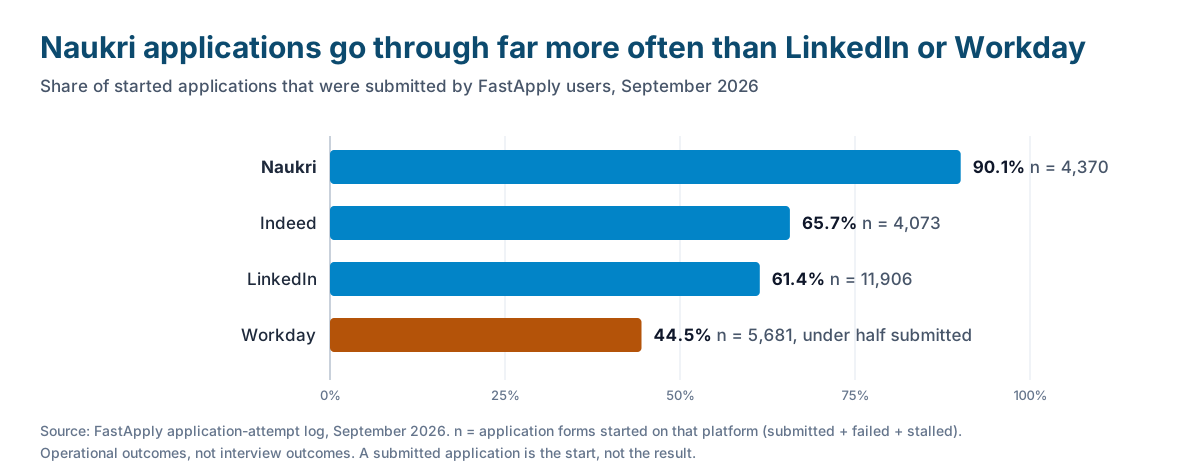
In September 2026, users of our extension started 4,370 applications on Naukri, and 90.1% of them were submitted. On Indeed it was 65.7% (4,073 started), on LinkedIn 61.4% (11,906 started), and on Workday, the system behind many large-company career portals, 44.5% (5,681 started). The whole log, including why applications fail, is in does auto-apply actually work.
For a fresher this means two things. Naukri’s apply flow is short and consistent, so it rewards volume. Company portals on Workday are where the big-brand fresher roles live, but every second application needs a hand to finish, usually because of account creation or a question the form did not expect. Do those by hand or in a review mode, and let the Naukri applications run.
These are operational numbers, not interview numbers. A submitted application is the start, not the result.
What happens after you apply
Set expectations before the first week ends.
- Replies take time. Mass recruiters reply in batches, often weeks after a drive closes. Naukri postings from small companies can reply the same day. A quiet first week is normal.
- Assessments come first. Most fresher processes start with an online test (aptitude, English, a typing test for support roles, SQL or Excel for analyst roles) before anyone reads your resume closely. Practise the test type for your role family.
- Recruiters search the database too. On Naukri, a profile updated this week with the right skills listed gets found without you applying. Keep the “last updated” date fresh.
- Volume does not fix a mismatch. If your resume says “B.Tech, no projects” and your applications say “data analyst”, 200 submissions will produce 200 silences. The mass apply guide covers where volume stops paying off, and how to get a job with no experience covers what to put on the resume instead.
If you want a tool to carry the repetitive part, FastApply works on Naukri, LinkedIn, Indeed and Glassdoor and on the application systems behind company portals, with a review mode so you can check the first ten. Pricing in India is Rs 599 a month, or Rs 433 a month on the 90-day plan, after 5 free applications.
FAQ
-
Where can freshers find jobs in India in 2026? Naukri has the largest number of fresher postings, with a 0 to 1 year experience filter and a walk-in tag. Company fresher portals (TCS, Infosys, Wipro, Accenture, Capgemini, Cognizant) run mass drives with online tests. LinkedIn’s entry-level filter, Indeed India, Internshala and Apna cover the rest.
-
Which site is best for fresher jobs? Naukri for volume and walk-ins, company portals for the large IT services drives, LinkedIn for product companies and startups. Most freshers need two of these checked daily, not all of them.
-
How many jobs should a fresher apply to per day? As many as pass your filters, which for most freshers is 10 to 25 a day. Naukri itself caps applications at 50 a day. Count replies weekly, and change the resume or titles if 50 applications bring none.
-
Is fresher hiring growing in 2026? Yes, according to Naukri’s JobSpeak index. Fresher hiring was up 8% in January 2026, 17% in February, 7% in May and 8% in June, and hiring for the 0 to 3 years band rose 16% across financial year 2026. The growth is concentrated in BPO, insurance, retail, banking sales and hospitality.
-
Which roles hire freshers in volume? Customer support and BPO, sales and relationship manager roles at banks and NBFCs, insurance, retail and hospitality, IT support and testing, and reporting or MIS roles. Software development roles for freshers exist, but in far smaller numbers.
-
Do I have to pay to apply for a fresher job? No. No genuine employer or portal charges candidates a registration, training or security-deposit fee. Treat any such request as a scam and report it at cybercrime.gov.in or by calling 1930.
Conclusion
The fresher market in 2026 has more postings than last year, and most of them sit on Naukri, company portals and LinkedIn, in roles that hire by the hundred. Pick three titles, fix your resume and your form answers once, apply early and daily, and count replies. The routine is dull. It also works, which is more than can be said for forwarding your CV to a WhatsApp group.
#fresher jobs
#jobs for freshers
#fresher jobs 2026
#entry level jobs india
#naukri fresher jobs
#how to apply for fresher jobs
#fresher hiring 2026

Ekekenta Clinton
Founder, FastApply