What Is a Reverse Recruiter, What It Costs, and When Software Is Enough (2026)
Short answer: A reverse recruiter is a person you pay to run your job search: find the roles, tailor your resume, submit the applications, and often message hiring managers and prepare you for interviews. In 2026 the established agencies charge $1,500 to $3,000 a month, usually plus 8% to 10% of your first-year salary when you accept an offer, and boutique executive programmes run $12,500 to $17,500. Cheaper “application services” at about $0.40 to $1.00 per application are people filling forms, not full reverse recruiting. Software such as FastApply costs $14 a month for 200 applications in the US and is not a person. Pay a human when the matching roles are few and senior, the judgement calls on each form are hard, or you have no time at all. Use software when the search is a volume search with repetitive forms and a budget under $50 a month.
Visitors in our support chat keep asking the same question in almost the same words: “is a real person applying?” The answer for FastApply is no. It is software. Apply for Me runs on our servers, Browse & Apply runs in your browser, and Copilot mode fills each form and waits for you to read it. Nobody at FastApply reads your applications or presses submit for you. That is the right answer for some searches and the wrong one for others, and this post is about telling the two apart, with the 2026 prices for every option in between.
What a reverse recruiter does
A normal recruiter works for the employer. The employer pays them to fill a role, so their loyalty is to the vacancy, not to you. A reverse recruiter flips that. You are the client, you pay the fee, and their job is to get you hired.
What that covers varies by agency, but the full version includes: building a target list of companies and roles; rewriting your resume and LinkedIn profile; finding postings every week; tailoring the resume and cover letter per application; submitting the applications under your name; messaging recruiters and hiring managers on your behalf; preparing you for interviews; and advising on the offer. Some agencies assign one named recruiter to you; others run a team behind one account manager.
The market grew because the job search got heavier. Fortune reported on 25 March 2026 that reverse recruiters were charging $1,500 a month just to help people look for jobs, and CNBC covered the same agency two days earlier. On the agency side, the work is repetitive enough that many of them use automation to hit their application quotas, which we covered in how reverse recruiters scale with job application automation. That is worth knowing as a buyer: part of what you pay a person for may be done by software anyway.
What reverse recruiting costs in 2026
Published prices, with the source and date for each. Where the figure comes from reviews rather than the provider, it says so.
| Service | Monthly fee | Success fee | Source |
|---|---|---|---|
| Reverse Recruiting Agency | $1,500 a month; the first month’s fee is refunded when you are placed | 10% of first-year salary on acceptance | Fortune, 25 March 2026; CNBC, 23 March 2026 |
| Find My Profession | $3,000 a month flat, or $1,500 a month with a success fee | 8% of first-year salary on the $1,500 option | Its own site, 2026 |
| iCareerSolutions | $2,995 a month fixed | None | Its own site, 2026 |
| Browning Associates (executive) | Not published; $12,500 to $17,500 for the full programme per reviews | Not published | Third-party reviews, 2026 (secondary) |
| Subscription-style services | $150 to $720 a month | Varies | Careerify roundup, 2026 (secondary) |
The success fee is the number people underestimate. On a $150,000 offer, 8% is $12,000 and 10% is $15,000. A four-month search at $1,500 a month plus a 10% fee on that offer comes to $21,000. The $3,000 flat option over the same four months is $12,000 with nothing owed on acceptance, which is cheaper if the search is short and the offer is large, and more expensive if the search drags on.
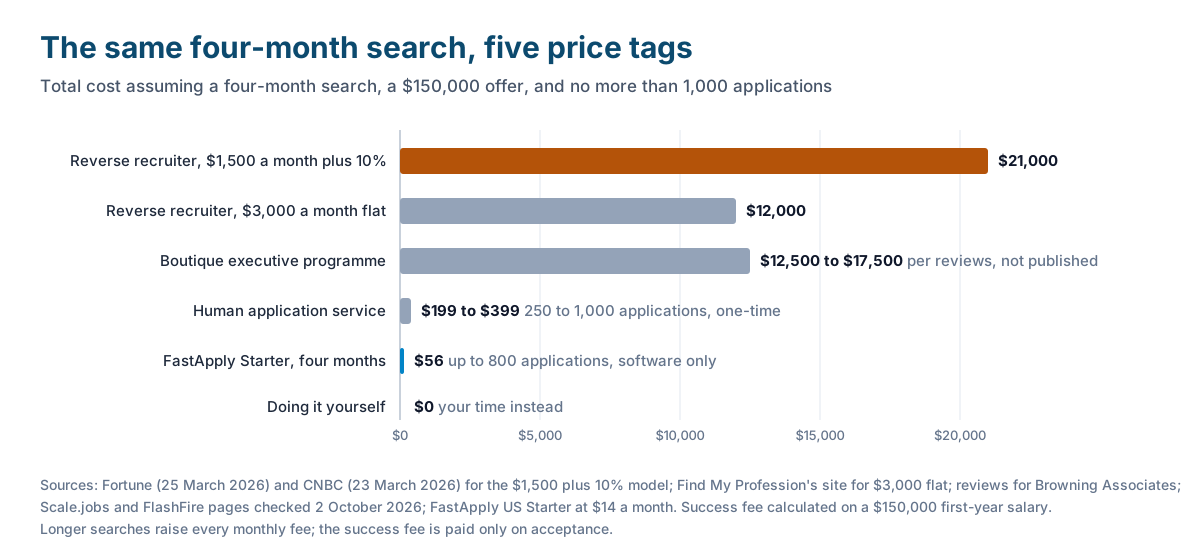
Two things the table does not show. Agencies usually cap applications per week (50 to 100 is a common promise, per the agency-side post linked above), so the monthly fee buys a bounded amount of work. And none of them publishes a placement rate we could verify, so “worth it” has to be judged on your own situation, not on a success statistic.
The cheaper middle: application services
Between a reverse recruiter and software sits a category that sells human form-filling without the strategy. You supply the resume and the target roles; a person applies for you and sends proof.
- ApplyScout’s Human Assistant lane works out to about $1.00 per application, with a real person on WhatsApp and screenshots of every submission (prices from its site, August 2026). Our FastApply vs ApplyScout comparison has the lane-by-lane detail.
- Scale.jobs sells one-time packages: $199 for 250 applications, $299 for 500, $399 for 1,000 (checked 2 October 2026).
- FlashFire sells $199 for 250 applications, $349 for 500 and $599 for 1,200, including a resume rewrite, with no refunds (checked 2 October 2026). The full breakdown is in our FlashFire pricing review.
These services answer “is a real person applying?” with yes, at roughly $0.40 to $1.00 per application. What you do not get is the targeting, the outreach to hiring managers, or the offer negotiation. You are buying hours, not judgement. Our wider comparison of job application services, AI tools and doing it yourself lines the three up on cost and control.
Software: not a person, and that is the point
Auto-apply software finds matching postings and fills the forms. FastApply, as one example, costs $14 a month for 200 applications on the US Starter plan, which is about $0.07 per application, with 5 free applications and no card to start. The Pro plan at $29 adds a resume and cover letter tailored to each job. The pricing page lists the plan caps.
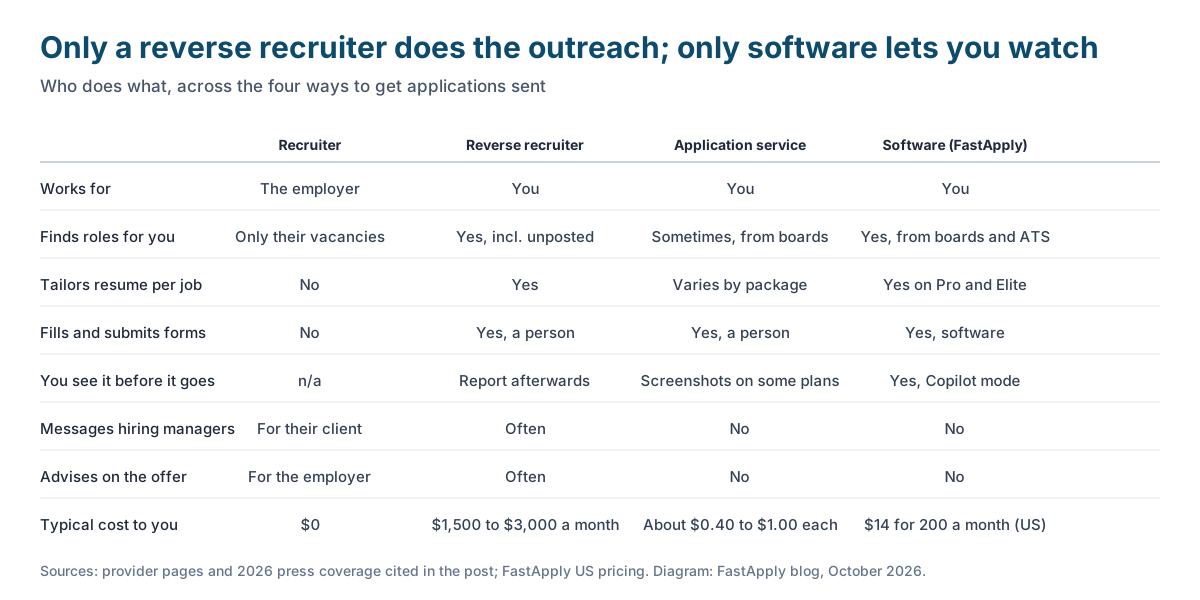
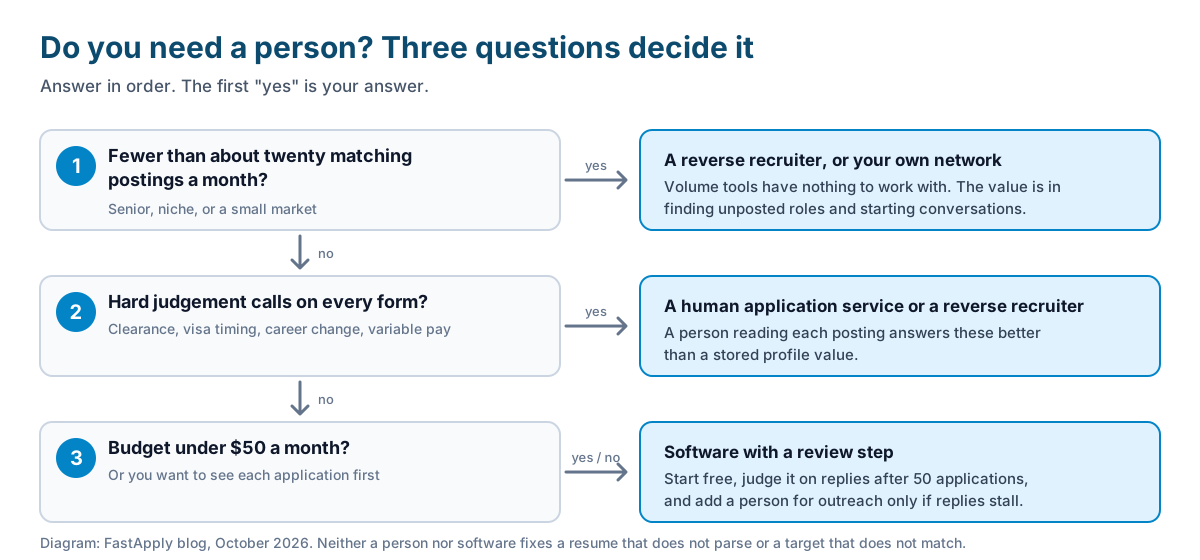
The honest part of the software pitch is in our own September 2026 log: of 127,964 application attempts, 38,606 (30.2%) were submitted, and of the applications that reached a form, 66.2% completed. Long multi-step forms are where it fails, which is why we built a mode that fills the form and waits for you. A person would complete more of those forms. A person also costs about 6 to 14 times more per application. The question is whether the extra completion is worth the difference for your search, and the matrix below is the fastest way to answer it.
When a human is worth paying for
The matching roles are rare. If fewer than twenty postings a month fit you, volume tools have nothing to work with. A reverse recruiter’s value is in finding the unposted roles and getting a conversation started.
Every form needs a judgement call. Security clearance questions, a visa timeline, a career change that needs explaining, compensation that varies by structure. A person reading the posting can answer these better than a stored profile value. (For the common cases, our guides to answering the work authorisation question and what to put for desired salary cover what to store.)
You need outreach, not applications. Senior roles are often filled through a referral or a message to the hiring manager. Software does not do that. Some reverse recruiters do it every day.
You have no time and the budget exists. A $1,500 month is cheaper than a lost month at a senior salary. If you are employed and cannot run a search from your desk, paying someone to run it is a rational trade.
When software is enough
The search is a volume search. Early or mid career, common job title, broad geography, a hundred or more postings a month that fit. The constraint is form-filling time, and that is what software removes.
The forms repeat. Work authorisation, notice period, salary expectation, relocation, start date. Store them once, review the first ten, let the tool fill the rest.
The budget is under $50 a month. No human service sells meaningful volume at that price. Software does, and the free tiers let you test before paying.
You want to see what goes out. Oddly, this is a point for software over a done-for-you service. In Copilot mode you read every application before it is sent. With an agency you get a report afterwards.
What neither one fixes
A resume that does not parse, a target that does not match your experience, and a market with no openings in your field. A reverse recruiter will tell you the second one in the first call, which is part of what you pay for. Software will show it to you as fifty applications with no reply. Either way, the fix is the same: change the resume or the target before buying more applications of any kind. Our guide to mass applying with AI has the six-step method, and the comparison of AI agents, human agents and doing it yourself covers the trade-offs in more depth.
FAQ
-
What is a reverse recruiter? A reverse recruiter is a job search professional who works for the candidate rather than the employer. You pay them to find roles, tailor your resume and cover letters, submit applications on your behalf, contact recruiters and hiring managers, and prepare you for interviews. A normal recruiter is paid by the employer to fill a vacancy.
-
How much does a reverse recruiter cost in 2026? The established agencies charge $1,500 to $3,000 a month. Reverse Recruiting Agency charges $1,500 a month plus 10% of first-year salary (Fortune, March 2026). Find My Profession charges $3,000 a month flat or $1,500 plus 8%. iCareerSolutions charges $2,995 a month with no success fee. Boutique executive programmes run $12,500 to $17,500 per reviews.
-
Is a reverse recruiter worth it? It can be for senior or niche roles with few postings, for searches that need outreach to hiring managers, and for people who cannot run a search themselves. For a volume search with repetitive forms it is usually not, because software does the form-filling for a fraction of the price. No agency we looked at publishes a verifiable placement rate, so judge it on your own situation.
-
Is a real person applying when I use FastApply? No. FastApply is software. Browse & Apply runs in your browser, Apply for Me runs on FastApply’s servers, and Copilot mode fills each application and waits for you to review and submit it. Nobody at FastApply reads or submits your applications for you.
-
What is the difference between a reverse recruiter and an application service? A reverse recruiter runs the whole search, including targeting, outreach and interview preparation, for $1,500 or more a month. An application service such as ApplyScout, Scale.jobs or FlashFire has a person fill and submit applications you choose, at roughly $0.40 to $1.00 per application, with no strategy or outreach.
-
What is the cheapest way to get applications sent for me? Software. FastApply’s US Starter plan is $14 a month for 200 applications, about $0.07 each, with 5 free applications to test on. Human application services start at about $199 for 250 applications. Reverse recruiters start at about $1,500 a month.
Conclusion
A reverse recruiter sells judgement, outreach and time, and charges accordingly: $1,500 to $3,000 a month plus a success fee that can add $12,000 to $15,000 on a $150,000 offer. Application services sell hours at about a dollar an application. Software sells form-filling at a few cents each and lets you watch. If your roles are rare or every application needs a human decision, pay the person. If your search is a numbers game with repetitive forms, run the numbers with software first and keep the agency fee for the stage where a person makes the difference.
#reverse recruiter
#what is a reverse recruiter
#reverse recruiter cost
#reverse recruiting services
#is a reverse recruiter worth it
#job application service

Ekekenta Clinton
Founder, FastApply