
Jobs in Dubai for Indians: How to Apply From India (2026)
Short answer: You apply from India to employers who will sponsor your employment visa, which is most of them. You cannot work in Dubai on a visit or tourist visa, so the sequence is: apply online, interview over video, receive an offer on the MOHRE-approved form, let the employer obtain your work permit and entry permit, then fly in for the medical test, Emirates ID and residence visa. UAE employers post on LinkedIn, Bayt, Naukrigulf, GulfTalent and their own career pages, and nobody legitimate charges you for a job. If you want to interview in person, the UAE jobseeker visit visa gives degree holders 60, 90 or 120 days in the country without a sponsor.
Gulf questions come up constantly in our support chat, from visitors already in the UAE or Saudi Arabia and from people in India asking us to “find me a job” in Dubai, usually with a job title, a city and nothing else. This guide is the answer we would like to paste back: the actual sequence, the boards that matter, and the handful of things that stop Indian applicants from getting a reply.
You cannot work on a visit visa, so the employer does the visa work
The UAE government’s own portal says it plainly: foreigners cannot work on visit or tourist visas. A job offer leads to a work permit, and the employer applies for it. That single fact shapes everything else about applying from India.
It also means that applying from India is normal. Employers in Dubai hire from India every week, and their HR teams know the process better than most applicants do. What they want to know early is simple: where you are now, how soon you can start, whether you currently hold any UAE visa, what salary you expect in dirhams, and whether you will need visas for family. Put those answers in your CV summary and you have already removed the first reason to skip you.
The employer’s side runs through the Ministry of Human Resources and Emiratisation (MOHRE) for the work permit and labour contract, and through the immigration authority (ICP federally, GDRFA in Dubai) for the entry permit and residence visa. Free-zone companies go through their free zone instead, which changes the forms but not the logic.
The sequence from an application in India to a desk in Dubai
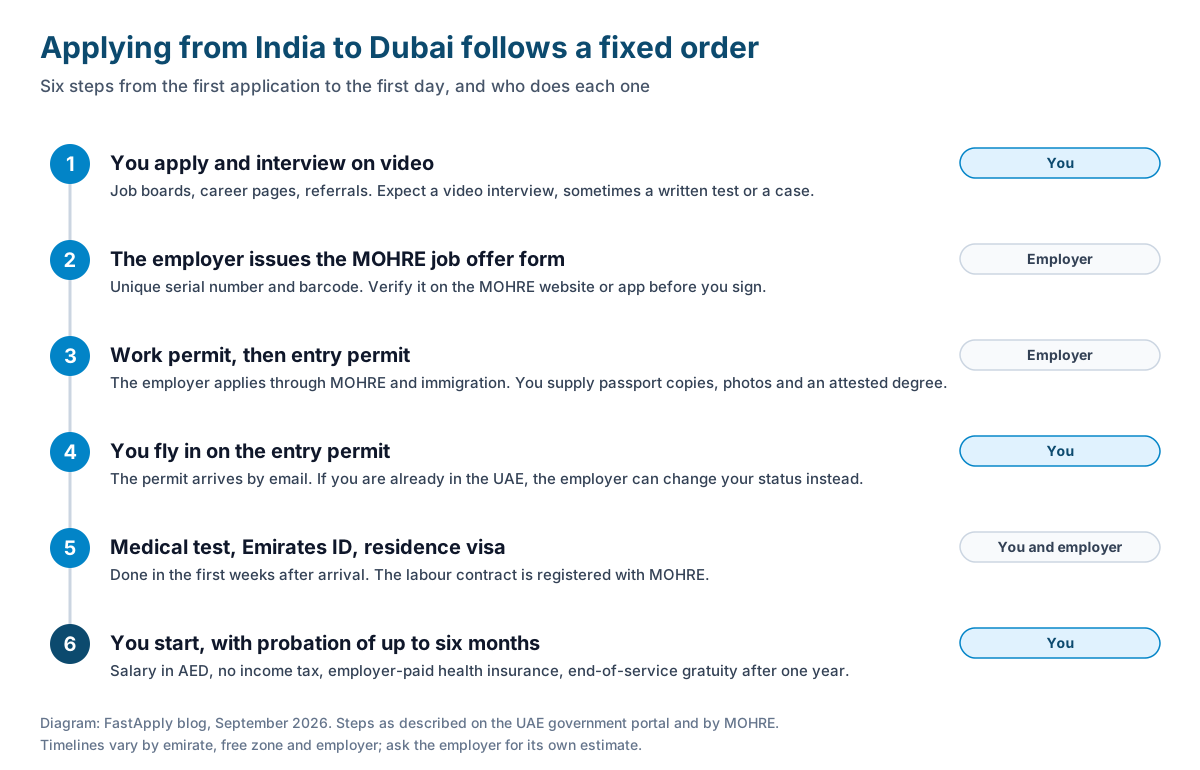
- You apply and interview. Through job boards or the company’s career page, with interviews on video and sometimes a test.
- The employer issues an offer on the MOHRE form. The approved job offer form carries a unique serial number and a barcode. You sign it before any visa work begins.
- The employer obtains the work permit, then the entry permit. You supply passport copies, photographs and an attested degree where the role needs one.
- You fly in on the entry permit. It arrives by email. If you are already in the UAE on a visit, the employer can change your status without you leaving.
- Medical test, Emirates ID, residence visa. All in the first weeks after arrival, and the labour contract is registered with MOHRE.
- You start. Probation can run up to six months under the current labour law.
Timelines vary by emirate, by whether the company sits in a free zone, and by how complete your documents are. Ask the employer for its own estimate rather than trusting a figure from a blog, including this one.
Where UAE employers post, and which boards reach them from India
Most Dubai roles are visible from India without any trick. The difference between boards is who reads the application and how quickly.
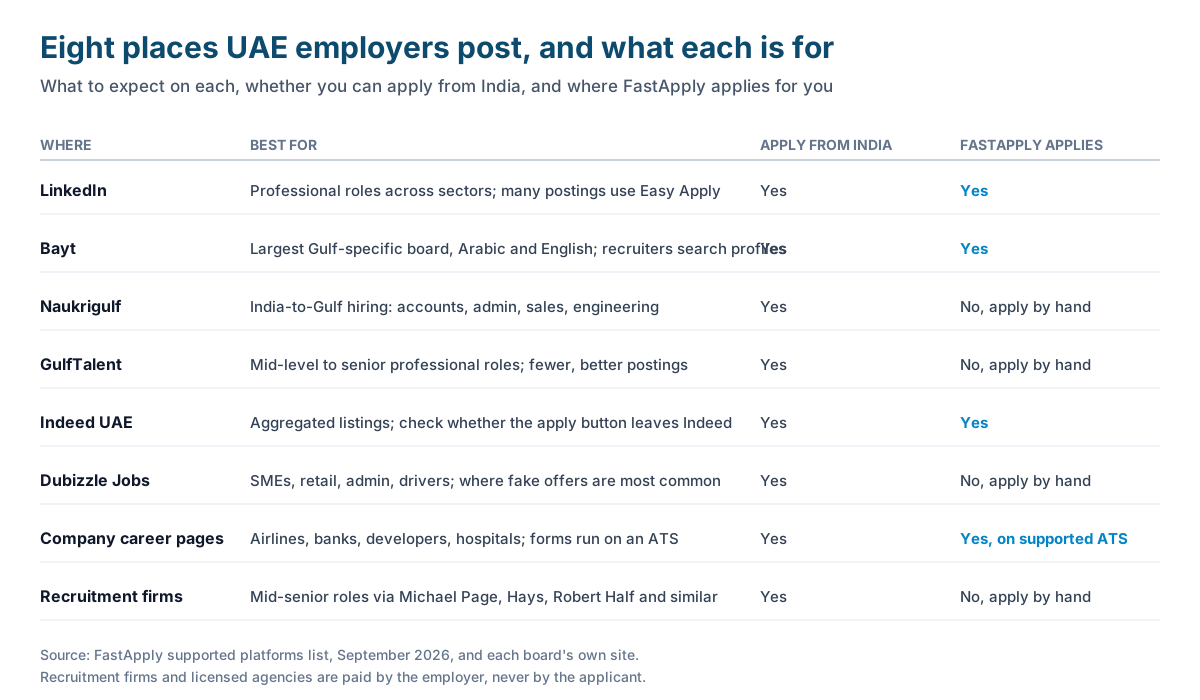
| Where | Best for | Note for applicants in India |
|---|---|---|
| Professional roles across sectors | Filter location to Dubai or the UAE and add UAE locations under Open to Work. | |
| Bayt | The largest Gulf-specific board | Complete the profile; recruiters search it. |
| Naukrigulf | India-to-Gulf hiring | Strong for accounting, admin, sales and engineering. |
| GulfTalent | Mid-level to senior roles | Fewer postings, better quality. |
| Indeed UAE | Aggregated listings | Check whether the apply button leaves Indeed. |
| Dubizzle Jobs | Small businesses, retail, admin, drivers | Volume roles, and the most fake offers. |
| Company career pages | Airlines, banks, developers, hospitals | Usually a Workday, SmartRecruiters or Taleo form. |
| Recruitment firms | Mid-senior roles via Michael Page, Hays, Robert Half | Paid by the employer, never by you. |
FastApply applies on LinkedIn, Indeed and Bayt, and on the application systems behind company career pages. Naukrigulf and GulfTalent are not on its supported list, so apply there by hand. For a wider view of which apps are worth installing, see our ranked list of job search apps.
The jobseeker visit visa: when it is worth the fare
The UAE offers a visit visa to explore job opportunities. As of September 2026 the official portals describe it like this: valid for 60, 90 or 120 days, single entry, no sponsor needed. You must hold a bachelor’s degree or equivalent, and either fall within MOHRE’s first, second or third skill level or have graduated within the last two years from a university in the top 500 of the classification the Ministry of Education uses. A financial guarantee is also required. You cannot work on it; once you get an offer, the employer converts your status in the usual way.
Costs are where sources disagree. Government fees come to a few hundred dirhams depending on the duration, plus a refundable deposit, while agencies quote all-in packages that run well above that. Check the ICP or GDRFA fee schedule directly before you pay anyone.
It is worth the fare when you already have two or three interviews arranged, or when you target a sector where meeting people matters: hospitality, retail management, sales. It is a poor fishing trip, and you still cannot start until the permit exists. Our earlier guide to getting a job in Dubai walks through the Golden, Green and employment visa types, so I will not repeat that here.
How to tell a genuine offer from a fake one
In August 2026 MOHRE warned job seekers inside and outside the UAE to verify offers before taking any step. Genuine employers issue the approved job offer form with a unique serial number and barcode, and you can check those details on the MOHRE website, in its app, or by calling 600590000. The ministry’s advice was direct: avoid any offer that asks for fees, money transfers, or personal and banking details.
Dubai Police said much the same in January 2026. The pattern they described is a real company’s name, a contact that starts on social media, and a request to pay for visa processing, training or a background check. Once the money moves, the offer disappears.
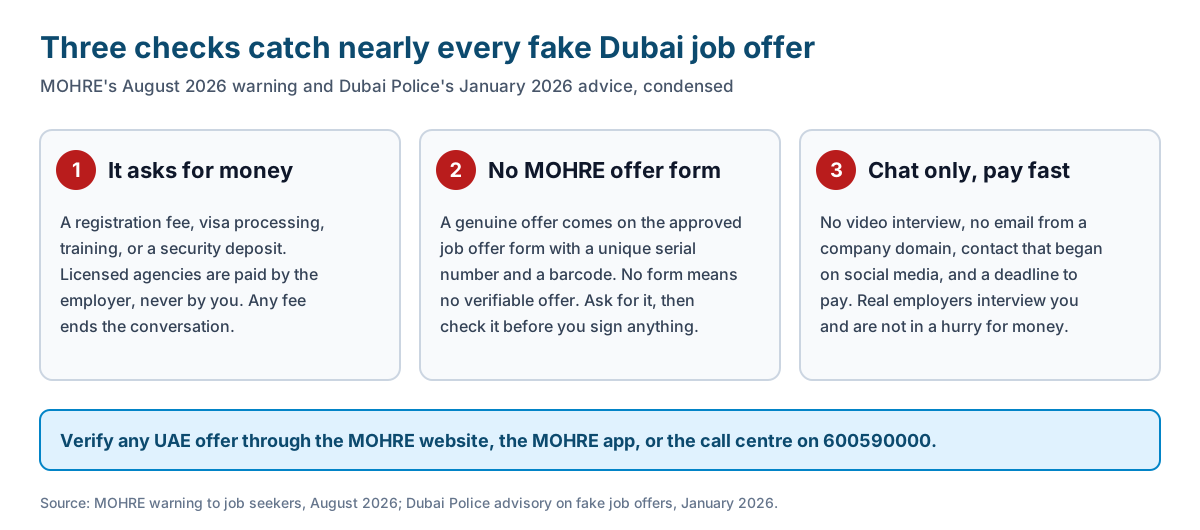
Three checks catch nearly all of it:
- Money. Licensed agencies are paid by the employer. A request for a registration fee, a visa-processing fee or a security deposit is the end of the conversation.
- The form. No MOHRE job offer form with a serial number and barcode means no verifiable offer. Ask for it, then verify it.
- The process. A real employer interviews you on video and emails from a company domain. An offer that lives entirely on WhatsApp, with a deadline to pay, is not an offer.
On the Indian side, recruiting agents who send workers abroad must be registered with the Protector General of Emigrants, and you can look an agent up on the eMigrate portal. An agent who is not there is not someone to pay.
What a Dubai contract gives you, and what it does not
Salary is paid in dirhams and there is no income tax. There is also no provident fund, so the retirement saving your Indian employer did through EPF stops, and you have to do it yourself.
In its place the UAE has an end-of-service gratuity. Under Federal Decree-Law 33 of 2021, an employee who completes at least one year receives 21 days of basic pay for each of the first five years and 30 days of basic pay for each year after that. Note the word basic. Many Dubai packages split the salary into basic plus housing and transport allowances, and the gratuity is calculated on the basic figure. When you compare two offers, ask for the split, not only the total.
Health insurance is the employer’s obligation, so an offer that asks you to arrange your own cover is a warning sign. Probation can run up to six months. Housing and transport allowances are common but not guaranteed, and an annual flight home is a perk some employers include and others do not.
On what the salary should be, sources conflict. The Michael Page UAE Salary Guide 2026, as reported by Quintedge, puts a general ledger accountant at AED 13,000 to 18,000 a month at small and mid-sized companies and AED 15,000 to 20,000 at multinationals. Aggregators built on self-reported data show far lower figures for the same title. Treat any single number as a starting point, and expect large gaps between a local SME, a multinational and a free-zone startup.
Paperwork on the Indian side
Two things are worth starting before you have an offer, because both take weeks.
Emigration clearance. Indian passports are either ECR or non-ECR. ECR status generally applies when the holder has not passed the 10th standard. ECR passport holders need emigration clearance through the eMigrate portal before taking up employment in the UAE, which is one of the 18 countries on the ECR list. Non-ECR passports do not need it. If you are a graduate, you are almost certainly non-ECR; check the passport page.
Degree attestation. Professional roles in the UAE routinely require an attested degree. The chain for an Indian degree is the state HRD department, then the Ministry of External Affairs, then the UAE embassy or consulate in India, and finally the Ministry of Foreign Affairs once you are in the UAE. Start it early, keep the originals safe, and keep scanned copies of every stamp.
A passport with at least six months of validity and, for some employers, a police clearance certificate round out the list.
The CV: Gulf habits and ATS reality
Gulf employers often expect things an Indian or American CV leaves out: a photograph, nationality, current location, visa status, notice period. Those conventions still hold for smaller companies and agencies.
Large Dubai employers run the same applicant tracking systems as everyone else, and a two-column CV with a photo in a sidebar parses badly on them. The compromise: a single-column, text-based PDF with a short header that states the Gulf fields as plain text (“Indian national, currently in Bengaluru, available to relocate to Dubai, notice period 30 days”), and the photo as a small image at the top. The format in our resume guide for freshers is the right base, and the ATS resume format guide explains why columns and text boxes fail.
Applying at volume from India without wasting the applications
Dubai postings draw applicants from several continents, so early applications get read and late ones often do not. A routine that works from India looks like this.
- Three titles, one location set. Use the titles Dubai employers use (an “accountant” in India may be a “general ledger accountant” there). Filter to Dubai and the wider UAE.
- Answer the relocation fields once, correctly. Willing to relocate: yes. Current location: your city. Notice period: the real figure, stated the way our notice period guide describes. Expected salary: in AED, and monthly, because Gulf forms usually ask for a monthly figure.
- Apply within a day or two of posting. Set alerts on LinkedIn and Bayt and check them early morning India time.
- Track replies, not submissions. A sheet showing which resume version went where tells you within a month whether the CV needs changing.
This is where software earns its keep. FastApply runs in your browser on every plan, fills the application on LinkedIn, Indeed, Bayt and the ATS pages behind career sites, then waits for your review in Copilot mode or submits while you watch. Pricing depends on where you are: from Rs 599 a month if you are in India, from $14 a month elsewhere, with 5 free applications and no card. Our Naukri auto apply guide covers the India side of a parallel search, and the visa sponsorship job boards list covers employers that sponsor in other countries.
Sectors where Indian applicants are hired in numbers, as of 2026: accounting and finance, IT, sales, logistics and supply chain, hospitality, healthcare, and construction and engineering. If your work sits in one of those, the demand exists. The job is to be early, verifiable and easy to process.
If your target is the wider Gulf, our companion guide to jobs in Saudi Arabia for foreign workers explains a process that looks similar but adds qualification checks, and for Europe see jobs in Germany for Indians.
FAQ
-
Can I apply for jobs in Dubai from India? Yes, and it is the normal route. Employers interview on video, issue an offer on the MOHRE job offer form, and obtain your work permit and entry permit before you travel. You cannot start work on a visit or tourist visa.
-
Do I need a visa before I apply? No. You apply first. The employment visa is sponsored by the employer after you accept an offer. The jobseeker visit visa is optional and only useful if you want to interview in person.
-
Which websites do UAE employers use? LinkedIn, Bayt, Naukrigulf, GulfTalent and Indeed UAE carry most professional postings, with Dubizzle Jobs for small-business and volume roles. Many large employers post on their own career pages, which run on systems such as Workday, SmartRecruiters and Taleo.
-
Is it legal for an agency to charge me for a Dubai job? Licensed agencies are paid by the employer, not the candidate. MOHRE’s August 2026 warning told job seekers to avoid any offer that asks for fees, transfers or bank details, and to verify offers through its website, app or call centre on 600590000.
-
What is the UAE jobseeker visit visa? A visit visa of 60, 90 or 120 days that lets you look for work without a sponsor. As of September 2026 it requires a bachelor’s degree or equivalent, plus either MOHRE skill level 1 to 3 or a recent degree from a top-500 university, and a financial guarantee. You cannot work on it.
-
What salary should I expect in Dubai? It depends on the role and the employer type, and published ranges conflict. The Michael Page UAE Salary Guide 2026, as reported by Quintedge, lists a general ledger accountant at AED 13,000 to 18,000 a month at SMEs and AED 15,000 to 20,000 at multinationals, while aggregator sites show lower figures. Ask for the basic-versus-allowance split, because gratuity is calculated on basic pay.
Conclusion
Applying to Dubai from India is a known path with a fixed order: apply, interview on video, sign a MOHRE offer, let the employer get the permits, then fly in for the medical, Emirates ID and residence visa. The boards are LinkedIn, Bayt, Naukrigulf, GulfTalent and company career pages. The traps are fees, offers without a serial number, and CVs that parse badly. Get the paperwork started early, answer the relocation fields once and correctly, and apply within a day of posting.
#jobs in dubai for indians
#how to apply for jobs in dubai from india
#dubai jobs for indians
#uae jobseeker visa
#dubai job search from india
#gulf jobs for indians

Ekekenta Clinton
Founder, FastApply